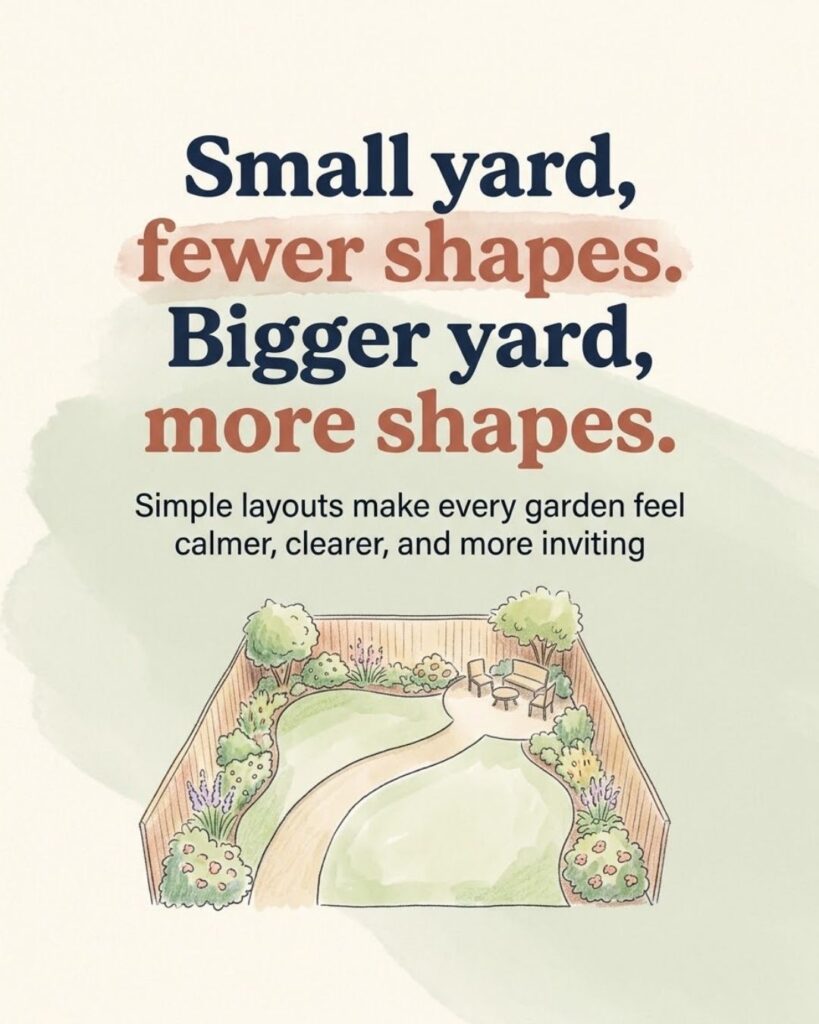
A small yard can become visually crowded long before it becomes physically full. A circular patio, curved flower bed, winding path, pond, lawn, seating area, and decorative border may all look appealing on their own, but when several strong shapes compete in a limited space, the garden can start to feel restless and fragmented.
One useful design principle is surprisingly simple: the smaller the yard, the fewer major shapes it usually needs.
Larger gardens have more room for variety. They can accommodate curved paths, separate seating areas, lawn panels, hidden corners, planting zones, and several focal points without feeling confused. Small gardens usually benefit from the opposite approach. A clear dominant shape, supported by simpler surrounding elements, often makes the space feel calmer, larger, and easier to understand.
You Might Also Like:
- Loading posts...
This does not mean a small garden has to be boring or perfectly rectangular. It simply means the layout should have a clear visual hierarchy instead of several unrelated ideas competing for attention.
Why Too Many Shapes Can Make a Small Yard Feel Smaller
Garden design is partly about how the eye moves through a space.
When several shapes appear close together, the eye has to stop and interpret each one. A curved lawn meets an angled patio, which touches a round planting bed, which leads to a winding path, which surrounds another small feature. Even if every individual element is attractive, the overall layout may feel complicated.
In a large garden, there is usually enough distance between these elements for each one to have its own identity. In a small backyard, those same shapes can become compressed together.
A simpler layout helps the eye move smoothly through the garden.
Instead of noticing six separate design decisions, you may first see one clean lawn, one strong patio, or one clear path. Plants, furniture, pots, lighting, and seasonal color can then provide detail without forcing the hard landscaping to do too much.
This distinction is useful because structure and decoration play different roles. The main layout should usually provide clarity. Smaller details can provide personality.
Start With One Main Shape
Before thinking about individual plants or decorative features, decide what the central shape of the garden will be.
That shape might be:
- a simple rectangular or gently curved lawn
- a round patio
- a square seating area
- a small pond surrounded by paving
- one main path leading through the garden
- a central planting area with borders around the perimeter
The exact choice depends on how you use the space.
Someone who entertains regularly may need the patio to become the dominant element. A household that wants room for children or pets may prefer a simple open lawn. A keen gardener may devote most of the area to planting beds while keeping circulation straightforward.
The important point is that one shape should usually lead the composition.
Once that decision is made, the rest of the garden becomes easier to organize.
Small Gardens Usually Look Better With Strong, Simple Geometry
There is a common temptation to make a small garden more interesting by adding more features. Often, the opposite works better.
A bold, uncomplicated layout can make a small space feel intentional rather than restricted.
For example, imagine a narrow backyard with a rectangular patio near the house and a straightforward lawn extending toward a planting border at the far end. That layout may sound basic, but it provides a strong framework.
Now imagine the same space with a semicircular patio, two curved beds, stepping stones, a tiny circular lawn, and a second paved sitting area. Each feature reduces the visual strength of the others.
Simplicity does not mean everything must be straight.
A single circle can be very effective in a compact garden. A round patio surrounded by planting may become the main feature of the entire yard. A gently curved lawn can also work well if the surrounding borders repeat and support that shape.
The problem usually begins when circles, curves, diagonals, squares, and irregular forms are all introduced at once.
Let Plants Soften the Structure
A simple hard-landscape layout does not have to look harsh.
Plants are one of the best ways to soften strong geometric forms.
A straight path can feel much more natural when grasses, herbs, or flowering perennials spill slightly over its edges. A square patio can feel relaxed when surrounded by loose planting. A rectangular lawn can become more interesting when the border contains plants of varied heights and textures.
This is an important difference between structural shape and visual softness.
The underlying design can remain simple while the planting makes the garden feel abundant and informal.
That approach is often more successful than trying to create softness by adding increasingly complicated paving lines and bed shapes.
Use Paths for a Reason
Paths can transform a garden, but they should normally lead somewhere.
A path might connect the house to a shed, greenhouse, seating area, gate, vegetable garden, or focal feature. In a larger landscape, it may also guide visitors through different areas of the garden.
In a very small backyard, unnecessary paths can consume valuable planting or usable space.
Before adding one, ask what purpose it serves.
If a path ends at a bench under a tree, it creates a destination. If it leads around a planting bed and back to nowhere in particular, it may simply complicate the layout.
That does not mean paths must always be straight. Curves can work beautifully when there is enough room for them to feel generous rather than forced.
A common design mistake is creating a series of tiny wiggles in an attempt to make a path look natural. Broad, confident curves generally read more clearly than many small bends.
Flower Borders Can Help Define the Space
In small gardens, perimeter planting is particularly useful.
Instead of breaking the center of the yard into many small beds, you can place borders around the edges and leave the central area visually open.
This has several advantages.
The planting helps screen fences and boundaries, while the open center gives the eye somewhere to rest. Taller plants at the back and shorter plants toward the front can create depth without consuming the entire yard.
Borders can also reinforce the main garden shape.
If you have a rectangular lawn, beds around the outside can frame it. If the lawn is gently curved, repeating that curve in the planting edge creates cohesion.
Again, repetition is often more powerful than variety.
Bigger Gardens Can Handle More Complexity
Larger yards offer a different set of possibilities.
When there is enough physical distance between features, several shapes can coexist successfully.
A larger garden might include a terrace close to the house, a broad lawn, curved planting beds, a secondary seating area, a pond, a vegetable garden, and pathways connecting them.
Because each area has breathing room, the garden can feel layered rather than cluttered.
This is where garden “rooms” become particularly useful.
Create Garden Rooms in Larger Spaces
A garden room is simply an area that feels somewhat distinct from the rest of the garden.
It may be separated by hedges, tall planting, trellis panels, walls, changes in level, or even the direction of a path.
For example, the main lawn might occupy the first part of the garden. Beyond a hedge opening, a gravel seating area could create a quieter second space. Farther back, a vegetable garden or wildlife area might form another zone.
The visitor does not see everything at once.
That sense of progression can make a large garden feel more interesting because there is always another area to discover.
It also solves a common problem with bigger yards: large open spaces can sometimes feel exposed or empty if they are treated as one enormous undivided area.
Hidden Sitting Areas Add a Sense of Discovery
A secondary seating spot can work particularly well in a larger garden.
It does not need to be elaborate. A bench at the end of a path, a pair of chairs surrounded by planting, or a small paved area beneath a tree may be enough.
The best location often has a reason behind it.
Perhaps it catches the evening sun, overlooks a favorite planting bed, feels sheltered from the house, or provides a cooler place to sit during hot weather.
This is where additional shapes become useful. A small circular gravel area, for example, may fit comfortably within a larger landscape because it has enough separation from the main patio and lawn.
In a tiny backyard, that same circle might compete with everything else.
Scale changes the effect.
Avoid Lots of Small, Unrelated Beds
One of the easiest ways to make any garden feel disorganized is to scatter many tiny planting beds around it.
Small beds can be difficult to maintain and may not have enough visual weight to feel intentional.
Where possible, combine planting into larger, stronger groups.
A generous border usually creates more impact than several isolated patches containing the same total number of plants.
The same principle applies to lawns and paving.
Three small pieces of lawn divided by paths may feel more complicated than one larger lawn. Several tiny patios rarely feel as useful or visually satisfying as one well-sized seating area.
Fewer, larger shapes usually create a stronger foundation.
Think About the View From Inside the House
Garden planning should not begin only at the back door.
Look at the yard from the rooms you use most.
A garden may be experienced through a kitchen window, dining room, living room, or upstairs bedroom for many more hours than it is experienced while walking through it.
Consider what the main shape looks like from those viewpoints.
A path leading toward a tree, sculpture, bench, or attractive planting can pull the eye outward and make the garden seem deeper.
Likewise, a strong patio or lawn shape can provide an attractive foreground even in winter when many plants are dormant.
This is another reason clear structure matters.
Plants change throughout the year, but the basic layout remains visible.
Use Focal Points Carefully
A focal point gives the eye somewhere to land.
In a small garden, one may be enough.
It could be a specimen plant, large pot, bench, birdbath, small tree, water feature, sculpture, or attractive gate.
Placing several prominent focal points close together weakens their effect because they begin competing.
In a large garden, multiple focal points can work because each belongs to a different zone.
A bench might terminate one path while a tree anchors another part of the garden. A sculpture may appear farther away through an opening in a hedge.
The key is not how many objects you own. It is how they relate to the overall layout.
Common Garden Layout Mistakes
Many garden-design problems begin with adding features one at a time without first deciding how they fit together.
A new curved border appears because there is an empty corner. Then a path is added to reach it. A second seating area follows, and later a pond is squeezed between the two.
Eventually the garden contains plenty of attractive individual features but lacks a clear overall plan.
Another common mistake is trying to use every available inch.
Open space has value.
An area of lawn, gravel, paving, or even bare visual space around a focal feature allows the surrounding elements to stand out.
You do not need to fill every corner with another bed, ornament, container, or piece of furniture.
A Simple Way to Plan Your Layout
If you are redesigning a garden, start with the largest decisions rather than the smallest details.
First, identify what the yard genuinely needs to do. That might include seating, play space, gardening, entertaining, storage, or access.
Next, choose the dominant shape.
In a small garden, keep the supporting shapes limited and closely related to it. In a larger space, decide where separate zones might make sense.
Then establish paths and circulation.
Only after those structural decisions are working should you begin refining planting beds, focal points, furniture, and decorative details.
This order prevents small features from controlling the entire design.
Give the Garden a Shape Before Filling It With Plants
A beautiful garden is not automatically the one with the greatest number of plants, paths, patios, or features.
Sometimes the biggest improvement comes from removing visual competition.
In a small backyard, one strong lawn, patio, path, or planting shape can provide the calm framework the garden needs. Plants can soften that structure and add color, texture, and seasonal change without overwhelming it.
Larger gardens have more freedom. They can support multiple shapes, separate rooms, curved routes, hidden seating areas, and moments of surprise because there is enough space between them.
The useful rule is not that small gardens must be simple and large gardens must be complicated. It is that the amount of visual complexity should match the scale of the space.
Start with the main shape. Give it room to work. Then add only the elements that make the garden more useful, comfortable, or enjoyable.
A yard often feels bigger and better planned not because more has been added, but because every shape finally has a clear reason to be there.