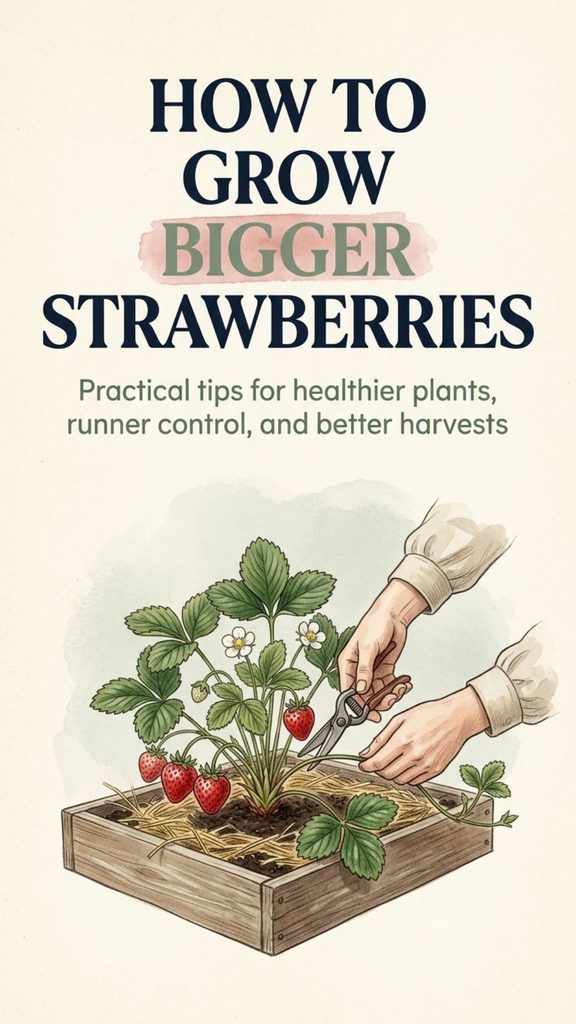
There is something especially satisfying about picking a large, perfectly ripe strawberry from your own garden. The flavor, freshness, and convenience are hard to beat. But if your strawberry plants keep producing tiny berries, crowded leaves, or disappointing harvests, the problem may have more to do with how you care for them than where you grow them.
Strawberries are relatively easy to grow, but consistently producing large, healthy fruit takes more than planting them in a sunny spot and waiting for harvest day.
The variety you choose, the age of your plants, soil conditions, watering habits, and how you manage runners can all influence berry size.
You Might Also Like:
- Loading posts...
One of the most useful lessons is that bigger strawberries usually come from healthy, well-managed plants—not from a single gardening trick.
Here is how to give your strawberry plants the conditions they need to produce their best fruit.
1. Choose a Strawberry Variety Known for Large Fruit
Before changing your gardening routine, look at the type of strawberries you are growing.
Fruit size is partly determined by genetics. Some varieties naturally produce large berries, while others are valued more for their sweetness, fragrance, or extended harvest season.
Even excellent growing conditions cannot turn a naturally small-fruited variety into one that consistently produces oversized strawberries.
June-Bearing Strawberries
June-bearing varieties usually produce one main crop over a relatively short period.
Despite their name, the harvest does not always happen in June. The timing depends on your climate, location, and variety.
These plants are often a good choice for gardeners who want a concentrated harvest for fresh eating, freezing, or making jam.
Some June-bearing cultivars are known for producing particularly large berries, especially early in the harvest.
Everbearing Strawberries
Traditional everbearing varieties generally produce more than one crop, often with a main harvest in late spring or early summer and another later in the growing season.
Their exact fruiting pattern varies with the cultivar and growing conditions.
Day-Neutral Strawberries
Day-neutral strawberries can produce flowers and fruit repeatedly through much of the growing season when temperatures are suitable.
They are popular for containers and smaller gardens because they can provide berries over an extended period.
However, hot weather may temporarily reduce flowering and fruit production.
The best choice: Select a variety recommended for your region that combines good fruit size with reliable disease resistance, flavor, and winter hardiness.
A local nursery or university Extension service can help you identify suitable cultivars.
2. Give Strawberry Plants Plenty of Sunlight
Strawberries produce their best crops in full sun.
Aim for a location that receives at least six to eight hours of direct sunlight daily, preferably more where summer temperatures are not excessively hot.
Sunlight supports the photosynthesis that provides energy for plant growth and fruit development.
Plants grown in too much shade may survive, but they often produce fewer flowers and smaller harvests.
If you are growing strawberries in containers, observe how sunlight moves through your garden during the day.
A patio that looks sunny in the morning may become shaded by the house or nearby trees during the afternoon.
In very hot climates, some protection from intense afternoon heat may help reduce plant stress. However, excessive shade can still limit fruit production.
3. Prepare Loose, Fertile Soil Before Planting
Strawberries have relatively shallow root systems, which makes soil quality especially important.
They perform best in soil that holds enough moisture for steady growth while allowing excess water to drain away.
Heavy, compacted soil can restrict root development, while poorly drained soil increases the risk of root and crown problems.
Before planting:
- Remove weeds and unwanted vegetation.
- Loosen the soil without damaging nearby roots.
- Mix in finished compost if additional organic matter is needed.
- Check that water drains away rather than collecting in puddles.
- Consider a soil test to determine whether fertilizer or pH adjustments are necessary.
Strawberries generally prefer slightly acidic soil, commonly around pH 5.5–6.5, although the preferred range can vary somewhat by growing conditions.
Avoid adding large amounts of fertilizer without knowing what the soil needs.
Too much nitrogen can encourage excessive leafy growth at the expense of balanced fruit production.
Well-rotted compost is useful for improving soil structure, but it does not automatically supply every nutrient in the correct amount.
4. Plant Strawberries at the Correct Depth
One of the most common strawberry-growing mistakes happens during planting.
Unlike many garden plants, strawberries are sensitive to how deeply their crowns are buried.
The crown is the compact section where the leaves emerge above the roots.
If the crown is buried too deeply, it may rot or struggle to grow. If the plant sits too high, its roots may become exposed and dry out.
The Correct Planting Method
- Dig a hole wide enough to accommodate the roots.
- Spread the roots downward without bending them sharply.
- Position the plant so the middle of the crown sits approximately level with the finished soil surface.
- Fill the hole carefully and firm the soil around the roots.
- Water thoroughly to settle the soil.
For strawberry plants already growing in nursery containers, planting at approximately the same depth is generally appropriate.
Check newly planted strawberries after heavy watering. Settling soil can sometimes leave the crown too low or expose the roots.
Correct planting gives your strawberries a healthier start and helps support stronger growth throughout the season.
5. Give Every Plant Enough Room to Grow
A strawberry bed can become overcrowded surprisingly quickly.
Mature plants produce leaves, flowers, and runners. Over time, new daughter plants fill the spaces between the original plants.
Although a thick carpet of strawberry leaves may look productive, overcrowding can reduce airflow, increase competition for water and nutrients, and make berries difficult to harvest.
It can also create favorable conditions for certain diseases.
The ideal spacing depends on your planting system.
In a matted-row system, typically used with June-bearing strawberries, some runners are allowed to establish new plants within a defined row.
In a hill system or many day-neutral plantings, runners are regularly removed to maintain individual plants with more space.
Follow the spacing recommended for your particular variety and system.
If an established patch becomes densely packed, thin excess daughter plants and remove weeds.
A smaller number of vigorous plants often provides a more manageable harvest than a neglected, overcrowded bed.
6. Manage Strawberry Runners Carefully
Runner management is one of the most useful techniques for controlling how strawberry plants grow.
Runners are long stems that extend from established plants. They can develop new plants, often called daughter plants, when their nodes contact suitable soil.
Producing runners requires resources that the plant could otherwise use for growth and fruiting.
However, cutting every runner is not always the correct approach.
When to Remove Runners
If you are growing strawberries in containers, individual planting pockets, or a hill system designed for fruit production, regularly removing runners can help prevent overcrowding.
Runner removal is particularly useful for many day-neutral strawberries.
Use clean scissors or garden pruners to cut unwanted runners near the parent plant without damaging the crown.
When to Keep Runners
If you are establishing a traditional matted row of June-bearing strawberries, allowing selected runners to root is part of the planting system.
These daughter plants help fill the row and provide younger plants for future harvests.
The key is to keep enough runners to establish a productive bed without allowing unrestricted growth.
The practical rule: Remove runners when your priority is maintaining individual fruiting plants. Keep a controlled number when your goal is propagation or renewing a matted row.
7. Understand When Removing Strawberry Flowers Helps
Some gardening advice recommends removing most strawberry flowers to produce enormous berries.
Although reducing the number of fruit can change how a plant distributes its resources, removing half the blossoms—or leaving only three or four—does not guarantee giant strawberries.
It can also reduce your total harvest substantially.
The clearest benefit of flower removal is during the establishment of certain new plantings.
First-Year June-Bearing Strawberries
When starting a new bed of June-bearing strawberries, gardeners are commonly advised to remove flowers during the first growing season.
This encourages the plants to establish healthy roots, crowns, leaves, and runners before their main fruiting year.
Sacrificing the first crop may feel disappointing, but it can improve the strength of the planting for subsequent seasons.
First-Year Day-Neutral Strawberries
New day-neutral strawberries are often managed differently.
Extension recommendations commonly suggest removing flowers for the first several weeks after planting, then allowing the plants to produce fruit once they are established.
The exact timing depends on the production system, climate, and plant condition.
Established Strawberry Plants
For established, productive plants, routine removal of most flowers is not generally necessary.
Instead, concentrate on preventing overcrowding, maintaining healthy foliage, and supplying consistent water.
You may naturally notice that the first berries in a flower cluster are larger than berries that develop later. This is a normal characteristic of strawberry fruiting.
Healthy plants and good growing conditions are a more dependable strategy than extreme flower thinning.
8. Water Consistently While Berries Are Developing
If you want larger strawberries, pay particular attention to watering.
Developing berries contain a high proportion of water. When plants experience moisture stress, their growth and fruit development can suffer.
Strawberries have shallow roots, so they may dry out more quickly than deeply rooted garden plants.
Established plants commonly need approximately 1–1½ inches of water per week during the growing season, including rainfall, although requirements vary with weather, soil, and growth stage.
Container-grown plants may need more frequent watering.
Better Watering Habits
- Check soil moisture regularly rather than watering automatically.
- Water deeply enough to moisten the root zone.
- Keep moisture reasonably consistent during flowering and fruit development.
- Avoid allowing containers to become completely dry.
- Ensure excess water can drain freely.
- Reduce unnecessary wetting of leaves and fruit when possible.
Drip irrigation or soaker hoses can be useful because they deliver water close to the roots.
Overhead watering is possible, but prolonged moisture on leaves and berries may encourage disease under certain conditions.
Avoid overwatering. Saturated soil can damage roots and interfere with healthy growth.
The goal is evenly moist soil, not constantly waterlogged conditions.
9. Use Mulch to Protect Berries and Control Weeds
Mulching offers several advantages in a strawberry bed.
A suitable mulch helps reduce weed competition, moderate soil temperature, conserve moisture, and keep developing berries away from bare soil.
Clean straw is a traditional option because it creates a relatively dry layer beneath the plants.
Apply it carefully around the plants rather than piling it over their crowns.
For established strawberry beds, a light layer can help protect berries from direct soil contact.
In colder regions, additional straw may be used for winter protection, but the timing and thickness should follow local recommendations.
Avoid fresh sawdust or heavy applications of uncomposted wood materials directly around strawberry crowns. Some materials can affect nitrogen availability as they decompose, and overly thick mulch can trap unwanted moisture.
Keep the planting area tidy and remove weeds while they are small.
Strawberries compete poorly with vigorous weeds, especially when those weeds grow directly around the crowns.
10. Keep Strawberry Plants Young and Productive
Strawberry beds do not remain equally productive forever.
Over time, plantings can become overcrowded, accumulate pest and disease problems, and produce smaller or fewer berries.
The age of the planting matters, although productivity also depends on the variety, climate, and maintenance.
Many traditional strawberry beds benefit from renovation or replacement after several productive seasons.
How to Maintain a Productive Strawberry Patch
For established June-bearing beds, renovation after the main harvest can help maintain productivity.
Depending on regional recommendations, this may involve:
- Removing weeds and unwanted runners.
- Narrowing overcrowded rows.
- Thinning excess plants.
- Removing old foliage using an appropriate method.
- Watering and fertilizing according to the plants’ needs.
- Encouraging healthy growth for the following season.
Do not automatically mow down every strawberry bed. Day-neutral and everbearing plantings have different management requirements, and cutting foliage at the wrong time can interfere with fruit production.
Create a Simple Replacement System
If you have room, divide your strawberries into separate planting areas.
One area can contain established fruiting plants, while another holds younger plants intended to replace them.
Label each section with the planting year.
This makes it easier to identify aging beds and maintain a steady supply of vigorous plants.
A rotation system also helps avoid repeatedly growing strawberries in the same tired, overcrowded soil.
11. Grow New Strawberry Plants From Healthy Runners
You do not have to purchase new strawberry plants every time you want to expand your patch.
Many varieties can be propagated from runners.
Choose strong, healthy mother plants with no obvious signs of disease.
How to Root a Strawberry Runner
- Select a healthy runner with a developing daughter plant.
- Fill a small pot with suitable, moist potting mix.
- Position the daughter plant on the surface of the potting mix while it remains connected to the mother plant.
- Gently secure it so the developing roots contact the growing medium.
- Keep the potting mix evenly moist while roots develop.
- Once the daughter plant has formed a healthy root system, cut the connecting runner.
- Move the young plant to its permanent growing location when conditions are suitable.
Keeping the daughter plant connected while it roots allows it to continue receiving support from the mother plant.
Avoid taking propagation material from plants showing suspicious leaf spots, stunted growth, crown problems, or other signs of disease.
Strawberry diseases can spread through infected planting material.
For a completely new bed, purchasing certified disease-free plants may be a better choice than repeatedly propagating an unhealthy old patch.
12. Protect Your Strawberries From Pests and Fruit Damage
Large berries are not much use if birds, slugs, or disease damage them before harvest.
A little prevention can make a noticeable difference.
Slugs and Snails
Slugs and snails often feed on ripe strawberries, leaving holes or irregular damaged areas.
They are especially troublesome in damp, sheltered locations.
To discourage them:
- Remove unnecessary debris where they hide.
- Keep weeds under control.
- Avoid creating excessively wet conditions.
- Inspect plants in the evening when slugs are more active.
- Hand-pick pests when practical.
- Use an appropriately labeled slug-control product if the problem becomes severe.
Copper barriers may help in some situations, but they need to be properly installed and maintained.
Crushed eggshells and diatomaceous earth are often promoted as easy solutions, yet their effectiveness as reliable barriers is inconsistent. Neither should be your only method of protecting the crop.
Birds
Birds are another common reason gardeners lose strawberries before they can harvest them.
One dependable option is to install suitable bird-exclusion netting over a secure frame.
Keep the netting taut, fasten its edges, and check it regularly to reduce the risk of wildlife becoming trapped.
Do not leave loose netting draped where birds or other animals can become entangled.
If using covers around flowering plants, consider the need for pollinator access. Appropriate timing and materials matter.
Painted rocks that resemble strawberries are sometimes suggested as bird deterrents, but there is little reliable evidence that they consistently protect a crop.
Gray Mold and Other Fruit Problems
Strawberries are susceptible to fruit rots, particularly during humid or rainy weather.
Help reduce problems by maintaining airflow, avoiding overcrowding, keeping berries off bare soil, and harvesting ripe fruit promptly.
Remove obviously rotten berries from the planting area rather than leaving them among healthy fruit.
Growing Big Strawberries in Containers
A large garden is not necessary to grow strawberries successfully.
Containers, hanging baskets, raised planters, and patio pots can all work well.
The main challenge is giving the roots enough space, nutrients, and consistent moisture.
Choose a container with drainage holes and sufficient room for the variety you are growing.
Use a good-quality potting mix rather than heavy garden soil.
Place the container where the plants receive adequate sunlight, and check moisture frequently during hot weather.
Container plants have limited soil volume, which means they can dry out and exhaust available nutrients more quickly than plants growing in the ground.
Follow an appropriate feeding schedule without applying excessive fertilizer.
Keep runners trimmed when they begin overcrowding the container.
For small patios, day-neutral varieties can be appealing because they may provide repeated harvests through the growing season.
Why Are My Strawberries Still Small?
If your berries remain disappointing despite regular care, work through the possible causes before adding more fertilizer or cutting off flowers.
| Problem | Possible Explanation | What to Try |
|---|---|---|
| Small berries throughout the season | Naturally small-fruited variety | Choose a cultivar known for larger fruit |
| Smaller berries after the first harvest | Normal differences between early and later fruit | Maintain healthy plants and realistic expectations |
| Small berries with dry soil | Inconsistent moisture | Improve watering during fruit development |
| Dense leaves and crowded plants | Too many runners or daughter plants | Thin the bed appropriately |
| Plenty of leaves but little fruit | Excess nitrogen, shade, or other growing conditions | Review sunlight and fertilizer use |
| Small or misshapen berries | Incomplete pollination, pest injury, or weather stress | Encourage pollinators and inspect flowers and fruit |
| Declining harvests in an old bed | Aging plants, crowding, or disease buildup | Renovate or establish a new planting |
Incomplete pollination is worth investigating if berries develop an unusual shape.
Strawberry flowers benefit from visits by pollinating insects. Poor pollination can prevent parts of the fruit from developing normally, resulting in misshapen berries.
Supporting pollinators and avoiding unnecessary insecticide applications during bloom can help.
When and How to Harvest Strawberries
Good harvesting habits protect fruit quality.
Strawberries generally do not continue ripening in sweetness the way some other fruits do after picking. For the best flavor, harvest when the berries have developed the appropriate ripe color for their variety.
Many common varieties are ready when the fruit is fully red.
Check the plants frequently during harvest season, particularly in warm weather.
Pick strawberries gently, leaving a short piece of stem attached when possible.
Avoid pulling hard enough to damage the plant.
Place berries in a shallow container to prevent crushing, and refrigerate them promptly if they will not be eaten soon.
Wash strawberries shortly before eating rather than soaking them before storage. Excess moisture can encourage deterioration.
A Simple Seasonal Strawberry Care Plan
Keeping strawberries productive becomes easier when you break maintenance into seasonal tasks.
Early Spring
- Check plants for winter damage.
- Remove winter mulch as appropriate for your region.
- Clear weeds and dead plant debris.
- Check soil moisture.
- Fertilize only as recommended for your growing system.
Flowering Season
- Protect vulnerable blossoms from damaging frost.
- Maintain consistent watering.
- Allow pollinating insects access to the flowers.
- Remove flowers from new plants when establishment guidelines recommend it.
Fruit Development and Harvest
- Monitor soil moisture closely.
- Keep ripening berries away from bare soil.
- Watch for birds, slugs, and fruit rot.
- Harvest ripe strawberries frequently.
After Harvest
- Renovate established June-bearing beds if appropriate.
- Thin excess runners and crowded plants.
- Propagate healthy daughter plants if replacements are needed.
- Continue watering to support future growth.
Fall and Winter
- Check that beds are healthy and free of weeds.
- Prepare replacement planting areas when necessary.
- Apply winter protection according to local climate recommendations.
- Review which varieties performed best so you can improve next year’s planting.
The Real Secret to Bigger Strawberries
Growing large strawberries is less about forcing a plant to produce oversized fruit and more about helping it reach its natural potential.
Start with a variety suited to your climate and known for good fruit size. Give it plenty of sunlight, well-drained soil, steady moisture, and enough space to grow.
Manage runners according to your planting system, avoid unnecessary flower removal on established plants, and replace or renovate aging beds before productivity declines.
Most importantly, pay attention to your plants throughout the season. Small changes in watering, spacing, and maintenance can make a meaningful difference over time.
A successful strawberry patch does not have to produce record-breaking berries. The better goal is a reliable harvest of sweet, healthy, flavorful strawberries that you can enjoy straight from your own garden.