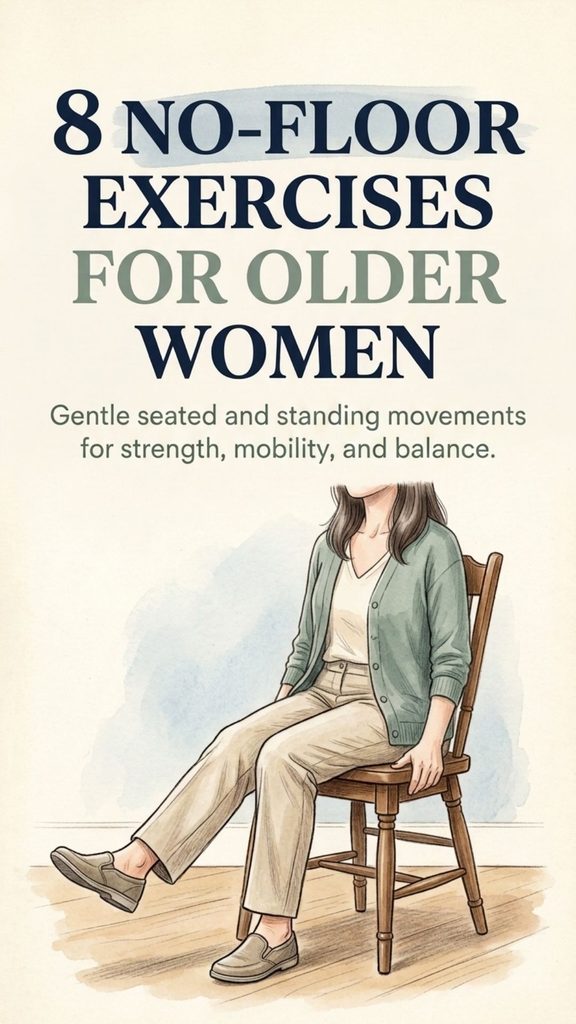
Getting stronger as you age shouldn’t require struggling to lower yourself onto an exercise mat or worrying about how you’ll get back up. If your knees are stiff, your hips are uncomfortable, or getting down on the floor feels difficult, you can still build a useful exercise routine without leaving your chair or standing position.
Some of the most practical movements for older women are surprisingly simple. Lifting your knees while seated, moving your legs while holding a sturdy chair, and practicing gentle balance exercises can help you maintain the strength and mobility needed for everyday activities.
You don’t need expensive equipment or an exhausting workout. What matters is choosing movements that suit your abilities, practicing them consistently, and gradually increasing the challenge as you become more comfortable.
You Might Also Like:
- Loading posts...
These eight no-floor exercises offer an approachable place to begin.
Why No-Floor Exercises Are Worth Trying
Physical activity becomes particularly valuable as we get older because muscle strength, balance, flexibility, and endurance all contribute to independent living.
Everyday activities depend on these abilities. Standing up from a chair requires leg strength. Reaching into a cupboard involves shoulder mobility. Walking over uneven ground challenges balance and coordination.
A well-rounded exercise routine helps maintain these physical abilities.
According to the Centers for Disease Control and Prevention, adults aged 65 and older should aim for a combination of aerobic activity, muscle-strengthening exercise, and balance training.
For many older women, seated and supported standing exercises make movement more accessible.
They can be especially useful if you:
- Experience occasional knee or hip stiffness.
- Find kneeling or getting up from the floor uncomfortable.
- Are returning to exercise after a period of inactivity.
- Want gentle movements you can practice at home.
- Prefer exercising without specialized equipment.
- Need a routine that can be adapted to your current mobility.
No-floor exercises are not automatically suitable for every health condition, but many can be modified to accommodate different ability levels.
If you have significant balance problems, recent surgery, a recent injury, or a condition that limits exercise, ask your healthcare professional or physical therapist which movements are appropriate.
1. Seated Marching to Wake Up Your Legs
<AsyncImage query=”older woman seated upright on sturdy chair performing seated marching knee lift exercise bright home interior instructional fitness photo” aspectRatio=”5:3″ width=”100%”/>
Seated marching is an excellent starting movement because it allows you to work your hip and thigh muscles while remaining supported.
It also provides a gentle way to increase activity after sitting for a long period.
How to Do It
- Sit upright in a sturdy chair with your feet resting flat on the floor.
- Relax your shoulders and look straight ahead.
- Lift your right knee a comfortable distance toward your chest.
- Lower your foot slowly.
- Repeat with your left leg.
- Continue alternating legs at a steady, controlled pace.
Starting goal: Try 10 knee lifts on each side. Rest if needed, then repeat if you feel comfortable.
Avoid leaning backward to lift your leg higher. The movement should come primarily from your hip, and a small lift is perfectly acceptable.
If you need additional support, hold the sides of the chair.
Seated marching can be a useful warm-up before your other exercises. You can also practice it during television commercials or between periods of desk work.
2. Standing Side Leg Raises for Hip Strength
<AsyncImage query=”older woman standing behind sturdy dining chair holding chair back lifting one leg sideways hip abduction exercise home realistic fitness instructional photo” aspectRatio=”5:3″ width=”100%”/>
The muscles along the outside of your hips help stabilize your pelvis during walking and other weight-bearing activities.
Standing side leg raises provide a straightforward way to strengthen these muscles without getting onto the floor.
How to Do It
- Stand behind a sturdy chair or beside a secure countertop.
- Hold the support lightly with both hands or as needed.
- Stand tall with your feet pointing forward.
- Slowly lift your right leg a short distance out to the side.
- Keep your knee relatively straight without locking it.
- Lower your leg with control.
- Complete your repetitions before changing sides.
Starting goal: Perform 8–10 repetitions per leg.
The most common mistake is swinging the leg or tilting the upper body in the opposite direction.
A smaller, controlled movement is more useful than lifting your leg as high as possible.
As your strength improves, you can gradually increase repetitions. Resistance bands may eventually provide an additional challenge, but they are unnecessary when you’re starting.
3. Chair Yoga Movements for Gentle Flexibility
<AsyncImage query=”older woman doing gentle seated chair yoga cat cow spine mobility stretch on stable chair airy living room realistic instructional photo” aspectRatio=”5:3″ width=”100%”/>
Chair yoga offers an accessible way to practice controlled movement and gentle stretching.
You don’t need to perform complicated poses or achieve a particular level of flexibility. The goal is to move comfortably through your available range of motion.
One useful exercise is a seated version of the cat-cow movement.
How to Do Seated Cat-Cow
- Sit near the middle of a sturdy chair with your feet flat on the floor.
- Place your hands on your thighs.
- Breathe in while gently lengthening your spine and opening your chest.
- Breathe out as you allow your upper back to round slightly.
- Return slowly to your starting position.
- Repeat without forcing your neck or lower back.
Starting goal: Try 5–8 gentle repetitions.
Keep the movement small, particularly if your back feels stiff.
People with osteoporosis, spinal fractures, or certain back conditions may need to avoid or modify spinal rounding and twisting. Ask a physical therapist about suitable alternatives if those concerns apply to you.
Chair yoga should feel comfortable and controlled. Stretching into pain is not necessary to gain benefits.
4. Arm Circles to Maintain Shoulder Mobility
<AsyncImage query=”senior woman seated in chair gently extending arms to sides performing small arm circles shoulder mobility exercise at home realistic photograph” aspectRatio=”5:3″ width=”100%”/>
Shoulder mobility plays a role in getting dressed, reaching for household items, and carrying out other everyday tasks.
Arm circles are a simple way to move your shoulders without requiring weights or complicated equipment.
How to Do It
- Sit or stand with your back comfortably upright.
- Raise your arms out to the sides as far as feels comfortable.
- Begin making small circles with your hands.
- Continue slowly for several repetitions.
- Reverse the direction.
- Lower your arms and rest.
Starting goal: Try 10 small circles in each direction.
If keeping your arms extended becomes tiring, bend your elbows or lower your arms slightly.
Start with small circles rather than large sweeping movements. Larger circles are not necessarily better, especially if you experience shoulder discomfort.
This movement works well as a short break after reading, sewing, using a computer, or doing other activities that keep your arms in one position.
5. Heel-to-Toe Walking to Practice Balance
<AsyncImage query=”older woman walking heel to toe in a straight line beside kitchen countertop hand near counter for stability safe balance exercise realistic photo” aspectRatio=”5:3″ width=”100%”/>
Balance deserves particular attention as we age.
Good balance involves coordination between your muscles, joints, vision, and nervous system. Practicing appropriate balance activities can help maintain stability during everyday movement.
Heel-to-toe walking is one exercise used to challenge balance, but it requires more caution than the seated movements in this routine.
How to Do It
- Choose a flat, uncluttered area beside a secure countertop or railing.
- Wear supportive shoes with nonslip soles.
- Stand upright and keep your gaze forward.
- Place one foot ahead of the other, bringing the heel of the front foot close to the toes of the back foot.
- Take another slow step in the same manner.
- Continue only while you can maintain control.
Starting goal: Try 5–10 careful steps with a hand on the support as needed.
If placing your feet directly in line feels too difficult, begin by walking with a slightly wider stance.
Never practice challenging balance exercises where a fall could cause injury. Avoid loose rugs, slippery floors, and furniture that might move.
If you frequently lose your balance or have experienced recent falls, get professional guidance before attempting heel-to-toe walking. A physical therapist can recommend a safer progression.
6. Seated Side Bends for Comfortable Torso Movement
<AsyncImage query=”older woman seated on chair one arm reaching gently overhead leaning slightly to side seated side bend stretching waist home wellness realistic photo” aspectRatio=”5:3″ width=”100%”/>
Spending hours sitting can leave the muscles around your shoulders and torso feeling stiff.
A gentle seated side bend moves the muscles along the sides of your body without requiring you to stand or lie down.
How to Do It
- Sit upright in a sturdy chair.
- Keep both feet comfortably planted on the floor.
- Rest your left hand beside your hip or on the chair.
- Raise your right arm overhead if your shoulder allows.
- Lean gently toward your left side.
- Pause when you feel a mild stretch.
- Return upright and repeat on the other side.
Starting goal: Hold each comfortable stretch for 10–15 seconds and repeat once or twice.
Avoid twisting or folding forward as you lean.
Keep both sitting bones supported by the chair. You should feel a gentle stretch, not a sharp pulling sensation.
If lifting an arm overhead causes shoulder pain, keep the arm lower or rest your hand against your side.
7. Shoulder Shrugs to Release Everyday Tension
<AsyncImage query=”older woman sitting upright in sturdy chair performing shoulder shrug relaxation exercise shoulders gently raised realistic bright home interior fitness photo” aspectRatio=”5:3″ width=”100%”/>
Shoulder shrugs are among the easiest movements to include in a daily routine.
They involve the upper shoulder and neck muscles, which may feel tense after long periods of sitting or concentrating.
Although shoulder shrugs are not a treatment for every cause of neck pain, gentle movement can help some people feel less stiff.
How to Do It
- Sit or stand comfortably with your arms relaxed.
- Slowly lift both shoulders toward your ears.
- Pause briefly without straining.
- Let your shoulders lower naturally.
- Repeat at an easy pace.
Starting goal: Perform 8–12 repetitions.
Try breathing in as your shoulders rise and breathing out as they lower.
Do not push your head forward or tighten your jaw.
You can follow the movement with a few small shoulder rolls if those feel comfortable.
This is a convenient exercise to practice throughout the day, particularly when you notice yourself sitting with raised or tense shoulders.
8. Seated Knee Extensions for Stronger Thigh Muscles
<AsyncImage query=”older woman sitting upright sturdy chair extending one lower leg straight forward seated knee extension quadriceps exercise realistic senior home workout photograph” aspectRatio=”5:3″ width=”100%”/>
The quadriceps are the muscles at the front of your thighs. They help straighten your knees and contribute to standing, walking, and climbing stairs.
Seated knee extensions work these muscles while your upper body remains supported.
How to Do It
- Sit upright with your back supported if needed.
- Place both feet flat on the floor.
- Slowly straighten your right knee, lifting your foot forward.
- Stop at a comfortable point without forcing the knee straight.
- Hold briefly.
- Lower your foot with control.
- Repeat with the left leg.
Starting goal: Try 8–12 repetitions on each side.
Avoid kicking your leg upward or using momentum.
If your knee hurts, reduce the movement range. Persistent or worsening pain is a reason to stop and seek guidance.
Light resistance may be added as you progress, but ankle weights should not be your first step if you have joint problems or are unfamiliar with the exercise.
How to Combine the Eight Exercises Into a Simple Routine
You do not need to complete every movement in one session when you first begin.
If you have been inactive, start with three or four comfortable exercises and gradually introduce the others.
Here is one example of a gentle routine:
| Exercise | Beginner Starting Amount |
|---|---|
| Seated marching | 10 lifts per leg |
| Standing side leg raises | 8 lifts per leg |
| Seated cat-cow | 5–8 repetitions |
| Arm circles | 10 each direction |
| Heel-to-toe walking | Up to 5–10 supported steps |
| Seated side bends | 10–15 seconds per side |
| Shoulder shrugs | 8–12 repetitions |
| Seated knee extensions | 8–12 per leg |
These are suggested starting amounts, not mandatory targets.
Rest between movements as needed. For someone just beginning, even five minutes of comfortable activity is a reasonable first session.
As your body adapts, you can work toward completing the routine more regularly.
Strength-focused exercises are often practiced on two or more days per week, while gentle mobility exercises may be included more frequently if they feel comfortable.
Five Ways to Make No-Floor Exercise Safer
A little preparation can make home exercise more comfortable and reduce avoidable risks.
Choose the Right Chair
Use a sturdy chair that does not roll, swivel, or slide easily.
A chair without wheels is generally preferable. Avoid soft couches that make upright sitting difficult.
Keep Support Within Reach
For standing movements, use a secure countertop or sturdy railing.
A lightweight chair that might tip over is not a reliable balance aid.
Wear Supportive Footwear
For standing exercises, choose shoes with nonslip soles and a secure fit.
Avoid slippery socks on polished flooring.
Move Slowly and Breathe Normally
Controlled movement gives you time to notice discomfort or balance changes.
Try not to hold your breath, particularly during strengthening exercises.
Know When to Stop
Muscle effort and mild stretching sensations can be normal. Sharp pain, severe dizziness, faintness, or unusual shortness of breath are not sensations to push through.
Stop exercising if these occur. Chest pain, fainting, or severe breathing difficulty requires urgent medical attention.
If you have ongoing health concerns or are unsure about your limitations, a healthcare professional can help you choose an appropriate routine.
How Often Should Older Women Exercise?
A few gentle movements are a useful beginning, but long-term physical fitness requires variety.
The general physical activity recommendations for adults aged 65 and older include:
- At least 150 minutes of moderate-intensity aerobic activity per week, when health and ability permit.
- Muscle-strengthening activity on at least two days per week.
- Regular activities that challenge and improve balance.
Moderate aerobic activity might include brisk walking, suitable dancing, or another activity that raises your heart rate while still allowing you to talk.
These eight exercises can contribute to your movement routine, but most people will need additional aerobic and strengthening activities to meet the full recommendations.
If 150 minutes sounds overwhelming, begin with an amount you can manage. Increasing activity gradually is more realistic than trying to reach the full target immediately.
Even small amounts of movement can be worthwhile, particularly for someone who has been sitting for much of the day.
Common Mistakes That Can Make Exercise Less Comfortable
A gentle routine can become unnecessarily difficult if you rush or focus too much on repetitions.
One common mistake is trying to match someone else’s range of motion. A person with stiff hips may lift a leg only a few inches, while someone else can raise it higher. Both can perform a controlled exercise within their abilities.
Another mistake is assuming that discomfort means an exercise is working. Muscle fatigue can occur during strength training, but joint pain should not be ignored.
It’s also easy to overlook rest. Older muscles still respond to progressive exercise, but recovery is part of building strength. You do not need to push the same muscles intensely every day.
Finally, avoid relying entirely on seated exercises if you can safely do more. Walking, supported standing exercises, and appropriate balance training provide benefits that a fully seated routine may not address.
The best program is one that challenges your abilities safely and leaves room for gradual improvement.
How to Tell If Your Routine Is Helping
Progress does not always appear as a dramatic physical transformation.
Often, the most meaningful improvements show up during ordinary activities.
You might notice that:
- Standing from a chair feels less tiring.
- Your legs can complete a few more repetitions.
- You need fewer pauses during a walk.
- Your shoulders feel more comfortable moving through daily tasks.
- You can hold a supported balance position with greater control.
- You feel more confident participating in activities you enjoy.
These changes are useful to notice, but improvement varies from person to person. A brief activity log can help you track what you practiced and how it felt.
Consider recording the exercise, repetitions, and comfort level once or twice a week. This makes progress easier to recognize without turning exercise into a competition.
Staying Active Without Getting on the Floor
You do not have to master floor exercises to make meaningful progress with your fitness.
A stable chair, a clear area of your home, and a few carefully chosen movements provide a practical starting point for improving strength, mobility, and balance.
Begin with the exercises that feel most manageable. Focus on smooth movement, use support when necessary, and gradually increase the amount you do.
The aim is not to perform every repetition perfectly or exercise through discomfort. It is to maintain the physical abilities that help you enjoy everyday life, from walking through your garden to carrying groceries and spending time with family.
A good exercise routine should fit your body and your circumstances. If staying upright makes movement more comfortable and accessible, that is a perfectly sensible place to start.