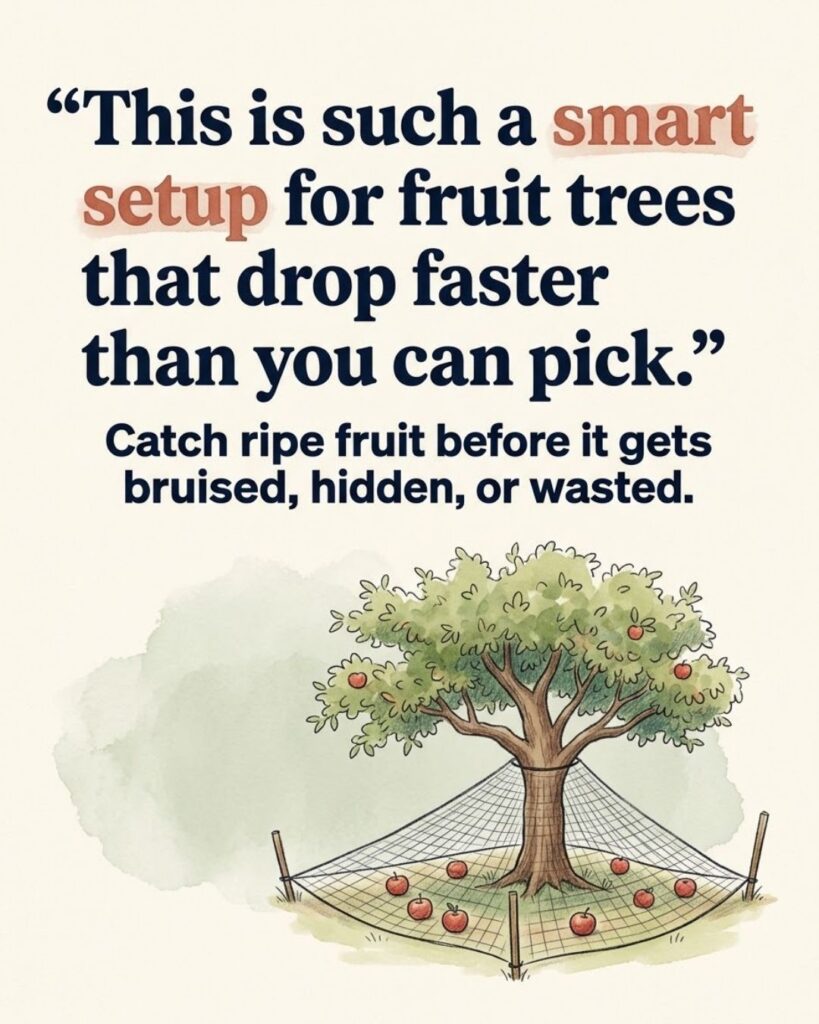
Fruit trees can produce more ripe fruit than one person can comfortably pick at exactly the right moment. Apples, plums, apricots, peaches, pears, and other tree fruits may ripen unevenly, then begin dropping quickly after wind, rain, heat, or a sudden change in weather. By the time you notice what has fallen, some of the best fruit may already be bruised in the grass, hidden under leaves, damaged by insects, or starting to rot.
A simple fruit-catching net can make that part of harvest much easier.
The idea is straightforward: stretch a strong piece of netting or fabric beneath the canopy so falling fruit lands on a cleaner, softer surface instead of directly on the ground. The outer edges are raised slightly, creating a shallow bowl or skirt around the tree. Fallen fruit can then be collected from one or two easy-to-reach areas.
You Might Also Like:
- Loading posts...
It will not replace careful hand-picking, especially for delicate fruit that you want to store, but it can reduce waste and make peak harvest season much more manageable.
Why Fallen Fruit Is So Easy to Lose
Fruit that drops naturally is often very close to full ripeness. Unfortunately, the ground is not a gentle landing place.
An apple or pear that falls onto hard soil may bruise immediately. A peach or apricot can split or soften where it hits. Fruit disappearing into tall grass or thick mulch may remain unnoticed until insects find it.
Dropped fruit can also collect beneath the canopy in places that are awkward to reach. If several fruits fall during the night or after a windy afternoon, it does not take long for the area under the tree to become messy.
A catching net does not prevent fruit from falling. Instead, it changes where the fruit lands and makes it easier to find quickly.
That distinction is important. Fruit that falls is still vulnerable to bruising, heat, insects, and decay, so regular collection remains necessary.
What You Need
A homemade fruit-catching system can be fairly simple. You do not necessarily need specialized orchard equipment for one or two backyard trees.
Useful materials include:
- Strong garden netting or a durable fruit-catching cloth
- Several garden stakes, short poles, or other sturdy supports
- Soft ties, rope, or garden cord
- Enough material to cover a useful portion of the area beneath the canopy
- A way to leave a loose opening around the trunk
The material should be strong enough to support falling fruit without tearing.
Very open netting may allow small fruit to fall through, while extremely stiff material can create a harder landing surface. A flexible fabric or fine, strong net generally works better for creating a shallow catching area.
Whatever you use, inspect it for holes, sharp pieces, or loose cords before setting it up.
1. Install the Net Before Heavy Fruit Drop Begins
Do not wait until the ground is already covered with ripe fruit.
Set up the catcher as the crop approaches maturity and you begin noticing the first naturally fallen fruit.
Installing it early gives you time to adjust the shape, strengthen weak supports, and make sure it does not interfere with walking, watering, or harvesting.
You also want to avoid repeatedly moving the net once large amounts of ripe fruit are already hanging above it.
Before installation, remove existing fallen fruit and obvious debris from beneath the tree. Starting with a clean area makes it easier to spot new problems and prevents old rotting fruit from attracting pests underneath the catcher.
2. Leave Space Around the Trunk
The center of the fabric should fit around the tree rather than being tied tightly against the bark.
Leave a small opening around the trunk and use soft ties only where necessary to position the net.
Do not cinch rope tightly around the tree.
Tree trunks continue growing, and bark can be damaged by tight cords or wire. A catching system only needs to stay in position; it should not grip or constrict the trunk.
If you plan to leave the net installed for several weeks, check the center periodically to make sure nothing is rubbing against the bark.
3. Raise the Outer Edges
A completely flat sheet beneath a tree will catch some fruit, but fruit near the edges may simply roll off.
Raising the perimeter makes the system much more useful.
Place stakes or short poles around the outside and attach the fabric securely enough to create a shallow basin. The exact height depends on the tree, the available space, and the material you are using.
You are not trying to create a deep hammock.
A gentle curve is usually enough to prevent most fruit from rolling away while still allowing you to reach the center.
Make sure stakes are visible and positioned where people will not easily trip over them.
4. Create a Gentle Slope Toward Collection Areas
A well-shaped catcher can do more than keep fruit off the ground. It can also guide fruit toward convenient collection points.
Adjust the supports so the fabric slopes gently toward one or two lower sections.
When fruit falls, some pieces will remain where they land, while others may roll gradually toward those areas.
Avoid creating an extremely steep slope. Fruit rolling too quickly can collide with other fruit and cause additional bruising.
The goal is controlled movement rather than turning the catcher into a chute.
For delicate fruit such as ripe peaches or apricots, keeping the surface fairly shallow may be better than encouraging much rolling at all.
5. Keep Enough Tension to Prevent Fruit From Hitting the Ground
The center of the net should not sag so deeply that falling fruit still strikes the soil beneath it.
Test the setup by pressing down gently on several sections.
If the material touches the ground with very little pressure, raise or tighten the supports.
At the same time, avoid stretching the fabric so tightly that it becomes a hard trampoline-like surface.
Some give in the material can help soften the landing.
The correct balance depends on the weight of the fruit. A structure catching small plums experiences much less force than one catching large apples or pears.
6. Pick the Best Fruit Directly From the Tree
A fruit-catching net is most useful as a backup system, not as the only harvesting method.
Fruit intended for storage generally benefits from being picked carefully before it falls. A hard drop can create internal bruising even when the skin still looks fine.
Hand-picking also allows you to inspect each fruit as you harvest it.
The catching net is especially valuable for:
- fruit that ripens between picking sessions
- trees producing more quickly than you can harvest
- fruit that drops overnight
- unexpected drops after wind or storms
- pieces hidden high in the canopy
- very ripe fruit intended for quick use
Think of the net as a way to rescue more of the harvest rather than a replacement for proper picking.
7. Check the Catcher Every Day
Installing the net does not mean fallen fruit can be ignored.
During peak ripening, inspect it at least daily. A heavily producing tree may need more frequent checks, particularly during hot weather.
Remove sound fruit first and move it somewhere cool.
Then remove damaged, split, leaking, or badly bruised pieces.
Do not allow spoiled fruit to build up in the net. Sugary, fermenting fruit can attract wasps, flies, ants, and other pests.
A pile of fruit also creates pressure. The pieces underneath can become crushed by later fruit falling on top.
Frequent collection is one of the biggest differences between a useful catching system and a messy one.
8. Pay Extra Attention After Wind and Rain
Weather can accelerate fruit drop.
Strong wind may shake ripe fruit loose, while heavy rain or storms can leave a large number of pieces beneath the tree in a short period.
Check the catcher after these events even if you already collected fruit earlier that day.
Wet fruit should not be left sitting in a damp pile.
If the net itself has collected rainwater, correct any low spots where water is pooling. Standing water increases weight on the supports and creates poor conditions for harvested fruit.
A mesh material may drain naturally, while solid cloth may need deliberate drainage points.
Should You Shake the Tree?
Shaking can be useful in limited circumstances, but it should be done cautiously.
If fruit is already fully ripe and releases with almost no resistance, gently moving a small branch can encourage loose fruit to fall onto the catcher.
Avoid aggressively shaking large branches or the entire trunk.
Forceful shaking can drop underripe fruit, damage branches, or cause large amounts of fruit to fall on top of one another.
The method also makes less sense for very delicate fruit that bruises easily.
If fruit is still firmly attached, it is usually better to leave it on the tree rather than forcing it off.
Which Fruit Trees Can Benefit?
The idea can work with several common backyard fruit trees, though the effectiveness varies with fruit size, softness, tree height, and the design of the net.
Apples and Pears
A catching surface can make windfalls much easier to find.
Because apples and pears can be relatively heavy, the supports and fabric need to be strong. Fruit intended for longer storage is still better harvested carefully by hand before it drops.
Plums
Plums can disappear quickly into grass or mulch, making a catching cloth particularly convenient.
Ripe plums are also soft enough that frequent collection is important.
Apricots
Apricots can become delicate as they ripen. A softer catching surface may help compared with bare ground, although a fall can still bruise the fruit.
Peaches
Ripe peaches require gentle handling. A net may save fruit from dirt and grass, but it cannot guarantee that a peach will remain unbruised after falling.
Collect peaches promptly and use damaged fruit quickly if it is otherwise sound.
Do Not Leave Damaged Fruit Under the Tree
One benefit of using a catcher is that it makes orchard sanitation easier.
Fallen fruit that remains under trees can provide food and habitat for various insects and other pests. Diseased or rotten fruit can also contribute to sanitation problems around the tree.
Collect fallen fruit regularly rather than letting it accumulate.
Fruit that is only lightly bruised may still be perfectly usable for immediate eating, cooking, sauces, preserves, or other preparations, depending on its condition.
Fruit showing extensive rot, mold, insect damage, or other spoilage should be discarded appropriately.
Do not assume that every fruit saved from touching the ground is suitable for storage.
Avoid Making the Net a Wildlife Trap
Any type of garden netting deserves careful installation.
Loose or poorly tensioned net can entangle birds and other small animals. Avoid leaving unnecessary folds, dangling sections, or large loose pockets where wildlife can become trapped.
Inspect the net regularly.
A taut fabric-style catcher may be easier to manage safely than loose, open bird netting.
If you notice animals frequently moving through the area, adjust the design rather than leaving a hazardous setup in place.
Make Harvesting Easier, Not More Complicated
The best backyard systems are the ones that reduce work rather than create another chore.
Keep the catcher low enough that you can easily reach the fruit. Leave a practical path around the tree. Make one side simple to detach if you need access for mowing, watering, pruning, or other maintenance.
You may also want to position collection points on the side of the tree closest to your normal garden path.
Small adjustments like these can make a big difference when you are emptying the net day after day.
Remove or Store the Catcher After Harvest
Once the main crop is finished, take the structure down unless you have a reason to keep it in place.
Remove any remaining fruit and leaves, clean the material, and let it dry thoroughly before storage.
Check the stakes, ties, and fabric for damage so you know what needs replacing before the next season.
Leaving fabric outdoors unnecessarily exposes it to sunlight, wind, weather, and animals, all of which can shorten its useful life.
A Simple Tool for Saving More of the Harvest
A fruit-catching net will not stop every bruise, eliminate pests, or replace careful hand-picking. What it can do is give falling fruit a much better destination than weeds, mud, gravel, or hard ground.
For a backyard gardener with one or two productive trees, that can be enough to make a noticeable difference.
Set the catcher up before heavy fruit drop, leave plenty of room around the trunk, raise the edges securely, and keep the surface gently sloped. Most importantly, empty it often.
During the busiest part of harvest, check it every day and again after strong wind or storms. Remove damaged fruit promptly, keep the material clean, and continue hand-picking the best fruit whenever possible.
A simple piece of well-supported fabric beneath the canopy cannot control when a tree decides to let go of its fruit. It can, however, help make sure much more of that harvest ends up in your kitchen instead of disappearing into the ground below.