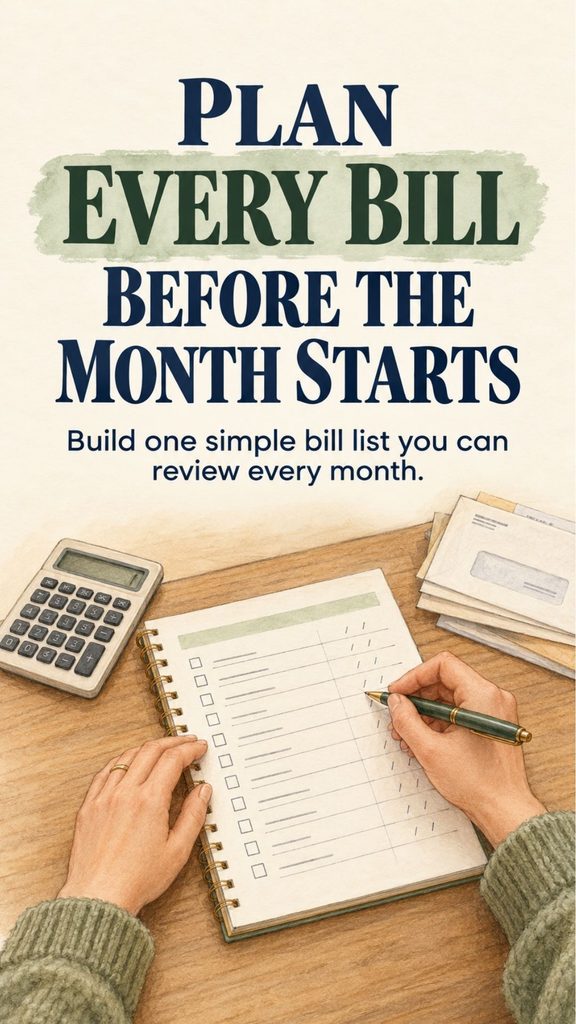
Bills feel much harder to manage when every payment lives somewhere different. Rent may be easy to remember, while an annual membership, insurance installment, streaming subscription, or quarterly expense quietly waits in the background. The problem is often not that there are too many bills. It is that there is no single place showing what is coming and when.
A simple monthly bill-planning system fixes that by moving the information out of your head and onto one dependable list. Instead of rebuilding your budget from scratch every few weeks, you create a basic bill template once, then review and adjust it before each new month begins.
The goal is not to predict every dollar perfectly. It is to know your regular obligations, prepare for expenses that change, and spot potential problems before payment dates arrive.
You Might Also Like:
- Loading posts...
Build a Master List of Your Regular Bills
Start by gathering every expense that arrives on a predictable schedule.
Your list might include:
- Rent or mortgage
- Electricity and gas
- Water
- Internet
- Mobile phone service
- Car payment
- Auto insurance
- Health or other insurance premiums
- Loan payments
- Credit card minimum payments
- Childcare
- Subscription services
- Membership fees
- Regular savings transfers
Write down the name of each bill, its normal due date, and the amount you typically expect to pay.
This becomes your master bill list.
The important part is that you do not throw it away when the month ends. Most recurring expenses will still exist next month, so there is little reason to reconstruct the same list repeatedly.
Instead, keep the master version and use it as the starting point for every new month.
Separate Fixed Bills From Variable Bills
Not every recurring expense behaves the same way.
A fixed bill is usually predictable. Your rent, mortgage, car loan, or certain subscription fees may remain the same from month to month.
Variable bills still arrive regularly, but the amount changes. Electricity, gas, water, and some phone bills are common examples.
Separating the two makes planning easier.
Your fixed expenses can usually be entered before the month begins without much thought. Variable bills may require an estimate until the actual statement arrives.
If your electricity bill usually changes with the season, for example, do not assume that last month’s amount will always be accurate. Look at recent bills and leave enough room in your budget for normal fluctuations.
The purpose of planning ahead is not to pretend that every amount is certain. It is to recognize what is predictable and identify what still needs to be confirmed.
Give Every Bill a Due Date
A list of monthly expenses is useful. A list with due dates is much more useful.
Next to each bill, record the day payment is due.
For example:
- Rent — 1st
- Internet — 6th
- Car payment — 12th
- Electricity — 16th
- Insurance — 20th
- Phone — 24th
Now you can see how your obligations are distributed throughout the month.
This matters because having enough money for the month’s total expenses is only part of the problem. You also need the money available at the right time.
If several major bills fall during the first half of the month, knowing that beforehand lets you plan around your pay schedule instead of discovering the problem after the bills arrive.
Match Bills to Your Paydays
Once your due dates are visible, compare them with the dates you expect to receive income.
Suppose you are paid twice each month. You could identify which bills will be covered by the first paycheck and which belong to the second.
You do not necessarily need separate bank accounts or a complicated budgeting method. Even a simple note beside each expense can help:
First paycheck: rent, phone, insurance.
Second paycheck: utilities, car payment, subscriptions.
The exact arrangement depends on your income schedule and due dates.
The point is to stop looking at your bank balance as one large pool of available money. Some of that money already has a job.
Knowing which bills a paycheck must cover makes it much easier to see what is genuinely available for groceries, transportation, discretionary spending, and other needs.
Treat Savings as a Planned Expense
Savings often receives whatever happens to remain at the end of the month. Unfortunately, some months leave very little behind.
One alternative is to put savings directly into the monthly plan.
You might include a transfer to:
- An emergency fund
- Retirement savings
- A home repair fund
- Car maintenance savings
- Holiday spending
- Travel
- Another personal goal
The amount does not have to be large.
What matters is deciding on it deliberately rather than waiting to see what is left.
Savings is different from a required bill because you may sometimes need to adjust the amount when essential expenses are unusually high. Still, placing it on the same planning sheet makes it visible and gives it a clear place in your financial priorities.
Plan for Bills That Do Not Arrive Monthly
Some of the most frustrating expenses are predictable but infrequent.
Examples can include:
- Annual insurance premiums
- Vehicle registration
- Property-related fees
- Membership renewals
- School expenses
- Holiday spending
- Routine car maintenance
- Annual software subscriptions
- Quarterly bills
Because these expenses do not appear every month, they are easy to forget.
A better approach is to keep them on a separate upcoming-expenses list or build them into your monthly plan gradually.
Suppose you expect a $240 annual expense. Setting aside $20 each month would accumulate $240 over twelve months.
This type of planned saving is often called a sinking fund: money reserved gradually for a known future expense.
The exact amount you save will depend on your budget, but even partial preparation can reduce the shock when the bill eventually arrives.
Review Instead of Rebuilding
This is where the system becomes easier.
Before each month begins, take out your existing bill list rather than opening a blank page.
Then work through it.
Check whether:
- Any amount has changed.
- A new subscription or payment has been added.
- A loan or subscription has ended.
- A variable utility bill needs a new estimate.
- An annual or quarterly expense is approaching.
- A payment date has changed.
- Your savings amount needs adjustment.
Most months, much of the list should remain unchanged.
That means monthly bill planning becomes a review process rather than a complete budgeting project.
You are maintaining a system instead of rebuilding one.
Mark Bills as They Are Paid
Add a small checkbox or status column beside each expense.
A simple system might use:
Planned — you know the bill is coming.
Scheduled — payment or autopay is arranged.
Paid — the money has actually left the account.
This distinction can be particularly useful with automatic payments.
Autopay does not mean a bill should disappear from your planning. You still need enough money in the account when the payment is processed.
Keeping automatic payments on your master list helps prevent the common problem of spending money that has already been committed to an upcoming withdrawal.
Prioritize Bills by Consequence
When money is tight, not every expense carries the same consequences.
Essential housing costs, utilities, insurance, transportation required for work, debt obligations, food, and other necessities generally deserve attention before optional entertainment subscriptions or nonessential purchases.
One useful exercise is to look at your bill list and ask:
What would create the biggest problem if it were not paid?
This helps distinguish necessities from expenses that could potentially be reduced, canceled, or postponed if your budget becomes strained.
The exercise is not about labeling every enjoyable expense as wasteful. It simply gives you a clearer picture of what must be protected first.
Check for Expenses You Are Still Keeping in Your Head
A bill planner is most useful when it captures the things you would otherwise have to remember.
Think beyond the obvious monthly payments.
Is there an annual subscription you always forget?
A car service due later this year?
A professional membership?
A quarterly payment?
A school expense that appears every semester?
A yearly renewal?
If you find yourself repeatedly thinking, “I need to remember that,” put it somewhere in your system.
Your planner should remember for you.
Do a Short Check-In Before Each New Month
You do not need a long budgeting session every few days.
Set aside a short period near the end of each month to prepare the next one.
Review your bill list, confirm upcoming amounts, check your income dates, add irregular expenses, and make sure essential payments are covered.
Then leave the system alone except when something changes or a payment needs to be marked complete.
A useful monthly bill planner should reduce the amount of attention your bills require, not create another complicated task to maintain.
Keep the System Simple Enough to Use
You can manage this process with a budgeting app, spreadsheet, printed planner, calendar, or ordinary notebook.
The tool matters far less than consistency.
Your system only needs to answer a few questions clearly:
What do I owe?
How much should I expect?
When is it due?
Which paycheck will cover it?
Has it been paid?
What irregular expenses are coming later?
Once those answers are visible in one place, the month becomes easier to understand.
You no longer have to reconstruct your financial obligations from emails, bank transactions, paper statements, and memory every few weeks.
Build the basic list once, update it when life changes, and review it before each month begins. A good bill-planning system does not eliminate expenses, but it can eliminate much of the surprise surrounding them.