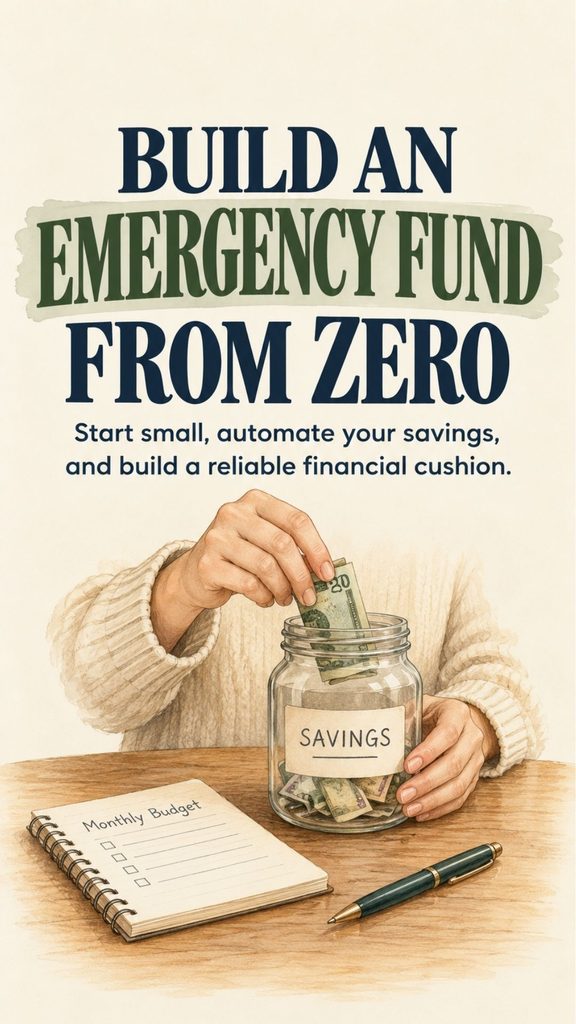
Building an emergency fund can feel difficult when you are starting with nothing, especially if your budget already feels tight. The good news is that you do not need to save several months of expenses all at once. A useful emergency fund is usually built gradually, through small deposits that are repeated consistently.
The purpose of this money is simple: to give you a financial cushion when an unexpected but necessary expense appears. A car repair, urgent home repair, temporary loss of income, medical bill, or another genuine emergency can become much harder to handle when there is no cash set aside.
Instead of focusing on a huge final number, start with a smaller target, keep the money separate, automate what you can, and build from there.
You Might Also Like:
- Loading posts...
Start by Knowing Your Essential Monthly Expenses
Before choosing an emergency-fund goal, calculate how much you actually need to cover one basic month.
Focus on essential expenses rather than every dollar you normally spend.
Your list might include:
- Rent or mortgage
- Utilities
- Groceries
- Transportation
- Insurance
- Minimum debt payments
- Necessary medications or healthcare costs
- Childcare
- Basic phone and internet service
Suppose your essential monthly expenses total $2,000. That number gives you a practical starting point because it shows what one month of basic financial survival looks like for your household.
Do not worry yet about saving several months of expenses. First, understand your baseline.
Begin With One Month as Your First Major Goal
Large emergency-fund recommendations can feel discouraging when your current balance is zero.
Instead of immediately thinking, “I need six months of expenses,” work toward one month first.
If your essential expenses are $2,000, your first long-term milestone could be $2,000.
You can break that down even further.
Your first targets might be:
$100
$250
$500
$1,000
One month of essential expenses
Each milestone gives you more protection than you had before.
Even a few hundred dollars can make a difference when the alternative is putting an unexpected expense on a credit card or borrowing money.
Keep Your Emergency Fund Separate
One of the simplest ways to protect emergency savings is to keep it separate from the account you use for everyday spending.
A dedicated savings account can make the money less tempting to spend while still keeping it accessible when a genuine emergency occurs.
Ideally, the account should be easy enough to access when necessary but not so connected to your daily spending that you constantly see the balance and treat it as available cash.
Before opening an account, check for:
- Monthly maintenance fees
- Minimum balance requirements
- Transfer restrictions
- Withdrawal rules
- Interest rate
- Deposit insurance where applicable
The purpose of an emergency fund is safety and accessibility, not chasing risky investment returns.
Money that may be needed on short notice generally should not depend on the stock market being up at the exact moment an emergency happens.
Automate Your Deposits
Saving becomes easier when you do not have to make a fresh decision every payday.
Set up an automatic transfer from your checking account to your emergency savings account.
The amount does not need to be impressive.
You could begin with:
- $10 per week
- $25 per paycheck
- $50 per month
- Any amount your budget can support consistently
A $20 weekly transfer adds up to more than $1,000 over a year if you are able to maintain it.
The point is not that everyone should save exactly that amount. The lesson is that small, repeated transfers can become meaningful over time.
Start with an amount that does not cause you to miss essential bills. You can increase it later.
Cut One Expense and Redirect the Money
Trying to dramatically reduce every area of spending at once often makes a savings plan difficult to maintain.
A simpler approach is to find one expense you can reduce and redirect that money directly into your emergency fund.
Maybe you cancel an unused subscription.
Perhaps you reduce restaurant spending by one meal each month.
Maybe you switch to a less expensive service plan or pause a purchase you no longer care much about.
If that change saves $20, $30, or $50 each month, transfer the savings instead of allowing it to disappear into other spending.
The key is the redirect.
Cutting an expense only helps build your emergency fund if the money you saved actually reaches the savings account.
Look for Ways to Increase Income
There is a limit to how much most households can cut.
If your budget is already lean, earning extra money may be more realistic than trying to remove another necessary expense.
Possible sources of temporary extra income could include selling unused household items, taking occasional freelance work, doing short-term gigs, working additional hours if available, or using an existing skill to earn extra money.
You do not necessarily need to turn a side job into a permanent second career.
Even occasional extra income can accelerate the early stages of your emergency fund.
If you sell unused belongings for $300, for example, consider transferring that money directly to your emergency savings instead of absorbing it into regular spending.
Use Unexpected Money Carefully
Extra money can provide a useful boost.
This might include a tax refund, work bonus, gift, rebate, or another unexpected payment.
You do not necessarily have to save every dollar, but assigning a portion to your emergency fund can move you toward your goal much faster.
A simple rule might be to save a percentage of unexpected income.
The exact percentage depends on your current obligations and priorities.
What matters is deciding before the money arrives how much will go toward savings. Otherwise, extra cash has a habit of disappearing into small purchases.
Track Your Progress
An emergency fund is easier to maintain when you can see it growing.
Check your progress once a month and compare your current balance with your target.
For example:
Goal: $2,000
Current balance: $650
Remaining: $1,350
Seeing the remaining amount makes the goal concrete.
You can track it in a notebook, spreadsheet, budgeting app, printable savings tracker, or simply through your bank account.
Avoid checking constantly if watching the balance becomes stressful. Monthly tracking is usually enough for seeing meaningful progress.
Increase Your Deposits When Your Situation Improves
Your first automatic transfer does not have to be your permanent amount.
If you receive a raise, pay off a debt, eliminate a monthly expense, or improve your financial situation, consider increasing your emergency-fund contribution.
Suppose you previously paid $150 each month toward a debt that has now been eliminated.
Instead of immediately absorbing the entire $150 into lifestyle spending, you could redirect some or all of it toward savings.
This lets you increase your financial security without needing to find completely new money in your budget.
Decide What Counts as a Real Emergency
An emergency fund works best when you establish some rules before you need the money.
A genuine emergency is usually:
Unexpected. Necessary. Urgent.
Examples might include a major car repair needed to get to work, an urgent home repair, an unexpected medical expense, or essential bills during a temporary loss of income.
A sale, vacation, new phone, holiday shopping, or an ordinary expense you knew was coming generally does not belong in this category.
Known future expenses should ideally have their own savings categories.
For example, if you know your car registration is due every year, that is not an emergency. You can gradually save for it in advance.
Separating predictable expenses from true emergencies helps protect the fund for the situations it was actually designed to handle.
Rebuild the Fund After Using It
Using emergency savings for a legitimate emergency does not mean you failed.
That is what the money is there for.
If you need to withdraw $700 for an urgent repair, handle the problem and then make rebuilding the balance a priority.
Return to your automatic deposits and work toward your previous target again.
An emergency fund is not a number you reach once and never touch. It is a financial buffer that may be used and replenished many times throughout your life.
Build Beyond the First Month Gradually
After you have saved one month of essential expenses, you can decide whether to continue building toward a larger cushion.
The appropriate amount depends on your circumstances.
Someone with stable income, two earners in the household, and relatively predictable expenses may feel comfortable with a smaller reserve than someone who is self-employed, has irregular income, supports several dependents, or works in an unstable industry.
Rather than chasing one universal number, think about how long you would realistically need your savings to support essential expenses if your income suddenly stopped.
Then build toward that larger goal gradually.
Consistency Builds Financial Security
Starting an emergency fund from zero does not require a dramatic financial transformation.
Know your essential expenses. Set a realistic first target. Keep the money separate. Automate small deposits. Redirect one expense if possible. Add extra income when opportunities appear. Track your progress and protect the fund from ordinary spending.
The first $100 matters.
So does the first $500.
Eventually, those small deposits can become a meaningful financial buffer.
The most important step is not starting with a large amount. It is beginning with an amount you can manage and continuing to build from there.