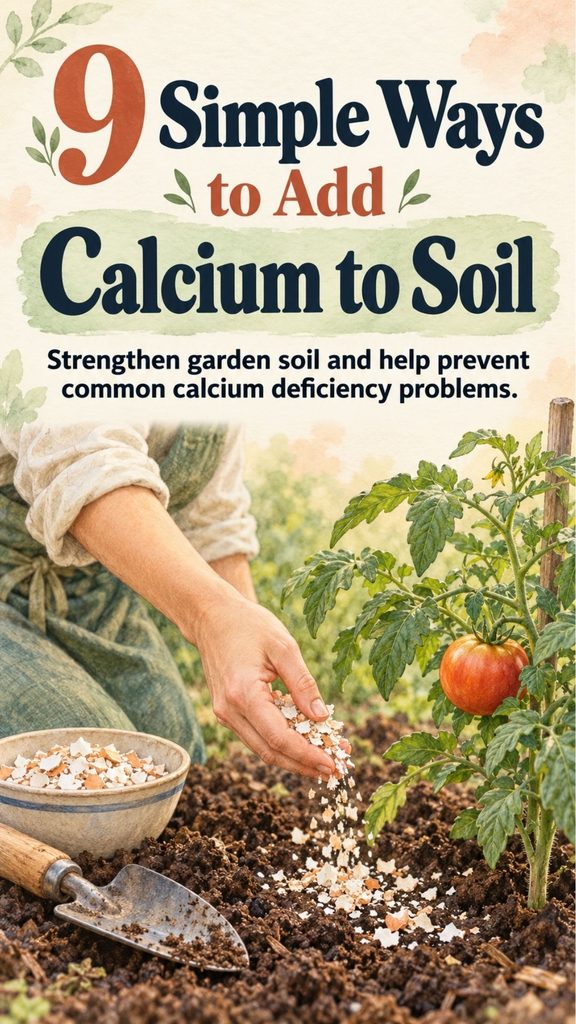
Calcium is an essential plant nutrient, but adding more of it to the garden is not always the answer when plants begin looking unhealthy.
The original guide focuses on nine calcium sources, including lime, eggshells, gypsum, wood ash, bone meal, oyster shells, and commercial fertilizers. It also correctly emphasizes the value of testing the soil before choosing an amendment.
That soil test matters because calcium problems can be more complicated than they first appear.
You Might Also Like:
- Loading posts...
One of the most familiar examples is blossom-end rot on tomatoes and peppers. Although blossom-end rot involves a shortage of calcium in developing fruit tissue, it often occurs even when the soil already contains enough calcium. Uneven watering, drought stress, damaged roots, excessive growth, and other conditions can prevent calcium from reaching the developing fruit. University of Minnesota Extension specifically notes that blossom-end rot is not necessarily caused by low soil calcium and that fluctuating moisture is a major factor.
So before scattering eggshells, lime, or fertilizer around every struggling tomato, determine whether the soil actually needs more calcium.
Why Plants Need Calcium
Calcium plays an important structural role in plants.
It contributes to healthy cell walls, growing points, roots, and developing tissues. The original guide also emphasizes calcium’s importance to plant tissue and cell development.
Unlike some nutrients, calcium is not easily redistributed from old plant tissue to new growth.
That means shortages often become noticeable in actively developing parts of the plant.
Possible symptoms associated with inadequate calcium availability can include:
- Distorted young leaves
- Stunted new growth
- Tip burn in certain leafy vegetables
- Poor root development
- Blossom-end rot in tomatoes, peppers, and some other fruiting crops
But these symptoms can have other causes too.
That is another reason not to diagnose a calcium deficiency by appearance alone.
Blossom-End Rot Does Not Always Mean Your Soil Needs Calcium
Blossom-end rot typically begins as a water-soaked or discolored area at the blossom end of a tomato or pepper.
The damaged area becomes dark, sunken, and leathery.
It is associated with inadequate calcium reaching the developing fruit, but that does not necessarily mean there is too little calcium in the soil.
Penn State Extension notes that blossom-end rot is frequently connected with environmental stress and irregular water availability, while University of Minnesota Extension explains that inconsistent moisture can interfere with calcium movement into the fruit.
Before adding calcium, therefore, check:
- Soil moisture
- Irrigation consistency
- Root damage
- Drainage
- Excessive fertilizer use
- Soil pH
Keeping the root zone evenly moist is often more useful than adding another amendment.
Start With a Soil Test
This is the most important step.
A good soil test can tell you:
- Soil pH
- Calcium level
- Magnesium level
- Phosphorus
- Potassium
- Other nutrients depending on the laboratory
The source recommends testing before fertilizing because calcium amendments frequently affect more than calcium alone.
That is particularly important with lime, wood ash, bone meal, and rock phosphate.
Adding one nutrient can alter pH or contribute large amounts of another nutrient you may not need.
Do not treat soil amendments like harmless ingredients.
More is not automatically better.
1. Use a Calcium-Containing Fertilizer
If a soil test confirms inadequate calcium, a commercial fertilizer or soil amendment containing calcium can provide a straightforward solution.
The exact product should depend on:
- Existing soil fertility
- Soil pH
- Other nutrient deficiencies
- The crop being grown
Always check the fertilizer analysis.
Some calcium fertilizers also contain nitrogen or other nutrients.
That can be helpful when those nutrients are needed but problematic when they are already abundant.
Excess nitrogen, for example, can produce lush leafy growth at the expense of balanced fruit production.
The source makes the same important point: calcium products may contain other nutrients, so soil testing should guide the choice.
Follow the product label rather than estimating an application rate.
2. Add Garden Lime When the Soil Is Too Acidic
Garden lime is one of the most familiar sources of calcium.
Most ordinary agricultural or garden lime is primarily calcium carbonate.
It performs two jobs:
- Supplies calcium.
- Raises soil pH.
That second effect is crucial.
Lime is appropriate when your soil is both acidic enough to benefit from liming and in need of calcium.
It is not a general calcium supplement for every garden.
Penn State Extension notes that many garden plants perform well around a mildly acidic pH, while liming acidic soil can improve nutrient availability and supply calcium.
Do Not Add Lime to Already-Alkaline Soil
If your garden pH is already high, lime can make nutrient availability worse.
The source also cautions that lime raises pH and recommends testing before using it.
So do not automatically put lime around tomatoes because you see blossom-end rot.
Test first.
What About Dolomitic Lime?
Dolomitic lime supplies both calcium and magnesium.
That can be useful when a soil test indicates that both are needed.
If magnesium is already adequate or high, ordinary calcitic lime may be the better choice.
Again, use the soil test to decide.
3. Add Eggshells to Compost—but Do Not Expect a Quick Calcium Fix
Eggshells contain plenty of calcium carbonate.
That makes them a legitimate source of calcium in the long term.
What they are not is a fast treatment for a tomato that has developed blossom-end rot.
The source recommends placing eggshells in planting holes and associates this practice with preventing blossom-end rot.
However, Penn State Extension notes that eggshells break down very slowly and that research does not support adding shell pieces to tomato planting holes as a reliable way to prevent blossom-end rot.
A Better Way to Use Eggshells
Add them to compost.
Crushing them into very small pieces increases their surface area and helps them break down more efficiently.
They can contribute calcium to the soil eventually, but think of them as a slow recycling method, not emergency plant medicine.
If laboratory testing shows an immediate calcium shortage, use an amendment that provides calcium in a more predictable form.
4. Be Cautious With Foliar Calcium Sprays
Calcium sprays are widely marketed for blossom-end rot.
The original guide recommends foliar calcium nitrate or calcium chloride solutions as a rapid way to get calcium into plants.
The evidence is much less convincing.
University of Georgia Extension notes that research on foliar calcium for blossom-end rot is inconclusive and explains that calcium moves mainly with water through the plant’s xylem. It does not move efficiently from treated leaves into developing fruit.
That means spraying leaves is not a dependable substitute for:
- Correct soil calcium
- Healthy roots
- Consistent watering
If you use a commercial calcium spray, follow its label exactly.
Do not mix stronger homemade concentrations in the hope of speeding up results.
And remember: damaged fruit will not repair itself. Management is aimed at helping later fruit develop normally.
5. Use Gypsum When You Need Calcium Without Raising pH
Gypsum is calcium sulfate.
Unlike limestone, gypsum supplies calcium without having the same strong liming effect.
University of Minnesota Extension explains that gypsum contains calcium but lacks the carbonate that makes limestone neutralize soil acidity, so it generally does not raise soil pH the way lime does.
This can make gypsum useful when:
- Calcium is needed.
- Soil pH is already appropriate.
- You do not want to make the soil more alkaline.
The original article recommends gypsum for this reason as well.
Do Not Add Gypsum Automatically to Every Clay Soil
Gypsum is often advertised as a universal clay-soil loosener.
Its effects depend heavily on soil chemistry.
For most home gardens, improving compacted soil with organic matter, avoiding working wet soil, and minimizing compaction are often more generally useful strategies.
Use gypsum because the soil conditions justify it, not simply because the ground feels heavy.
6. Ground Oyster Shells Can Supply Calcium Slowly
Oyster shells are primarily calcium carbonate.
Ground shell products can therefore contribute calcium and, much like limestone, may influence soil pH as they break down.
The original guide describes them as a slow calcium source.
Because the material decomposes gradually, oyster shell is better considered a long-term amendment than a quick correction.
Use finely ground material if the goal is soil amendment.
Large shell fragments can take a very long time to break down.
And because they contain calcium carbonate, they are not an ideal choice when your soil is already alkaline.
7. Use Wood Ash Only When Your Soil Actually Benefits From It
Clean wood ash contains calcium along with potassium, magnesium, and other minerals.
It can also act as a liming material.
That makes it potentially useful in acidic soils.
It also makes it easy to misuse.
Oregon State University Extension recommends testing soil pH before applying wood ash and warns against using it where soil pH is already above 7.0.
Only Use Clean Wood Ash
Use ash from clean, untreated wood.
Never apply ash from:
- Painted wood
- Pressure-treated lumber
- Stained wood
- Trash fires
- Coal
- Barbecue charcoal containing additives
- Manufactured wood products
Oregon State also recommends gloves, eye protection, and dust protection when handling ash because it is alkaline and irritating.
Softwood Ash Is Not Automatically Harmful
The original article suggests that softwood ash is harmful to plants.
That is too broad.
Both hardwood and softwood ashes can contain useful minerals; the nutrient concentration varies. Oregon State notes that hardwoods often yield more nutrient-rich ash by weight, but the important questions are what was burned, how much ash is applied, and what the soil actually needs.
Use wood ash sparingly.
It is not something to dump repeatedly into one corner of the vegetable garden.
8. Bone Meal Supplies Calcium—but Also a Lot of Phosphorus
Bone meal is made from processed animal bones and contains both calcium and phosphorus.
The original article recommends it as a broad calcium amendment.
But there is an important reason to use it selectively:
You may not need more phosphorus.
Many established garden soils already contain adequate or excessive phosphorus.
Adding bone meal solely for calcium can therefore provide an unnecessary nutrient at the same time.
A better approach is:
- Test the soil.
- Check phosphorus levels.
- Read the product analysis.
- Use bone meal when its complete nutrient profile suits the soil.
Do not regard bone meal as something every gardener needs to keep on hand.
A fertilizer is useful only when it supplies something the soil actually requires.
9. Rock Phosphate Is a Slow Amendment, Not a Quick Calcium Treatment
Rock phosphate, including so-called soft rock or colloidal phosphate products, can contain calcium.
But these materials are used mainly as sources of phosphorus.
The original guide notes that they release nutrients slowly and work better in acidic conditions.
For correcting a clear calcium deficiency, rock phosphate usually would not be the first amendment to reach for.
Its nutrient release can be slow, and adding significant phosphorus without a demonstrated need may create another imbalance.
If your soil test shows low phosphorus as well as conditions appropriate for rock phosphate, it may have a role.
Otherwise, choose a more targeted calcium amendment.
How to Choose the Right Calcium Source
Instead of asking:
What can I add for calcium?
Ask three questions.
1. What Is My Soil pH?
If the soil is too acidic, lime may supply calcium while correcting pH.
If pH is already appropriate, gypsum or another non-liming calcium source may make more sense.
If the soil is alkaline, avoid casually adding lime, oyster shell, or wood ash.
2. Does the Soil Actually Test Low in Calcium?
If calcium is already adequate, adding more may accomplish nothing.
Blossom-end rot, especially, often results from poor calcium movement rather than an empty calcium reserve in the soil.
3. What Else Does the Amendment Add?
Calcium amendments rarely contain calcium alone.
For example:
- Dolomitic lime also supplies magnesium.
- Wood ash supplies potassium and raises pH.
- Bone meal supplies substantial phosphorus.
- Calcium nitrate supplies nitrogen.
- Gypsum supplies sulfur.
Choose according to the entire soil profile.
How to Prevent Blossom-End Rot More Effectively
If blossom-end rot is the reason you started looking for calcium, begin with irrigation.
University of Minnesota Extension recommends maintaining consistent soil moisture because large fluctuations in water availability can interfere with calcium reaching developing fruit.
Useful practices include:
- Water deeply and consistently.
- Avoid allowing plants to become severely dry between waterings.
- Use mulch to moderate soil moisture.
- Avoid damaging roots through aggressive cultivation.
- Avoid excessive nitrogen fertilizer.
- Make sure containers are large enough and do not repeatedly dry out.
Container-grown tomatoes are particularly vulnerable because a relatively small amount of potting mix can move rapidly from wet to dry during hot weather.
A regular moisture supply often does more to prevent blossom-end rot than another handful of eggshells.
Signs That You May Be Adding Too Much
Calcium is necessary, but soil fertility is about balance.
Unnecessary amendments can alter pH or interfere indirectly with the availability of other nutrients.
Watch for a broader pattern rather than continually treating individual symptoms.
If plants continue performing poorly after fertilization, stop adding products and investigate:
- pH
- Drainage
- Irrigation
- Root health
- Fertilizer history
- Salt buildup
- Other nutrient levels
Repeatedly adding something because a plant “looks deficient” can make diagnosis harder.
The Simplest Calcium Strategy for Home Gardeners
For most gardeners, the process can be reduced to four steps.
Step 1: Test
Find out the soil pH and nutrient levels.
Step 2: Correct Watering Problems
Especially if tomatoes or peppers have blossom-end rot.
Step 3: Choose an Amendment That Matches the Soil
Use lime for acidic soil that needs liming.
Use gypsum when calcium is genuinely needed without a major pH increase.
Use multi-nutrient products only when the additional nutrients are appropriate too.
Step 4: Recheck Before Adding More
Give amendments time to work.
Do not continually add calcium throughout the season without knowing whether it is still required.
Calcium Is Important—But More Is Not Always Better
There are many ways to add calcium to garden soil.
Some are inexpensive.
Some are slow.
Some change pH.
Some add other nutrients at the same time.
The nine common options are:
- Calcium-containing fertilizer
- Garden lime
- Eggshells
- Calcium sprays
- Gypsum
- Ground oyster shell
- Wood ash
- Bone meal
- Rock phosphate
But they are not interchangeable.
The best amendment is not the one that sounds most natural or produces the quickest-looking solution.
It is the one that matches what your soil actually needs.
Test first.
Keep watering consistent.
Choose amendments carefully.
And if your tomatoes develop blossom-end rot, remember that the problem may be calcium delivery rather than calcium supply.
Once that distinction is clear, managing calcium in the garden becomes much simpler—and you are far less likely to create one soil problem while trying to fix another.