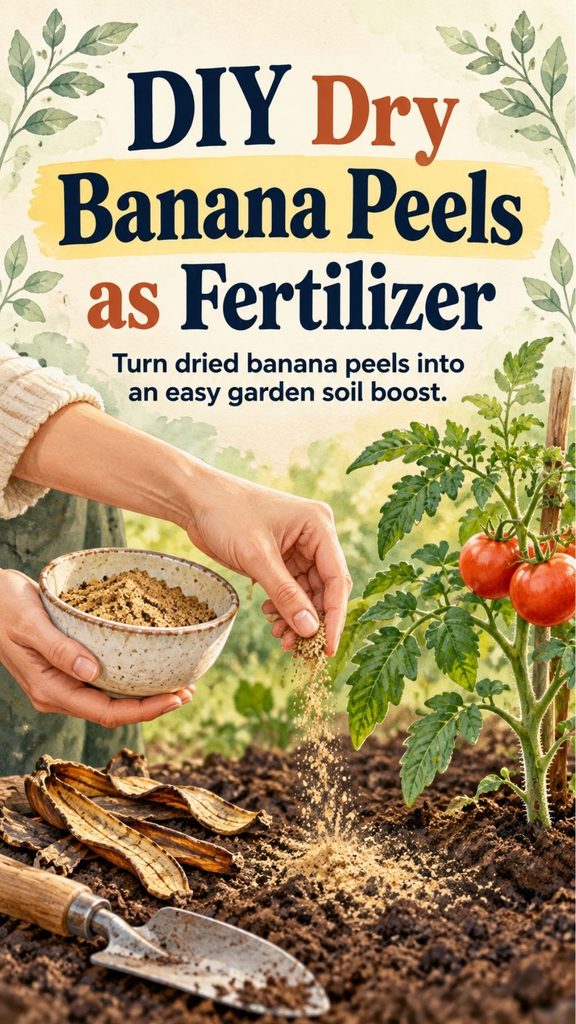
Banana peels are easy to toss into the trash or compost bin, but gardeners sometimes save them for another purpose: turning them into a simple homemade soil amendment.
Banana peels contain potassium along with smaller amounts of other plant nutrients. Potassium plays several important roles in plant growth, including regulating water movement, supporting enzyme activity, and helping plants tolerate certain stresses. It is one of the three primary nutrients represented by the familiar N-P-K numbers on fertilizer labels.
That does not mean banana peels are a complete fertilizer, however. Plants need nitrogen, phosphorus, potassium, and a range of other nutrients in appropriate amounts. Dried banana peels can contribute organic matter and nutrients as they break down, but they should be treated as a supplemental soil amendment rather than a substitute for balanced fertilization.
You Might Also Like:
- Loading posts...
Drying the peels first makes them easier to store, grind, and apply in small amounts. It also gives you a practical way to reuse kitchen scraps without burying large pieces of fresh peel around plants.
Why Dry Banana Peels Before Using Them?
Fresh banana peels contain a great deal of moisture. If buried whole in the garden, they will eventually decompose, but the process can take time.
Large pieces of fresh organic material may also be inconvenient around established plants because soil microorganisms must break them down before most of their nutrients become available. Fresh scraps can sometimes attract insects or animals as well.
Drying changes the peel into something much easier to handle.
Once completely dehydrated, banana peels become brittle. They can then be crushed or ground into flakes or powder and mixed into soil, compost, or potting materials in modest quantities.
Drying does not magically create additional nutrients. It simply removes much of the water, reducing the volume and concentrating the remaining dry material.
That distinction is useful. Banana peel powder can contribute nutrients eventually, but it is not a fast-acting source comparable to a soluble commercial fertilizer.
Banana Peels Are Not a Complete Fertilizer
One of the most common gardening claims about banana peels is that they are a powerful potassium fertilizer.
There is some truth behind the idea: bananas and their peels do contain potassium.
The problem comes when banana peels are treated as though potassium is the only nutrient plants need.
Healthy plant growth depends on the balance of nutrients already present in the soil. Adding more potassium to soil that already contains enough will not necessarily improve flowering, fruit production, or root growth.
Too much of one nutrient can sometimes interfere with the availability or uptake of others.
That is why soil testing is so valuable, especially in vegetable gardens where fertilizers and amendments are added regularly. A soil test can tell you much more than trying to diagnose nutrient problems by looking at leaves alone.
For example, purple foliage is sometimes blamed on potassium deficiency, but purpling can have several causes and is more commonly associated with phosphorus problems, cold conditions, plant genetics, or other stresses. Potassium deficiency more often appears as yellowing or browning along the margins of older leaves, although symptoms vary by crop.
Visual symptoms alone are rarely enough for an accurate diagnosis.
Save Your Banana Peels
If you want to make a reasonable amount of dried banana peel powder at once, save your peels over several days or weeks.
A freezer bag or reusable freezer-safe container works well.
After eating a banana, remove any produce stickers and place the peel in the freezer. You can cut off the hard stem if you wish, although this is optional.
Freezing is mainly a convenient storage method. It prevents the peels from becoming unpleasant while you collect enough for a batch.
You do not need dozens of peels before starting. A smaller batch works perfectly well if that is what you have available.
How to Prepare Banana Peels for Drying
When you are ready to process the peels, allow frozen peels to thaw enough that they can be safely cut.
Use a clean knife or kitchen scissors to cut each peel into smaller pieces or strips.
Pieces approximately 1 to 3 inches long are much easier to dry than whole peels because more surface area is exposed to moving air and heat.
Try to keep the pieces roughly similar in size. Uniform pieces are more likely to finish drying at approximately the same time.
There is no need for perfect measurements.
The goal is simply to avoid having a mixture of tiny pieces that become brittle quickly and thick whole sections that remain moist much longer.
How to Dry Banana Peels in a Dehydrator
A food dehydrator is one of the easiest ways to prepare banana peels.
Arrange the cut pieces in a single layer on the dehydrator trays. Avoid piling them on top of one another.
Dry them according to the operating instructions for your dehydrator. Moderate dehydrating temperatures work well, and drying time will vary depending on the machine, thickness of the peels, humidity, and size of the pieces.
The peels are ready when they are thoroughly dry and brittle rather than soft or flexible.
Do not rely entirely on a fixed drying time. One batch may finish much faster than another.
The final texture is the better guide.
How to Dry Banana Peels in the Oven
You can also use an oven if you do not own a dehydrator.
Place the pieces in a single layer on a baking sheet lined with parchment paper or another oven-safe surface.
Use the lowest practical oven temperature and check the peels regularly.
The goal is to remove moisture slowly rather than roast or burn them.
Ovens differ considerably at their lowest settings, so drying times will vary. Thin pieces will usually dry more evenly than large sections.
Use appropriate ventilation according to your oven manufacturer’s guidance rather than automatically leaving the oven door open. Some manufacturers advise against operating an oven with the door ajar.
Continue drying until the peel pieces are completely brittle.
Let the Peels Cool Completely
Do not grind warm peels immediately.
Allow them to cool completely first.
This makes it easier to determine whether they are genuinely dry. A piece that still bends instead of snapping may contain enough moisture to reduce storage life.
If necessary, return soft pieces to the dehydrator or oven.
Proper drying matters particularly if you plan to keep the finished powder rather than use it immediately. Moisture trapped in stored plant material can encourage spoilage or mold.
Grind the Dried Banana Peels
Once cool and crisp, place the dried pieces in a blender, food processor, coffee grinder reserved for non-coffee ingredients, or similar appliance.
Pulse until you have coarse flakes or a finer powder.
It does not need to become perfectly smooth.
Smaller particles generally have more surface area available to soil organisms, so they can break down more readily than large pieces. They will still need to decompose before most of their nutrients become part of the soil nutrient cycle.
Keep your face away from the container when opening finely ground material because the powder can produce dust.
How to Store Banana Peel Powder
If you are not using the powder immediately, transfer it to a clean, completely dry container with a secure lid.
Store it somewhere cool and dry.
The most important requirement is keeping moisture out.
If the material develops mold, an unusual odor, or signs that moisture has entered the container, it is better to add it to an active compost pile rather than use it directly around valuable plants.
You can also skip long-term storage entirely and make small batches whenever you accumulate enough peels.
3 Practical Ways to Use Dried Banana Peels
Dried banana peel powder is best used conservatively.
Because homemade amendments do not have a standardized nutrient analysis, there is no universal application rate comparable to a packaged fertilizer label.
Here are several reasonable ways to use it.
1. Add It to Compost
This is arguably the simplest option.
Mix dried banana peel flakes or powder into your compost along with other kitchen and garden materials.
Composting allows microorganisms to break down the peel material along with a broad mixture of carbon-rich and nitrogen-rich ingredients.
Finished compost then contributes organic matter and a range of nutrients to garden soil.
Using banana peels this way also reduces the temptation to rely on one kitchen scrap as though it were a complete fertilizer.
2. Mix a Small Amount Into Garden Soil
You can lightly incorporate a modest amount of finely ground peel into the upper layer of soil around established plants.
Avoid piling concentrated material directly against plant stems or crowns.
Mixing it into soil spreads the organic material over a wider area and gives soil organisms access to it.
Remember that the nutrients will not become instantly available. Decomposition takes time.
For plants showing an actual nutrient deficiency, use soil-test recommendations and an appropriately formulated fertilizer rather than expecting banana powder to correct the problem quickly.
3. Add a Little to Soil Before Planting
A small amount of finely ground peel can also be mixed into the soil before planting.
Do not place a thick layer of undecomposed banana material directly beneath delicate roots.
Instead, distribute it through the surrounding soil or combine it with finished compost.
This reduces the chance of creating a concentrated pocket of decomposing organic material immediately against young roots.
What About Banana Peel Water?
Another popular homemade fertilizer involves soaking banana peels in water and pouring the liquid around plants.
Although some soluble compounds may move into the water, there is no reliable way for a home gardener to know how much plant nutrition the liquid contains.
It is therefore difficult to dose consistently.
Soaking banana peels also leaves behind the solid peel, which still contains material that must be composted or discarded.
If your goal is to recycle the entire peel, drying, composting, or incorporating fully decomposed material into the soil is generally more practical.
Be Careful With Epsom Salt
Banana peel fertilizer recipes are sometimes combined with Epsom salt because Epsom salt contains magnesium sulfate.
That does not mean every plant needs additional magnesium.
Adding Epsom salt without evidence of magnesium deficiency can alter soil nutrient balance and is unnecessary in soil that already contains adequate magnesium.
The same principle applies to eggshells, coffee grounds, banana peels, and other popular homemade amendments.
Each material contains something useful, but that does not mean every garden requires more of it.
A soil test is far more dependable than automatically combining several household ingredients.
A Better Way to Think About Homemade Fertilizers
Kitchen scraps can be useful resources in a garden, but there is an important difference between recycling organic material and supplying precise plant nutrition.
Banana peel powder is best viewed as an organic amendment that contributes small amounts of nutrients as it decomposes.
It should not be expected to provide everything a tomato, pepper, rose, houseplant, or fruiting crop needs.
Good plant nutrition begins with healthy soil.
That may include compost, appropriate fertilizers when needed, suitable pH, adequate moisture, good drainage, and enough organic matter.
Banana peels can be one small part of that system.
Turn Kitchen Waste Into Something Useful
Drying banana peels is an easy project for gardeners who enjoy finding another use for household scraps.
Save the peels, cut them into manageable pieces, dry them until completely crisp, grind them, and use the resulting material sparingly in compost or soil.
There is no need to treat banana peel powder as a miracle fertilizer.
Its real appeal is much simpler.
Instead of sending an organic kitchen scrap directly to the trash, you can return it to the garden, where decomposition allows its nutrients and organic matter to re-enter the soil cycle.
That may not be dramatic, but it is a practical habit—and one that makes good use of something you already have.