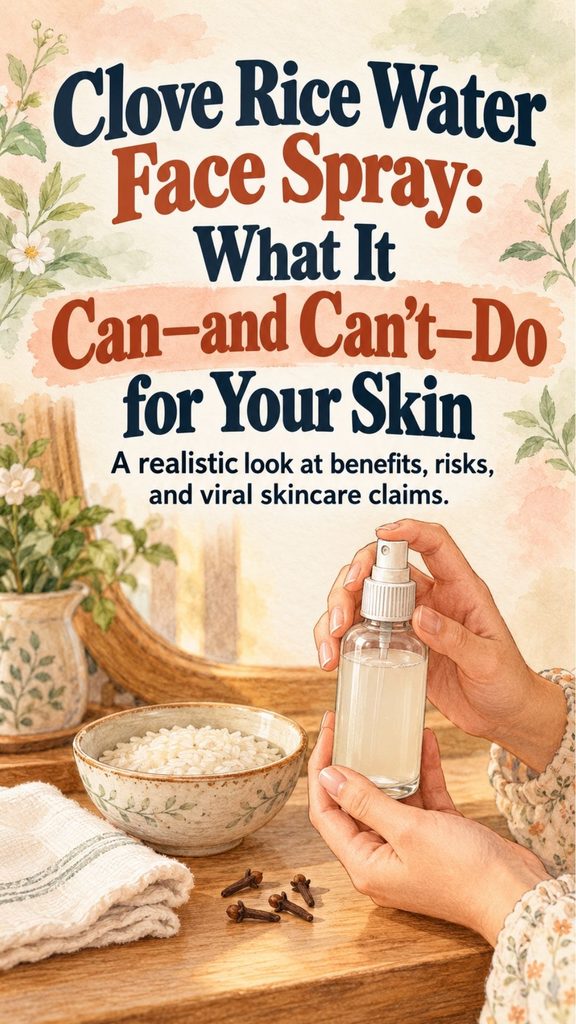
A homemade spray made from rice water and cloves has been circulating online with dramatic promises: tighter skin, fewer wrinkles, more collagen, faded dark spots, clearer acne, and an instant glow. Some posts go even further and suggest that spraying the mixture several times a day can make mature skin look decades younger.
Those claims deserve a closer look.
Rice-derived ingredients do have a history in skincare, and some laboratory and clinical research has found potentially useful properties in specific rice extracts, rice starch, rice bran ingredients, and formulated rice-based products. Cloves also contain compounds with biological activity, especially eugenol.
You Might Also Like:
- Loading posts...
But that does not mean soaking rice and whole cloves in water creates a proven anti-aging treatment. A homemade infusion is very different from a professionally formulated cosmetic containing standardized, tested ingredients.
The mixture may feel refreshing on the skin, but expectations should remain realistic.
What Is Clove Rice Water?
The viral recipe is usually very simple:
- rice
- several whole cloves
- water
The ingredients are soaked, sometimes overnight, then heated or boiled briefly, strained, cooled, and poured into a spray bottle.
The finished liquid is then applied to the face like a toner or facial mist.
At first glance, this sounds harmless because everything involved is familiar and natural. However, “natural” does not automatically mean effective, non-irritating, or suitable for frequent facial use.
The two ingredients should be considered separately before deciding whether combining them makes sense.
What Does Rice Water Actually Do for Skin?
Rice has been used in traditional beauty routines for generations, and modern cosmetic companies also use rice-derived ingredients.
There is some scientific reason for that interest.
Research reviews have identified potentially useful compounds in rice and rice bran, including phenolic compounds, squalene, tricin, and other components that may have moisturizing, anti-inflammatory, antioxidant, or pigmentation-related effects under certain conditions.
Rice starch has also been studied for its effect on the skin barrier. Research has found that rice starch used in bath water may support barrier recovery in irritated skin.
That sounds promising, but there is an important limitation.
Studies of purified rice ingredients, rice starch, fermented rice products, rice bran extracts, or professionally formulated cosmetics cannot automatically be applied to homemade rice-soaking water.
The concentration, composition, pH, stability, and skin penetration may be completely different.
Research looking specifically at rice water for pigmentation has also found that the evidence remains limited, with much of the support coming from laboratory research rather than strong human clinical trials.
So rice water may be an interesting cosmetic ingredient, but claims that homemade rice water visibly erases wrinkles or dark spots should not be treated as established fact.
Can Rice Water Tighten Skin?
A facial mist can make skin feel temporarily fresher or slightly tighter as the water evaporates.
That sensation is not the same as permanently tightening skin.
Skin firmness depends on several factors, including collagen, elastin, hydration, sun exposure, age, genetics, and overall skin health.
There is no good evidence that a simple homemade rice-water spray can meaningfully reverse age-related skin laxity.
A temporary feeling of tightness after a liquid dries should not be confused with structural changes deeper in the skin.
Does Rice Water Boost Collagen?
This is another common viral claim.
Certain rice-derived compounds have shown interesting biological activity in laboratory research, but that is very different from proving that ordinary rice water sprayed onto the face increases collagen enough to reduce visible aging.
Collagen production takes place within the skin and is influenced by complex cellular processes.
A homemade infusion does not have a known concentration of active compounds, and there is no reliable way to know how much, if any, reaches the layers of skin where collagen is produced.
So “naturally boosts collagen” is much stronger than the available evidence supports.
Can Rice Water Fade Dark Spots?
Rice-based skincare ingredients are being investigated for pigmentation, and some components may eventually prove useful in properly formulated products.
However, homemade rice water should not be considered a proven treatment for hyperpigmentation.
Dark spots can be caused by sun exposure, acne, irritation, hormonal changes, or other conditions. Effective treatment depends partly on the cause.
The most important everyday measure for preventing many forms of pigmentation from worsening is consistent sun protection.
For persistent dark spots, ingredients with better-established evidence, used in appropriate formulations, are generally more dependable than kitchen-made sprays.
What About Cloves?
Cloves contain eugenol, the aromatic compound responsible for much of their characteristic smell.
Eugenol has been studied for antimicrobial and other biological properties. That sometimes leads to the assumption that cloves can be used directly on facial skin to treat acne.
The problem is that eugenol is also a known contact allergen.
Some people can develop allergic contact reactions to eugenol and clove-related substances, particularly if they are already sensitized.
That does not mean everyone who touches diluted clove preparations will develop a rash.
It does mean that adding cloves to a leave-on facial product is not automatically harmless.
Frequent application could cause irritation, redness, burning, itching, or dermatitis in susceptible skin.
Can Cloves Kill Acne-Causing Bacteria?
Laboratory studies of plant compounds can show antimicrobial activity, but that does not establish a homemade clove infusion as an effective acne treatment.
Acne is not simply caused by dirty skin or one type of bacteria.
It involves several factors, including excess sebum, clogged follicles, inflammation, hormones, and microorganisms living within follicles.
Even if a plant extract inhibits bacteria in a laboratory dish, it must still be tested at a safe and effective concentration on human skin before it can reasonably be recommended as an acne treatment.
A kitchen infusion has no standardized concentration.
That makes it difficult to know whether it contains enough clove compounds to have any meaningful effect—or enough to irritate the skin.
The Biggest Problem With Homemade Face Sprays: Contamination
One of the least discussed problems with viral skincare recipes is microbiological safety.
Rice water mixed with plant material creates a water-based preparation containing organic substances. Once stored in a bottle, it can provide conditions in which microorganisms may grow.
Commercial cosmetics containing water usually require careful manufacturing practices and preservation systems designed to control microbial contamination.
Boiling the mixture once does not turn it into a permanently sterile product.
The liquid can become contaminated again during cooling, straining, pouring, spraying, or storage.
A homemade bottle also lacks the preservation testing used for properly formulated commercial products.
For that reason, preparing a large batch and keeping it for repeated facial use is not a particularly good idea.
Why Spraying It Three Times a Day Is Not Necessarily Better
More skincare is not always better skincare.
Applying a clove-containing mixture several times a day increases the amount of exposure your skin receives. If the mixture is irritating, repeated application can make that irritation worse.
Skin that becomes inflamed may look red, dry, rough, or darker afterward, particularly in people prone to post-inflammatory hyperpigmentation.
A treatment intended to improve dark spots can therefore have the opposite effect if it repeatedly irritates the skin.
That is one reason strong claims such as “spray three times daily” should not be copied blindly from social media.
If You Still Want to Try Rice Water
If you enjoy traditional skincare and want to experiment with rice water, the simpler version is the more sensible approach.
Skip the cloves.
A plain, freshly prepared rice-water rinse or brief-use facial application is less complicated than adding a potentially sensitizing spice.
Because homemade rice water contains no validated preservative system, avoid preparing a large quantity for extended storage. Use clean utensils and containers, make small amounts, and discard the mixture if its smell, color, or appearance changes.
Do not use it on broken, inflamed, freshly shaved, or already irritated skin.
If your skin begins to sting, burn, itch, or turn persistently red, rinse it off and stop using it.
Anyone with eczema, fragrance allergies, highly reactive skin, or a history of contact dermatitis should be especially cautious with homemade botanical preparations.
A Better Routine for Glowing, Healthy-Looking Skin
If the real goal is smoother, brighter, healthier-looking skin, the basics are far less exciting than a viral recipe—but considerably more dependable.
A simple routine can include:
- A gentle cleanser suited to your skin type.
- A moisturizer that helps support the skin barrier.
- Broad-spectrum sunscreen during the day.
- Evidence-based treatment ingredients chosen for a specific concern.
- Enough time and consistency to judge whether the routine is actually working.
Someone concerned mainly with acne will need a different approach from someone treating dryness or hyperpigmentation.
Likewise, mature skin does not need to be “fixed” or made to look twenty years younger. Healthy skin at 50 will naturally look different from healthy skin at 20.
That is normal.
What About Wrinkles?
No kitchen spray can realistically make a 50-year-old face look 20.
Wrinkles and skin texture reflect years of facial movement, sun exposure, natural collagen changes, genetics, and other influences.
Some skincare ingredients and dermatological treatments can modestly improve the appearance of fine lines, but genuine changes generally take time.
Claims promising dramatic age reversal from rice water, cloves, coffee, lemon juice, or similar household ingredients are a good reason to be skeptical.
A product can be pleasant without being miraculous.
The Bottom Line on Clove Rice Water Face Spray
Rice-derived ingredients are genuinely interesting in skincare, and research suggests that some may offer useful moisturizing, barrier-supporting, antioxidant, or pigmentation-related properties when properly formulated.
That does not validate the viral claim that rice soaked with cloves will tighten skin, erase wrinkles, boost collagen, cure acne, fade dark spots, and make someone decades younger.
Cloves introduce an additional concern because eugenol can cause allergic contact dermatitis in susceptible people.
There is also the practical problem of storing an unpreserved, water-based homemade cosmetic, which can become contaminated over time.
If you enjoy rice water as a simple traditional beauty ritual, keep expectations modest and the preparation simple.
Your skin does not need a miracle spray. Gentle cleansing, good moisturization, daily sun protection, and treatments with evidence behind them will do far more for long-term skin health than any promise that says “age 50, look 20.”