
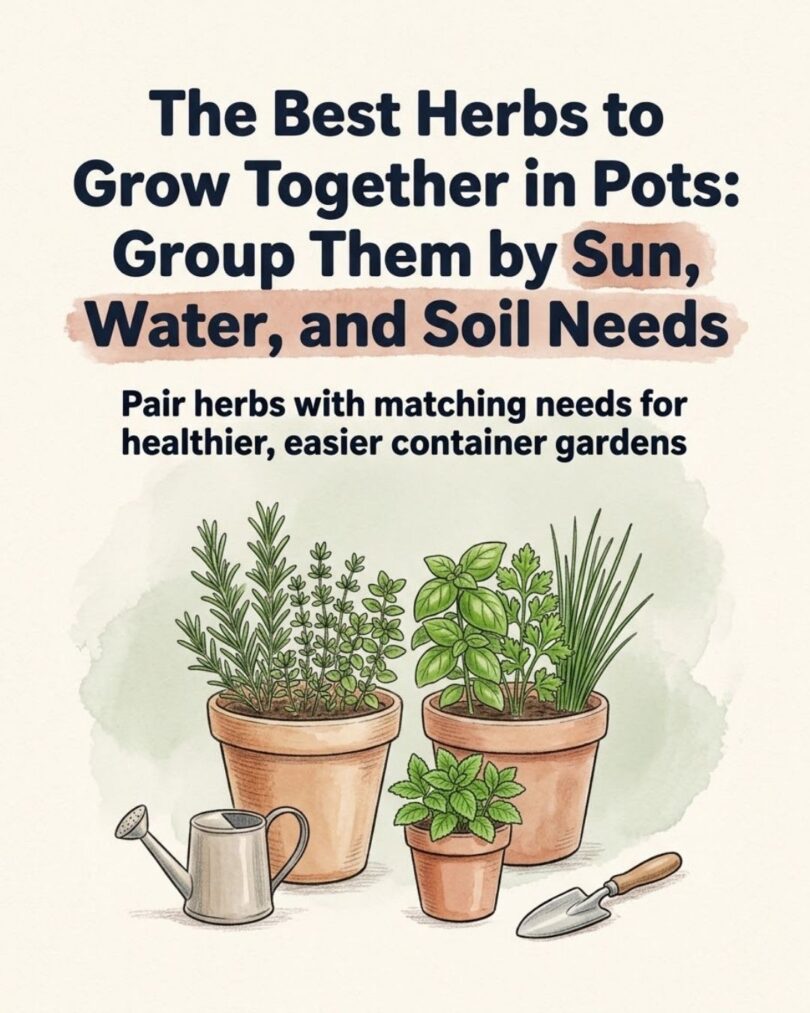
A mixed herb pot can look beautiful on planting day and become frustrating a few weeks later. Rosemary may be struggling in soil that stays too wet, basil may wilt because the container dries too quickly, and mint may send runners through every available inch of space.
The problem usually is not that herbs dislike having neighbors. It is that their growing requirements do not match.
A better way to design a container herb garden is to group plants by what they need from the gardener. Herbs sharing a pot should tolerate roughly the same amount of sunlight, soil moisture, drainage, and seasonal temperatures. Their mature size and growth habits should also be compatible.
You Might Also Like:
- Loading posts...
This simple rule makes mixed herb containers much easier to maintain: one pot should have one basic watering routine.
Here is how to choose herb combinations that make sense, plus a few popular groupings that need more caution than they first appear to.
Start With Growing Conditions, Not Recipes
It is natural to put herbs together because they taste good in the same dishes. Basil, oregano, and rosemary, for example, may all appear in Mediterranean-inspired cooking.
That does not necessarily make them ideal container companions.
Rosemary and oregano tolerate well-drained conditions and should not remain constantly wet. Basil, by contrast, performs best when it receives sufficient moisture and is not repeatedly allowed to wilt.
The same issue appears with many attractive herb combinations. One plant wants dry, lean conditions while its neighbor grows better with consistent moisture.
Before combining herbs, compare four things:
- Sun exposure
- Moisture requirements
- Drainage
- Mature plant size and spreading habit
Container size matters too. Even compatible herbs will compete if three large plants are squeezed into a pot intended for one.
Containers should always have drainage holes, and a quality potting mix is preferable to ordinary garden soil for most container herbs.
1. Rosemary, Thyme, and Oregano
This is one of the most practical mixed-herb combinations.
Rosemary, thyme, and oregano are associated with relatively sunny, well-drained growing conditions. Oregano in particular can suffer in persistently heavy or wet soil, making good drainage important.
Use a container with generous drainage holes and avoid allowing it to remain waterlogged.
The pot should also be large enough for the rosemary. Rosemary can eventually become much larger than low-growing thyme, so a tiny tabletop pot will not remain suitable indefinitely.
Arrange the taller rosemary toward the center or back and allow thyme to occupy an edge where it has room to spread.
This group works particularly well for gardeners who tend to be more comfortable letting the upper layer of potting mix dry somewhat between waterings rather than keeping a container constantly moist.
2. Sage, Thyme, and Oregano
Another useful grouping replaces rosemary with sage.
Sage, thyme, and oregano can all work in a sunny container with excellent drainage. They are also perennial herbs in climates where winter conditions allow them to survive, although cold tolerance varies by species, cultivar, and local climate.
This combination is a better choice than automatically mixing sage with moisture-loving herbs.
Give the plants enough space for air to move between them. Sage can become fairly substantial, so check the mature size listed for the particular variety you buy.
Do not assume a “Mediterranean herb pot” should be watered on a rigid schedule such as every three days. Containers dry at very different rates depending on their material, diameter, weather, plant size, and exposure.
Instead, check the potting mix before watering.
3. Basil, Parsley, and Chives
For gardeners who prefer a container with steadier moisture, basil, parsley, and chives are a more logical group.
Basil needs warmth and adequate moisture during active growth. Parsley can grow in full sun or partial shade, while chives are adaptable container plants.
Unlike rosemary and thyme, this is not a pot to leave dry for prolonged periods during hot weather.
A larger container makes maintenance easier because more potting mix generally dries more slowly than the small volume in a tiny pot.
There is one seasonal complication: basil is a warm-season tender herb, while parsley and chives tolerate cooler conditions more readily. That does not prevent them from sharing a summer container, but basil may be the first member of the group to decline as temperatures drop.
Regular harvesting also helps keep basil productive and bushy.
4. Cilantro, Dill, and Chervil
Cilantro, dill, and chervil are useful to think of as a seasonal container rather than a permanent herb arrangement.
These herbs are generally better suited to the cooler part of the growing season than basil and other heat-loving herbs. Chervil and coriander can both be grown with some protection from intense conditions, and RHS guidance includes coriander among herbs that can tolerate shade.
A movable container is particularly useful.
During mild spring weather, the pot can receive good light. As conditions become hotter, moving it away from harsh afternoon sun may help prolong useful growth, depending on your climate.
Dill creates another consideration: height.
Some dill varieties become tall enough to overwhelm small containers. Illinois Extension notes that taller herbs such as dill need greater soil depth than smaller herbs.
Choose a substantial pot and avoid overcrowding the seedlings.
5. Mint: Better Contained, but Often Better Alone
Mint deserves special treatment in a container garden.
It spreads vigorously through underground stems and can quickly occupy garden soil. Both Illinois Extension and Penn State Extension recommend containing mint rather than allowing it unrestricted access to a garden bed.
That makes pots an excellent solution.
However, putting mint, lemon balm, and bee balm together in one ordinary-sized container is not necessarily the best idea. All are members of the mint family, but similar botanical relationships do not guarantee compatible size or behavior.
Mint and lemon balm are both capable of spreading vigorously. Penn State specifically identifies both as herbs worth containing.
A simpler approach is to give mint its own pot.
You can even create a mixed mint container using different culinary mint varieties if there is enough space, although vigorous varieties may eventually compete with one another.
Keeping mint separate also gives you much more freedom to water neighboring Mediterranean herbs differently.
6. Lemon Balm Can Have Its Own Container Too
Lemon balm is another herb that can become more enthusiastic than expected.
A separate pot prevents it from spreading into areas where it is not wanted and makes it easier to control its size through harvesting.
If you want the visual effect of several herbs growing together, separate pots grouped closely on a patio often work better than forcing every herb to share the same root zone.
This is one of the most useful tricks in container herb gardening.
Three individual pots placed inside or beside a decorative planter can look like one herb garden while allowing each plant to receive different amounts of water.
7. Oregano, Marjoram, and Winter Savory
For another sunny, well-drained container, oregano, marjoram, and winter savory can make a sensible starting point.
These aromatic herbs are often more comfortable in free-draining conditions than thirsty leafy herbs such as basil.
Again, drainage is more important than trying to create an extremely dry pot. Container herbs still need water, especially during hot, sunny periods. University of Minnesota Extension notes that outdoor container-grown herbs can require frequent watering during hot weather.
The goal is not to deprive dry-tolerant herbs of water. It is to avoid keeping their roots continuously saturated.
Check the soil rather than relying purely on the calendar.
8. Lavender and Other Dry-Loving Herbs Need Extra Drainage
Lavender is frequently included in decorative herb arrangements, but it deserves careful placement.
It fits best with plants that appreciate strong light and excellent drainage rather than herbs requiring continuously damp potting mix.
Sage or thyme can be more natural neighbors than basil or parsley.
If you grow lavender in a mixed container, do not choose an oversized collection of thirsty plants and then compensate by watering the entire pot heavily.
The container itself also matters. There must be a drainage hole, and excess water should be able to escape freely rather than collecting in a decorative outer pot.
9. Lemongrass and Thai Basil Can Share Warm-Weather Conditions
Lemongrass and Thai basil make more sense together from a temperature perspective than either would with cool-season herbs.
Both are warm-weather plants, and basil should be kept warm with adequate moisture.
The challenge is space.
Lemongrass can form a substantial clump. Trying to fit lemongrass, Thai basil, and galangal into a modest patio pot may result in root competition long before the growing season ends.
Galangal also develops rhizomes underground and needs room.
If you want to grow all three, think in terms of an extra-large planter rather than a standard herb pot—or keep the galangal separate.
Compatibility includes root space as much as watering needs.
10. Be Careful With Tarragon, Sorrel, and Chervil
This combination sounds appealing for a partially shaded herb garden, but the three plants do not match perfectly enough to recommend them automatically for one pot.
Chervil is well suited to cooler conditions and can appreciate some shade. Sorrel can also grow successfully without intense all-day sun.
French tarragon, however, generally performs best in well-drained conditions and should not simply be treated as another moisture-loving shade herb.
A better approach is to grow chervil with other cool-season leafy herbs while giving tarragon a location where its drainage and light requirements can be managed separately.
Remember that “tolerates partial shade” and “prefers shade” are not the same thing.
11. Chamomile, Lavender, and Lemon Verbena Are Not Perfect Roommates
A tea-themed planter is attractive in theory, but grouping plants according to how you use them can recreate the same problem as grouping herbs by recipe.
Lavender prefers especially well-drained conditions.
Lemon verbena, meanwhile, does well in containers but should be kept more uniformly moist without being overwatered, according to Illinois Extension.
That difference makes lavender and lemon verbena less convenient roommates than they first appear.
You can still create a tea-herb collection—just use neighboring pots.
Place lavender in its own free-draining container and grow lemon verbena separately. You get the same practical collection without forcing both root systems to live under one watering schedule.
Container Size Can Ruin an Otherwise Good Combination
Matching water and sunlight is only half the job.
Plants also need physical space.
Illinois Extension suggests that a 12-inch container may accommodate roughly three or four herb plants under suitable conditions, while larger containers can support more, but mature plant size still needs to guide the decision. Taller herbs such as dill require greater soil depth.
A tiny nursery-style pot containing three young plants may look charming initially. Once those plants double or triple in size, they can compete for water, nutrients, light, and root room.
Give vigorous herbs more space from the beginning.
You will usually spend less time rescuing wilted plants later.
Do Not Treat Every Herb Pot the Same
One of the easiest mistakes is lining up six containers and watering all six equally.
A rosemary pot may still contain plenty of moisture while a large basil plant beside it is already becoming dry.
Before watering, check the pot.
Conditions that affect how quickly a container dries include:
- Pot size
- Plant size
- Sun exposure
- Wind
- Temperature
- Container material
- Potting mix
- Recent rainfall
This is why fixed watering schedules are unreliable.
During hot, sunny weather, container herbs may need significantly more frequent attention than herbs growing directly in the ground.
Drainage Is Non-Negotiable
No matter which herbs you combine, the pot needs somewhere for excess water to go.
Illinois Extension recommends containers with ample drainage holes and prepared potting mix for container-grown herbs.
Avoid filling a decorative container with garden soil and assuming it will behave like a garden bed. Soil taken directly from the ground can perform poorly in a pot because drainage and aeration are different in containers.
If you use a decorative cachepot without drainage, keep the herbs in a separate inner pot that can drain freely.
Never allow the inner container to sit indefinitely in collected water.
The Simplest Rule for Better Herb Pots
You do not need to memorize a complicated companion-planting chart.
Instead, ask a few practical questions before putting two herbs in the same container.
Do they want similar amounts of sun? Can they share roughly the same moisture level? Do both tolerate the same drainage conditions? Will one become so large or aggressive that it overwhelms the other?
If the answers line up, you probably have a workable combination.
Rosemary, thyme, and oregano make sense because their general growing preferences overlap. Basil, parsley, and chives are easier to manage together because they can share a somewhat steadier moisture routine. Cool-season herbs such as cilantro, dill, and chervil can make a useful seasonal pot.
Mint and lemon balm are often easier to control in containers of their own, while attractive combinations such as lavender with lemon verbena deserve a second look because their moisture preferences are not identical.
The goal is not to discover magical herbs that make one another grow better. It is much simpler than that: put plants together that allow you to care for the entire container consistently.
Once every plant in a pot is asking for roughly the same treatment, keeping an herb garden healthy becomes considerably easier.


Leave a Comment