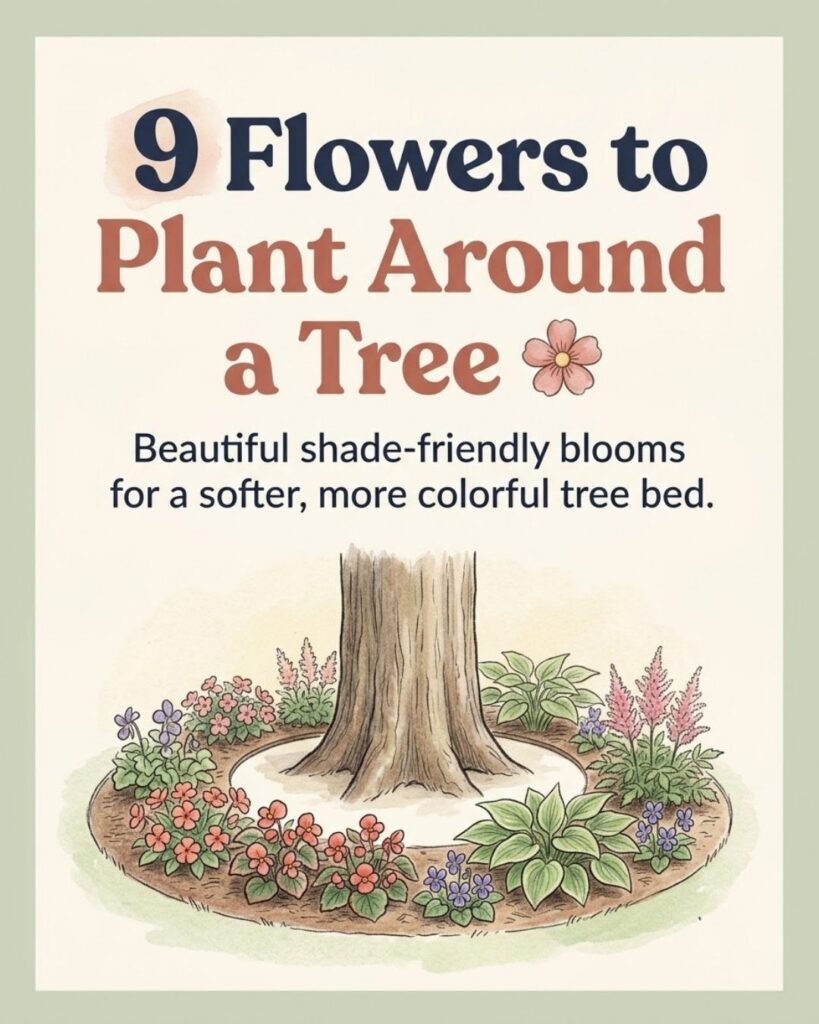
The ground beneath a mature tree often looks like an obvious place for flowers. There is already a natural focal point, the canopy creates a sheltered feeling, and a planted bed can soften the transition between the trunk and the rest of the yard.
Growing plants under trees, though, is different from filling an ordinary flower bed. Tree roots already occupy much of the available soil and compete for moisture and nutrients. The canopy may block both sunlight and rainfall, and digging too aggressively can damage important roots. University of Minnesota Extension notes that root competition can make gardening beneath trees challenging and that shade levels can range from light, dappled shade to much darker conditions.
The best approach is not simply to choose plants labeled “shade tolerant.” Look at how much light actually reaches the ground, how dry the soil becomes, and how much root competition exists. Then choose flowers and foliage plants suited to those conditions.
You Might Also Like:
- Loading posts...
Here are nine plants worth considering, along with a few important rules for planting around an established tree without creating problems for the tree itself.
Before Planting, Pay Attention to the Tree
The tree should remain the priority.
Avoid covering the base of the trunk with extra soil or building a deep raised bed directly over existing roots. Tree roots need access to oxygen, and changing the soil level around an established tree can cause stress.
Mulch should also stay away from the trunk. University of Minnesota Extension recommends spreading mulch in a broad layer rather than piling it into a “volcano” around the base. Keeping mulch away from the bark reduces the risk of excess moisture, decay, pests, and other trunk problems.
When planting small flowers, dig only where necessary and work around major roots rather than cutting through them. You may find that smaller transplants are easier to tuck into spaces between established roots than large nursery plants.
With those basics in mind, the following plants can create a beautiful understory garden.
1. Impatiens
Impatiens are one of the easiest ways to add strong color to a shady tree bed.
They are usually grown as annuals in climates where frost kills them, and their flowers can provide color through much of the growing season when conditions suit them.
Impatiens generally prefer shade or partial shade rather than intense afternoon sun, making them useful beneath trees with filtered light.
Their biggest challenge under mature trees is often moisture. A large tree can remove water from the surrounding soil quickly, while its canopy may prevent some rainfall from ever reaching the ground.
Check the soil rather than assuming shade means it stays moist. You may need to water impatiens more frequently beneath a thirsty tree.
Because they are relatively compact, impatiens can also fit into small pockets between roots without requiring major excavation.
2. Begonias
Begonias are another excellent choice when you want dependable color in partial shade.
Many commonly grown bedding begonias tolerate filtered light and can create a neat border around the outer part of a tree bed. Their compact growth habit works especially well when you want something more orderly than a spreading woodland groundcover.
Begonias are available with green, bronze, or dark foliage as well as flowers in several colors, so the leaves can contribute to the design even when flowering temporarily slows.
Avoid assuming that all begonias have identical requirements. There are many different types, and some tolerate more sun than others.
For planting beneath a tree, choose a variety suited to the actual amount of light in that location rather than buying solely based on flower color.
3. Hostas
Hostas are technically valued more for their foliage than their flowers, but they deserve a place on this list because they perform so well in many shaded gardens.
Their leaves can bring shades of green, blue-green, gold, cream, and variegated patterns into places where flowering plants may struggle.
Hostas also produce flower stalks, usually during summer, depending on the variety.
Despite their reputation as deep-shade plants, hostas generally perform better with at least some light. University of Missouri Extension notes that many hostas prefer morning sun followed by afternoon shade or dappled sunlight rather than extremely dense shade. It also notes that hostas can compete effectively with the roots of many tree species.
That makes them particularly useful beneath trees with a high, open canopy.
Hostas vary enormously in mature size, so check the variety before planting. A small hosta that looks lost when first planted may become a substantial clump after several growing seasons.
4. Astilbe
Astilbe brings a completely different texture beneath a tree.
Its feathery flower plumes rise above fern-like foliage, creating a soft woodland appearance that pairs particularly well with hostas and other broad-leaved plants.
Astilbe is best suited to shaded locations where the soil does not become extremely dry. Illinois Extension describes astilbe as useful for shady, moist sites.
That requirement is important because the ground under many mature trees is surprisingly dry.
If your tree has dense surface roots and pulls large amounts of moisture from the soil, astilbe may require regular supplemental watering. It may not be the easiest option beneath trees where maintaining consistent moisture is difficult.
In the right location, however, its upright flower plumes provide height without requiring a large footprint.
5. Columbine
Columbine can give a tree bed a softer, more natural cottage or woodland character.
Its distinctive flowers rise above attractive foliage, and many species and cultivars tolerate partial shade well.
Columbine works particularly well when you do not want the planting around a tree to look overly formal. Instead of arranging every plant in a perfect ring, you can place small groups around existing roots and allow the bed to develop a more relaxed appearance.
Conditions vary significantly among columbine species, so choose one appropriate for your climate and soil.
Native species can be especially useful when creating a woodland-style planting, provided they are native to your particular region.
As with the other plants on this list, avoid disturbing major tree roots just to achieve perfectly even spacing.
6. Coral Bells
Coral bells, or Heuchera, offer two layers of interest: colorful foliage near the ground and delicate flower stems that rise above the leaves.
Depending on the cultivar, foliage can range from green and lime to bronze, burgundy, purple, or nearly silver.
That makes coral bells particularly useful in shade gardens because you do not have to rely entirely on flowers for color.
A tree bed can look attractive for months simply through contrasting foliage.
Coral bells are among the plants recommended by Illinois Extension for certain difficult growing conditions, alongside other shade-garden favorites such as hostas and astilbe.
Give them well-drained soil and avoid burying the crown too deeply. As with all plants placed beneath established trees, monitor moisture during dry weather rather than assuming the canopy provides a cool, damp environment.
7. Violets
Violets are ideal if you want the planting beneath a tree to feel less like a formal flower bed and more like a woodland floor.
Their low-growing habit allows them to fill spaces between taller plants, and their small flowers add spring color without competing visually with the tree.
Some violet species can spread readily when conditions suit them. That can be useful if you want a natural groundcover, but it may be undesirable in a highly controlled garden.
Before planting, identify the species or cultivar and learn how aggressively it spreads in your region.
Native violets can also have ecological value in areas where they naturally occur, but “violet” describes a large group of plants rather than one single garden plant. Their exact soil, moisture, and light requirements vary.
Use them where their spreading habit is welcome rather than placing them somewhere you will constantly be trying to contain them.
8. Foamflower
Foamflower, commonly known as Tiarella, is especially well suited to a woodland-style garden.
Its airy flower spikes rise above attractive foliage and create a light, delicate effect beneath deciduous trees.
Foamflower generally prefers shade or filtered light and is often most comfortable in soil that does not dry out severely.
That makes site selection important.
A tree that casts gentle shade over relatively moist soil may provide good conditions. A large tree with an extremely dense root system and bone-dry soil may not.
Foamflower looks particularly natural when planted in small groups rather than arranged as a rigid circle around the trunk.
Pairing it with hostas, coral bells, ferns, or other woodland plants can create layers of foliage and flowers instead of one flat band of color.
9. Creeping Phlox
Creeping phlox needs a little more careful placement than most of the other plants on this list.
It is often suggested for planting around trees, but it is not truly a plant for dense shade. University of Missouri Extension describes creeping phlox as a groundcover for full sun and relatively dry soil.
That means the darkest area immediately beneath a heavy tree canopy is usually not its best location.
Instead, use creeping phlox near the outer edge of a tree bed where several hours of direct sunlight reach the ground.
In spring, established plants can form a low carpet of flowers. After flowering, their low foliage continues to define the edge of the bed.
This is a good example of why the area beneath a tree should not be treated as one uniform growing environment. The inner portion may be heavily shaded, while the outer edge receives considerably more sun.
Think in Zones Instead of Planting One Perfect Ring
One of the easiest ways to make a tree bed more successful is to stop thinking of it as a single circle with identical conditions everywhere.
The environment can change dramatically as you move away from the trunk.
Closer to the tree, you may have:
- heavier shade
- more exposed roots
- stronger competition for water
- less available planting space
Farther toward the edge of the canopy, there may be:
- brighter filtered light
- several hours of direct sunlight
- easier digging
- fewer large surface roots
This creates opportunities to layer plants according to their preferences.
Hostas, foamflower, coral bells, and similar shade plants can occupy darker areas, while brighter outer sections may support begonias, impatiens, or sun-loving creeping phlox.
University of Minnesota Extension recommends matching plants to the actual shade level and site conditions rather than treating all shade as the same.
Do Not Build a Mulch Volcano
Mulch is useful around both trees and flowers, but it needs to be applied correctly.
Organic mulch can help conserve soil moisture, moderate soil temperature, and suppress weeds.
The mistake is piling it against the trunk.
Instead, spread mulch relatively evenly through the planted area and leave clear space around the bark. University of Minnesota Extension generally recommends a layer of roughly 2 to 4 inches for garden mulching while maintaining separation from tree trunks and plant stems.
If old mulch is already present, check its existing depth before adding more. Mulch does not need another thick layer every year simply because spring has arrived.
Remember That Tree Shade Can Also Be Dry Shade
A shaded garden may feel cool, but that does not guarantee moist soil.
The tree itself is using water, and its roots may extend well beyond the area directly beneath the canopy. At the same time, leaves and branches can intercept some rainfall.
This combination creates what gardeners often call dry shade—one of the more challenging garden conditions.
Watch newly planted flowers carefully during their first growing season.
Water the soil deeply enough to reach the plant roots rather than sprinkling the surface briefly. At the same time, avoid constantly saturating an area just because a moisture-loving plant has been added. Both the flowers and the tree need suitable soil conditions.
If keeping moisture-loving flowers alive requires excessive irrigation, choosing plants better adapted to dry shade may be a smarter long-term solution.
Work With the Tree Instead of Fighting It
The prettiest planting around a mature tree is not necessarily the one containing the greatest number of flowers.
Start with the conditions that already exist.
Observe the area at several times during the day to see where sunlight actually falls. Check how quickly the soil dries after watering or rain. Notice where large roots make digging difficult. Then place plants into the spaces and conditions they naturally suit.
Hostas and coral bells can provide lasting foliage. Astilbe and foamflower can bring soft texture where moisture is sufficient. Impatiens and begonias offer seasonal color. Columbine and violets create a looser woodland feeling. Creeping phlox can brighten the sunnier outer edge.
Most importantly, leave the tree trunk exposed, avoid damaging major roots, and keep mulch pulled back from the bark.
A successful tree bed should look as though the flowers belong there—not as though the tree had to be buried, cut, or crowded to make room for them.