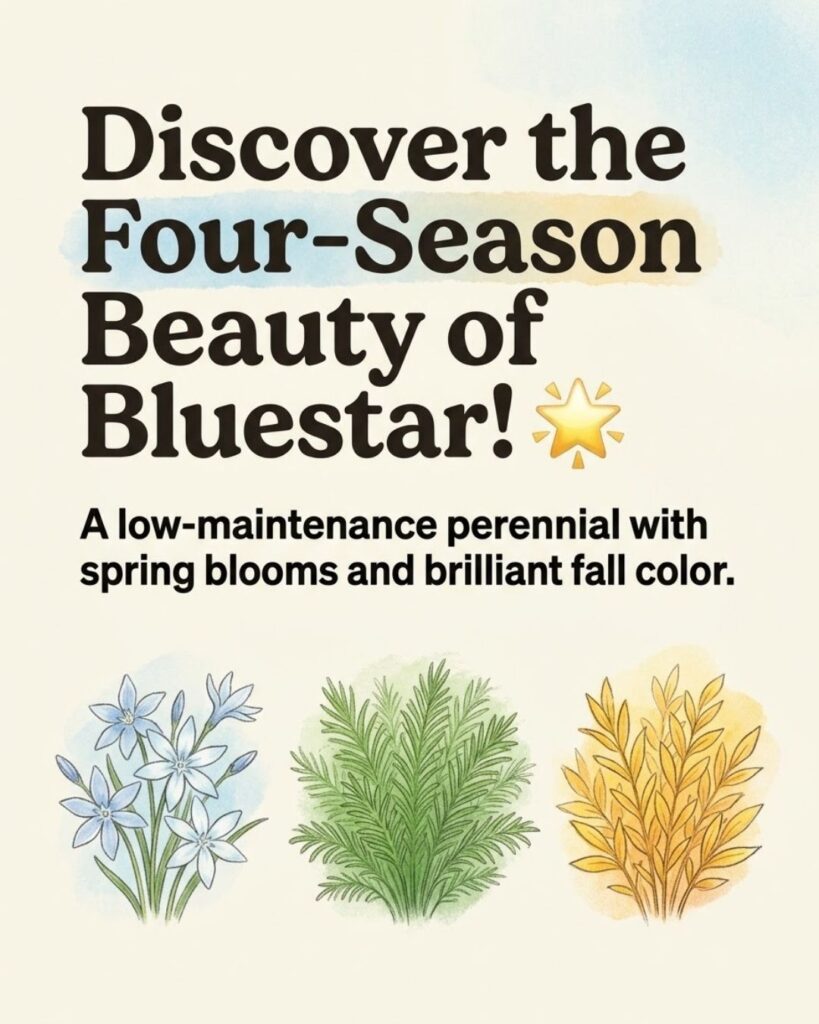
Some perennials earn their place in the garden with a spectacular flowering period and then fade quietly into the background. Bluestar, or Amsonia, offers something different. Its appeal changes as the growing season progresses: clusters of star-shaped flowers in spring, attractive foliage through summer, and yellow to golden foliage in autumn.
That combination makes bluestar particularly useful in perennial borders where gardeners want more than a few weeks of flowers. Depending on the species or cultivar, the foliage may be narrow and feathery or broader and willow-like, but it generally remains attractive long after flowering has finished. Chicago Botanic Garden describes Amsonia as a group valued for blue flowers in late spring or early summer, handsome foliage throughout the growing season, and yellow-to-gold autumn color.
It is also a relatively undemanding perennial once established, provided it is planted in an appropriate site. Here is what makes bluestar useful in the landscape and what to know before adding it to your garden.
You Might Also Like:
- Loading posts...
What Is Bluestar?
Bluestar is the common name given to plants in the genus Amsonia. They are herbaceous perennials, meaning the top growth dies back after the growing season and new stems emerge from the established crown the following year.
Different Amsonia species vary noticeably in height, leaf shape, flower color, and growth habit. Some remain relatively compact, while others form substantial clumps several feet across. The flowers are generally shades of blue and are grouped near the ends of the stems.
Two commonly encountered garden types are Amsonia tabernaemontana, often called eastern bluestar, and Amsonia hubrichtii, sometimes called Arkansas bluestar or threadleaf bluestar.
The second is especially prized for its very narrow foliage and bright autumn display.
That distinction matters because not every photograph labeled simply “bluestar” represents every Amsonia. Flower shade, mature size, foliage texture, and even hardiness can differ by species and cultivar.
Spring Brings the Flowers
Bluestar begins earning attention in late spring, when clusters of small star-shaped flowers appear at the ends of its stems.
True to the common name, the flowers are normally blue or blue-toned rather than pure white. Depending on the species, cultivar, lighting, and stage of bloom, they may appear pale blue, lavender-blue, or deeper blue.
For example, the compact cultivar ‘Blue Ice’ produces relatively dark blue flowers, while other bluestars carry much paler blossoms. NC State describes ‘Blue Ice’ as flowering from late spring into early summer with clusters of star-shaped blue flowers.
The individual blossoms are modest rather than oversized, but a mature clump can carry enough flower clusters to create a soft haze of color.
This makes bluestar useful beside plants with larger or more strongly colored flowers. Instead of competing visually, it can provide a lighter transitional layer in the border.
Summer Is About Foliage and Form
Once flowering ends, bluestar does not become useless.
Its foliage becomes the main attraction.
The exact appearance depends on the plant. Amsonia hubrichtii has especially narrow leaves that create a soft, almost grasslike texture. Other species have broader leaves that can resemble those of willow.
Chicago Botanic Garden notes that foliage across the genus ranges from threadlike to willow-like while remaining attractive during the growing season.
Mature plants usually develop into rounded or vase-shaped clumps rather than spreading aggressively across the bed.
This form makes them useful among flowering perennials that can become visually untidy after blooming. A substantial mass of green foliage provides structure and gives neighboring plants a clean background.
Bluestar can work well in:
- perennial borders
- cottage-style gardens
- pollinator-oriented plantings
- naturalistic gardens
- woodland edges with sufficient light
- mixed beds with ornamental grasses
It is particularly effective when several plants are grouped together, although a mature specimen can also serve as an individual accent.
Fall May Be Bluestar’s Best Season
Spring flowers may introduce the plant, but autumn foliage is one of bluestar’s strongest features.
As the growing season winds down, green foliage can shift into shades of yellow and gold. Amsonia hubrichtii is particularly famous for this transformation. Missouri Botanical Garden highlights its light golden-yellow autumn color, while Chicago Botanic Garden describes good to outstanding yellow-to-gold fall foliage within the genus.
A large established clump can create a considerable patch of warm color at a time when many flowering perennials have already finished.
Full sun generally encourages stronger flowering, sturdier growth, and good fall coloration. For the cultivar ‘Blue Ice,’ Missouri Botanical Garden specifically notes that the best fall foliage color is usually produced in full sun.
This does not mean every plant will produce identical autumn color every year. Light levels, weather, species, cultivar, and growing conditions can all influence the display.
How Much Sun Does Bluestar Need?
Most commonly grown bluestars perform well in full sun to partial shade.
NC State recommends full sun to part shade for Amsonia hubrichtii, while eastern bluestar can also grow under similar conditions.
More sun generally produces a denser, sturdier plant.
Too much shade can cause some types to stretch, open up, or flop. This is particularly worth considering if you want the naturally rounded form that makes bluestar attractive in a border.
In very hot climates, some afternoon shade may be useful. Missouri Botanical Garden notes that while full sun can improve the autumn color of ‘Blue Ice,’ its flowers may last longer with some afternoon shade in areas where the sun is particularly intense.
So the best location is not necessarily the brightest spot available. Climate matters.
Soil Requirements Are Fairly Flexible
Bluestar is often described as adaptable, but “adaptable” should not be confused with indestructible.
A good starting point is moderately moist, well-drained soil.
Amsonia hubrichtii can grow in clay, loam, or sandy soil according to NC State, provided drainage and other conditions are suitable.
Willow-leaf bluestar is similarly adaptable to clay and sandy soils, although it prefers moist, well-drained loam.
That adaptability is useful for gardeners who do not have perfectly rich garden soil.
Poor drainage is a different issue. A plant that tolerates clay does not automatically tolerate constantly waterlogged roots. If your site remains saturated for long periods, improving drainage or choosing a more suitable planting location may be necessary.
Is Bluestar Drought Tolerant?
Established bluestar can tolerate some dry periods, but newly planted specimens still need dependable moisture while their root systems develop.
NC State lists Amsonia tabernaemontana as drought tolerant once established, and mature ‘Blue Ice’ plants are also described as fairly drought tolerant.
That “once established” qualification is important.
A newly installed perennial should not be planted and forgotten during hot, dry weather. Water deeply enough to encourage roots to move outward into the surrounding soil, then gradually reduce supplemental watering as the plant becomes established and local conditions allow.
Mulch can help moderate soil moisture and temperature, but avoid piling it directly against the crown.
Deer and Rabbits Usually Leave It Alone
Bluestar has another advantage for gardens regularly visited by browsing animals.
The stems contain a milky latex-like sap that makes the plant less appealing to many herbivores. NC State describes eastern bluestar as resistant to deer and other browsing animals for this reason, and ‘Blue Ice’ is similarly described as resistant to damage from deer and rabbits.
“Resistant,” however, does not mean completely animal-proof.
Hungry wildlife can behave unpredictably, particularly where food is scarce. It is more accurate to think of bluestar as a plant that deer and rabbits generally find less desirable than many alternatives.
The milky sap is also a reason to handle cut stems thoughtfully. Gloves are sensible when pruning, particularly for anyone with sensitive skin.
How to Plant Bluestar Successfully
Bluestar is straightforward to establish if you give it enough room and avoid burying it too deeply.
A simple planting process works well:
- Choose a location with full sun or partial shade and well-drained soil.
- Check the expected mature width of the specific species or cultivar you bought.
- Dig a hole roughly as deep as the root ball and wider than the root mass.
- Set the plant so its crown sits at approximately the same level it occupied in the container.
- Backfill with the existing soil, firming it gently rather than packing it hard.
- Water thoroughly after planting.
- Keep the soil reasonably moist while roots establish.
- Add a modest layer of mulch around the root zone without covering the crown.
Avoid planting several specimens extremely close together simply because young plants look small.
Some bluestars eventually reach two or three feet in both height and width. Giving them adequate space from the beginning produces a better-looking mature planting and improves airflow.
Does Bluestar Need Pruning?
Bluestar does not require elaborate pruning.
If the plant becomes loose or floppy after flowering, some species can be cut back to encourage a more compact form. NC State notes that eastern bluestar may benefit from cutting stems back after flowering to create a rounder appearance, particularly when plants have become lanky.
Pruning is optional rather than mandatory.
If you enjoy the natural shape, you can leave the plant largely alone.
Later in the year, the golden foliage can remain in place through autumn. Once the plant goes dormant and the stems are no longer contributing to the garden, they can be cut back either in late fall or before new growth begins in spring, depending on your preferred garden-maintenance style.
Give Bluestar Time to Mature
One mistake gardeners sometimes make with long-lived perennials is judging them too quickly.
Bluestar may take time to develop into the substantial rounded clump shown in mature garden photographs. Missouri Botanical Garden specifically advises patience while Amsonia hubrichtii becomes established.
That slow development can actually become an advantage.
Once established, the plant can remain in place for years without requiring the constant dividing, replacing, or rearranging associated with some shorter-lived perennials.
Plan for its mature size rather than filling every temporary gap around a young plant.
Good Companion Plants for Bluestar
Bluestar’s combination of blue spring flowers, green summer foliage, and yellow autumn color makes it easy to pair with other perennials.
For spring, plants with pink, purple, white, or yellow flowers can create attractive contrasts with the blue blossoms.
During summer, bluestar’s foliage works as a background for stronger bloomers such as coneflowers, bee balm, black-eyed Susans, and other sun-loving perennials suited to the same conditions.
In autumn, its yellow foliage pairs particularly well with grasses and plants that develop burgundy, red, purple, or copper tones.
The important consideration is not simply color. Choose companions that prefer similar amounts of sunlight, moisture, and drainage.
Is Bluestar Really a Four-Season Plant?
Bluestar is often marketed as having four-season interest, but that description deserves a little nuance.
Its strongest ornamental seasons are spring through fall.
Spring brings flowers. Summer provides handsome foliage. Autumn delivers the characteristic yellow or golden transformation.
Winter interest depends much more on how the plant is managed and on the garden setting. Dormant stems may remain visible if left standing, but bluestar is an herbaceous perennial rather than an evergreen shrub. Its living top growth eventually dies back for winter.
So it is more accurate to describe bluestar as an excellent multi-season perennial rather than promising substantial color during all four seasons.
Why Bluestar Deserves More Attention
Bluestar succeeds because it does several jobs without demanding center stage all season.
The spring flowers are delicate rather than overpowering. Summer foliage provides dependable structure. Then the same plant that quietly supported the border for months can become a mass of glowing yellow in autumn.
Add reasonable drought tolerance after establishment, adaptability to several soil types, relatively low appeal to deer and rabbits, and a long-lived perennial habit, and it becomes easy to understand why gardeners value Amsonia.
The best results come from choosing the right type for your garden rather than treating every bluestar as identical. Check mature dimensions, hardiness, foliage type, and light requirements before buying. Give it enough room, provide regular moisture while it establishes, and place it where its autumn color can be appreciated.
Bluestar does not rely on one spectacular week to justify its space. Its real strength is the way it keeps changing—and keeps contributing—from the first flush of spring growth until the garden turns gold in fall.