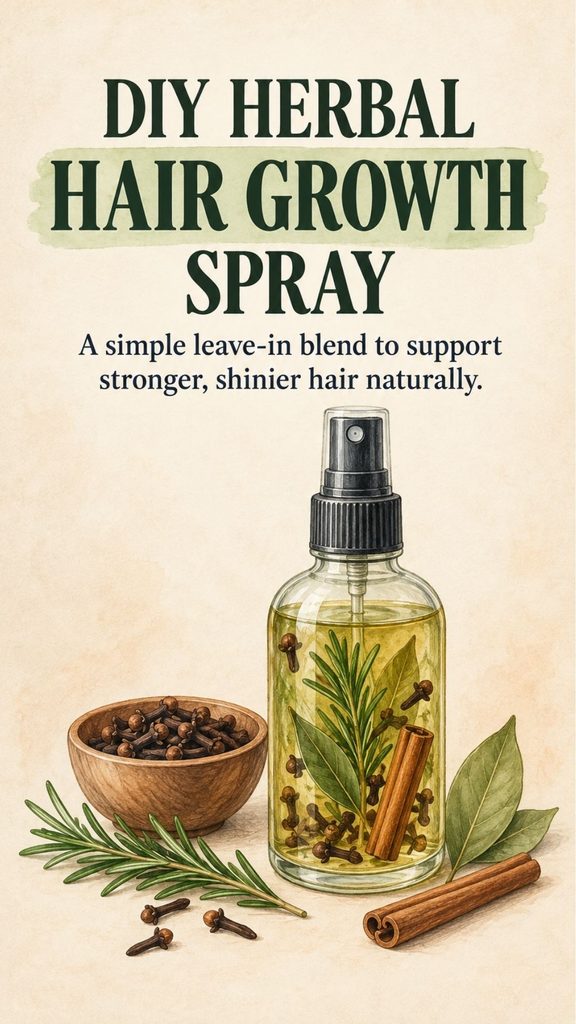
Homemade herbal hair sprays are everywhere online, and one combination appears again and again: rosemary, cloves, cinnamon, bay leaves, and water. The usual promise is dramatic—faster hair growth, less shedding, a healthier scalp, more shine, and even the end of dandruff.
The ingredients certainly smell fresh and make an appealing botanical rinse, but claims that a homemade spray will make hair “grow nonstop” go far beyond what the evidence supports.
A better way to use this type of recipe is as an occasional herbal scalp and hair rinse while understanding its limitations. Some of the ingredients contain aromatic plant compounds that are being studied for skin and hair applications, but a homemade tea is not the same thing as a clinically tested hair-loss treatment.
You Might Also Like:
- Loading posts...
Here is how to make the mixture more sensibly, how to use it, and what to watch for.
The Basic Herbal Hair Spray
A commonly shared version uses:
- 10 whole cloves
- 3 bay leaves
- 1 cinnamon stick
- 2 fresh rosemary sprigs
- 250 ml water
You will also need:
- A small saucepan
- Fine strainer
- Clean glass or heat-safe container
- Clean spray bottle
Because this mixture contains fresh plant material and water but no preservative, make small batches rather than preparing a large bottle that sits around for weeks.
How to Make It
Pour the water into a small saucepan and add the rosemary, cloves, cinnamon stick, and bay leaves.
Bring the water just to a gentle boil, then lower the heat and allow the herbs to simmer briefly.
Remove the pan from the heat, cover it, and allow the infusion to cool completely.
Strain carefully so no small pieces remain.
Transfer the cooled liquid to a thoroughly clean spray bottle.
Refrigerate the mixture between uses and discard it if the smell, appearance, or texture changes. Homemade water-based preparations can support microbial growth because they do not contain the preservatives used in commercial hair products.
Making small quantities is the safest and least wasteful approach.
Why Rosemary Is the Most Interesting Ingredient
Of all the ingredients in this mixture, rosemary has attracted the most attention in hair-care research.
That does not mean rosemary sprigs boiled in water are a proven hair-growth treatment.
Some limited research has looked at rosemary oil in relation to certain types of hair loss. Rosemary essential oil, however, is a concentrated product and is very different from an herbal water infusion.
A rosemary rinse may leave hair smelling pleasant and can be incorporated into a scalp-care routine, but it should not be presented as a guaranteed treatment for thinning hair.
Hair growth depends on many factors, including genetics, hormones, nutrition, age, scalp health, medications, stress, and underlying medical conditions.
No kitchen rinse can override all of those influences.
What About Cloves?
Cloves contain aromatic compounds, particularly eugenol.
That is one reason cloves have such a powerful smell.
While these compounds have attracted interest for antimicrobial and other biological properties, that does not prove that clove water makes human hair grow faster.
There is also an important downside.
Concentrated clove preparations can irritate sensitive skin. Even a homemade infusion may cause burning, redness, itching, or dryness in some people.
More cloves are not necessarily better.
If your scalp is already inflamed, scratched, or very sensitive, this is not the time to experiment with a strongly scented herbal treatment.
Cinnamon Needs Extra Caution
Cinnamon is another ingredient frequently added to DIY scalp treatments because it creates a warming sensation.
That sensation is sometimes described online as proof that circulation is increasing and hair growth is being stimulated.
That conclusion is far too simple.
A warm or tingling sensation can also mean irritation.
Cinnamon contains naturally occurring aromatic compounds capable of causing contact dermatitis in susceptible people. A strong cinnamon preparation should therefore not be left on an irritated scalp simply because tingling is interpreted as the treatment “working.”
If it burns, wash it off.
Pain and irritation are not signs that a hair treatment is becoming more effective.
What Bay Leaves Add
Bay leaves contain aromatic plant compounds and are widely used in cooking, but evidence supporting bay-leaf water as a treatment for hair loss is limited.
Adding a few leaves to an herbal rinse may contribute fragrance and plant compounds, but claims that bay leaves prevent baldness, permanently eliminate dandruff, or trigger dramatic hair growth should be treated skeptically.
They are better viewed as an optional botanical ingredient rather than the secret to the recipe.
Can This Spray Make Hair Grow Faster?
There is no good reason to expect this homemade mixture to make hair grow “nonstop.”
Normal scalp hair grows through repeating biological cycles. Each follicle goes through periods of active growth, transition, rest, and shedding.
A topical homemade infusion does not simply switch every follicle permanently into growth mode.
What an herbal spray may do is make the scalp and hair feel refreshed, add fragrance, and become part of a gentle grooming routine if your skin tolerates it.
That is very different from treating medical hair loss.
Can It Stop Hair Loss?
Occasional shedding is normal.
Noticeably increasing hair loss, widening of the part, bald patches, receding areas, or substantial thinning deserves more attention because the cause matters.
Hair loss can be associated with factors such as:
- Hereditary pattern hair loss
- Recent illness
- Significant stress
- Hormonal changes
- Certain medications
- Nutritional deficiencies
- Tight hairstyles
- Scalp disorders
- Autoimmune conditions
A rosemary-and-spice spray cannot reliably distinguish between these problems or treat all of them.
If shedding is sudden, severe, patchy, or persistent, identifying the cause is much more useful than continuously adding stronger homemade ingredients to the scalp.
Will It Eliminate Dandruff?
Dandruff is another condition that homemade hair posts often oversimplify.
Flaking can have several causes, and true dandruff or seborrheic dermatitis often responds better to shampoos containing established anti-dandruff ingredients.
An herbal rinse may make the scalp feel fresh, but it should not be described as a guaranteed dandruff cure.
In fact, cinnamon or cloves could make itching and redness worse if your scalp reacts to them.
Persistent flaking, thick scaling, soreness, or significant redness may need a different approach.
A Safer Way to Try the Herbal Spray
If you still want to experiment with the mixture, start conservatively.
First, test a small amount on a limited area of skin rather than spraying the entire scalp immediately.
Wait and watch for:
- Redness
- Burning
- Persistent itching
- Swelling
- Rash
- Excessive dryness
If any of these occur, stop using it.
For the first scalp application, use a small amount rather than soaking the hair.
Massage gently with your fingertips. Avoid aggressive scratching, which can irritate the scalp regardless of what product you are using.
You do not need to drench your hair.
Should You Leave It In Without Rinsing?
Many versions of the recipe instruct users to spray it on and never rinse it out.
That is not necessary.
Because cloves and cinnamon can irritate some people, leaving a strong homemade infusion on the scalp for many hours may not be the best starting point.
A more cautious approach is to apply it for a short period and then rinse your hair if your scalp is sensitive.
If you eventually choose to use a small amount as a leave-in treatment and experience no irritation, avoid assuming that leaving it on longer will produce faster growth.
Longer exposure is not automatically better.
How Often Should You Use It?
Start no more than once or twice a week.
That gives you enough time to see how your scalp responds.
If you notice dryness, itching, tightness, or increasing flaking, stop.
People with sensitive skin, eczema, psoriasis, or an already irritated scalp should be particularly cautious with strongly aromatic homemade preparations.
Keep the Scalp Healthy First
Hair grows from follicles within the scalp, but healthy hair care does not require applying dozens of ingredients to those follicles.
Simple habits matter:
- Wash the scalp often enough to control oil and buildup.
- Avoid scratching aggressively.
- Limit hairstyles that constantly pull on the roots.
- Reduce unnecessary heat and chemical damage.
- Condition hair lengths when needed.
- Eat an adequately balanced diet.
- Address persistent scalp problems rather than covering them with fragranced products.
Hair also breaks.
Sometimes what looks like poor growth is actually hair growing normally at the roots but breaking along the lengths. Gentle handling and good conditioning can therefore make hair appear fuller and allow it to retain more length.
Do Not Make the Recipe Stronger
DIY treatments often gradually become more concentrated because people assume more ingredients will give faster results.
Avoid that approach.
Do not keep adding extra cinnamon, crushed cloves, essential oils, acids, or other irritating ingredients.
Plant-based does not automatically mean gentle.
A substance can be completely natural and still cause a significant skin reaction.
Fresh Herbal Water Needs Proper Storage
This detail is often missing from social-media recipes.
Once herbs have been boiled or steeped in water, the finished liquid does not become permanently preserved.
A spray bottle repeatedly opened, handled, and stored at room temperature can eventually become contaminated.
Prepare a small batch, refrigerate it, keep the bottle clean, and replace it frequently rather than topping up an old batch with new liquid.
Discard the mixture immediately if you notice cloudiness, an unusual odor, visible growth, or other changes.
A Simple Version May Be Better
You also do not need four different botanicals.
If your main interest is rosemary, a simple rosemary-water rinse removes some of the additional irritation potential associated with cinnamon and cloves.
Boil or steep a few clean rosemary sprigs in water, allow the infusion to cool, strain it thoroughly, and use a small fresh batch.
Even then, treat it as a cosmetic herbal rinse rather than a medical hair-growth treatment.
The Realistic Takeaway
Rosemary, cloves, cinnamon, and bay leaves can be combined into a fragrant homemade hair rinse, but the impressive claims commonly attached to the recipe need to be separated from what is actually known.
It is not proven to make hair grow nonstop.
It cannot guarantee that shedding will stop.
It should not be relied upon to cure dandruff.
And cinnamon and cloves can irritate some scalps rather than improve them.
If you enjoy herbal hair care, make a small fresh batch, use it conservatively, test your skin first, and stop at the first sign of irritation.
Healthy hair usually comes from consistent scalp care, gentle handling, adequate nutrition, and addressing the actual cause when unusual hair loss occurs—not from making a homemade treatment stronger and stronger.