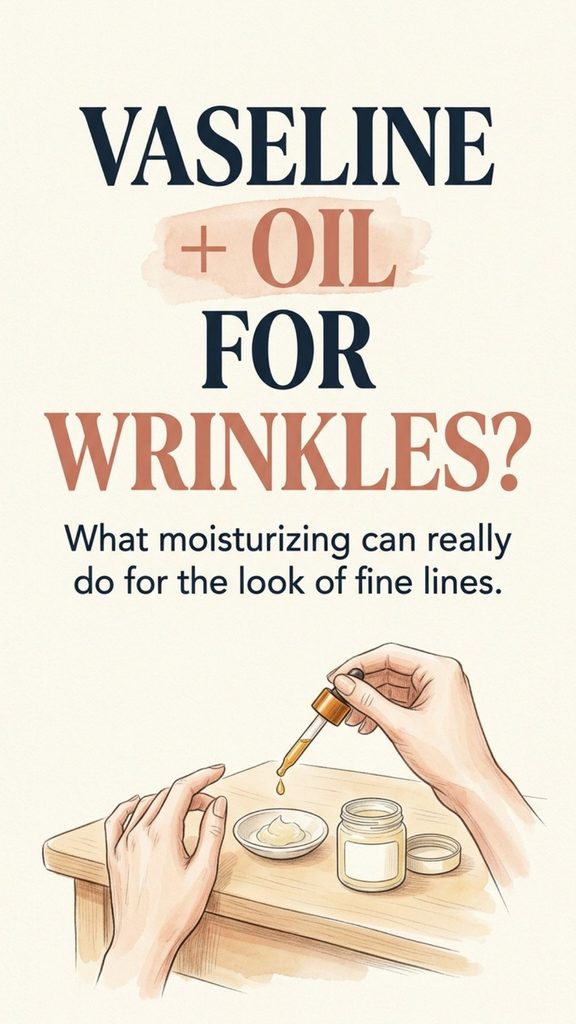
A small jar of Vaseline and a few drops of facial oil might seem like an unlikely combination for an anti-aging skin-care treatment. Yet this inexpensive beauty idea has gained attention through claims that applying the mixture regularly can dramatically reduce wrinkles and make mature skin look years younger.
Some versions of the tip even suggest that women in their 50s can achieve the appearance of someone much younger simply by combining petroleum jelly with a particular oil.
The reality is more interesting—and more useful—than those dramatic promises.
You Might Also Like:
- Loading posts...
Vaseline can be an effective way to protect dry skin and improve its appearance. Certain facial oils can also help soften the skin and support moisture retention. However, neither ingredient has been shown to erase wrinkles or reverse the biological aging process.
Understanding what these products actually do can help you decide whether they deserve a place in your skin-care routine.
Why Vaseline Can Make Wrinkles Look Less Noticeable
Vaseline is a familiar brand of petroleum jelly, a thick, semi-solid substance commonly used to protect dry or irritated skin.
Its main benefit comes from its ability to reduce moisture loss.
The outer layer of the skin acts as a protective barrier, helping retain water while limiting exposure to environmental irritants.
As skin becomes drier, fine lines can appear more noticeable. The surface may also look rough, dull, or less supple.
Petroleum jelly forms a protective layer that helps prevent water from escaping.
This property makes it an occlusive moisturizer.
When properly used on suitable skin, it can help maintain hydration, soften rough patches, and temporarily improve the appearance of fine lines associated with dryness.
That improvement can be visually noticeable, particularly for someone whose skin has been lacking moisture.
However, the distinction is important: making fine lines less noticeable is not the same as removing permanent wrinkles.
Petroleum jelly does not rebuild lost facial volume, eliminate deep creases, or restore the skin to a younger biological age.
What Happens When You Mix Vaseline With Facial Oil?
Facial oils vary considerably in their ingredients and effects.
Some are designed primarily to soften the skin and reduce moisture loss. Others contain fragrances, concentrated botanical extracts, or active ingredients that may irritate sensitive skin.
Adding a suitable facial oil to a moisturizing routine may help some people manage dryness.
But there is no established rule that mixing exactly three drops of oil with Vaseline creates a superior anti-aging treatment.
The number of drops alone tells us very little.
The identity of the oil, its concentration, the product’s formulation, and the person’s skin type all matter.
Why the Type of Oil Matters
A fragrance-free facial oil formulated for cosmetic use is very different from a concentrated essential oil.
Essential oils can cause irritation or allergic reactions, especially when applied to delicate facial skin.
Diluting an unknown essential oil into petroleum jelly does not automatically make the mixture safe.
Similarly, products containing strong active ingredients should not be mixed casually with other substances. Doing so may change how evenly the active ingredients are applied and make it harder to follow the manufacturer’s directions.
If a beauty tip mentions an unnamed oil, there is not enough information to judge whether the mixture is safe or effective.
The best approach is to identify the exact product and review its ingredients before considering facial use.
Can Vaseline and Oil Actually Reverse Skin Aging?
Skin aging involves several processes.
Over time, the skin undergoes changes in collagen and elastin, the proteins that contribute to its structure and elasticity.
Sun exposure can accelerate visible skin aging, while genetics, environmental conditions, and personal habits also influence how the skin changes.
In middle age, hormonal changes can contribute to increased dryness and alterations in skin texture.
Moisturizing products can improve the appearance and comfort of the skin, but they cannot reverse all these processes.
A person who looks younger than their chronological age may have inherited favorable skin characteristics, practiced consistent sun protection, or benefited from other factors.
Photographs can also be affected by lighting, makeup, camera settings, and facial expression.
Someone appearing unusually youthful at 53 does not establish that a particular homemade cream caused the difference.
Personal experiences can be interesting, but they should not be treated as proof of an anti-aging treatment’s effectiveness.
The Benefits Petroleum Jelly Can Genuinely Provide
Although petroleum jelly is not a wrinkle eraser, it does offer several practical skin-care benefits.
1. Helps Reduce Moisture Loss
Petroleum jelly is particularly useful for protecting dry areas.
Applied over slightly damp skin or an appropriate moisturizer, it helps reduce the loss of water from the skin’s surface.
This can be helpful when the skin feels tight or uncomfortable.
2. Softens Rough, Dry Patches
Dry areas around the face, lips, and other parts of the body may benefit from a small amount of petroleum jelly.
Its protective properties can help soften rough skin when dryness is the underlying problem.
3. Supports the Skin’s Protective Barrier
A healthy skin barrier helps maintain moisture and limits irritation from everyday environmental exposure.
Petroleum jelly can provide a protective coating while dry skin recovers.
However, persistent redness, cracking, unusual irritation, or recurring rashes may require a dermatologist’s assessment.
4. Temporarily Improves the Look of Dry Fine Lines
Well-moisturized skin often appears smoother than dehydrated skin.
This can make superficial lines less prominent.
The effect is cosmetic and does not mean that deeper wrinkles have disappeared.
5. Offers Affordable Moisture Protection
Petroleum jelly is generally inexpensive, and a small amount can cover a considerable area.
For people with suitable skin types, it may provide a budget-friendly addition to a moisturizing routine.
How to Use Vaseline on Your Face Safely
If your skin is dry and generally tolerates petroleum jelly, you may not need to mix it with anything.
Using a small amount of plain petroleum jelly is a simpler approach than experimenting with an unidentified oil.
Step 1: Wash Your Face Gently
Cleanse your face with a mild facial cleanser and lukewarm water.
Avoid harsh scrubbing, particularly if your skin is already dry or sensitive.
Pat your face gently with a clean towel, leaving the skin slightly damp.
Step 2: Apply Your Usual Moisturizer
Use a fragrance-free facial moisturizer suitable for your skin type.
Ingredients such as glycerin and hyaluronic acid can help attract or retain moisture, while ceramides can support the skin barrier.
A suitable moisturizer may provide enough hydration on its own.
Step 3: Apply a Very Thin Layer of Petroleum Jelly
If you still have areas of pronounced dryness, apply a small amount of plain petroleum jelly over those spots.
A thin coating is generally sufficient.
There is no need to cover your entire face with a heavy layer.
Step 4: Pay Attention to Your Skin’s Response
If you notice irritation, worsening breakouts, or discomfort, stop using the product.
People with acne-prone skin should be especially cautious. The American Academy of Dermatology advises avoiding petroleum jelly on the face if you are prone to acne because it may cause breakouts in some individuals.
Step 5: Keep the Routine Simple
Adding more products does not necessarily improve results.
A gentle cleanser, appropriate moisturizer, and consistent sun protection provide a useful foundation for most skin-care routines.
Should You Apply Vaseline Every Night?
Nighttime application may be convenient because petroleum jelly has a thick texture that some people find uncomfortable during the day.
However, daily facial use is not necessary for everyone.
Someone with very dry skin may appreciate additional moisture protection, while someone with oily or acne-prone skin may prefer a lightweight, non-comedogenic moisturizer.
If your usual moisturizer already keeps your skin comfortable, adding petroleum jelly may provide little additional benefit.
The right frequency depends on your skin’s needs and how well it tolerates the product.
There is no evidence that applying increasingly thick layers will deliver stronger anti-aging effects.
Better Ways to Reduce the Appearance of Wrinkles
If your primary goal is to prevent premature skin aging or improve existing fine lines, some approaches have stronger scientific support than homemade oil mixtures.
1. Use Sunscreen Consistently
Sun exposure is a major contributor to premature skin aging.
Ultraviolet radiation can damage the skin and contribute to wrinkles, uneven pigmentation, and changes in texture.
Choose a broad-spectrum sunscreen with SPF 30 or higher.
Apply it to exposed skin and reapply as directed, particularly when spending extended periods outdoors.
Sun protection also helps reduce the risk of skin cancer.
For long-term skin care, this habit is more important than any homemade wrinkle cream.
2. Moisturize According to Your Skin Type
Dry skin often benefits from a richer cream containing ingredients that support hydration and the skin barrier.
People with oily or acne-prone skin may prefer lighter products labeled non-comedogenic.
Using a moisturizer consistently can help maintain a smoother, more comfortable complexion.
You do not necessarily need an expensive cream to obtain these benefits.
3. Consider Retinoids for Fine Lines
Retinoids are vitamin A derivatives used in skin care.
Certain retinoid products have evidence supporting their ability to improve the appearance of fine lines, uneven pigmentation, and some signs of sun damage.
However, they can cause dryness, peeling, and irritation, particularly when introduced too quickly.
People considering retinoids should choose a suitable formulation and follow usage instructions carefully.
Retinoids should be avoided during pregnancy, and anyone who is pregnant, planning pregnancy, or breastfeeding should discuss treatment options with a healthcare professional.
4. Avoid Harsh Skin-Care Habits
Repeatedly scrubbing the face, using irritating products, and washing with very hot water can aggravate dryness and sensitivity.
A gentle routine is usually easier to maintain and less likely to disrupt the skin barrier.
5. Protect Your Overall Health
Smoking can contribute to premature skin aging.
Adequate sleep, balanced nutrition, and other healthy habits support general health, including the health of the skin.
These habits do not eliminate wrinkles, but they are sensible parts of long-term personal care.
Why Mature Skin Often Needs More Moisture
Many people notice that their skin becomes drier during their 40s and 50s.
Changes in the skin’s natural oil production, hormonal influences, and age-related changes in the skin barrier can contribute to this experience.
Dryness may make fine lines more noticeable and leave the skin feeling less comfortable.
For this reason, a skin-care routine that worked well at 25 may no longer be ideal at 50.
A richer moisturizer may become more useful, particularly during cold weather or in dry indoor environments.
Some people also benefit from reducing their use of harsh cleansers or strongly fragranced products.
The objective should be to maintain healthy, comfortable skin rather than expecting it to look identical to skin decades younger.
Common Mistakes With Homemade Anti-Aging Mixtures
Before trying a homemade facial treatment, consider these frequent mistakes.
Using an unidentified oil: Not every oil is appropriate for facial application, and concentrated essential oils can be irritating.
Applying too much petroleum jelly: A thick layer is not necessarily more effective than a thin one.
Expecting permanent wrinkle removal: Moisturization can temporarily improve the appearance of fine lines, but it does not erase deep wrinkles.
Ignoring breakouts: A product that works well for one person’s dry skin may be unsuitable for someone prone to acne.
Skipping sunscreen: No moisturizing mixture can replace protection from ultraviolet radiation.
Combining too many ingredients: Complicated homemade mixtures make it harder to identify which ingredient is responsible if irritation develops.
Assuming natural means safe: Botanical ingredients can cause allergic reactions just as other cosmetic ingredients can.
For any new skin-care product, testing a small area before widespread use is a sensible precaution.
Is Expensive Anti-Aging Cream Really Necessary?
Price alone does not determine whether a skin-care product is effective.
A relatively inexpensive moisturizer may provide excellent hydration, while a costly cream may contain ingredients that offer little additional benefit for your particular concerns.
Instead of focusing on dramatic marketing promises, look at what a product is designed to accomplish.
For dryness, consider moisturizers with well-established hydrating ingredients.
For prevention of premature sun-related aging, prioritize sunscreen.
For persistent concerns about wrinkles, pigmentation, or skin texture, a dermatologist can explain which treatments have evidence supporting their use.
Petroleum jelly can be a useful and affordable product, but its benefits are primarily related to moisture protection.
The Truth About the Vaseline Wrinkle Trick
Combining Vaseline with a few drops of oil may produce a rich moisturizing mixture, but the result depends heavily on the oil being used and the individual’s skin.
There is no reliable evidence that this particular combination can erase wrinkles, restore lost collagen, or make a person in their 50s biologically resemble someone in their 30s.
What petroleum jelly can do is help protect dry skin from moisture loss. For people whose fine lines appear more noticeable because of dryness, improved hydration may make the skin look smoother and softer.
That is a useful benefit without the need for exaggerated promises.
If you’re interested in trying petroleum jelly, begin with a small amount of the plain product on suitable dry areas rather than mixing it with an unknown ingredient.
Combine good moisturizing habits with daily sunscreen and a gentle routine suited to your skin type.
Healthy aging does not require pretending that wrinkles should disappear. Comfortable, well-cared-for skin is a worthwhile goal at every age.