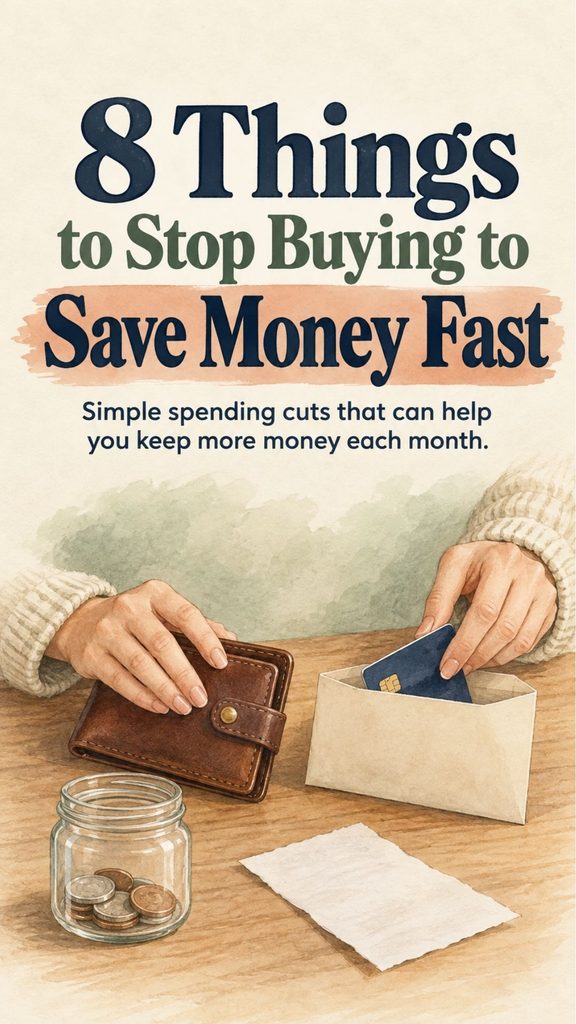
Saving money often feels complicated because personal finance advice can make it sound as though you need an elaborate spreadsheet, a perfect budget, several investment accounts, and enough discipline to track every penny.
But sometimes the fastest improvement comes from something much simpler:
stop repeatedly paying for things that are not helping you.
You Might Also Like:
- Loading posts...
The source article focuses on several common money drains, including consumer debt, restaurant spending, unused subscriptions, disposable products, unnecessary “stuff,” multiple streaming services, convenience foods, and shopping in search of happiness.
Those are useful places to investigate, but not every household will save the same amount in every category.
The goal is not to stop buying everything enjoyable.
It is to identify purchases that consume money without providing enough value in return.
Here are some of the best places to start.
1. Stop Paying Interest on Consumer Debt Whenever You Can
Debt itself is not something you purchase from a store, but interest is a real cost.
If you carry a credit-card balance from month to month, part of every payment goes toward the privilege of having borrowed the money rather than toward something new you can use.
That makes high-interest consumer debt one of the most important expenses to address.
Start by listing:
your balances,
interest rates,
minimum payments,
and due dates.
Then make every required minimum payment while directing additional money toward debt according to the strategy you choose.
Two common approaches are:
Debt avalanche: pay extra toward the highest-interest debt first.
Debt snowball: pay extra toward the smallest balance first for quicker psychological wins.
Mathematically, the avalanche method usually minimizes interest.
Behaviorally, some people find the snowball method easier to stick with.
The best method is one you will actually continue using.
Don’t automatically cut up every credit card
The source suggests cutting up credit cards as one possible way to stop accumulating debt.
That may help someone who repeatedly overspends with credit.
But it is not universally necessary.
Some people use credit cards responsibly, pay the balance in full each month, and benefit from fraud protection or rewards.
The important rule is simpler:
Do not use credit to purchase things you cannot realistically repay according to your plan.
If a card makes overspending too easy, remove it from shopping apps, put it somewhere inconvenient, or stop carrying it.
2. Stop Automatically Eating Out Because You Didn’t Plan Dinner
Restaurants are not inherently a waste of money.
Going out with friends, celebrating something important, or deliberately enjoying a favorite restaurant can be worthwhile.
The problem is unplanned restaurant spending.
It is the Tuesday evening when nobody knows what to cook.
The coffee purchased simply because you left home without breakfast.
The delivery order placed because the refrigerator contains ingredients but no actual meal plan.
Those purchases add up because convenience comes at a premium.
Instead of banning restaurants completely, distinguish between:
intentional dining out
and
emergency convenience spending.
Try keeping several easy meals available at home.
Examples include:
pasta and sauce,
eggs and toast,
bean quesadillas,
frozen homemade soup,
rice and beans,
sandwich ingredients,
or a simple freezer meal.
The goal is not gourmet cooking.
It is having something easier than opening a delivery app.
3. Stop Paying for Subscriptions You Forgot You Had
Subscriptions are dangerous precisely because each one feels small.
A few dollars for an app.
A monthly streaming service.
Cloud storage.
A fitness membership.
A premium newsletter.
A software tool.
A subscription box.
One charge rarely destroys a budget.
A dozen forgotten charges can.
Review at least the last two or three months of bank and credit-card statements.
Look for recurring payments.
For each one, ask:
Did I use this in the last month?
Would I deliberately sign up for it again today at this price?
If the answer is no, cancel it.
You do not need to keep a subscription merely because you might use it eventually.
You can usually subscribe again later.
4. Stop Paying for Five Streaming Services at the Same Time
Streaming was originally marketed as a cheaper alternative to cable.
That advantage can disappear quickly when a household subscribes to several platforms simultaneously.
Instead, rotate them.
Keep one or two services for a month or two.
Watch the shows you actually want.
Cancel them.
Then subscribe to another service.
This works particularly well because many people cannot realistically watch several streaming libraries at once anyway.
You can also use:
free ad-supported platforms,
your local library,
borrowed DVDs or Blu-rays,
or content you already own.
The goal is not to eliminate entertainment.
It is to stop paying continuously for entertainment you are not currently using.
5. Stop Buying Random “Stuff” Without a Plan
Small purchases are often more dangerous than large ones because they do not feel serious.
A decorative item.
Another mug.
A kitchen gadget.
Cheap home décor.
A shirt you do not need.
A storage container for things you probably should not own in the first place.
Another notebook.
A sale item that was “too good to pass up.”
One purchase seems harmless.
Repeated every week, it becomes hundreds or thousands of dollars over time.
Before buying a nonessential item, ask:
What problem does this solve?
Where will I store it?
Do I already own something that serves the same purpose?
Would I still buy it if it were not on sale?
Would I rather have this item or the money toward my larger goal?
That last question is especially useful.
Money has opportunity cost.
Every $40 impulse purchase is also $40 that cannot go toward your emergency fund, debt payment, vacation, home repair, or another priority.
6. Use a Waiting Period for Nonessential Purchases
One of the easiest ways to stop impulse buying is to create time between wanting something and purchasing it.
Try a 24-hour rule for inexpensive items.
For larger purchases, wait several days or even a month.
Put the item on a wish list instead of immediately buying it.
Often the desire fades.
If you still want it later and it fits comfortably into your budget, buy it deliberately.
This does not mean denying yourself every enjoyable purchase.
It simply separates genuine wants from momentary excitement.
7. Stop Buying Disposable Products When a Reusable Alternative Actually Saves Money
Some single-use items create recurring costs.
Examples can include:
bottled water,
disposable shopping bags,
paper towels,
single-use coffee pods,
plastic food-storage bags,
and disposable cleaning products.
Reusable alternatives may reduce spending over time.
But there is an important warning:
do not spend $200 on reusable products to save $20.
Use what you already own first.
A reusable water bottle you already have is useful.
Buying six fashionable bottles because sustainability is trending is still consumption.
Similarly, a washable cloth can replace some paper-towel use without requiring an expensive set of specialty cleaning cloths.
Reuse should simplify spending, not create another shopping category.
8. Stop Buying Bottled Water When Your Tap Water Is Safe and You Have a Practical Alternative
Bottled water can be expensive when purchased routinely.
If your local tap water is safe to drink and you like its taste, filling a reusable bottle at home can dramatically reduce the cost per drink.
If you dislike the taste, a suitable water filter may help.
But bottled water still has a place.
It can be useful for:
emergency preparedness,
travel,
areas with unsafe or disrupted water supplies,
or situations where reliable drinking water is unavailable.
Frugality should never take priority over safe hydration.
9. Stop Buying Convenience Coffee Every Day If You Barely Notice It
A café coffee can be an enjoyable treat.
But there is a difference between:
“I love meeting my friend for coffee every Saturday.”
and
“I spend $6 every morning because I never make coffee before leaving home.”
One is intentional enjoyment.
The other may simply be habit.
If a $5 drink is purchased five weekdays a week, that is roughly $25 each week before any food is added.
You do not need to stop forever.
Try making coffee at home most days and choosing one café visit you genuinely enjoy.
This preserves the pleasure while removing the automatic spending.
10. Stop Buying Highly Convenient Foods When You Can Make an Easier Version Yourself
Packaged foods are not automatically expensive, unhealthy, or wasteful.
Some are extremely useful.
Frozen vegetables can be economical.
Canned beans are inexpensive and convenient.
Jarred pasta sauce can save time.
A loaf of bread may be cheaper to buy than to bake, depending on ingredients and energy costs.
So the rule should not be “never buy processed food.”
A better rule is:
compare convenience with cost.
Pre-cut fruit often costs more than whole fruit.
Individual snack packages may cost more than a larger bag portioned at home.
Prepared rice may cost more per serving than dry rice.
Pre-marinated meat may cost more than seasoning it yourself.
Look at the unit price, not just the package price.
Then decide whether the convenience is worth paying for.
Sometimes it absolutely is.
11. Stop Assuming Fresh Produce Is Always the Cheapest Option
The source suggests that fresh vegetables are inexpensive and that switching toward whole foods can lower grocery spending.
That can be true, but not universally.
Fresh berries out of season may be expensive.
Frozen vegetables can sometimes cost less and last much longer.
Canned tomatoes, beans, corn, or fruit may be excellent budget choices.
The most frugal approach is flexible.
Compare:
fresh,
frozen,
and canned.
Choose according to:
price,
quality,
storage life,
and how you actually cook.
Food that spoils in the refrigerator before you eat it is not a bargain.
12. Stop Buying Food Without Checking What You Already Have
One of the easiest grocery-saving habits costs nothing.
Before shopping, look in:
the pantry,
refrigerator,
and freezer.
Build a few meals around what is already there.
Maybe you have:
half a bag of rice,
two cans of beans,
frozen chicken,
three carrots,
pasta,
and a jar of tomato sauce.
That is several meals before you buy anything substantial.
A pantry-first meal plan reduces duplicate purchases and food waste.
It also prevents the strange experience of returning from the grocery store with five bags of food but still having “nothing to make for dinner.”
13. Stop Buying Duplicate Products
How many open bottles of shampoo are in the bathroom?
How many cleaning sprays?
How many half-used notebooks?
Candles?
Lotions?
Condiments?
Craft supplies?
Sometimes we buy more because we forget what we already own.
Try a use-it-up period.
Before buying a replacement, finish the existing product unless it genuinely does not work for you.
This is particularly effective for:
beauty products,
cleaning supplies,
pantry goods,
toiletries,
craft materials,
and home fragrance.
Shopping your own home can feel surprisingly satisfying.
14. Stop Replacing Things That Can Be Repaired
Not everything is worth repairing.
Sometimes replacement is safer or more economical.
But many items are discarded for extremely minor problems.
A loose button.
A small seam tear.
A broken zipper pull.
A scratched piece of furniture.
A lamp needing a new shade.
Shoes needing new heel tips.
A kitchen tool with a loose screw.
Learning basic repair skills can extend the useful life of things you already paid for.
A $5 repair is much cheaper than a $60 replacement.
This is one reason traditional skills such as sewing, mending, basic maintenance, and simple DIY can have real financial value.
15. Stop Buying Sale Items Just Because They Are on Sale
A discount only saves money if you were going to buy the item anyway.
A $100 item marked down to $60 did not save you $40 if you did not need it.
It cost you $60.
This is particularly important during:
Black Friday,
clearance events,
holiday sales,
flash sales,
and “limited-time” online promotions.
Retailers know urgency makes people act quickly.
Slow yourself down.
Ask:
Would I buy this at full price?
If the answer is no, decide whether you actually want the product or merely enjoy the feeling of getting a deal.
16. Stop Buying a Fantasy Version of Your Life
This category is enormous.
Exercise equipment for the person you imagine becoming.
Craft supplies for hobbies you have not started.
Formal clothing for events that do not exist.
Kitchen equipment for recipes you never make.
Books for a reading habit you have not developed.
Storage products for a perfectly organized house you are still filling with unnecessary belongings.
Buy for the life you actually live.
If you want to try a hobby, start small.
Borrow equipment.
Buy secondhand.
Use beginner supplies.
Finish one project before purchasing materials for six more.
You can always upgrade later.
17. Stop Buying Things to Impress People
Some spending is really social signaling.
A luxury car.
Designer clothing.
The newest phone.
An expensive watch.
Elaborate vacations.
Home upgrades.
Restaurant meals.
None of those things are inherently wrong.
The question is why you are buying them.
If you genuinely love the item and can comfortably afford it, fine.
If the purchase exists mostly because you want strangers, coworkers, relatives, or social-media followers to think you are successful, the cost may never produce the satisfaction you expect.
There will always be someone with something newer, larger, rarer, or more expensive.
Comparison has no finish line.
18. Stop Trying to Buy Happiness
Shopping can produce a genuine short-term emotional lift.
Anticipation feels good.
Buying something new can feel exciting.
But the feeling fades.
Then another purchase begins to look tempting.
This does not mean possessions cannot bring joy.
A comfortable mattress can improve life.
A beautiful coat can be enjoyed for years.
A musical instrument can support a meaningful hobby.
A family vacation can create wonderful memories.
The problem is expecting consumption itself to solve boredom, loneliness, insecurity, or dissatisfaction.
Before shopping because you feel bad, try identifying the feeling first.
Are you:
bored?
stressed?
lonely?
tired?
procrastinating?
comparing yourself with someone online?
If the problem is not actually “I need this item,” buying the item may not solve it.
19. Stop Buying Organizers Before Decluttering
This is a classic money trap.
A cluttered room feels overwhelming, so you buy:
bins,
baskets,
drawer dividers,
shelves,
boxes,
labels,
and storage furniture.
Now you have the original clutter plus $150 worth of containers.
Declutter first.
Decide what you actually want to keep.
Then see whether additional storage is still necessary.
Often the cheapest organizing tool is simply owning less.
20. Stop Paying Convenience Fees You Could Easily Avoid
Small fees deserve attention because they often repeat.
Look for:
ATM fees,
late fees,
delivery charges,
rush shipping,
bank fees,
ticketing fees,
parking penalties,
interest charges,
and subscription upgrades.
Not all fees are avoidable.
Sometimes paying for convenience is completely reasonable.
But recurring charges caused by forgetfulness or poor planning are worth fixing.
Set reminders.
Use automatic bill payment where appropriate.
Keep a small buffer in the checking account.
Order before you need rush shipping.
A little organization can save actual money.
21. Stop Buying Cheap Versions of Things You Replace Constantly
Frugality is not always about choosing the lowest price.
Suppose you buy a $20 pair of shoes every six months because they quickly fall apart.
A better-made $80 pair that lasts several years may ultimately be cheaper.
The same principle can apply to:
cookware,
tools,
coats,
bags,
furniture,
shoes,
and household equipment.
But “buy it for life” can become another excuse for overspending.
Pay for durability when durability matters.
You do not need a professional-grade $400 kitchen tool for something you use twice a year.
22. Stop Upgrading Electronics Without a Real Reason
Technology companies release new products constantly.
Your current phone does not become unusable because a newer model exists.
Before upgrading, ask:
What can the new device do that my current device genuinely cannot?
If the answer is mostly:
better camera,
slightly faster processor,
new color,
or social pressure,
you may be able to wait another year.
Keeping electronics longer can save hundreds or thousands over time.
Replace devices when they no longer meet your needs—not simply because the marketing cycle says they are old.
23. Stop Treating Every Raise as Permission to Spend More
Lifestyle inflation is one of the quietest ways higher income disappears.
You receive a raise.
Then the car improves.
The apartment gets larger.
Restaurants become more frequent.
Vacations get more expensive.
Subscriptions multiply.
Within months, you feel just as financially stretched as before.
When income rises, deliberately assign part of the increase before your lifestyle absorbs it.
You might direct it toward:
retirement,
debt payoff,
an emergency fund,
investing,
a home down payment,
or another long-term goal.
You can still enjoy some of the increase.
Just do not let every extra dollar automatically become a new monthly expense.
24. Stop Shopping Without a Budget for Fun
Extreme frugality often fails because people try to eliminate every enjoyable purchase.
Then eventually they feel deprived and overspend.
A small discretionary allowance can work better.
Give yourself an amount you can spend without guilt.
Coffee.
Books.
Clothes.
Hobbies.
Dining out.
Whatever matters to you.
When the category is empty, wait until the next budget period.
If you do not spend it, allow it to accumulate toward something larger.
This creates boundaries without making money management feel like punishment.
25. Stop Saving Whatever Happens to Be Left Over
For many households, there is rarely much left over accidentally.
Saving works better when it becomes one of the planned expenses.
When money comes in, transfer a predetermined amount toward savings before discretionary spending consumes it.
Even a small automatic transfer is useful.
Then increase it when circumstances allow.
Think of savings as paying your future household.
That money may eventually cover:
car repairs,
medical costs,
job loss,
home maintenance,
travel,
or retirement.
Saving gives future problems fewer ways to become emergencies.
Where Should You Start?
Do not try all 25 ideas this afternoon.
Start with your bank statements.
Look at the last month and find the three categories where money disappeared without giving you much value.
Perhaps it is:
$180 in delivery meals,
$70 in forgotten subscriptions,
and $140 in random shopping.
That is potentially $390 in one month.
You may not eliminate all of it.
Even cutting it in half would free nearly $200.
That is meaningful.
Give Every Dollar You Save Somewhere to Go
This is the step people often miss.
Suppose you cancel $40 of subscriptions and stop spending $100 on unnecessary shopping.
If that $140 remains sitting in checking with no purpose, it may quietly disappear somewhere else.
Redirect it.
For example:
$70 to your emergency fund.
$50 toward credit-card debt.
$20 toward a planned purchase.
Now the sacrifice produces something visible.
You are not simply “spending less.”
You are building something.
Saving Money Is Mostly About Priorities
Frugality is not refusing to enjoy life.
It is refusing to spend carelessly on things you do not value so you have more money for the things you do.
Maybe you love restaurants but do not care about clothing.
Spend on restaurants occasionally and keep your wardrobe simple.
Maybe travel matters deeply to you but streaming services do not.
Cancel the subscriptions and build a travel fund.
Perhaps you love books.
Keep buying books intentionally and reduce spending somewhere you care less about.
A budget should reflect your priorities, not someone else’s list of acceptable purchases.
Stop Buying What Doesn’t Serve You
The fastest savings often come from eliminating recurring waste before hunting for tiny discounts.
Start with:
high-interest debt,
unused subscriptions,
automatic restaurant spending,
unnecessary purchases,
duplicate products,
avoidable fees,
and lifestyle upgrades that add little happiness.
Then look at your everyday routines.
Use what you own.
Cook more often when practical.
Repair things worth repairing.
Rotate subscriptions.
Wait before impulse purchases.
Buy for your real life instead of an imaginary one.
And when you save money, send it somewhere meaningful immediately.
You do not need to stop spending.
You need to stop spending without thinking.
That distinction is what turns frugality from deprivation into freedom.