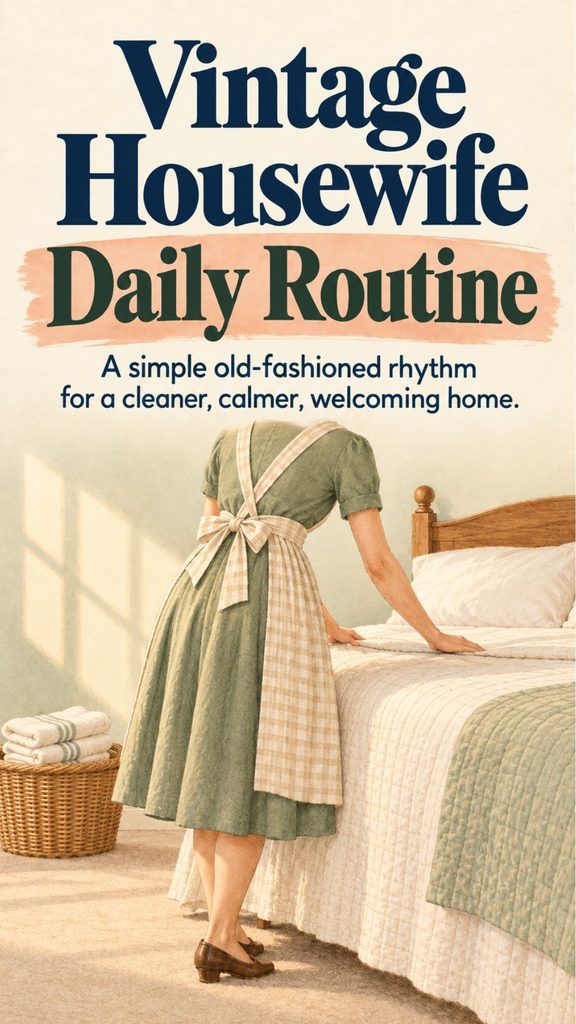
The image of the 1940s or 1950s housewife often looks wonderfully orderly: breakfast on the table, beds made early, laundry fluttering on the line, dinner cooking before the family comes home, and a tidy kitchen waiting at the end of the day.
Real life was usually less perfect.
Homemaking routines varied enormously according to income, location, family size, whether a woman worked outside the home, the appliances available, and the decade itself. A rural household with a vegetable garden and few labor-saving appliances operated very differently from a suburban home with an automatic washer and a supermarket nearby.
You Might Also Like:
- Loading posts...
Still, many mid-century homemakers depended heavily on routine.
Housework was repetitive and time-consuming, so assigning jobs to particular parts of the day—or particular days of the week—made the workload more manageable.
That is the part of vintage homemaking worth borrowing.
You do not need to rise before dawn, iron everything in sight, serve three cooked meals every day, or greet your family wearing pearls.
The useful lesson is simpler:
give ordinary household work a rhythm so it does not occupy your entire mental space.
Here is what a vintage-inspired homemaking day might look like, along with practical ways to adapt it to modern life.
Morning: Begin the Day Before the House Gets Away From You
Morning routines mattered because a few completed jobs could make the rest of the day feel much easier.
A vintage homemaker often began by getting herself ready, preparing breakfast, restoring order to the kitchen, and starting whichever household task required the most time.
The modern version can be much simpler.
Get Yourself Ready
Older homemaking advice frequently encouraged women to dress for the day rather than remain in nightclothes.
There can still be something useful about that transition.
Getting dressed tells your brain that the day has begun.
That does not mean applying makeup, styling your hair elaborately, or wearing a dress unless you enjoy those things.
Your routine might simply be:
wash your face,
brush your teeth,
get dressed,
comb your hair,
and make the bed.
The goal is not to look presentable for other people.
It is to create a boundary between rest and work.
If pajamas do not affect your motivation, there is no reason to make this a rule. But if you routinely feel sluggish when you remain in sleepwear all morning, changing clothes may help.
Make the Bed
Bed-making is one of those tiny homemaking habits that produces an immediate visual result.
It takes only a few minutes but makes the bedroom look significantly more orderly.
You do not need decorative pillows, hospital corners, or an elaborate arrangement.
Pull the bedding into place.
Straighten the pillows.
Done.
If possible, allow bedding to air briefly before making the bed, especially if the room has become warm or humid overnight.
Prepare a Simple Breakfast
Vintage depictions often show large cooked breakfasts, but modern mornings do not require pancakes, eggs, bacon, toast, and coffee every day.
A dependable breakfast is more useful than an impressive one.
Try:
oatmeal with fruit,
eggs and toast,
plain yogurt with fruit and nuts,
whole-grain toast with peanut butter,
or leftovers from another meal.
If family members leave at different times, a self-serve breakfast station may make much more sense than cooking individually for everyone.
The vintage lesson is simply that feeding people is easier when you have a predictable plan.
Reset the Kitchen Immediately
One of the strongest habits to borrow from older housekeeping routines is finishing one meal before mentally moving on to the next part of the day.
After breakfast:
load or wash dishes,
wipe the table,
clean obvious spills,
put food away,
and clear the sink.
You do not need to deep-clean the kitchen every morning.
The purpose is to prevent breakfast from remaining on the counters until lunch.
A clean sink and mostly clear counter make the entire kitchen feel easier to use.
Start One Time-Dependent Task
Laundry historically consumed far more labor than it usually does today.
Modern machines reduce much of the physical effort, but laundry still benefits from being started early.
If you need to wash clothes that day, begin a load while doing other morning tasks.
The machine works while you work.
The same principle can apply to:
bread dough that needs rising,
beans that need soaking,
a slow-cooker meal,
a dishwasher cycle,
or another task that requires waiting.
Do time-dependent jobs early so they can progress in the background.
Late Morning: The Main Housekeeping Block
Once the immediate morning jobs were complete, traditional homemaking schedules often moved into focused household work.
This is where modern homemakers can benefit most from a vintage-style routine.
Instead of attempting to deeply clean the entire house every day, choose a daily maintenance routine plus one larger focus.
Make the Bedrooms Presentable
A quick bedroom reset might include:
making beds,
putting dirty clothing in the hamper,
returning obvious items to their places,
opening curtains,
and airing the room when weather and outdoor conditions allow.
That is enough for an ordinary day.
Save detailed dusting, vacuuming, changing sheets, and closet work for scheduled cleaning days.
Do a Quick Whole-House Reset
Walk through the main living areas with a basket.
Collect things that belong elsewhere.
Straighten cushions.
Fold blankets.
Put shoes away.
Clear surfaces.
Do not get distracted by every small project you discover.
If you notice a drawer that needs reorganizing, write it down rather than turning a ten-minute tidy into a two-hour project.
A daily reset should make the house functional, not perfect.
Give Each Day a Main Job
Traditional homemaking schedules often assigned large tasks to specific days.
The exact historical schedules varied, but the basic concept remains useful.
A modern version might be:
Monday — Laundry and linens
Tuesday — Bedrooms and dusting
Wednesday — Mending, paperwork, and errands
Thursday — Bathrooms
Friday — Floors and deeper kitchen cleaning
Saturday — Groceries, baking, or household projects
Sunday — Rest, family time, and light preparation
There is nothing sacred about these days.
Move them around.
A household with young children, shift work, homeschooling, or employment outside the home will need a different schedule.
What matters is removing the question:
“What am I supposed to clean today?”
The routine has already answered it.
Keep Bathrooms Under Control With Small Daily Jobs
Bathrooms become much easier to maintain when they receive a few minutes of attention regularly.
A quick routine might include:
wiping the sink,
putting toiletries away,
hanging towels properly,
checking toilet paper,
and removing obvious floor debris.
You do not need to scrub the entire shower every morning.
A weekly deeper clean can handle that.
Small maintenance prevents the room from becoming unpleasant before cleaning day arrives.
Midday: Food, Planning, and Household Administration
Midday in older homes often involved another meal, errands, and preparation for the coming days.
Modern life may look very different, but the middle of the day is still a useful time to stop and reassess.
Keep Lunch Simple
Lunch does not have to become another major cooking production.
Use:
leftovers,
soup,
sandwiches,
salads,
eggs,
grain bowls,
or whatever is already prepared.
One of the easiest ways to make homemaking exhausting is to behave as though every meal must be made completely from scratch immediately before eating.
Cooking from scratch can be economical and enjoyable.
That does not mean refusing leftovers or convenience.
A good homemaker uses resources intelligently.
Look Ahead to Dinner
Before afternoon becomes busy, make sure you know what dinner is.
Ask:
Is the meat thawed?
Do beans need cooking?
Does something need to come out of the freezer?
Do vegetables need using?
Is the slow cooker already going?
Do I have every ingredient?
This two-minute check prevents the 5:30 p.m. discovery that the planned chicken is still frozen solid.
Vintage homemakers often depended on planning because food preparation required more time.
Modern kitchens are faster, but planning still saves stress.
Check the Pantry Before Shopping
Older households often relied more heavily on knowing what was available at home.
That habit is still worth keeping.
Before making a grocery list, check:
the refrigerator,
freezer,
pantry,
and produce that needs using.
Plan several meals around what is already there.
This reduces food waste and helps control grocery spending.
It also makes shopping more purposeful.
Keep a Running Household List
Instead of trying to remember everything, keep one central list for:
groceries,
household supplies,
errands,
repairs,
appointments,
and things that need replacing.
Paper works.
A phone app works.
A family whiteboard works.
The system matters far less than having one dependable place where household information goes.
Mental clutter is still clutter.
Afternoon: Projects, Repairs, and Work That Requires More Attention
Traditional homemaking did not consist solely of routine cleaning.
Households also required repairs, sewing, food preservation, paperwork, gardening, and ongoing projects.
The afternoon can be a good place for those jobs once the basic home is functioning.
Mend Before You Replace
Mending was once a normal household skill because clothing represented a significant investment.
You do not need to become an expert seamstress to borrow this habit.
Learn how to:
sew on a button,
repair a loose seam,
fix a small hem,
patch simple tears,
and remove pills from knitwear.
A ten-minute repair can keep an otherwise useful garment in service for years.
Keep a small mending basket somewhere accessible.
When something needs repair, place it there instead of returning it to the closet damaged.
Choose a regular time to empty the basket.
Iron Selectively
Vintage homemakers sometimes spent hours ironing clothes, linens, handkerchiefs, and other household textiles.
Modern fabric and dryers have made much of that unnecessary.
Iron what genuinely benefits from ironing.
Perhaps that is:
a linen shirt,
a tablecloth for a special meal,
a dress,
or work clothing.
You do not earn additional homemaking points for ironing pillowcases nobody cares about.
Borrow the care without automatically borrowing the workload.
Complete One Small Household Project
Afternoons are a good time for limited projects.
The key word is limited.
Choose one cupboard.
One shelf.
One drawer.
One basket of paperwork.
One garden bed.
One repair.
Do not announce that you are “organizing the entire house” at 2 p.m.
Small finished projects build momentum.
Large vaguely defined projects produce clutter and frustration.
Make Room for Creative Homemaking
Homemaking is not merely removing dirt.
It can also include creating beauty and comfort.
You might:
arrange flowers from the garden,
bake bread,
sew,
knit,
decorate seasonally,
work on a scrapbook,
tend plants,
write letters,
or prepare something special for the evening meal.
These activities are optional, but they can transform household work from constant maintenance into something creative.
A home is not simply a building you clean.
It is a place you shape.
Late Afternoon: Prepare for the Evening Before Everyone Is Tired
One of the smartest features of traditional routines was preparing for evening before the evening actually arrived.
The hours between late afternoon and bedtime can become chaotic quickly, especially when everyone is hungry.
A little preparation changes the mood considerably.
Start Dinner Before You Are Starving
Do not wait until everyone is hungry to decide what to eat.
Begin early enough that you can work without rushing.
This may mean:
chopping vegetables at 4 p.m.,
putting a casserole into the oven,
making soup,
starting rice,
or simply setting out ingredients for a quick meal.
Not every dinner must be elaborate.
A balanced simple meal served calmly is far better than an ambitious meal that leaves everyone exhausted.
Use a Five-Minute Evening Reset
Before dinner—or before family members arrive home—spend five minutes restoring the main living space.
Put obvious clutter away.
Straighten the sofa.
Clear the dining table.
Turn on a lamp.
That small reset can dramatically change how the home feels at the end of the day.
Historically, homemaking literature sometimes framed this preparation as something wives should do specifically for husbands.
A modern household can interpret it more generously.
Everyone benefits from coming into a calmer shared space.
And everyone living there can participate in creating it.
Set the Table Simply
A table does not need fine china or a centerpiece to feel intentional.
Put out:
plates,
glasses,
cutlery,
and napkins.
Clear away unrelated clutter.
That alone changes dinner from eating wherever there is available space into a shared meal.
If you enjoy flowers, candles, or pretty dishes, use them.
Do not save every beautiful household item for hypothetical special guests.
Your own family lives there every day.
Evening: Let Dinner Become a Pause in the Day
The old-fashioned family dinner is worth preserving when schedules allow.
Not because every family must eat together every evening, but because shared meals create natural opportunities for conversation.
Put phones aside when practical.
Ask about the day.
Let children participate.
Eat slowly enough to notice the meal.
Some evenings will be rushed.
Some family members may work late.
Some households contain one person.
The principle still works.
Give at least one meal enough attention that it feels like a real pause rather than another task completed while scrolling.
Don’t Make One Person Responsible for Everything
One major part of vintage domestic life does not need to be recreated.
Historically, household work was often treated as women’s work regardless of how much labor it required.
Modern homemaking works better when everyone who is able contributes.
Children can learn age-appropriate chores.
Partners can cook, clean, shop, wash dishes, fold laundry, and manage household administration.
A beautifully run home does not require one exhausted person quietly doing everything.
Homemaking is work.
Shared homes should involve shared responsibility.
Night: Reset Instead of Starting Over Tomorrow
One of the most effective homemaking habits is ending the day with a short reset.
You do not need to deep-clean the house at night.
You simply want tomorrow morning to begin without confronting yesterday’s unfinished mess.
Close the Kitchen
After dinner:
put leftovers away,
wash or load dishes,
wipe the dining table,
clean major spills,
wipe counters,
and leave the sink reasonably clear.
If something needs soaking, soak it.
If the dishwasher is full, run it.
This routine may take fifteen minutes, but it can completely change the next morning.
Walking into yesterday’s greasy pans makes breakfast feel harder than it needs to be.
Reset the Living Room
Put away obvious items.
Fold blankets.
Return cups to the kitchen.
Gather children’s toys into their proper area.
Straighten cushions.
Again, this is not detailed cleaning.
You are simply returning the room to its starting position.
Finish the Laundry Cycle
Laundry becomes overwhelming when each stage is treated as a separate project.
Whenever possible, complete the whole cycle:
wash,
dry,
fold,
put away.
A basket of permanently clean clothes sitting on the floor is technically clean laundry, but it still occupies physical and mental space.
If you cannot finish everything, at least move the process forward deliberately.
Prepare for Tomorrow
Older homemaking routines often included preparation for the next day.
A modern version might mean:
checking tomorrow’s calendar,
setting out children’s school items,
packing lunches,
choosing clothes,
taking meat from the freezer,
writing tomorrow’s top three tasks,
or making sure you know what breakfast will be.
Five minutes of preparation at night can save twenty frantic minutes in the morning.
Quiet Evening Time Matters Too
A home should not require constant labor until bedtime.
At some point, stop.
Read.
Watch something.
Talk with your family.
Take a bath.
Work on a hobby.
Sit quietly.
Historically, homemaking could be relentless precisely because there was always another chore waiting.
That is still true.
There will always be something that could be cleaned.
Learning to declare the day’s work finished is part of a sustainable household routine.
What a Vintage Housekeeping Week Might Look Like Today
Instead of trying to complete every job every day, use a weekly rhythm.
Monday: Laundry and linens
Catch up on clothing, towels, sheets, and anything left from the weekend.
Tuesday: Bedrooms
Dust, vacuum, change bedding as needed, and tidy bedroom surfaces.
Wednesday: Household administration
Handle paperwork, appointments, errands, mending, and small organizing tasks.
Thursday: Bathrooms
Clean toilets, showers, tubs, mirrors, sinks, and floors more thoroughly.
Friday: Kitchen and floors
Clean appliances that need attention, wipe cabinet fronts, vacuum, and mop.
Saturday: Groceries and projects
Shop, meal-prep, work outside, bake, or tackle a household project.
Sunday: Rest and prepare
Keep chores light, review the upcoming week, plan meals, and reset necessary spaces.
Your routine may look completely different.
That is fine.
The point is to divide work so that the entire house does not demand your attention simultaneously.
What We Can Borrow From Vintage Homemaking
There are several old-fashioned habits that still work beautifully.
Have a rhythm
Predictable routines reduce decision fatigue.
When you know that Thursday is bathroom day, you stop mentally reminding yourself all week that the bathroom eventually needs cleaning.
Clean as you go
Wash breakfast dishes after breakfast.
Put ingredients away while dinner cooks.
Return objects when you finish using them.
Small acts prevent large messes.
Care for what you own
Repair garments.
Maintain appliances.
Clean shoes.
Store household items properly.
Taking care of belongings can reduce unnecessary replacement.
Plan meals before hunger makes the decision
A simple menu saves time, money, and stress.
It does not need to be rigid.
Knowing five possible dinners is often enough.
Make ordinary life pleasant
Use the nice tablecloth occasionally.
Put flowers in a jar.
Open the curtains.
Light a lamp instead of relying solely on harsh overhead lighting.
Serve soup in bowls you enjoy.
Beauty does not need to wait for guests.
Finish small jobs
A completed ten-minute task often improves the home more than starting a massive project that remains unfinished for days.
What We Can Leave in the Past
Vintage homemaking can be inspiring without romanticizing everything about the era.
We can leave behind the idea that:
a woman’s value depends on how perfectly she keeps a house,
a wife must always look polished for her husband,
every meal needs to be elaborate,
children should never see a messy home,
rest is laziness,
housework belongs only to women,
or a home must appear perfect to outsiders.
Homes are for living.
That means laundry appears.
Dishes get dirty.
Children make messes.
People become tired.
Some weeks run beautifully.
Others do not.
A useful routine accommodates real life.
Create Your Own Vintage-Inspired Daily Routine
You do not need to copy a historical schedule exactly.
Start with a few anchors.
Morning
Get ready.
Make beds.
Eat breakfast.
Reset the kitchen.
Start laundry if needed.
Late morning
Tidy main rooms.
Complete one cleaning focus.
Midday
Eat something simple.
Check dinner.
Handle errands or household administration.
Afternoon
Complete one project, repair, or deeper task.
Late afternoon
Start dinner.
Reset the living area.
Evening
Eat.
Clean the kitchen.
Put the main rooms back in order.
Night
Prepare a few things for tomorrow.
Then stop working.
That is enough structure for many households.
The Best Part of Vintage Homemaking Is the Rhythm
The daily routine of a vintage housewife was not magical.
It was work.
Before automatic appliances and modern conveniences, much of that work required considerably more time and physical effort than the same chores do today.
What made the workload possible was often repetition.
Certain jobs happened in the morning.
Others happened after lunch.
Large tasks had assigned days.
Meals were planned.
Clothes were maintained.
The kitchen was reset.
Tomorrow was prepared before bedtime.
That sense of rhythm remains useful.
You do not need a spotless house.
You do not need a rigid schedule.
You do not need to recreate the 1950s.
Take the useful parts instead:
a morning reset, a weekly cleaning rhythm, planned meals, regular maintenance, simple evening preparation, and the discipline to finish the day rather than endlessly chasing perfection.
A well-run home is not one where nothing ever becomes messy.
It is one where there is a dependable way to bring things back into order.
That may be the most timeless homemaking lesson of all.