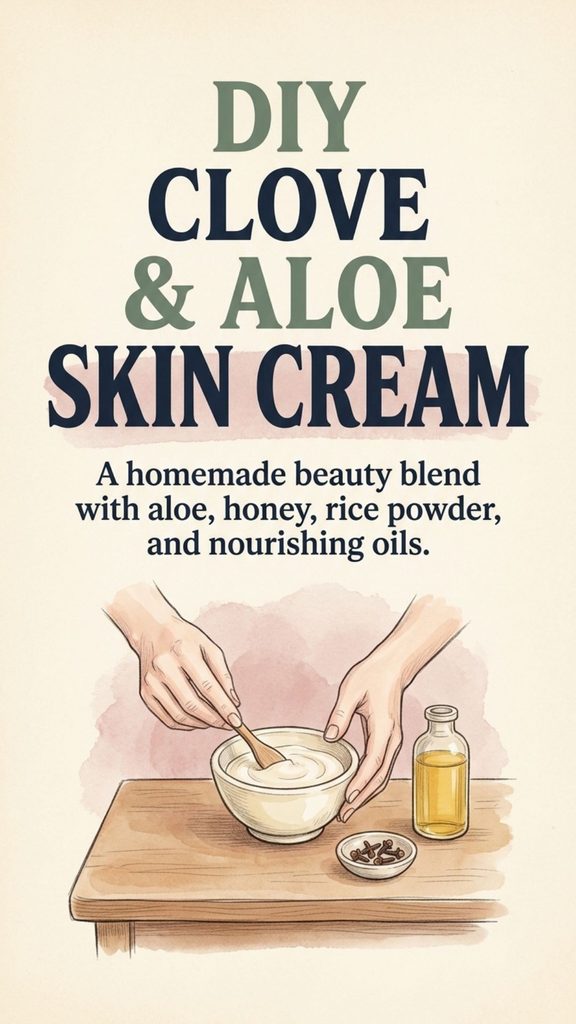
Homemade skincare recipes have become incredibly popular, especially those promising smoother, firmer, and younger-looking skin using simple ingredients from the kitchen. One recipe attracting attention combines cloves, baby oil, rice powder, aloe vera, vitamin E, honey, almond oil, and rose water into what is described as a homemade collagen cream.
Some versions even claim that applying this mixture every night for 21 days can make a 57-year-old woman look 21 again.
It’s an appealing idea. Most people would love to improve their skin without spending a fortune on expensive creams or complicated beauty treatments.
You Might Also Like:
- Loading posts...
But can these ingredients actually rebuild collagen, reduce wrinkles, or reverse visible signs of aging?
While several ingredients in the mixture have moisturizing or skin-conditioning properties, the dramatic anti-aging claims aren’t supported by reliable scientific evidence. There are also important safety concerns with preparing and storing a homemade cream.
Understanding what each ingredient does can help you make better skincare decisions and develop a routine that supports healthy, comfortable, hydrated skin.
What Is Homemade Collagen Cream?
Collagen is a structural protein naturally found in the skin. It helps provide support and contributes to skin firmness and strength.
As we age, collagen production changes, and existing collagen is gradually affected by natural aging and environmental influences, including ultraviolet radiation.
These changes contribute to fine lines, wrinkles, and reduced skin firmness.
Cosmetic products marketed as collagen creams often focus on improving skin hydration and temporarily reducing the appearance of fine lines.
However, applying collagen to the skin doesn’t automatically replace collagen within its deeper layers. Native collagen molecules are generally too large to penetrate the skin barrier effectively.
The popular homemade mixture described as a collagen cream doesn’t actually contain collagen. Instead, it combines oils, botanical ingredients, and other substances intended to moisturize or condition the skin.
That distinction matters because improving surface hydration is not the same as restoring lost collagen.
Ingredients in the Popular Homemade Collagen Cream Recipe
The widely shared recipe uses the following ingredients:
| Ingredient | Amount |
|---|---|
| Cloves | 2 teaspoons |
| Baby oil | 3 tablespoons |
| Rice powder | 1 tablespoon |
| Aloe vera gel | 1 tablespoon |
| Vitamin E | 1 capsule |
| Raw honey | 1 teaspoon |
| Almond oil | 1 teaspoon |
| Rose water | 1 teaspoon |
Although these ingredients are often used individually in traditional beauty practices or commercially formulated skincare products, combining them at home doesn’t establish their effectiveness or safety.
This mixture is not recommended as a homemade overnight face cream. It combines water-containing ingredients with oils without an appropriate preservation or formulation system, and some ingredients may irritate sensitive skin.
The more useful approach is to understand the individual ingredients and decide which, if any, deserve a place in a properly formulated skincare routine.
1. Cloves: Popular in DIY Beauty but Potentially Irritating
Cloves are aromatic flower buds commonly used in cooking.
They contain eugenol, a compound responsible for much of their distinctive fragrance.
Eugenol has been studied for several biological properties, but laboratory findings don’t establish that applying cloves to your face will reduce wrinkles or stimulate collagen production.
Clove-derived ingredients can also cause irritation or allergic contact dermatitis in some individuals.
This concern becomes particularly relevant with concentrated clove oil or homemade preparations where the amount of active compounds is unknown.
Facial skin can be sensitive, especially around the eyes and mouth.
Adding teaspoons of cloves to an overnight cream doesn’t provide a proven anti-aging benefit, and it introduces avoidable irritation risks.
For people interested in botanical skincare, a properly formulated product with appropriate ingredient concentrations is a more sensible option than experimenting with concentrated homemade mixtures.
2. Baby Oil: Helps Reduce Moisture Loss
Baby oil is commonly made from mineral oil, sometimes with added fragrance.
Cosmetic-grade mineral oil is an occlusive ingredient. This means it forms a protective layer that helps reduce water loss from the skin.
Occlusive products can be useful for dry areas because they help retain existing moisture.
However, baby oil doesn’t increase collagen production or reverse deep wrinkles.
It also doesn’t supply water to dehydrated skin by itself.
For some people, a fragrance-free mineral-oil-based product can be useful as part of a moisturizing routine.
Those who experience irritation from fragranced products may prefer fragrance-free alternatives.
Rather than mixing baby oil with food ingredients, consider a properly formulated moisturizer containing compatible occlusive and hydrating ingredients.
3. Rice Powder: A Traditional Beauty Ingredient
Rice has a long history of use in various Asian beauty traditions.
Rice-derived ingredients appear in numerous modern skincare formulations, including cleansers, masks, and creams.
However, plain rice powder and professionally formulated rice extracts are not interchangeable.
Rice powder is sometimes used for physical exfoliation, but its texture and particle size can vary.
Rubbing coarse particles against the face may cause irritation, especially for sensitive or inflamed skin.
There is also insufficient clinical evidence that mixing ordinary rice powder into a homemade cream rebuilds collagen or removes wrinkles.
If your goal is smoother skin texture, choose a gentle skincare product designed for your skin type rather than relying on abrasive homemade exfoliants.
4. Aloe Vera Gel: A Familiar Skin-Conditioning Ingredient
Aloe vera is commonly included in cosmetic products because of its water-rich gel and skin-conditioning properties.
Some people find commercially prepared aloe vera products pleasant and soothing.
However, aloe can still cause irritation or allergic reactions in certain individuals.
Fresh aloe gel also presents preservation concerns when incorporated into homemade skincare products.
Once extracted, it can become contaminated if handled or stored improperly.
A commercially prepared aloe vera moisturizer with appropriate preservation is generally more reliable than combining fresh gel with oils and storing the mixture for repeated application.
Aloe vera may contribute to a comfortable skincare routine, but it shouldn’t be considered a proven treatment for deep wrinkles or age-related collagen loss.
5. Vitamin E: An Antioxidant With Limitations
Vitamin E is a fat-soluble nutrient with antioxidant functions.
It is included in many skincare formulations to help protect ingredients from oxidation or provide skin-conditioning benefits.
However, opening a vitamin E supplement capsule and applying its contents directly to the face is not equivalent to using a professionally formulated cosmetic product.
Capsules are generally designed for their intended labeled use, which may be oral supplementation rather than topical application.
The contents may not have an appropriate texture or concentration for facial skin.
Some individuals also experience contact dermatitis from topical vitamin E.
There is no reliable evidence that adding one vitamin E capsule to a homemade mixture will dramatically reduce wrinkles within three weeks.
For those interested in antioxidant skincare, products formulated specifically for topical use provide a more predictable approach.
6. Raw Honey: A Humectant, Not a Miracle Anti-Aging Treatment
Honey contains sugars that can attract and retain moisture, which helps explain its use as a humectant in certain cosmetic formulations.
Different honey products vary considerably in composition and processing.
Although some medical-grade honey preparations have established uses in wound care, ordinary raw honey from the kitchen is not equivalent to sterile medical honey or a preserved cosmetic ingredient.
Raw honey may contain impurities or microorganisms, and some individuals can develop irritation or allergic reactions.
Its sticky texture can also make it inconvenient for overnight facial application.
There is no convincing evidence that applying raw honey every night will restore the facial appearance of someone decades younger.
Properly formulated humectant moisturizers offer a simpler way to support skin hydration.
7. Almond Oil: Useful for Some Dry Skin Types
Sweet almond oil is an emollient, meaning it can help soften and smooth the skin.
It contains fatty acids that contribute to its conditioning properties.
For people who tolerate it, almond oil may help improve the feel of dry skin.
However, it cannot replace lost collagen or permanently tighten sagging facial tissue.
People with relevant nut allergies should be cautious and seek professional advice before applying nut-derived products.
Almond oil may also feel too heavy for some facial skincare preferences.
A lightweight, fragrance-free moisturizer is often a more convenient everyday choice.
8. Rose Water: Pleasant Fragrance With Possible Sensitivity
Rose water is commonly associated with traditional skincare routines.
It has a floral fragrance and is sometimes included in facial toners and cosmetic products.
However, natural fragrance compounds can cause irritation or allergic reactions, especially in people with sensitive skin.
Rose water also introduces a water-containing component into a homemade formula.
When mixed with oils, honey, and aloe without an appropriate preservative and emulsifier system, the resulting product may separate and become vulnerable to microbial contamination.
Using rose water doesn’t automatically make a homemade cream safer or more effective.
For sensitive skin, fragrance-free products are often a better starting point.
Why This Homemade Cream Is Difficult to Prepare Safely
The main concern isn’t simply that the ingredients lack proven collagen-building benefits.
The complete mixture also creates formulation challenges.
Baby oil and almond oil are oil-based, while aloe vera gel and rose water contain water.
A stable cosmetic cream normally requires a suitable emulsifier to combine these phases.
It also typically requires a properly designed preservation system to control microbial contamination.
Honey, vitamin E, or refrigeration alone should not be assumed to provide adequate preservation.
According to the U.S. Food and Drug Administration, microbial contamination in cosmetics can pose health risks.
Homemade products containing water are particularly concerning when they’re prepared without validated preservation methods.
A mixture may look and smell normal even when contamination has occurred.
For these reasons, preparing a jar of this eight-ingredient cream and applying it nightly for 21 days is not a reliable or advisable skincare practice.
Can Any Cream Make a 57-Year-Old Look 21 in 21 Days?
No credible clinical evidence supports that claim.
Skin aging involves several processes, including changes in collagen, elastin, facial fat distribution, pigmentation, and skin thickness.
A moisturizer can improve hydration and temporarily soften the appearance of fine lines.
Some well-studied skincare ingredients can gradually improve certain signs of photoaging, but visible results generally require consistent use over longer periods.
No ordinary homemade cream can reliably reverse decades of biological skin aging in three weeks.
Claims involving dramatic age transformations should be approached cautiously, particularly when they rely on promotional photographs rather than controlled clinical evidence.
Lighting, makeup, photography, and image editing can all influence how skin appears.
A realistic skincare goal is healthier, more comfortable skin with improvements in hydration, texture, and the appearance of some fine lines.
A Safer 21-Day Skincare Routine for Smoother-Looking Skin
If the idea of a three-week beauty routine appeals to you, a simple approach based on established skincare principles is more worthwhile than mixing unpreserved ingredients.
The American Academy of Dermatology identifies daily sun protection and moisturizing as two important foundations of anti-aging skincare.
Morning Routine
- Cleanse gently. Use a mild facial cleanser appropriate for your skin type. Avoid scrubbing or harsh washing.
- Apply moisturizer. Choose a product containing ingredients such as glycerin, ceramides, or hyaluronic acid to support hydration and the skin barrier.
- Use sunscreen. Apply a broad-spectrum sunscreen with SPF 30 or higher to exposed skin. Reapply as directed, especially during prolonged outdoor activity.
Sun protection is particularly important because ultraviolet exposure contributes to premature skin aging.
Evening Routine
- Remove makeup and sunscreen using a gentle cleanser.
- Apply a suitable fragrance-free moisturizer.
- For very dry areas, consider an appropriate occlusive moisturizer to help reduce moisture loss.
- Keep the routine consistent rather than introducing several new products at once.
People interested in treating fine lines or uneven skin texture may consider an appropriate retinoid or retinol product after assessing their skin type and tolerance.
Retinoids have evidence supporting improvements in certain signs of photoaging, but they can cause irritation and require careful introduction. Retinoids should be avoided during pregnancy, and professional guidance is appropriate when needed.
What Results Can You Expect After 21 Days?
Three weeks is enough time to begin developing a consistent skincare habit.
Some people may notice that their skin feels softer or more comfortable after regularly using a suitable moisturizer.
Fine dehydration lines may also appear less noticeable when the skin is adequately hydrated.
However, deeper wrinkles, significant sagging, and age-related volume changes are unlikely to change dramatically over such a short period.
Skin responses vary depending on age, genetics, skin type, environment, and the products used.
Instead of focusing on unrealistic transformations, pay attention to practical improvements.
Does your skin feel less dry? Is your routine comfortable? Are you using sunscreen consistently? Have you avoided products that cause burning or irritation?
These are useful signs that your skincare approach is meeting your needs.
Everyday Habits That Support Healthy-Looking Skin
Skincare products are only one part of maintaining healthy skin.
Several everyday habits also contribute to skin health.
Protect against excessive sunlight. Sun protection helps reduce ultraviolet damage and premature photoaging.
Avoid smoking. Smoking contributes to several adverse effects on skin and overall health.
Eat a balanced diet. Include vegetables, fruits, protein-rich foods, and sources of healthy fats to support general nutritional needs.
Get adequate sleep. Sufficient sleep is important for overall health and normal bodily functioning.
Cleanse gently. Harsh scrubbing and irritating products can damage the skin barrier.
Choose products suited to your skin. Expensive formulas aren’t automatically more effective than affordable, well-formulated alternatives.
Consistency matters more than having a bathroom cabinet filled with different treatments.
Common Mistakes With Homemade Anti-Aging Skincare
Homemade skincare recipes can be appealing, but a few common assumptions deserve attention.
Assuming Natural Means Safe
Natural ingredients can still trigger irritation, allergies, and other adverse reactions.
Cloves, fragrances, botanical extracts, and nut oils may not be suitable for everyone.
Mixing Products Without Preservatives
Water-containing homemade mixtures may become contaminated during preparation and storage.
Adding oils or antioxidants doesn’t automatically prevent microbial growth.
Applying Too Many Ingredients at Once
Combining numerous ingredients makes it difficult to identify which one caused an adverse reaction.
A simpler skincare routine is easier to manage and evaluate.
Expecting Permanent Results From Moisturizers
Moisturizers can improve skin hydration and temporarily reduce the appearance of fine lines.
They do not permanently replace lost facial volume or reverse all age-related changes.
Ignoring Sunscreen
Even an expensive skincare routine may provide disappointing results if the skin is repeatedly exposed to excessive ultraviolet radiation without protection.
Daily sun protection remains one of the most useful preventive steps.
Frequently Asked Questions About Homemade Collagen Cream
Does Homemade Collagen Cream Actually Contain Collagen?
The recipe containing cloves, baby oil, rice powder, aloe vera, vitamin E, honey, almond oil, and rose water does not contain collagen as an ingredient.
Its name reflects a promotional claim rather than its composition.
Can Baby Oil Remove Wrinkles?
Baby oil can help reduce moisture loss, which may temporarily soften the appearance of fine lines associated with dryness.
It doesn’t remove deep wrinkles or rebuild collagen.
Is It Safe to Apply Cloves to the Face?
Clove-derived substances can irritate skin or trigger allergic contact dermatitis.
There isn’t a standardized, proven method for safely using ordinary kitchen cloves as a facial anti-aging treatment.
Does Vitamin E Tighten Facial Skin?
Vitamin E has antioxidant properties, but applying the contents of a supplement capsule hasn’t been shown to produce substantial facial tightening.
Can You Store Homemade Cream for Three Weeks?
The described mixture lacks a validated preservation system.
It should not be assumed safe for storage and repeated facial application over three weeks, even if refrigerated.
What Is the Best Affordable Alternative?
A gentle cleanser, a suitable fragrance-free moisturizer, and broad-spectrum SPF 30 or higher sunscreen are a practical foundation.
For particular concerns such as persistent pigmentation or wrinkles, a dermatologist can help identify appropriate treatments.
Healthy Skin Doesn’t Require Miracle Creams
The appeal of homemade collagen cream is understandable. Simple ingredients, low costs, and the promise of smoother skin make these recipes attractive.
But the ingredients in the popular clove-and-baby-oil mixture do not create a proven collagen treatment, and the dramatic claim of looking decades younger after 21 days isn’t supported by scientific evidence.
Some individual ingredients can contribute to skin conditioning or moisture retention when used in suitable formulations. That doesn’t make an unpreserved homemade combination effective or safe.
A better approach is to focus on gentle cleansing, reliable moisturizing, daily sun protection, and proven treatments selected for your individual needs.
The goal isn’t to make mature skin look 21 again. It’s to keep your skin healthy, comfortable, well cared for, and looking its best at every age.