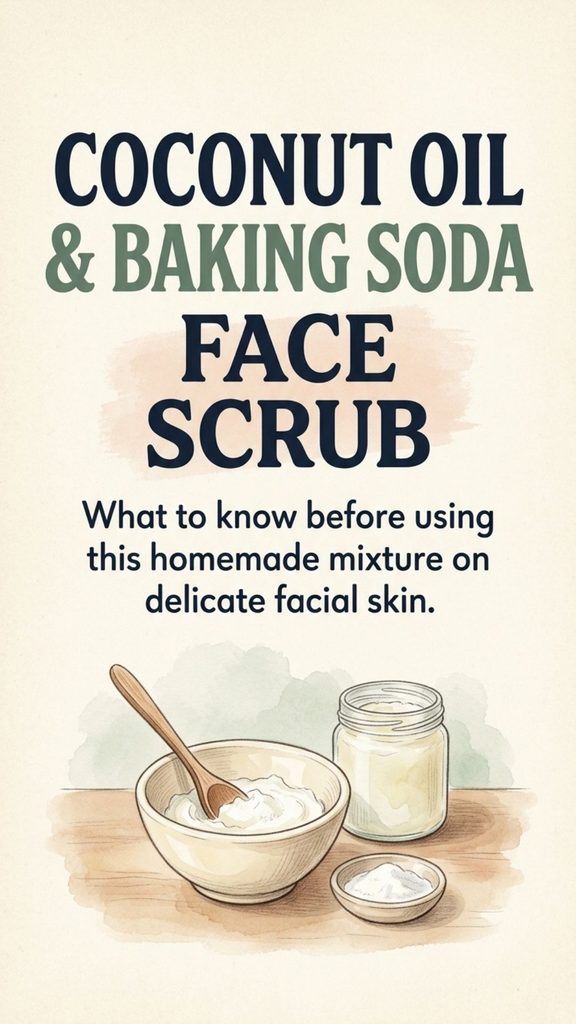
Homemade beauty treatments have become popular because they’re inexpensive, simple to prepare, and often use ingredients already sitting in the kitchen cupboard. One combination that continues to attract attention is coconut oil mixed with baking soda.
The promise sounds tempting: mix two ordinary ingredients, massage the mixture onto your face a few times a week, and enjoy clearer, softer, brighter-looking skin within a month.
Coconut oil is known for its moisturizing properties, while baking soda is often promoted as a natural exfoliant. Together, they’re sometimes described as a homemade facial cleanser that can remove blackheads, fade acne scars, smooth wrinkles, and improve uneven skin tone.
You Might Also Like:
- Loading posts...
But does this combination actually work?
Although both ingredients have useful properties, mixing coconut oil and baking soda is not a dermatologist-recommended facial treatment. Baking soda can disrupt the skin’s natural protective barrier, and coconut oil may clog pores in people who are prone to acne.
The good news is that you don’t need an expensive skincare collection to keep your face clean, hydrated, and healthy.
Understanding how these ingredients affect the skin can help you avoid unnecessary irritation while choosing simpler, safer alternatives.
Why Coconut Oil and Baking Soda Became Popular for Skincare
Natural beauty remedies often become popular because people associate familiar kitchen ingredients with gentleness and safety.
Coconut oil has been used for personal care in many cultures. It appears in hair treatments, body moisturizers, soaps, and cosmetic formulations.
Baking soda, also called sodium bicarbonate, is a familiar household ingredient used in baking and cleaning.
When combined, the oil creates a slippery base while the baking soda adds a grainy texture.
That combination can feel like a facial scrub.
After rinsing, some people may notice that their skin feels smoother or less greasy. However, an immediate change in texture doesn’t necessarily mean the treatment is improving skin health.
Temporary smoothness can result from removing surface material, while a tight or unusually squeaky-clean feeling may indicate that the skin has been stripped of protective oils.
To understand the risks, it’s helpful to examine each ingredient separately.
1. Coconut Oil: A Natural Moisturizer With Some Limitations
Coconut oil contains fatty acids, including lauric acid, and is commonly used in moisturizing products.
When applied to the skin, it forms a layer that helps limit moisture loss.
This can be useful for certain areas of dry skin, particularly on the body.
What Coconut Oil May Help With
For people who tolerate it, coconut oil may:
- Reduce moisture loss from the skin.
- Make dry skin feel softer.
- Improve the temporary appearance of rough patches.
- Provide a protective layer over certain dry areas.
Some research has also examined its effects on skin-barrier function and moisture retention.
However, results from studies involving dry body skin shouldn’t automatically be applied to every facial skin type.
Can Coconut Oil Clog Facial Pores?
Yes, it can.
Coconut oil is considered potentially comedogenic, meaning it may contribute to clogged pores.
People with oily or acne-prone skin may notice more blackheads, whiteheads, or pimples after using it on their faces.
Not everyone responds identically, but coconut oil isn’t usually the best first choice for facial moisturizing when breakouts are a concern.
For acne-prone skin, a lightweight moisturizer labeled non-comedogenic or won’t clog pores is generally more suitable.
Does Coconut Oil Remove Acne Scars?
There isn’t convincing evidence that applying ordinary coconut oil fades established acne scars.
True acne scars involve structural changes within the skin.
Moisturizing can temporarily make the skin surface appear smoother, but that isn’t the same as repairing depressed or raised scars.
Dark marks left after pimples are also different from scars and may require different treatments.
2. Baking Soda: Why It Can Be Too Harsh for Your Face
Baking soda is useful in the kitchen, but facial skin has different needs.
Healthy skin has a naturally slightly acidic surface, often called the acid mantle.
This acidity contributes to normal skin-barrier function and helps maintain a suitable environment for microorganisms living on the skin.
The skin’s surface typically has a pH around 4.5–5.5, although values vary.
Baking soda, by contrast, is alkaline.
An ordinary baking soda solution has a pH around 8–9, depending on concentration.
Why Skin pH Matters
The outer skin barrier helps prevent excessive moisture loss and protects against environmental irritants.
Repeatedly exposing skin to unsuitable alkaline products can interfere with normal barrier function.
Potential effects include:
- Dryness
- Redness
- Tightness
- Burning or stinging
- Increased irritation
- Flaking
- Greater discomfort in people with sensitive skin
A brief exposure won’t necessarily damage everyone’s skin, but repeated facial applications introduce avoidable risks.
Is Baking Soda a Good Exfoliant?
Baking soda has a grainy texture that can physically rub against the skin.
That doesn’t make it an ideal facial exfoliant.
Aggressive rubbing can irritate the surface, especially around active pimples or delicate areas.
People with rosacea, eczema, sensitive skin, or a damaged skin barrier may experience particular discomfort.
The American Academy of Dermatology recommends gentle, nonabrasive cleansing rather than scrubbing the face aggressively.
Does Baking Soda Bleach or Whiten Skin?
Baking soda isn’t an established treatment for facial hyperpigmentation.
Claims that it reliably fades dark spots, removes acne scars, or restores an even complexion are unsupported.
In fact, irritation from harsh homemade treatments can sometimes worsen dark marks, particularly in people whose skin is prone to post-inflammatory hyperpigmentation.
3. What Happens When You Mix Coconut Oil and Baking Soda?
A popular homemade recipe recommends mixing equal quantities of coconut oil and baking soda, sometimes as much as half a cup of each.
The mixture is applied to the face, rubbed in circles, left in place for 15–20 minutes, and repeated several times a week.
That is a substantial amount of baking soda for delicate facial skin.
Although coconut oil makes the mixture feel smoother, it doesn’t reliably cancel out the alkaline properties or potential abrasiveness of baking soda.
What Might You Notice Immediately?
Some people may experience temporarily smoother-feeling skin after rinsing.
Others may notice dryness, redness, or tightness.
The oil can leave a moisturizing film, but it can also leave residue and potentially contribute to clogged pores.
These effects vary according to skin type, application method, and individual sensitivity.
What Happens After One Month?
There is no reliable clinical evidence demonstrating that applying this homemade mixture three times a week for one month produces clearer skin, fewer wrinkles, smaller pores, or lighter acne scars.
Possible outcomes include no noticeable improvement, temporary smoothness, irritation, or breakouts.
The results cannot be predicted from the ingredients alone.
There is no evidence-based reason to recommend this mixture as a repeated facial treatment for 30 days.
4. Can Coconut Oil and Baking Soda Treat Acne?
Acne develops through several interacting processes, including excess sebum production, clogged hair follicles, inflammation, and the activity of skin microorganisms.
A homemade scrub doesn’t adequately address all these factors.
Although coconut oil contains compounds studied for antimicrobial activity, applying ordinary coconut oil directly to the face has not been established as an effective acne treatment.
Its potential to clog pores may also make it unsuitable for people who already experience breakouts.
Baking soda doesn’t provide a reliable solution either.
Scrubbing inflamed pimples may worsen irritation and increase the risk of lingering discoloration.
Better Options for Acne-Prone Skin
Depending on the type and severity of acne, more established treatments include:
Salicylic acid: Helps address clogged pores and can be useful for blackheads and whiteheads.
Benzoyl peroxide: Can help treat certain inflammatory acne lesions.
Adapalene: A topical retinoid used to treat acne by helping prevent clogged follicles and reducing inflammation.
These ingredients should be introduced according to product directions because they can also cause irritation.
Topical retinoids, including adapalene, should be avoided during pregnancy unless an appropriate healthcare professional advises otherwise.
Persistent, painful, or scarring acne deserves dermatological assessment.
5. Can This Homemade Mixture Remove Wrinkles?
Another common claim is that coconut oil and baking soda can reduce fine lines and make the face look younger.
There’s an important difference between temporarily improving the appearance of dry skin and changing the underlying causes of wrinkles.
Moisturizing can make fine lines less noticeable because hydrated skin often looks smoother.
However, coconut oil doesn’t reliably reverse wrinkles caused by aging or sun damage.
Baking soda hasn’t been shown to stimulate collagen production or tighten loose facial skin.
What Actually Helps Prevent Premature Wrinkles?
Daily sun protection is one of the most dependable steps.
Broad-spectrum SPF 30 or higher sunscreen helps protect against ultraviolet damage, which contributes to premature skin aging.
A suitable moisturizer can improve dryness and temporarily soften the appearance of fine lines.
Certain retinoid products may improve some signs of photoaging with consistent use, although they aren’t appropriate for everyone.
No ordinary homemade scrub can deliver the same results as a clinically evaluated skin treatment simply because its ingredients are natural.
6. A Safer Way to Cleanse Your Face at Home
If your goal is to keep your skin clean and smooth without spending much money, a basic skincare routine is a better starting point than an abrasive homemade mixture.
You only need a few well-chosen products.
Step 1: Wash With a Gentle Cleanser
Choose a facial cleanser designed for your skin type.
Look for a nonabrasive product without unnecessary fragrance if your skin is sensitive.
Wet your face with lukewarm water.
Apply the cleanser gently with your fingertips, avoiding aggressive scrubbing.
Rinse thoroughly and pat dry with a clean, soft towel.
Washing once or twice a day is sufficient for many people, with additional cleansing after heavy sweating when appropriate.
Step 2: Apply a Suitable Moisturizer
Apply moisturizer while the skin is slightly damp.
Ingredients such as glycerin, ceramides, hyaluronic acid, and dimethicone can help support hydration and skin-barrier function.
Choose a richer cream for dry skin or a lightweight, non-comedogenic formula if your skin is oily or acne-prone.
Step 3: Protect Your Skin From the Sun
In the morning, finish with broad-spectrum SPF 30 or higher sunscreen on exposed skin.
Reapply according to the product’s instructions when outdoors.
Sun protection is particularly important if you’re concerned about dark spots, uneven skin tone, or premature wrinkles.
A gentle three-step routine often makes more sense than using several harsh homemade treatments.
7. What If You Want to Exfoliate Your Face?
Exfoliation removes some dead skin cells from the surface.
It can improve the appearance of rough texture in certain circumstances, but it isn’t necessary for everyone.
There are two main approaches.
Physical Exfoliation
This involves mechanical friction from a textured product or tool.
Some facial scrubs contain carefully selected particles designed for cosmetic use.
However, scrubbing too frequently or applying too much pressure can irritate the skin.
People with sensitive or inflamed skin may be better off avoiding physical scrubs.
Chemical Exfoliation
Certain formulated products contain ingredients such as lactic acid, glycolic acid, or salicylic acid.
These work differently from abrasive particles and may address specific concerns.
But chemical exfoliants can also cause irritation if overused.
Choose a product appropriate for your skin type, follow its instructions, and introduce it gradually.
Don’t combine several exfoliating products at once.
If your skin is already irritated, focus on gentle cleansing and moisturizing instead.
8. What Should You Do If Baking Soda Irritates Your Skin?
If you’ve already tried the coconut oil and baking soda mixture and your face feels uncomfortable, stop using it.
Gently rinse off any remaining product with lukewarm water.
Avoid scrubbing or applying more baking soda in an attempt to remove the residue.
Help Your Skin Recover
For mild irritation:
- Stop using the homemade mixture.
- Gently rinse away any remaining product.
- Use a bland, fragrance-free moisturizer.
- Temporarily avoid scrubs, exfoliating acids, retinoids, and other potentially irritating products.
- Protect the irritated skin from sun exposure.
Avoid putting undiluted essential oils, lemon juice, or other home remedies onto the irritated area.
Even aloe vera may cause reactions in some people, so it isn’t a guaranteed solution.
If you develop severe burning, blistering, significant swelling, or persistent pain, seek medical care. Breathing difficulty or swelling involving the tongue or throat requires emergency attention.
9. How to Choose the Right Skincare Routine for Your Skin Type
Different skin types respond differently to cosmetic products.
That’s why a treatment that one person enjoys may cause discomfort for someone else.
| Skin type | Practical skincare approach |
|---|---|
| Dry skin | Gentle cleanser and richer fragrance-free moisturizer |
| Oily skin | Lightweight non-comedogenic products |
| Acne-prone skin | Gentle cleansing and appropriate acne treatment |
| Sensitive skin | Minimal fragrance-free routine; avoid harsh scrubs |
| Combination skin | Light hydration with extra moisture on dry areas |
| Mature skin | Moisturizer, sunscreen, and optional suitable anti-aging ingredients |
There is no universal need to add coconut oil, baking soda, or another kitchen ingredient to a skincare routine.
Choose products according to how your skin behaves rather than following a recipe because it promises dramatic results.
10. Common DIY Skincare Mistakes Worth Avoiding
Homemade treatments can seem harmless because the ingredients are familiar, but kitchen products aren’t automatically formulated for facial skin.
Some common mistakes include:
Assuming natural means safe: Plant oils, food ingredients, and other natural substances can cause irritation or allergic reactions.
Using baking soda as a daily cleanser: Its alkalinity makes it unsuitable as a routine facial wash.
Scrubbing active pimples: Friction can worsen inflammation and post-acne marks.
Applying undiluted lemon juice: Its acidity can irritate the skin, and exposure to certain citrus compounds followed by sunlight can cause additional reactions.
Using coconut oil on acne-prone areas: It may contribute to clogged pores and breakouts.
Expecting instant scar removal: Established acne scars generally don’t disappear through ordinary homemade masks.
Skipping sunscreen: Even an excellent moisturizer won’t replace protection from ultraviolet radiation.
Trying several new remedies simultaneously: If irritation develops, it becomes difficult to determine which ingredient caused the reaction.
The most useful beauty routine is one you can follow consistently without damaging your skin.
A Simple 30-Day Skincare Reset
If you were considering the coconut oil and baking soda treatment because you want better-looking skin within a month, try a gentler approach instead.
Week 1: Simplify Your Routine
Choose a gentle cleanser, an appropriate moisturizer, and sunscreen.
Stop using harsh scrubs or unnecessary homemade mixtures.
Pay attention to whether your skin feels dry, tight, comfortable, or irritated.
Week 2: Build Consistency
Continue cleansing and moisturizing.
Use sunscreen consistently during the day.
Avoid changing products repeatedly.
If you have acne-prone skin, choose products labeled non-comedogenic.
Week 3: Address One Specific Concern
If your skin is comfortable, consider whether an additional treatment is actually necessary.
For acne, an appropriate over-the-counter acne product may help.
For persistent pigmentation, sun protection and a dermatologist-recommended treatment may be useful.
Introduce only one new active ingredient at a time.
Week 4: Review Your Skin’s Response
Look for changes in dryness, comfort, texture, and irritation.
Don’t expect deep acne scars or established wrinkles to disappear in four weeks.
Many acne and pigmentation treatments require considerably longer to show meaningful results.
Continue what suits your skin and discontinue products that cause persistent discomfort.
If a problem remains troublesome, a dermatologist can help you identify an appropriate treatment.
Final Thoughts: Should You Wash Your Face With Coconut Oil and Baking Soda?
Coconut oil and baking soda may be inexpensive, but combining them doesn’t create a proven facial treatment.
Coconut oil can help reduce moisture loss, particularly on dry body skin, yet it may clog facial pores in acne-prone individuals.
Baking soda has useful household applications, but its alkaline nature and potential abrasiveness make it a poor choice for regular facial exfoliation.
There is no reliable evidence that using the mixture several times a week will remove acne scars, eliminate blackheads, tighten wrinkles, or transform your complexion in one month.
A simple routine built around gentle cleansing, suitable moisturizing, daily sun protection, and targeted treatments when needed is more dependable.
You don’t have to spend a fortune to care for your skin, and you don’t need to experiment with harsh kitchen mixtures to achieve a healthy-looking complexion.
The best skincare isn’t necessarily the most natural or the most expensive. It’s the routine that keeps your skin comfortable, protects its barrier, and addresses your actual needs without unnecessary irritation.