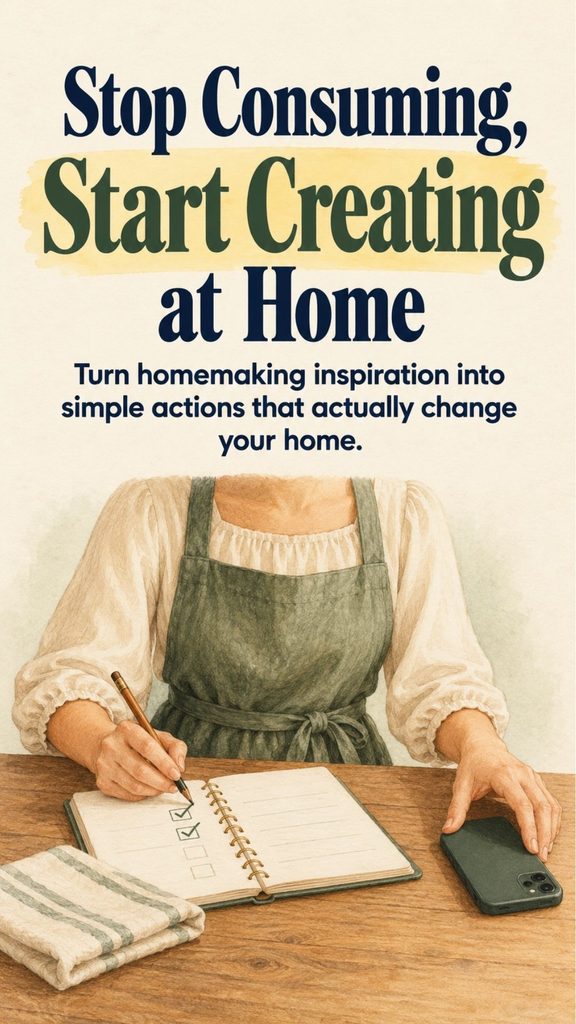
It is remarkably easy to spend an hour watching homemaking videos and feel as though you accomplished something.
You watched someone reset her kitchen.
You saved a pantry organization idea.
You Might Also Like:
- Loading posts...
You learned a better laundry routine.
You pinned three inexpensive dinner recipes.
You listened to advice about morning routines, decluttering, hospitality, gardening, budgeting, and keeping a peaceful home.
Then you put your phone down and notice that the dishes are still in the sink, the drawer you wanted to organize is still overflowing, and the meal-planning system you loved yesterday has not actually made its way into your kitchen.
The problem is not that homemaking content is useless.
The problem is that inspiration can feel so satisfying that we mistake learning for doing.
There is a point where collecting another tip no longer helps. What helps is choosing one useful idea and putting it into practice.
For a homemaker, transformation happens when information becomes action.
Homemaking Is Creative Work
Homemaking is much more than maintaining objects.
You are creating rhythms.
Creating meals.
Creating order.
Creating traditions.
Creating spaces where people rest, eat, talk, work, celebrate, recover, and grow.
For Christian homemakers, this idea can carry an additional spiritual meaning. Proverbs 14:1 describes the wise woman as one who “builds her house.”
That building is not limited to walls and furniture.
A home is built through thousands of ordinary decisions.
How do we speak to one another?
What happens at mealtimes?
Do we repair things or immediately replace them?
Is there room for hospitality?
Does everyone know where important belongings belong?
Do our routines help the household function or create more confusion?
None of these questions is answered by watching someone else’s home.
They are answered through what we repeatedly do in our own.
Inspiration Is Useful—Until It Replaces Action
There is nothing wrong with looking for ideas.
Sometimes a single homemaking article genuinely solves a frustrating problem.
You may discover a better way to organize cleaning supplies.
A video may finally teach you how to bake bread.
A gardening tutorial might show you why your seedlings keep failing.
The difficulty begins when we keep searching long after we already have enough information to begin.
Instead of trying the cleaning routine, we search for another cleaning routine.
Instead of cooking one of the five recipes we saved, we collect ten more.
Instead of decluttering the bathroom cabinet, we watch someone else declutter her entire house.
Eventually, consuming becomes its own form of procrastination.
We feel productive because the content is productive.
But someone else’s productivity does not automatically improve our home.
The Homemaking Hack Trap
There is always another trick available.
Another “life-changing” cleaning method.
Another perfect morning routine.
Another organizing container.
Another weekly reset.
Another meal-planning system.
Another homemaker whose house seems calmer, cleaner, prettier, and more efficient.
That can create the impression that the answer to our household struggles is hiding in the next video.
Usually it is not.
Most homes do not need fifty new systems.
They need a handful of simple systems followed consistently.
A kitchen improves when dishes are regularly washed and returned to their places.
Laundry improves when there is a repeatable rhythm for washing, drying, folding, and putting away.
Meals become easier when somebody decides what dinner will be before everyone is hungry.
Clutter decreases when unwanted things actually leave the house.
None of those ideas is particularly exciting.
That is precisely why we are tempted to keep searching for something more interesting.
But ordinary consistency changes homes much more reliably than endless novelty.
Learn With Your Apron On
One helpful way to approach homemaking content is to imagine that you are learning with your apron already on.
In other words, do not consume information as passive entertainment.
Consume it expecting to use something.
Before opening a video or article, ask:
What problem am I trying to solve?
Perhaps you need help planning inexpensive dinners.
Maybe your entryway is constantly messy.
Maybe you need to learn how to preserve herbs.
Maybe you want a workable cleaning rhythm.
Now look specifically for information that addresses that need.
Once you find a reasonable solution, stop searching and try it.
This changes your relationship with homemaking content completely.
Instead of wandering through hundreds of ideas, you begin looking for tools.
Take Fewer Notes and Use More of Them
A notebook filled with beautiful homemaking ideas is only useful if some of those ideas eventually leave the notebook.
Try a simple rule.
Whenever you learn something genuinely helpful, write down only:
What did I learn?
and
What will I do with it?
For example:
I learned: Keeping a small rag basket in the kitchen can reduce paper-towel use.
I will do: Cut two worn cotton towels into cleaning cloths this Saturday.
Or:
I learned: Planning dinner before grocery shopping can reduce impulse purchases.
I will do: Choose five dinners before making Friday’s grocery list.
The second sentence is where transformation begins.
Use the One-Change Rule
If homemaking currently feels overwhelming, resist the urge to change everything at once.
Choose one improvement.
Then live with it long enough to discover whether it actually works.
Maybe this week you establish a ten-minute evening kitchen reset.
That is enough.
Do it for several days.
Notice what helps and what does not.
Adjust.
Once it becomes reasonably natural, add something else.
Trying to establish a morning routine, new laundry schedule, meal plan, cleaning system, budget, exercise habit, sourdough starter, garden, and weekly family night all at the same time usually creates more pressure than peace.
Homes are built gradually.
Your systems can be built the same way.
Turn Saved Content Into a Project List
If you have hundreds of saved posts, pins, screenshots, and videos, stop adding to the collection for a while.
Go through what you already saved.
Most of it will fall into one of three categories:
Do it.
Save it for a specific future season.
Delete it.
If you saved instructions for building a raised bed and you plan to build one this spring, keep them.
If you saved a laundry tip you could use immediately, try it.
If you cannot remember why you saved something and no longer care about it, delete it.
Digital clutter can create the same mental burden as physical clutter.
You do not need to preserve every good idea you encounter.
Schedule the Action, Not Just the Idea
“I should do that sometime” is where useful ideas go to disappear.
Give the task a place.
If you want to organize the pantry, decide when.
If you want to try homemade bread, put it on Saturday’s plan.
If you want to mend three shirts, place them beside your sewing kit and schedule half an hour.
If you want to clean out the refrigerator, connect it to the day before grocery shopping.
Homemaking improves when vague intentions become specific actions.
You do not need a complicated planner.
Even a simple note can work:
Tuesday — clean one refrigerator shelf.
Thursday — plan next week’s meals.
Saturday — repair loose coat button.
Small scheduled actions accumulate.
Stop Comparing Your Beginning With Someone Else’s Routine
Homemaking content can be encouraging, but it can also create unnecessary discouragement.
You see someone’s perfectly stocked pantry without seeing the years it took to build her cooking habits.
You see a spotless kitchen after the reset, not the mess before the camera turned on.
You see the productive garden in July, not every failed seedling in March.
Use another homemaker’s ideas as possibilities, not as evidence that you are behind.
Your home has different people, finances, schedules, abilities, preferences, and responsibilities.
A routine that works beautifully for someone else may be completely wrong for you.
The goal is not to recreate somebody else’s household.
It is to become more capable of caring for your own.
Let Practical Work Teach You
There are some things you cannot truly learn through content alone.
You can watch ten bread-making videos, but eventually you have to touch dough.
You can read about gardening, but you still need to discover how quickly soil dries in your own yard.
You can study organizing systems, but only living with one tells you whether your family will actually use it.
Action gives you information that research cannot.
You learn:
where the routine breaks down,
what takes longer than expected,
what nobody in the family remembers,
what equipment you actually need,
and what looked wonderful online but is completely unnecessary in your home.
Practice turns borrowed advice into personal knowledge.
Create Before You Consume More
One helpful habit is to place creation before consumption.
Before watching another homemaking video, complete one useful household action.
Wash the breakfast dishes.
Start the laundry.
Water the garden.
Prep dinner.
Clear one cluttered surface.
Then, if you still want to watch something, enjoy it.
This prevents content from taking the time that was supposed to be used for the very homemaking it inspires.
It also changes the emotional experience.
Instead of sitting in a messy room watching someone else clean, you can watch after completing your own small reset.
That feels very different.
Not Every Homemaking Idea Needs to Become Your Idea
You can admire something without adopting it.
Maybe you love watching people can fifty jars of tomatoes but have no desire to preserve food yourself.
Perhaps beautifully organized craft rooms are enjoyable to look at even though you do not craft.
Maybe elaborate seasonal decorating is inspiring, but your own preference is one wreath and a vase of garden branches.
That is fine.
Do not turn inspiration into obligation.
A good homemaker is not someone who performs every domestic skill.
She learns the skills that serve her household and lets the rest remain optional.
A Simple Three-Step Homemaking Challenge
The next time you read an article, watch a video, or save a homemaking idea, do three things.
1. Write down two useful ideas.
Not twenty.
Two.
2. Choose one to apply.
Pick the idea that would make the greatest practical difference in your home right now.
3. Put it on your calendar.
Give it a day.
Then do it before searching for another solution to the same problem.
This tiny practice can dramatically change how much value you receive from the content you already consume.
Measure Progress by What Changed
At the end of the week, do not ask:
“How many homemaking videos did I watch?”
Ask:
“What is easier in my home now?”
Maybe dinner is planned three nights ahead.
Maybe everyone finally has a place for shoes.
Maybe you learned to mend a torn seam.
Maybe one drawer stays organized because you removed half of what was inside.
Maybe you baked your first loaf.
Maybe you stopped buying something you can easily make.
That is real progress.
Small changes are often far more valuable than dramatic temporary transformations.
Creating Does Not Mean Constant Productivity
There is another trap worth avoiding.
Moving from consuming to creating does not mean every free minute should become work.
Rest is part of home life too.
Reading for enjoyment is worthwhile.
Watching a beautiful video simply because you enjoy it is not a failure.
Sitting outside with coffee is not wasted time.
The difference is intention.
Entertainment is perfectly healthy when you know you are choosing entertainment.
The trouble begins when we tell ourselves we are “learning” for three hours while using information to avoid the task we already know needs to be done.
Honesty restores balance.
Build the Home in Front of You
There will always be more advice available.
You could spend years learning about cleaning, cooking, gardening, decorating, budgeting, sewing, preserving, organizing, hospitality, parenting, and simple living.
You will never reach the end of the information.
Fortunately, you do not need to.
You need enough knowledge for the next faithful step.
Learn something useful.
Put down the phone.
Tie on the apron.
Try it.
Adjust it.
Keep what works.
Discard what does not.
Then learn the next thing when you actually need it.
For the Christian homemaker, building a home is not primarily about producing something impressive enough to display online. It is about faithfully caring for the people, responsibilities, and resources that have been placed in front of you.
The transformation happens in ordinary action.
Not in another saved post.
Not in another perfect routine.
Not in watching another woman build her home.
In building yours.