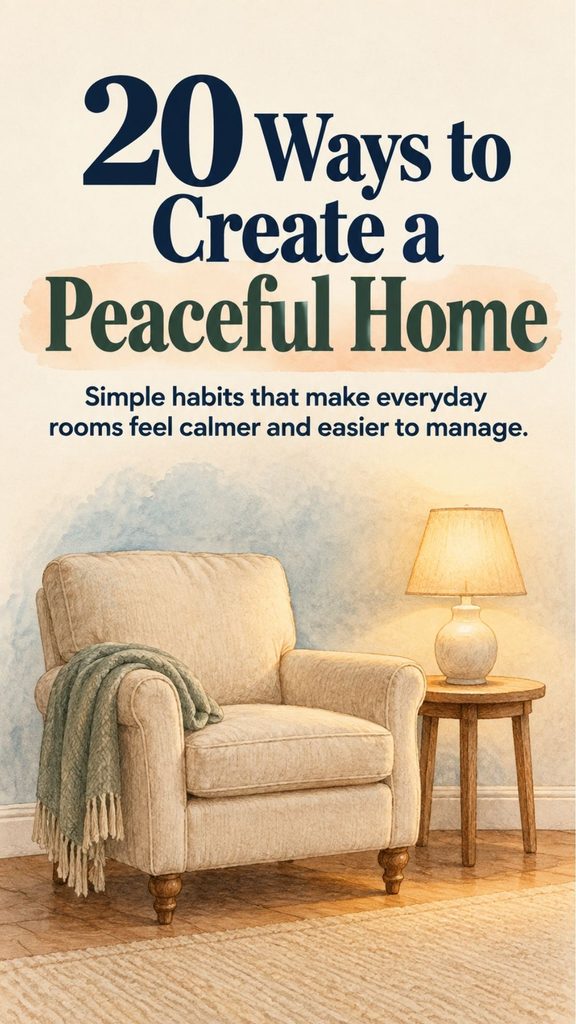
A peaceful home is not necessarily a spotless home, a silent home, or a perfectly decorated home.
It is a place where daily life feels manageable.
You can walk through a room without constantly moving piles out of the way. There is somewhere comfortable to sit. The lighting is pleasant in the evening. Family members have some predictable rhythms. Technology does not dominate every quiet moment. And when life becomes stressful outside the home, there are at least a few places inside it where you can slow down.
You Might Also Like:
- Loading posts...
Creating that atmosphere usually has less to do with buying new decor and more to do with removing unnecessary friction.
A few small changes repeated consistently can make a home feel noticeably calmer.
Here are 20 practical ways to begin.
1. Declutter a Little Every Day
Clutter creates visual noise.
A chair covered in clothes, a kitchen counter buried beneath papers, or an entryway filled with shoes may not seem like a major problem individually, but several cluttered areas together can make a home feel unsettled.
You do not need to spend an entire weekend decluttering.
Try ten minutes a day.
Return things to their proper places.
Throw away obvious rubbish.
Put dishes in the kitchen.
Move laundry where it belongs.
Remove one item you no longer need.
The goal is not minimalism for its own sake. It is making everyday spaces easier to use.
2. Use Warm, Comfortable Lighting
Harsh overhead lighting can make an otherwise comfortable room feel clinical.
During the evening, use softer lamps where practical.
A reading lamp beside a chair, a small lamp in the kitchen, or warm-toned bulbs in living areas can create a gentler atmosphere than relying entirely on bright ceiling lights.
That does not mean every room should be dim.
Work areas still need enough light to be safe and useful.
Think in layers: strong light when you are cleaning or cooking, softer light when the household is winding down.
3. Add a Few Indoor Plants
Plants can make a room feel more alive without requiring complicated decoration.
A pot of herbs in the kitchen, a trailing plant on a shelf, or a sturdy houseplant near a window may be enough.
Choose plants that actually suit the light available in your home.
A struggling plant in the wrong location creates more work rather than more peace.
If you have pets or small children, check whether a plant is appropriate for your household before bringing it indoors.
You do not need a jungle.
One healthy plant is better than ten neglected ones.
4. Use Sound Intentionally
A home does not need to be silent to feel peaceful.
Sometimes gentle background sound makes a space feel warmer.
Soft instrumental music, nature sounds, quiet radio, or simply the natural sounds coming through an open window can all work.
The important thing is avoiding constant unwanted noise.
If the television runs all day even when nobody is watching, try turning it off for part of the afternoon.
You may be surprised by how different the room feels.
5. Be Careful With Home Fragrance
Scent can influence how we experience a room, but stronger is not always better.
If you enjoy essential oils, candles, simmer pots, or other fragrance products, use them lightly and safely.
Fresh air, clean textiles, an emptied rubbish bin, and a clean kitchen often improve the smell of a home more effectively than trying to cover odors with fragrance.
Essential oils also require caution around children and pets, and some people are sensitive to strong scents.
A peaceful home should be comfortable for the people living in it.
6. Limit Background Screen Time
Screens can quietly take over a household.
The television is on.
Everyone has a phone nearby.
A tablet sits on the kitchen counter.
Notifications interrupt conversations.
You do not need to ban technology to reduce that noise.
Choose a few parts of the day when screens are not automatically present.
Perhaps phones stay away from the dinner table.
Maybe the television remains off during the first hour of the morning.
Small boundaries can make the home feel less rushed and distracted.
7. Create One Cozy Corner
You do not need to redesign an entire room.
Create one place that feels good to sit.
It might be a chair near a window with a small table and lamp.
It could be one corner of the sofa with a basket of blankets nearby.
Perhaps it is a porch chair where you drink coffee in the morning.
Give that spot a clear purpose: reading, resting, journaling, knitting, or simply sitting quietly.
A dedicated place to slow down can make rest feel more natural.
8. Keep a Simple Daily Routine
Predictability reduces a surprising amount of household stress.
You do not need a minute-by-minute schedule.
A few anchors are enough.
Open the curtains in the morning.
Make the bed.
Reset the kitchen after dinner.
Start laundry on certain days.
Prepare tomorrow’s essentials before bed.
Regular rhythms keep small tasks from turning into emergencies.
The best routine is not the most impressive one.
It is the one your household can actually maintain.
9. Choose Colors You Can Live With
Neutral colors can feel calm to some people, but there is no rule that peaceful homes must be beige.
The better principle is to avoid surrounding yourself with colors that feel visually exhausting to you.
Maybe you prefer cream, sage, soft blue, warm wood, and linen.
Someone else may feel happiest around deeper greens, terracotta, or rich navy.
Use quieter colors on larger surfaces if that helps you relax, then add stronger colors through smaller pieces.
Your home does not need to follow a trend.
It needs to feel comfortable to you.
10. Make the Most of Natural Light
Open curtains or blinds during the day when privacy and weather allow.
Natural daylight can make rooms feel more open and pleasant.
It also helps you notice which parts of the home actually need artificial lighting.
Keep windows reasonably clean and avoid blocking every window with heavy furniture.
If a room receives little natural light, work with it rather than fighting it. Use appropriate lamps, mirrors carefully placed for brightness, and lighter surfaces where useful.
11. Create Quiet Periods
Constant sound can be tiring.
Consider establishing a naturally quieter time in the household.
Perhaps early mornings remain calm.
Maybe the hour before bed is quieter.
Turn down music.
Avoid unnecessary television.
Let children read or play quietly.
A quiet period does not have to mean enforced silence.
It simply gives everyone a break from constant stimulation.
12. Make Honest Conversation Normal
A beautifully organized house cannot compensate for constant tension between the people living in it.
A peaceful home depends partly on how family members speak to one another.
Listen before responding.
Discuss problems before resentment grows.
Apologize when necessary.
Avoid turning every irritation into a confrontation.
Not every disagreement can be solved immediately, but respectful conversation prevents many ordinary problems from becoming larger than they need to be.
Peace is not the absence of disagreement.
It is the ability to handle disagreement without making the home feel emotionally unsafe.
13. Choose Comfortable Furniture Over Impressive Furniture
Furniture should support the way people actually live.
A beautiful sofa nobody enjoys sitting on is not particularly useful.
Neither is a dining chair that looks stylish but becomes uncomfortable after ten minutes.
When replacing furniture, consider comfort, durability, cleaning, size, and how often the piece will be used.
You do not need to replace furniture simply to create a peaceful room.
Sometimes rearranging what you already own improves the space more than buying anything new.
14. Let Fresh Air In When Conditions Allow
Opening windows can quickly freshen a room.
When outdoor air quality, weather, temperature, and safety allow, even a short period of ventilation can make indoor spaces feel less stale.
Cross-ventilation works particularly well when windows on opposite sides of a room or home can be opened.
Of course, there are times when windows should stay closed—during extreme temperatures, high pollution, wildfire smoke, or heavy pollen for sensitive household members.
Use common sense rather than treating open windows as a rule.
15. Decorate With Less, but Make It Meaningful
More decoration does not always make a room feel more complete.
Sometimes it makes the room harder to clean and visually busier.
Keep the pieces you genuinely enjoy.
A framed family photograph.
A favorite painting.
A handmade quilt.
A bowl from your grandmother.
A few books.
A vase of seasonal branches.
Meaningful objects tend to feel warmer than shelves filled simply because empty space seemed wrong.
Allow some surfaces to remain clear.
Empty space can be useful.
16. Add Soft Textures Where They Help
Comfort often comes from texture rather than decoration.
A washable throw blanket.
Cotton or linen curtains.
A rug beside the bed.
A comfortable cushion.
Soft bedding.
These little things can make rooms feel more inviting.
But avoid accumulating more textiles than you can reasonably wash and store.
A sofa covered with fourteen decorative pillows may become another daily chore.
Choose softness that serves a purpose.
17. Create One Tech-Free Space
Consider choosing one area where phones, tablets, and laptops are not the default activity.
The dining table is an obvious choice.
A reading chair could be another.
Perhaps the bedroom stays mostly screen-free.
The idea is not to create strict household punishment.
It is to preserve at least one place where attention is not constantly divided.
When a space has a clear purpose, habits often follow.
18. Surround Yourself With Words That Actually Matter
Positive quotes can be encouraging, but you do not need every wall covered in slogans.
Choose one or two words, verses, family sayings, or pieces of writing that genuinely mean something to you.
Frame a favorite passage.
Keep a meaningful note on the refrigerator.
Write a reminder in your planner.
The value is not in decoration itself.
It is in putting something visible in the home that reminds you how you want to live.
19. Practice Gratitude for the Home You Already Have
It is difficult to create peace while constantly comparing your home with someone else’s.
There will always be a larger kitchen.
A more beautiful garden.
A cleaner living room.
Newer furniture.
Better storage.
Gratitude does not mean pretending your home has no problems.
It means noticing what is already serving you.
The table where everyone eats.
The window that gets morning sun.
The old chair that is still comfortable.
The pantry with enough food for dinner.
The garden that produced three tomatoes instead of thirty.
A home does not have to be finished before it can be appreciated.
20. Let Go of Perfection
This may be the most important one.
A peaceful home will still become messy.
Laundry will accumulate.
Someone will leave shoes where they do not belong.
Dinner will occasionally be late.
Plants will die.
Projects will remain unfinished.
Children will make noise.
Guests may arrive when the bathroom is not spotless.
If your idea of peace depends on everything being perfect, peace will always remain one chore away.
Aim for a home that functions.
A home that feels cared for.
A home where people can rest.
A home where mistakes are allowed.
That is far more sustainable than trying to maintain perfection.
Peace Usually Comes From Removing Friction
Notice how few of these ideas require buying something.
Most involve subtraction.
Less clutter.
Less unnecessary noise.
Less screen distraction.
Less pressure.
Less comparison.
Less perfectionism.
Then you add a few useful things back:
a routine,
comfortable light,
fresh air,
a place to sit,
meaningful conversation,
and small habits that make the household easier to live in.
That combination can transform the feeling of a home much more effectively than a shopping trip.
Start With the Room You Use Most
Do not try to change the entire house tomorrow.
Choose one room.
If that is the kitchen, clear the counters and establish a simple evening reset.
If it is the living room, remove unnecessary clutter and improve the lighting.
If it is the bedroom, clear the nightstand and make the bed comfortable.
If it is the entryway, create obvious places for shoes, keys, and bags.
Once one room becomes easier to live in, move to the next.
A Peaceful Home Is Built Through Small Repeated Choices
Peace is rarely created by one dramatic makeover.
It comes from what happens every day.
Putting something away instead of dropping it.
Turning off a screen nobody is watching.
Opening the curtains.
Speaking gently.
Clearing the kitchen before bed.
Choosing not to buy another decorative object.
Sitting down for ten minutes without feeling guilty.
Those choices may seem insignificant individually.
Together, they create the atmosphere of a home.
And that is the real goal—not a perfect room, but a place where the people living there can breathe a little easier.