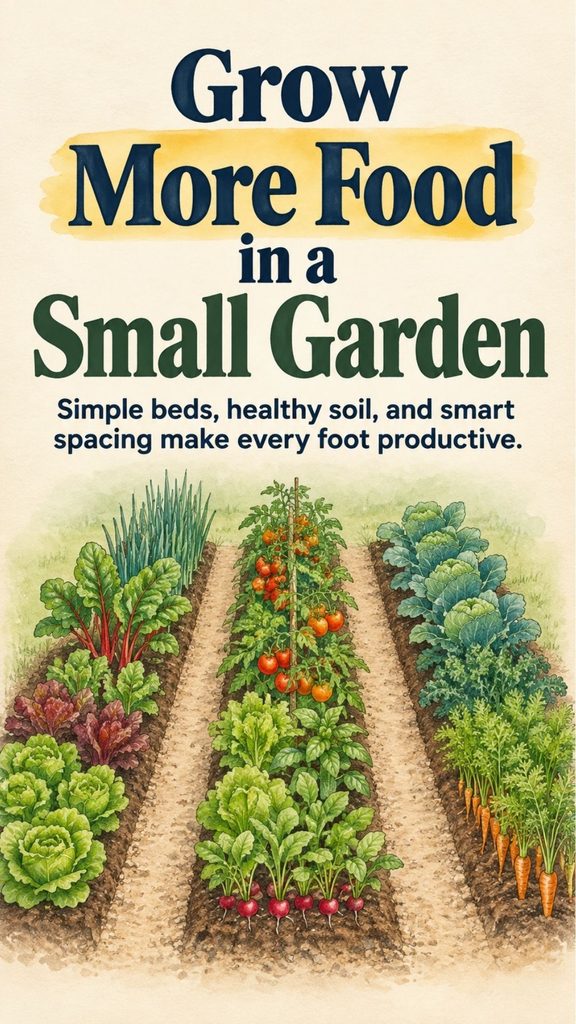
A small garden does not have to mean a small harvest.
When space is limited, the goal is not to squeeze plants into every available inch. The better approach is to make the growing area productive, keep the layout simple, improve the soil, and use each bed repeatedly through the season.
That is the central lesson from Charles Dowding’s Small Garden at Homeacres. His small growing area was designed around three goals: produce a high output from limited space, work around difficult conditions such as shade and buried slabs, and grow a diverse range of vegetables over a long harvest season.
You Might Also Like:
- Loading posts...
The garden demonstrates something encouraging for anyone with a modest backyard: you do not need a huge vegetable plot to grow a useful amount of fresh food.
You need to use the space well.
Start by Looking at the Space You Actually Have
A small garden is easier to plan when you stop wishing it were bigger.
Look honestly at the site.
Where does the sun fall?
Which areas are shaded?
Where are the fences?
Are there trees or neighboring shrubs competing for light?
Is the soil easy to work, or are there stones, old foundations, buried slabs, or other obstacles?
The Homeacres small garden was not an ideal blank plot when it began. It was overgrown, had previously contained structures, and still had old slabs beneath the soil that made pushing in canes and stakes difficult. There were also neighboring plants and weeds affecting the edges.
Instead of trying to create perfect conditions everywhere, the garden was organized around those limitations.
That is useful advice for any small garden.
Work with the best growing area first.
Keep the Layout Simple
One of the easiest mistakes in a small garden is making the design too complicated.
Too many tiny beds, decorative borders, narrow corners, and unnecessary structures can use valuable space without adding much growing area.
The Homeacres example uses just three beds. Together, the beds and paths occupy about 25 square metres, or 270 square feet. Each bed is approximately 1.5 metres, or 5 feet, wide.
A simplified top view looks something like this:
+----------------------+
|                      |
|        BED 1         |
|                      |
+----------------------+

--------- PATH ---------

+----------------------+
|                      |
|        BED 2         |
|                      |
+----------------------+

--------- PATH ---------

+----------------------+
|                      |
|        BED 3         |
|                      |
+----------------------+
You do not need to copy these dimensions exactly.
The useful principle is keeping enough growing width to produce plenty of food while still being able to reach the plants from the paths.
Simple beds are also easier to mulch, weed, plant, and replant.
You Do Not Necessarily Need Wooden Sides
Raised beds are often pictured as wooden boxes, but productive garden beds do not have to be surrounded by boards.
At Homeacres, the first beds in this area were created with compost and no wooden sides. Cardboard was used initially on the paths.
This can make a small garden simpler and leave more of the available width for growing.
Wooden sides may still be useful in particular gardens, but they are not a requirement for defining a vegetable bed.
A bed can simply be a permanent growing strip with a permanent walking path beside it.
The important part is knowing where you walk and where you grow.
Keep Your Feet Out of the Beds
Once beds and paths are established, keep walking on the paths.
That simple habit means the growing areas do not have to withstand repeated foot traffic.
You can then tend the beds from either side rather than stepping between vegetables.
In a small garden, permanent paths also make the layout much easier to manage because there is never any question about where the next crop belongs.
The structure stays the same even when the vegetables change.
Feed the Surface With Compost
The Homeacres beds are managed with a no-dig approach.
Rather than repeatedly turning the soil, the beds receive a surface mulch of compost.
The small garden is generally mulched each year with about 5 cm, or 2 inches, of compost. The compost may be homemade or purchased. It is usually spread in autumn after the final crops are cleared, although timing can change when an autumn crop is being planted.
The useful lesson is consistency.
Instead of repeatedly rebuilding the bed, maintain the same growing area and replenish the surface.
For a small garden, this is particularly convenient because only a limited area needs compost each year.
Do Not Divide Every Bed Too Rigidly
It can be tempting to draw a garden plan with every bed divided into perfectly equal squares.
Real vegetables do not always cooperate with perfect geometry.
At Homeacres, each of the three beds is thought of as having several cropping areas, but Dowding specifically notes that it works better to remain flexible rather than insisting that every crop receives an exact quarter of a bed. Different vegetables need different amounts of room, and gardeners also want different quantities of each crop.
A flexible plan might look like this:
+--------------------------------+
| LETTUCE |      BEANS           |
|---------|----------------------|
| BEET    |      CARROTS         |
+--------------------------------+
Then, in another bed:
+--------------------------------+
|        KALE       | RADISH     |
|-------------------|------------|
|        LEEKS      | SALAD      |
+--------------------------------+
The divisions are not permanent.
They simply change according to what you want to grow.
Grow What You Actually Eat
This becomes especially important in a small garden.
There is little value in giving half your best bed to a vegetable your household rarely eats.
Use more space for crops you enjoy and less space for crops you only want occasionally.
The source garden was planned to provide a diverse range of vegetables, with the intention of having several fresh choices available daily through much of the growing season.
Your own version may be completely different.
Perhaps salad leaves matter most.
Perhaps tomatoes, beans, herbs, and cucumbers are your priorities.
The smaller the garden, the more important those decisions become.
Think in Harvests, Not Just Plantings
A small garden becomes much more productive when you stop thinking of each bed as being occupied by one crop for the whole year.
Once one crop finishes, another can take its place.
In Dowding’s temperate Zone 8 conditions, many vegetables can produce two crops in the same space within one year. After the first crop is removed, the next can be planted without another application of compost in many cases.
That changes the way a small garden should be viewed.
A three-bed garden is not necessarily just three planting opportunities.
Each section may produce more than once.
For example:
SPRING
+----------------------+
|       LETTUCE        |
+----------------------+

          ↓ harvest

SUMMER / AUTUMN
+----------------------+
|       BEANS          |
+----------------------+
Or:
EARLY CROP
+----------------------+
|       RADISH         |
+----------------------+

          ↓ harvest

LATER CROP
+----------------------+
|       SPINACH        |
+----------------------+
The exact crop sequence depends on your climate and growing season, but the principle is simple: do not leave productive soil empty unnecessarily.
Have the Next Crop Ready
Succession growing works much better when the next plant is ready before the first crop finishes.
If you wait until a bed becomes empty before deciding what to sow, several weeks of growing time may be lost.
Instead, think one crop ahead.
As vegetables approach harvest, decide what will replace them.
This makes small-space gardening much more deliberate.
Your garden starts behaving less like several isolated beds and more like a continuous cycle.
Remove Finished Crops Without Rebuilding the Bed
Another useful part of the Homeacres approach is how quickly one crop can be replaced by another.
Dowding describes removing the remains of the first crop and putting the next crop directly into the bed.
There is no need to treat every harvest as the beginning of a major soil renovation.
The bed remains the bed.
The crop changes.
That saves time, which is especially helpful when several planting windows arrive close together.
Crop Rotation Can Be Flexible Too
Gardeners are often taught complicated crop-rotation systems in which plant families must move through a strict sequence over several years.
In a small garden, that can become difficult.
If you only have three beds and grow many kinds of vegetables, a rigid rotation may make the garden harder to use rather than easier.
The Homeacres small-garden approach does not treat rotation as something that must be fixed permanently. Some separation between repeated crops can be useful where practical, but the planting plan remains flexible.
That is particularly practical in limited spaces.
You can still pay attention to where crops have grown without allowing a complicated rotation chart to dictate every planting decision.
Keep the Garden Edges Under Control
Small gardens can lose usable space surprisingly quickly when the edges become overgrown.
Ivy, nettles, bindweed, grass, shrubs, and plants from neighboring properties may slowly creep toward the productive beds.
At Homeacres, the surrounding edges require regular attention. Ivy is removed from the fence periodically, weeds appear near boundaries, gravel edges are weeded, and nettles are cut back several times each year.
This is easy to overlook because boundary maintenance does not feel as rewarding as planting vegetables.
But in a small garden, every foot matters.
Keeping edges tidy also makes paths easier to use and prevents vigorous plants from stealing light or growing room.
Shade Is Not Always a Reason to Give Up
A small garden often has less control over sunlight than a large open plot.
Fences, buildings, trees, and neighboring shrubs may create shade at different times of day.
You may not be able to change those things.
Instead, observe where the strongest light falls and use the space accordingly.
The original small garden was deliberately intended to work around limiting conditions rather than waiting for perfect ones.
That attitude is valuable.
Garden the space you actually have.
Don’t Waste Space on Complicated Paths
Paths are necessary, but they should serve a clear purpose.
You need enough width to walk, harvest, and work comfortably.
Beyond that, extra path width reduces the area available for crops.
In a very small garden, a straightforward arrangement often makes more sense than winding decorative routes.
The goal is easy access to every part of the beds without stepping into them.
Keep the Beds Productive Into Autumn
A productive vegetable garden does not necessarily finish when summer ends.
Some autumn plantings can remain in place and continue producing well beyond the main summer season.
The Homeacres article gives spinach planted in August as an example of an autumn planting capable of cropping into the following year under its local conditions.
This is another reason to think ahead.
An empty bed in late summer may still represent months of potential food production.
Winter Is Part of the Plan
Even when winter growth slows, the garden does not need to become irrelevant.
Some vegetables may remain harvestable, and beds not carrying crops can be prepared for the following season.
The original goal for the Homeacres space included fresh vegetables during the main May-to-November period and some winter production as well.
Your own possibilities depend heavily on local climate, but the underlying lesson is worth keeping:
Think of the garden as a year-round space rather than a project that exists only in summer.
A Small Garden Rewards Regular Attention
Large gardens can sometimes hide neglect.
Small gardens cannot.
A few weeds can quickly become a large percentage of the bed.
One crop left too long may occupy valuable growing space.
A neglected boundary can shade an entire section.
But the advantage works in the opposite direction too.
Because the space is small, maintenance can be quick.
A few minutes of weeding may cover the entire garden.
Adding compost requires less material.
Harvesting is easy.
Checking for problems takes little time.
A well-managed small garden can therefore be surprisingly efficient.
Don’t Measure Success by Garden Size
A garden is productive because of what it produces, not because of how many square feet it occupies.
Three well-managed beds that are planted repeatedly can offer more useful food than a much larger area that is planted once and then neglected.
That is the real value of the Homeacres small-garden example.
The area is modest—about 25 square metres including paths—yet its design is based on diversity, regular cropping, annual compost, and quick succession between vegetables.
The system is simple enough to understand:
COMPOST BED
     ↓
PLANT CROP 1
     ↓
HARVEST
     ↓
REMOVE FINISHED CROP
     ↓
PLANT CROP 2
     ↓
HARVEST AGAIN
That cycle is what turns limited ground into productive ground.
A Practical Small Garden Layout
If you are starting from scratch, a simple three-bed arrangement is enough to demonstrate the idea.
        SMALL VEGETABLE GARDEN

+-----------------------------+
|            BED 1            |
| salads | roots | vegetables |
+-----------------------------+

=========== PATH ==============

+-----------------------------+
|            BED 2            |
| beans | greens | vegetables |
+-----------------------------+

=========== PATH ==============

+-----------------------------+
|            BED 3            |
| herbs | leeks | succession  |
+-----------------------------+
The labels are only examples.
What matters is having clearly defined growing areas, accessible paths, and enough flexibility to replace harvested crops quickly.
Make Every Square Foot Work More Than Once
Small gardens encourage good decisions.
There is less room for crops nobody eats.
Less room for unused soil.
Less space for weeds.
Less reason to leave harvested beds empty.
That limitation can actually make you a more attentive gardener.
Keep the design straightforward.
Create permanent beds and paths.
Feed the beds with compost.
Grow vegetables you genuinely want to harvest.
Stay flexible about how much space each crop receives.
Prepare second crops before the first ones finish.
Keep the boundaries under control.
And resist the idea that you need a large property before vegetable gardening is worthwhile.
A small garden may never produce everything your household eats.
It does not need to.
If a few carefully managed beds give you regular harvests of fresh vegetables across much of the year, that small patch of ground is already doing a great deal.