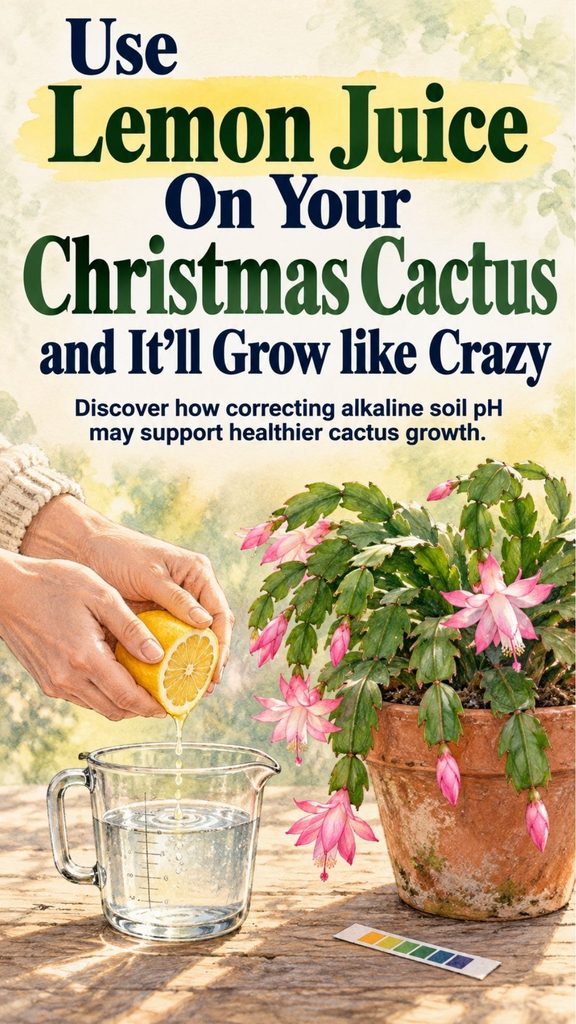
A Christmas cactus covered in glossy green segments and beautiful winter flowers is one of the loveliest houseplants to have around the home. But when yours seems to stop growing, produces only a few new segments, or refuses to bloom, it can be tempting to try every homemade gardening trick you come across.
One particularly popular suggestion involves adding lemon juice to the watering can to make Christmas cactus grow faster and produce healthier foliage.
The idea comes from the fact that Christmas cacti generally prefer a slightly acidic growing medium. Since lemon juice contains citric acid, it might seem like an inexpensive way to create better growing conditions.
You Might Also Like:
- Loading posts...
However, there is an important difference between providing the correct soil pH and repeatedly adding household acids to a plant’s roots.
Lemon juice is not a proven growth stimulant for Christmas cactus, and using too much can make growing conditions worse rather than better.
Understanding why the idea became popular, what soil acidity actually does, and how to improve your plant’s growing environment will help you encourage healthier growth without unnecessary experimentation.
Why Soil Acidity Matters for Christmas Cactus
Christmas cactus belongs to the Schlumbergera genus, a group of tropical cacti native to Brazil.
Unlike the desert cacti many people are familiar with, these plants naturally grow in humid forest environments, often establishing themselves in organic material collected around trees and rocks.
They are adapted to conditions quite different from those preferred by typical desert succulents.
Christmas cacti generally grow well in a loose, well-draining, slightly acidic potting medium. A pH of approximately 5.5–6.5 is a reasonable target, although plants can tolerate some variation.
Soil pH matters because it influences how readily certain nutrients become available to plant roots.
If the growing medium becomes excessively alkaline or acidic, nutrient availability can change, potentially contributing to poor growth.
However, soil pH is only one part of plant care.
A Christmas cactus that isn’t producing new growth may also be struggling with improper watering, inadequate light, compacted soil, temperature stress, root damage, or insufficient nutrients.
That is why adding lemon juice without identifying the actual problem is unlikely to provide a dependable solution.
Can Lemon Juice Help a Christmas Cactus?
Fresh lemon juice is acidic because it contains citric acid.
When mixed with water, it can temporarily lower the pH of that solution. This is the reason some gardeners recommend using diluted lemon juice around plants that prefer slightly acidic conditions.
But there are several limitations.
The acidity of individual lemons can vary, and the effect of lemon juice depends on the chemistry of the water and growing medium.
A homemade mixture also does not provide the predictable, buffered pH adjustment that a properly selected horticultural product can offer.
Repeated applications may cause unwanted fluctuations in the root environment, particularly in small containers.
While a small amount of heavily diluted lemon juice may not necessarily cause immediate visible damage, there is insufficient evidence that regularly watering Christmas cactus with it improves growth or flowering.
For this reason, lemon juice should not be treated as a routine fertilizer, growth booster, or solution for an unhealthy plant.
A better approach is to investigate the soil and water conditions before making adjustments.
Step 1: Check Your Christmas Cactus Soil
If your Christmas cactus has stopped growing despite otherwise suitable care, begin by examining the potting medium.
A healthy Christmas cactus needs a mixture that provides moisture while allowing excess water to drain freely.
Old, compacted potting soil can become problematic because it may hold too much water or provide insufficient airflow around the roots.
Check whether the pot has drainage holes and whether water moves through the growing medium properly.
Also look for obvious problems such as an unpleasant smell, persistent sogginess, or roots showing signs of deterioration.
If you suspect a genuine pH problem, use a suitable soil pH test rather than guessing.
Commercial soil-testing kits or laboratory testing are more informative than homemade experiments involving kitchen vinegar or baking soda, which do not provide dependable numerical measurements.
Remember that a slightly alkaline reading does not automatically explain every case of slow growth.
Consider the plant’s overall condition before making changes.
Step 2: Improve the Growing Medium Naturally
If your Christmas cactus is planted in unsuitable soil, replacing the potting medium is often a more practical long-term solution than repeatedly adding acidic liquids.
Choose a loose mixture suitable for tropical epiphytic cacti.
A combination of appropriate potting mix with ingredients such as perlite, fine orchid bark, or other suitable aerating materials can provide a balance of drainage and moisture retention.
The exact proportions depend on the ingredients and how quickly they dry in your home.
Avoid using dense garden soil in a small indoor pot, as it may compact and drain poorly.
When repotting, choose a container with drainage holes and avoid increasing the pot size unnecessarily.
Christmas cactus often flowers well when somewhat snug in its container, provided the roots remain healthy and the growing medium is in good condition.
Step 3: Pay Attention to Water Quality
Water quality can influence the long-term condition of container-grown plants.
Some tap water contains relatively high concentrations of dissolved minerals and bicarbonates. Repeated watering with highly alkaline water may gradually affect the chemistry of certain potting media.
This is one possible reason why a Christmas cactus might experience difficulties even when the original potting mix was suitable.
However, hard water and alkaline water are not exactly the same thing. Hardness mainly refers to dissolved calcium and magnesium, while alkalinity describes the water’s capacity to neutralize acids.
If you suspect your water is contributing to a problem, consider having it tested.
Where practical, collected rainwater can be an alternative, provided it is gathered and stored hygienically.
Suitable low-mineral water may also be useful for plants affected by excessive mineral accumulation.
There is no need to automatically add lemon juice to every watering can.
If a measurable water-alkalinity problem requires correction, use an appropriate horticultural treatment according to reliable guidance.
Step 4: Give Your Christmas Cactus the Right Amount of Light
One of the most important factors affecting Christmas cactus growth is light.
These plants prefer bright, indirect sunlight.
An eastern-facing window can provide suitable conditions, offering gentle morning light without prolonged exposure to intense afternoon sun.
A position near another bright window may also work, depending on the season and your climate.
Too little light can contribute to weak growth and poor flowering. Excessive direct sunlight, especially through hot summer windows, may cause stress, discoloration, or damage to the segments.
Aim for a bright location where the plant receives enough light without being exposed to harsh heat.
Moving a Christmas cactus from a dark corner to a more suitable position may help considerably more than experimenting with homemade soil additives.
Step 5: Adjust Your Watering Routine
Christmas cactus requires a different watering approach from most desert cacti.
It appreciates moisture during active growth, but its roots should not remain continuously waterlogged.
Rather than following a rigid daily or weekly watering schedule, check the growing medium.
Allow the upper portion of the mix to begin drying before watering again.
When watering, moisten the growing medium thoroughly and allow excess water to drain from the bottom of the container.
Empty any water that collects in an outer decorative pot or saucer.
During cooler periods or when the plant is growing more slowly, it may require less frequent watering.
Persistent overwatering can damage the roots, making it difficult for the plant to absorb the moisture and nutrients it needs.
Ironically, a Christmas cactus with unhealthy roots may look dehydrated even when its soil remains wet.
Step 6: Maintain Comfortable Temperatures
Christmas cactus generally grows comfortably at ordinary indoor temperatures.
During active growth, temperatures around 65–75°F (18–24°C) are often suitable.
Try to keep the plant away from heating vents, cold drafts, and sudden temperature extremes.
Although Christmas cactus tolerates a range of conditions, repeated environmental stress can interfere with healthy development.
Temperature also plays an important role in flower-bud formation.
The plant’s blooming cycle is influenced by day length and temperature, which is why mature Christmas cacti often begin developing buds as autumn progresses.
Suitable cooler conditions and sufficiently long, uninterrupted nights can help encourage flowering.
Simply adding lemon juice to the soil cannot replace those natural environmental signals.
Step 7: Feed Your Christmas Cactus During Active Growth
If your Christmas cactus has healthy roots, adequate light, and an appropriate growing medium but produces little new growth, nutrition may be worth considering.
A suitable balanced houseplant fertilizer can provide essential nutrients during the growing season.
Follow the manufacturer’s instructions and avoid excessive feeding.
Many indoor gardeners prefer a diluted fertilizer applied periodically during spring and summer, when new segments are actively developing.
Reduce feeding during periods of slower growth, particularly when environmental conditions are less favorable.
Remember that lemon juice is not a balanced plant fertilizer.
It does not provide the nitrogen, phosphorus, potassium, and other essential nutrients required for healthy plant development.
Can Lemon Juice Encourage More Christmas Cactus Flowers?
There is no dependable evidence that watering Christmas cactus with lemon juice directly stimulates flower production.
Flowering is influenced by several environmental and physiological factors, particularly plant maturity, light exposure, nighttime conditions, and temperature.
To encourage blooming, focus on providing a consistent care routine throughout the year.
During autumn, Christmas cactus can benefit from naturally shortening days and cooler nighttime temperatures appropriate for bud development.
Avoid exposing the plant to strong artificial lighting throughout the night when trying to encourage flowering through a short-day routine.
Once buds begin forming, maintain reasonably stable conditions.
Sudden changes in temperature, severe drying, prolonged waterlogging, or other environmental stresses can contribute to bud drop.
A healthy plant given appropriate seasonal conditions has a better opportunity to flower than one receiving repeated experimental treatments.
Common Reasons Your Christmas Cactus Isn’t Growing
Before attempting to change soil acidity, look for these common problems.
Insufficient light: A plant kept in a dim room may produce very little new growth.
Overwatering: Constantly wet soil can interfere with root function and contribute to root deterioration.
Poor drainage: Heavy or compacted growing media may retain more moisture than the plant can tolerate.
Nutrient limitations: A plant growing in an old, depleted medium may benefit from appropriate fertilization or repotting.
Temperature stress: Extreme heat, cold drafts, and sudden changes can affect growth.
Seasonal slowing: Christmas cactus does not necessarily produce new segments at the same rate throughout the entire year.
Root problems: Damaged or unhealthy roots can prevent a plant from absorbing the water and nutrients it needs.
Identifying the actual cause is much more useful than applying the same homemade remedy to every struggling plant.
What About Lemon Juice’s Antimicrobial Properties?
Lemon juice is sometimes promoted as a natural treatment for harmful bacteria and fungi in potting soil.
Although citric acid and certain lemon-derived preparations have demonstrated antimicrobial activity under laboratory conditions, this does not establish diluted lemon juice as an effective treatment for houseplant diseases.
Soil contains a complex community of microorganisms, including many that contribute to normal decomposition and nutrient cycling.
Repeatedly adding acidic substances without understanding their effects may disturb the growing environment rather than improve it.
If your Christmas cactus develops signs of root rot or another disease, identify the problem and correct the contributing conditions.
Good drainage, appropriate watering, healthy planting material, and suitable growing conditions are more reliable starting points than household acid treatments.
How Fast Should a Healthy Christmas Cactus Grow?
Christmas cactus growth varies according to plant maturity, growing conditions, season, and general health.
During favorable periods, a healthy plant produces new flattened stem segments from the ends of existing growth.
A mature Christmas cactus may also develop a fuller, cascading appearance over time.
However, there is no universal number of inches that every plant must grow each year.
A plant that appears relatively unchanged during winter may begin producing fresh segments when spring brings longer days and more favorable conditions.
Look for firm, healthy growth and gradual development rather than expecting constant rapid expansion.
The Best Way to Help Your Christmas Cactus Thrive
Homemade gardening tricks can be interesting, but not every popular suggestion deserves a permanent place in your plant-care routine.
Christmas cactus does benefit from a suitable, slightly acidic growing medium, but repeatedly adding lemon juice is not a reliable way to maintain that environment or guarantee vigorous growth.
If your plant appears unhappy, begin with the basics: examine its roots, check drainage, provide bright indirect light, water appropriately, and consider the condition of its potting mixture.
Test soil or water chemistry when there is a genuine reason to suspect a pH-related problem.
If correction is necessary, choose a controlled horticultural approach rather than guessing with kitchen ingredients.
The most dependable way to grow a beautiful Christmas cactus is to recreate the conditions it prefers as closely as practical.
With consistent care, appropriate nutrition, and suitable seasonal conditions, your plant can gradually develop healthy new segments and reward you with its distinctive winter flowers—no miracle lemon juice treatment required.