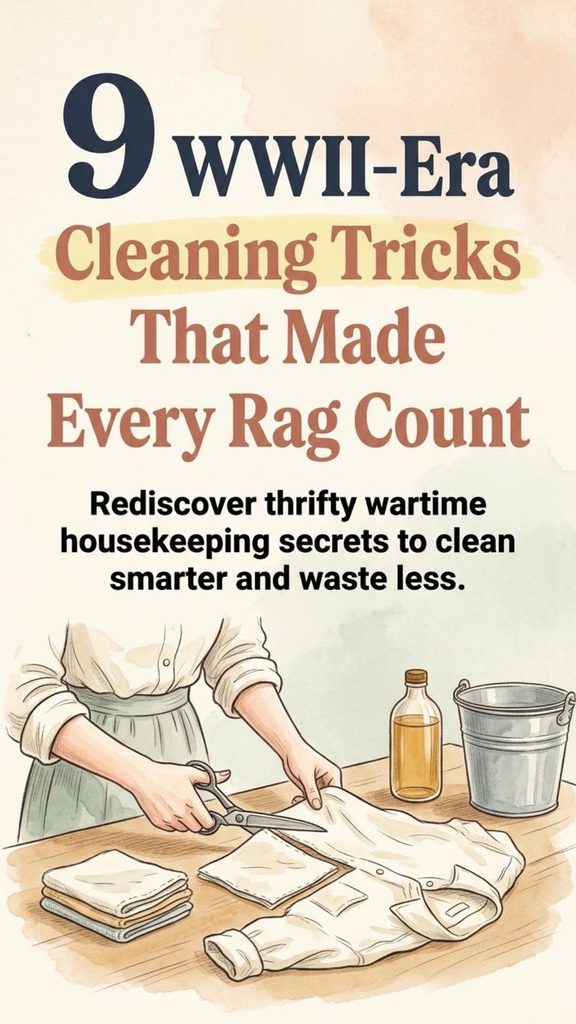
There was a time when an old shirt wasn’t automatically thrown away, a worn towel still had several useful years ahead of it, and cleaning the house didn’t require an entire cupboard filled with specialized products.
During World War II, shortages, rationing, and the demands of wartime production encouraged households in many countries to make better use of the materials they already owned. Fabric, fuel, soap, and other everyday supplies could be difficult to obtain, so repairing, reusing, and conserving became important parts of domestic life.
Homemakers learned to stretch household resources, save useful scraps, and approach cleaning with practicality rather than convenience.
You Might Also Like:
- Loading posts...
Although modern homes have access to better appliances, more effective cleaning products, and improved sanitation standards, some of those resourceful habits still make sense today.
You don’t have to wash everything by hand, abandon your washing machine, or recreate the hardships of the 1940s to appreciate old-fashioned housekeeping.
The real lesson is that keeping a comfortable home doesn’t always require buying something new.
Here are nine WWII-era cleaning traditions worth revisiting, including a few that benefit from modern safety knowledge.
1. Turn Old Clothing and Towels Into Reusable Cleaning Rags
One of the simplest wartime housekeeping habits was making the most of available fabric.
When textiles were valuable, an old garment could remain useful long after it was no longer suitable to wear.
Worn cotton shirts, damaged linen, and threadbare household towels could be cut into smaller pieces and repurposed for cleaning.
This is still an excellent way to reduce unnecessary purchases.
Instead of throwing away an old cotton T-shirt, cut it into several manageable squares. Use the softer pieces for dusting furniture and more durable sections for ordinary household cleaning.
You can even create a simple rag storage system.
Keep separate containers for kitchen cloths, general dusting rags, bathroom cleaning cloths, and rougher jobs such as wiping garden tools or outdoor furniture.
This separation helps prevent cloths used in dirtier areas from being accidentally reused on kitchen counters.
How to Maintain Reusable Cleaning Rags
Wash used cloths regularly with a suitable laundry detergent.
Cloths exposed to raw food juices, bathroom contamination, or other potentially hazardous materials should be handled and laundered appropriately.
Allow everything to dry completely before returning it to storage.
Sunlight can help fabrics dry outdoors, but hanging a rag in the sun alone should not be considered a reliable method of disinfecting it.
Why this trick is worth keeping: Repurposed fabric can replace many disposable cleaning towels while giving old textiles a useful second life.
2. Use Diluted White Vinegar for Suitable Cleaning Jobs
Before modern supermarket shelves were filled with dozens of cleaning sprays, households made use of familiar ingredients for a variety of domestic tasks.
White vinegar remains a popular example.
Its acidity can help dissolve certain mineral deposits and remove some types of buildup, making it useful for selected household surfaces.
A simple cleaning mixture can be prepared using:
- 1 part distilled white vinegar
- 2 parts water
Combine the ingredients in a clearly labelled spray bottle.
This mixture may be useful for appropriate glass and acid-resistant surfaces or for tackling certain hard-water deposits.
However, vinegar is not an all-purpose cleaner suitable for every material.
Avoid using it on marble, limestone, travertine, and other acid-sensitive natural stones. Repeated acidic cleaning can damage vulnerable finishes and surfaces.
It should also not be treated as a dependable household disinfectant.
When a surface genuinely needs disinfection, use an appropriate registered product and follow its directions, including the required contact time.
Never mix vinegar with chlorine bleach, as this can release dangerous chlorine gas.
Why this trick is worth keeping: One inexpensive ingredient can handle several specific cleaning tasks, reducing the need for unnecessary specialty products when used correctly.
3. Give Used Tea Leaves a Second Purpose
Resourceful housekeeping often involved finding additional uses for materials that would otherwise be discarded.
Used tea leaves are an interesting example.
Traditional cleaning advice sometimes recommended scattering damp tea leaves over dusty surfaces, carpets, or floors before sweeping. The intention was to help collect loose dust rather than allow it to scatter through the air.
However, this method deserves some caution in a modern home.
Wet tea leaves can stain pale fabrics, leave organic residue, and introduce unnecessary moisture into carpets or upholstery. Damp plant material left behind may also create conditions favorable to unwanted microbial growth.
For modern carpets and upholstered furniture, vacuuming with suitable equipment is generally more practical.
But used tea leaves don’t have to go directly into the rubbish.
A Better Way to Reuse Them
Allow suitable used tea leaves to cool and add them to your household compost system.
If using tea bags, check whether the bag material is actually compostable rather than assuming all tea bags are made entirely from paper.
Loose tea leaves can contribute organic material to a balanced compost pile when combined with other appropriate ingredients.
The important takeaway from this old practice isn’t that every traditional carpet-cleaning method should be repeated exactly.
It’s that ordinary household waste sometimes has another useful purpose.
Why this trick is worth keeping: Tea leaves offer a small opportunity to reduce kitchen waste, even if modern cleaning equipment is better suited to maintaining carpets.
4. Hang Laundry Outside Instead of Automatically Using the Dryer
Long before tumble dryers became common household appliances, washing lines and outdoor drying racks were familiar features of domestic life.
Freshly washed sheets, clothing, towels, and table linens were hung outside whenever weather conditions allowed.
This old-fashioned practice remains one of the easiest ways to reduce household energy consumption.
An outdoor washing line requires no electricity to dry clothing, and moving air can help laundry dry without the mechanical tumbling associated with a dryer.
It can also be surprisingly pleasant to bring in fresh bedding after a breezy afternoon.
Tips for Successful Line Drying
Shake garments gently before hanging them to reduce bunching and help them dry more evenly.
Leave enough space between larger items for air to circulate.
Turn certain dark or brightly colored garments inside out when drying them in strong sunlight, as prolonged exposure can contribute to fading.
Bring laundry inside promptly if the weather changes.
Avoid leaving thick towels or bedding damp for extended periods.
While sunlight has ultraviolet radiation that can affect some microorganisms, ordinary outdoor line drying does not provide a controlled or verified disinfection process.
If laundry requires sanitization because of illness or contamination, follow suitable laundering guidance instead.
Why this trick is worth keeping: Line drying can reduce dependence on an electric dryer while providing a simple, inexpensive way to care for everyday laundry.
5. Keep Baking Soda for Gentle Scrubbing and Odor Control
Baking soda has earned its reputation as a useful household staple for good reason.
Also known as sodium bicarbonate, it is mildly alkaline and can provide gentle abrasive action when used as a cleaning powder.
That makes it suitable for several ordinary household tasks.
It is particularly useful when you need a little extra scrubbing power without immediately reaching for an aggressive abrasive product.
Make a Simple Baking Soda Cleaning Paste
Combine:
- 2 tablespoons baking soda
- Enough water to create a spreadable paste
Apply the mixture to a suitable surface using a soft sponge or cloth.
Rub gently, then rinse thoroughly and dry.
Always test an inconspicuous area first, particularly on delicate or easily scratched finishes.
Baking soda can also help manage certain household odors.
For example, a small open container can be placed in an appropriate refrigerator location as part of routine odor management, although removing spoiled food and cleaning spills remains essential.
One limitation worth remembering is that baking soda is not a universal stain remover.
It should not be expected to remove every grease mark, ink stain, or discoloration, and it is not a replacement for detergent or a registered disinfectant.
Why this trick is worth keeping: A single inexpensive pantry ingredient can provide gentle scrubbing and help with selected odor problems.
6. Save Useful Cooking Fat Instead of Automatically Throwing It Away
During periods when cooking supplies were limited, wasting usable fats was something many households tried to avoid.
Cooking grease and rendered fat could be collected for appropriate reuse, while some historical households also contributed surplus waste fats to wartime collection programs.
Today, saving suitable cooking fat can still be practical, provided it is handled with food safety in mind.
For example, rendered bacon fat can add flavor to certain savory dishes.
How to Save Bacon Fat Safely
Allow freshly rendered cooking fat to cool enough for safe handling without allowing it to sit unrefrigerated for an extended period.
Carefully strain it through an appropriate fine strainer to remove food particles.
Transfer it into a clean, heat-safe container, refrigerate it promptly, and use it within a suitable storage period.
Discard the fat if it develops rancid odors, shows signs of spoilage, or has been excessively heated.
Avoid repeatedly reusing old cooking oil simply because it seems wasteful to throw it away. Repeated heating can degrade oils, making reuse unsuitable.
What About Making Soap From Leftover Fat?
Traditional soap making is another example of making use of household resources.
However, producing soap from fat requires an appropriate alkali, commonly sodium hydroxide, which is caustic and must be handled with proper protective equipment and an accurate recipe.
It is not a safe project to improvise using random quantities of kitchen scraps.
For beginners interested in soap crafting, using a prepared melt-and-pour soap base is a more approachable alternative.
Why this trick is worth keeping: Thoughtful use of suitable cooking leftovers can reduce waste, but food safety and appropriate handling should always come first.
7. Revisit the Old Cornmeal Cleaning Trick—With a Few Modern Adjustments
One unusual piece of traditional housekeeping advice involves using dry cornmeal to absorb greasy residue.
The idea is simple: apply an absorbent dry ingredient to a small oily area, allow it to take up some of the residue, then carefully remove it.
Cornmeal appeared in various old-fashioned household cleaning suggestions, including recommendations for dealing with certain floor stains.
However, scattering food products across modern flooring is not generally the best cleaning method.
Cornmeal can leave particles behind, become trapped between floorboards, or attract pests if not completely removed.
Its grainy texture may also be unsuitable for delicate surfaces.
For modern finished wood flooring, use a cleaning product recommended by the flooring manufacturer.
If you’re dealing with a fresh greasy spill, blot away as much as possible using suitable absorbent material before cleaning the remaining residue according to the surface’s care instructions.
Avoid flooding wooden floors with water, vinegar, or other homemade mixtures.
If you do experiment with any traditional absorbent technique on a suitable nonporous surface, test it first and remove all residue promptly.
Why this trick is worth remembering: It illustrates how earlier homemakers used ordinary absorbent materials creatively, even though many modern surfaces are better maintained using purpose-made cleaning methods.
8. Use Appropriate Heat When Washing Heavily Soiled Linens
Hot-water washing was an important part of traditional laundry routines.
Before modern washing machines offered specialized hygiene cycles, boiling suitable cotton linens and certain household cloths was one method used to clean heavily soiled laundry.
Large laundry pots could be used for items such as plain cotton fabrics, although this was physically demanding work.
Today, most households have more convenient and controlled alternatives.
Modern washing machines may include hot-water programs or sanitizing cycles designed for specific types of laundry.
However, hotter water is not automatically better for every fabric.
Which Items Can Handle Hot Washing?
Always begin by checking the care label.
Some sturdy white cotton towels, appropriate cleaning cloths, and certain bedding may tolerate higher washing temperatures.
Delicate fabrics, wool, elastic materials, synthetic blends, dyed garments, and items containing heat-sensitive finishes may become damaged.
For ordinary laundry, an appropriate detergent and suitable machine cycle are generally sufficient.
When laundry requires additional hygiene precautions, follow current health guidance and your appliance manufacturer’s instructions.
Avoid attempting to boil mixed household laundry in a cooking pot. Handling large quantities of near-boiling water introduces unnecessary burn risks.
Why this trick is worth keeping: Traditional laundry reminds us to match cleaning methods to the material and task rather than relying on the same wash cycle for absolutely everything.
9. Try Lemon and Salt for Certain Tarnished Metals
Before the availability of specialized metal polishes, household ingredients were sometimes used to brighten copper and brass.
Lemon and salt remain a familiar traditional combination.
Lemon juice contains citric acid, which can react with certain tarnish deposits, while salt can provide abrasive action.
However, not every metal or decorative finish is suitable for acidic cleaning.
This method should be reserved for appropriate, unlacquered copper or brass when the manufacturer permits it.
Do not automatically apply lemon and salt to silver, plated objects, antique hardware, lacquered metals, or valuable decorative pieces.
Acidic ingredients and abrasives may scratch or damage sensitive surfaces.
How to Clean Suitable Unlacquered Copper or Brass
If the item is compatible with acidic cleaning, test a hidden section first.
Apply a small amount of lemon juice and a little fine salt using a soft cloth.
Rub gently without excessive pressure.
Rinse thoroughly and dry immediately to avoid leaving moisture or cleaning residue on the surface.
Stop if you notice unexpected changes to the finish.
For valuable antiques or metal objects with protective coatings, professional conservation advice or an appropriate specialist product is a better choice.
Why this trick is worth keeping: Simple household ingredients can sometimes help maintain suitable metal objects, provided the surface and finish are correctly identified first.
What WWII-Era Housekeeping Can Teach Us Today
The most interesting thing about wartime homemaking isn’t necessarily any particular cleaning recipe.
It’s the practical attitude toward household resources.
When supplies were limited, maintaining what you already owned became especially important. A torn garment could be repaired. A worn towel could become a cleaning cloth. An ordinary household ingredient might serve several different purposes.
That mindset still has value.
Modern homes often accumulate specialized products for tasks that could be managed with existing equipment and a small collection of reliable cleaning supplies.
Of course, convenience has its place.
We benefit enormously from washing machines, refrigerators, effective detergents, safer food handling, and cleaning products developed for particular materials and hygiene requirements.
There is no reason to abandon those improvements in pursuit of historical authenticity.
Instead, combine modern knowledge with the resourcefulness of earlier generations.
How to Build Your Own Old-Fashioned Cleaning Kit
If you would like to bring a little wartime-inspired simplicity into your housekeeping routine, you can begin with supplies you probably already own.
A small practical cleaning collection might include:
- Reusable cotton cleaning cloths.
- A sturdy scrubbing brush.
- Mild dish soap.
- Baking soda.
- White vinegar for compatible surfaces.
- A bucket.
- A durable broom and dustpan.
- An appropriate general-purpose cleaner.
- A suitable disinfectant for occasions when disinfection is necessary.
There is no need to purchase everything again if your existing supplies already work.
The purpose is to reduce unnecessary duplication and make routine cleaning easier.
Consider creating separate cloth storage areas for kitchen, bathroom, and general household use. Wash reusable supplies appropriately, allow them to dry completely, and replace them when they become too worn to function effectively.
Small Changes That Make Old-Fashioned Housekeeping Practical
You don’t have to adopt all nine ideas at once.
Begin with something that will genuinely help your household.
If you regularly purchase disposable cleaning cloths, try cutting up an old cotton towel.
If the electric dryer runs every day, experiment with outdoor line drying when the weather allows.
If your cleaning cupboard is overflowing, review which products are actually necessary and identify safe, practical alternatives.
If food waste is a concern, look for appropriate ways to reuse ingredients or add suitable scraps to your compost.
These may be small changes, but they encourage a more thoughtful approach to everyday consumption.
And unlike complicated household challenges, they are easy to incorporate gradually.
Making Every Rag Count Again
The homemakers who managed households during World War II faced circumstances that most of us would never wish to recreate.
But the habits that developed around conserving supplies, repairing belongings, and finding additional uses for ordinary materials still offer practical inspiration.
A comfortable home doesn’t require endless purchases or a cupboard full of expensive cleaning products.
Sometimes it begins with a few dependable tools, reusable cloths, sensible routines, and the willingness to look at old household habits with fresh eyes.
Keep the resourcefulness, adapt the methods where modern safety knowledge calls for it, and let simplicity make housekeeping a little less wasteful and more manageable.