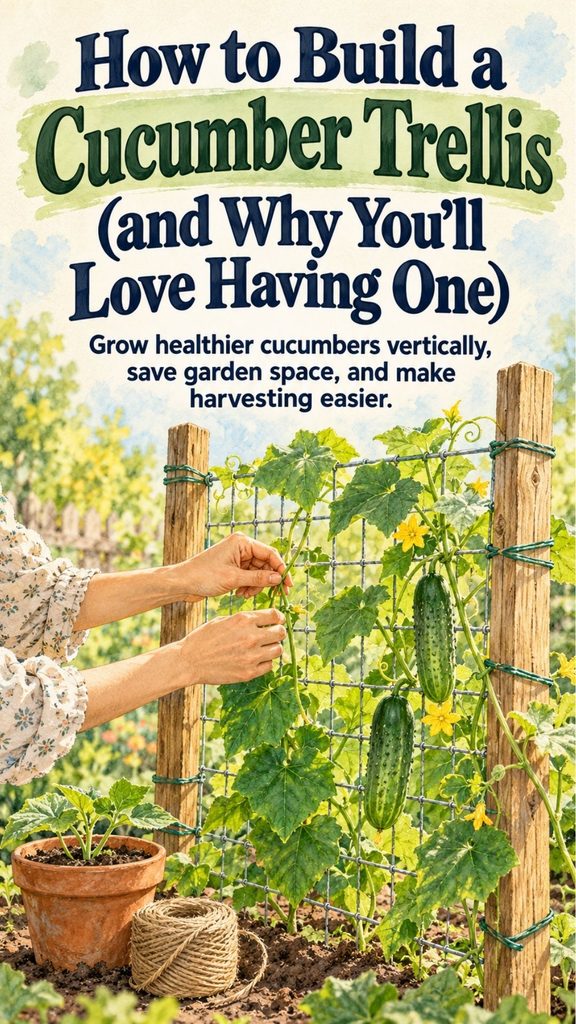
Cucumber plants have a remarkable ability to take over a garden bed. One week, they are tidy little seedlings with a few cheerful green leaves. Before long, their wandering vines are stretching across the soil, wrapping around neighboring plants, and hiding cucumbers beneath a thick blanket of foliage.
If you have ever discovered an enormous, overripe cucumber that somehow escaped your attention for days, you already know how frustrating growing cucumbers on the ground can be.
Fortunately, there is a simple solution: give your cucumbers somewhere to climb.
You Might Also Like:
- Loading posts...
A cucumber trellis is one of the most practical additions you can make to a vegetable garden, particularly when growing space is limited. It encourages vines to grow vertically, keeps developing fruit easier to see, improves access for maintenance, and makes harvesting considerably more convenient.
You don’t need expensive gardening equipment or advanced carpentry skills to build one. A few strong supports, suitable garden mesh, and basic fasteners are enough to create a structure that can serve your cucumber plants throughout the growing season.
Why Growing Cucumbers Vertically Makes Sense
Many common cucumber varieties naturally produce climbing vines with slender tendrils that wrap around nearby supports.
Without something sturdy to climb, those vines spread across the ground instead.
Allowing cucumbers to sprawl is a perfectly valid growing method, but vertical gardening offers several practical advantages.
Better use of garden space: A trellis directs growth upward, leaving more ground available for pathways, neighboring crops, and routine maintenance.
Cleaner fruit: Cucumbers hanging above the soil are less likely to remain in direct contact with damp ground, mud, and soil debris.
Improved airflow: Keeping vines supported and avoiding excessively crowded foliage can encourage air movement around the plants. This may help reduce conditions favorable to certain diseases, although trellising alone cannot prevent them.
Easier harvesting: Fruit is more visible when hanging from a supported vine, making it easier to pick cucumbers before they become excessively mature.
Less tangled growth: Training plants onto a designated structure helps prevent long cucumber vines from spreading into neighboring beds.
There is also the visual appeal. A healthy cucumber trellis covered with green leaves, yellow flowers, and developing fruit creates a beautiful living feature in a productive garden.
Choosing the Right Cucumber Trellis Design
Before purchasing materials, consider how much space you have, how many cucumber plants you want to grow, and whether the structure needs to be temporary or permanent.
Different garden layouts benefit from different trellis styles.
1. Simple Vertical Panel Trellis
A vertical panel is one of the easiest designs for beginners.
It consists of two or more strong upright posts supporting a section of garden fencing or wire mesh.
The cucumber vines climb directly up the panel while developing fruit hangs along the surface.
This design works particularly well along the back or edge of a raised bed and requires relatively few materials.
2. Wooden A-Frame Trellis
An A-frame uses two sloping supports joined at the top to create a triangular structure.
Garden netting, wire mesh, or horizontal wooden supports can be attached to each side.
Cucumbers can grow up either slope, making this a practical arrangement for gardeners who want to train several plants within a relatively compact space.
A-frame structures can also be attractive additions to traditional cottage-style vegetable gardens.
3. Cattle Panel Arch
For gardeners who have enough room, a cattle panel arch can create a particularly impressive growing structure.
A suitable livestock panel is carefully curved between securely anchored supports to form a tunnel.
Cucumber vines climb the sides and eventually spread across the overhead section. As the plants mature, developing fruit may hang beneath the structure.
Make sure the panel is securely anchored and suited to bending before attempting installation. Large metal panels can spring back during handling, so this project is easier and safer with assistance.
4. Bamboo V-Frame
Bamboo poles offer a lightweight, natural-looking alternative to conventional fencing.
Arrange poles into a supported V-shaped structure, secure the connections, and attach garden twine or netting for additional climbing points.
This design can look particularly attractive in rustic vegetable gardens.
Choose sufficiently strong bamboo, as mature cucumber vines become heavier as foliage and fruit develop.
5. Slanted Grid Trellis
A sloped panel is useful when you prefer cucumbers to grow at an angle rather than directly upward.
The supporting frame can lean away from the planting area, allowing some fruit to hang beneath the foliage where it is easier to find.
This design can be especially convenient alongside raised beds, provided the structure is properly secured.
Where Should You Put a Cucumber Trellis?
Location plays an important role in how well your cucumbers grow.
Cucumbers are warm-season vegetables that generally perform best with approximately six to eight hours of direct sunlight each day.
Choose a bright area with fertile, reasonably well-drained soil and convenient access to water.
Also consider the direction of sunlight and the height of nearby plants.
A tall trellis positioned carelessly can shade shorter vegetables growing behind it. In Northern Hemisphere gardens, placing taller supports toward the northern side of a planting area can help reduce unwanted shading, depending on the garden layout.
Leave enough working space to reach both the plants and developing cucumbers.
If building beside a pathway, make sure the finished structure will not obstruct access once the vines are fully grown.
Finally, consider wind exposure. A mature cucumber trellis can carry considerable foliage, so its supports must remain stable throughout the season.
Materials Needed for a Simple DIY Cucumber Trellis
For a straightforward vertical trellis approximately three to four feet wide, you will need:
- Two sturdy wooden posts, approximately 6–7 feet long.
- A suitable section of galvanized garden fencing or rigid wire mesh.
- Heavy-duty outdoor zip ties, sturdy garden wire, or appropriate fencing fasteners.
- A hammer, post driver, or suitable installation tool.
- Measuring tape.
- Wire cutters, if the fencing needs trimming.
- Protective gardening gloves.
- Optional diagonal supports for additional stability.
Choose fencing with openings large enough for cucumber tendrils to grip and for your hand to reach through comfortably during harvesting.
Avoid flimsy materials that may collapse under the weight of mature vines.
If you are using repurposed fencing, inspect it for rusted-through sections, sharp broken wires, and weak attachment points before installation.
How to Build a Simple Cucumber Trellis Step by Step
This basic design is a good starting point for gardeners who want a practical structure without undertaking a large construction project.
Step 1: Measure Your Growing Area
Decide where the trellis will stand and measure the available width.
For a small raised bed or vegetable row, a three- to four-foot-wide panel is often convenient.
Mark the locations for your upright posts, ensuring there is enough room for planting along the base.
Step 2: Install the Supporting Posts
Position a wooden post at each end of the planned trellis.
Drive the posts securely into the soil, allowing sufficient depth for stability. Around 12–18 inches may be appropriate for some smaller structures, but the necessary depth depends on soil conditions, exposed height, wind, and the weight the posts must support.
Check that both posts are upright and firmly anchored.
If they wobble noticeably before the mesh is attached, reinforce them rather than assuming the fencing will hold everything together.
Step 3: Attach the Garden Mesh
Unroll your garden fencing and position it between the upright supports.
Attach the mesh securely at the top, middle, and lower sections of each post.
Use strong outdoor-rated fasteners rather than thin household string that may deteriorate before the growing season ends.
The mesh should remain reasonably straight and supported without placing excessive sideways pressure on the posts.
Trim or bend back exposed wire ends to reduce the risk of scratches and injuries during harvesting.
Step 4: Check the Finished Structure
Before planting, gently test the trellis for movement.
Pay particular attention to the posts and mesh connections.
Cucumber seedlings may be light, but established vines carrying numerous leaves and fruit can place considerably more stress on the structure.
Adding reinforcement now is much easier than trying to repair a leaning trellis in the middle of summer.
How to Plant Cucumbers Along Your New Trellis
Once the structure is ready, prepare the planting area by removing weeds and loosening the soil as appropriate.
Incorporate suitable finished compost if your soil would benefit from additional organic matter.
Plant cucumber seeds or transplants near the base of the trellis, generally leaving a small gap of approximately six inches between the plants and the actual support.
Follow the spacing recommendations for your chosen cucumber variety. Vigorous vining cucumbers usually require more room than compact varieties, and overcrowding can make watering, harvesting, and plant maintenance difficult.
Water thoroughly after planting.
If you are starting cucumbers from seed, wait until conditions are suitably warm and the danger of frost has passed. Cucumbers are sensitive to cold temperatures and generally prefer warm soil for successful germination and growth.
How to Train Cucumbers to Climb
Cucumber plants produce curling tendrils that naturally attach themselves to nearby objects.
However, young vines may need a little encouragement before they discover the trellis.
As the plants grow, carefully guide the leading stems toward the mesh.
Allow the tendrils to wrap naturally around the support whenever possible.
If a vine repeatedly falls away from the trellis, use a loose piece of soft garden twine or a flexible plant tie to hold it in position.
Avoid tightly wrapping string around the stem. Cucumber vines are tender, and restrictive ties can damage them as they expand.
Check the plants occasionally and redirect wandering growth before it becomes tangled with neighboring vegetables.
Once established, most climbing cucumber varieties will do much of the work themselves.
Caring for Cucumbers Growing on a Trellis
A good trellis makes maintenance easier, but it doesn’t replace the normal requirements of a healthy cucumber plant.
Water Consistently
Cucumbers need a dependable supply of moisture, particularly during flowering and fruit development.
Water deeply enough to moisten the root zone rather than repeatedly applying tiny amounts to the soil surface.
The exact frequency depends on temperature, rainfall, soil type, and whether your cucumbers are growing in containers or garden beds.
A layer of suitable organic mulch can help moderate soil temperature and reduce rapid moisture loss.
Water Near the Base of the Plant
A watering wand, soaker hose, or drip irrigation system can deliver moisture directly to the soil without unnecessarily wetting the foliage.
This approach can be useful for reducing prolonged leaf wetness associated with certain plant diseases.
However, remember that powdery mildew can develop even when foliage is kept dry, so good watering habits are only one part of garden disease management.
Maintain Reasonable Airflow
As cucumber plants mature, inspect the lower foliage for yellowing, damage, or disease.
Remove clearly diseased leaves when appropriate, using clean pruning tools.
Avoid stripping large amounts of healthy foliage simply to make the vine look tidier. Leaves are essential for photosynthesis and help support fruit development.
Good plant spacing and sensible training are generally better starting points than excessive pruning.
Feed According to the Soil’s Needs
Cucumbers are productive plants that benefit from suitable soil fertility.
If necessary, use compost or an appropriate vegetable fertilizer according to soil conditions and product instructions.
Avoid assuming that applying more fertilizer will automatically produce more cucumbers.
Excessive nitrogen, for example, may encourage abundant leafy growth without providing the balance of nutrients needed for productive flowering and fruiting.
When and How to Harvest Trellised Cucumbers
Harvesting is one of the most enjoyable parts of growing cucumbers vertically.
Instead of searching through a thick mat of leaves at ground level, you can inspect the trellis and spot developing fruit hanging from the vines.
Check your plants frequently once production begins.
Many cucumber varieties grow quickly during warm weather, and leaving fruit too long on the vine can result in oversized cucumbers with larger seeds and less desirable eating quality.
Harvest at the recommended size for your variety.
Use clean garden scissors or pruning shears to cut the stem rather than pulling the cucumber forcefully from the plant.
Regular harvesting also helps keep developing fruit from being overlooked beneath mature foliage.
Common Cucumber Trellis Mistakes to Avoid
A simple trellis doesn’t require much construction experience, but a few common errors can make the project less successful.
Using weak supports: Thin stakes or loosely installed posts may lean or collapse as the cucumber plants mature.
Installing the trellis too late: Trying to untangle established vines and lift them onto a support can damage stems and leaves. Ideally, put the structure in place before planting or while the seedlings are still small.
Crowding too many plants together: More cucumber plants do not automatically mean a larger harvest. Adequate spacing helps maintain airflow and allows each plant room to develop.
Using unsuitable mesh: Very fine netting may make harvesting inconvenient, while unsupported, overly flexible materials may sag under the vines’ weight.
Forgetting accessibility: Position the trellis where you can comfortably inspect the foliage, water the roots, and reach developing cucumbers.
Is a Cucumber Trellis Worth Building?
For many gardeners growing vining cucumber varieties, a trellis is a practical investment of time and materials.
It can make a small vegetable garden more productive in terms of space usage, reduce the amount of fruit resting directly on the soil, and simplify everyday tasks such as watering, inspecting plants, and harvesting.
A basic vertical panel is often enough to get started. If you have a larger growing area, an A-frame or cattle panel arch can turn cucumber cultivation into an attractive garden feature.
You don’t need to create an elaborate structure or spend a fortune on materials.
Start with something sturdy, position it in a sunny location, install it before the vines become established, and give your cucumbers a little guidance as they begin to climb.
Once summer arrives and the trellis is covered with healthy green growth and hanging cucumbers, you’ll appreciate how much easier vertical growing makes the vegetable gardening experience.