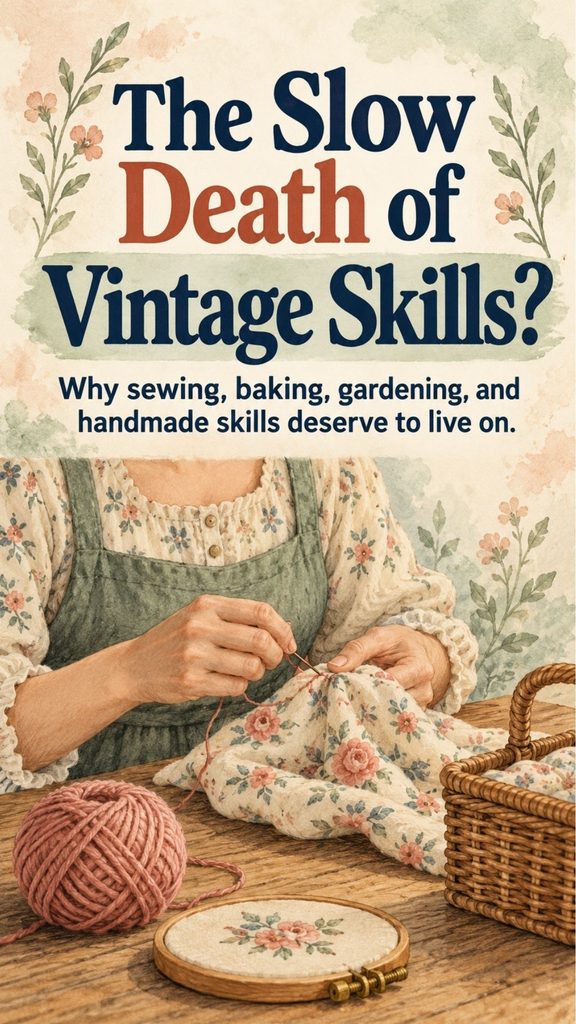
There is a peculiar difference between knowing that something can be done and knowing how to do it yourself.
Most of us know bread can be baked, clothes can be mended, vegetables can be grown, and food can be preserved. Yet fewer households depend on those abilities in daily life. Instead, we buy bread already sliced, replace damaged clothing, purchase vegetables throughout the year, and rely on supermarkets for foods that previous generations often prepared or preserved at home.
That change has brought enormous convenience. It has also made many traditional household skills less common.
You Might Also Like:
- Loading posts...
Sewing, knitting, preserving food, gardening, bread making, repairing household items, and other practical crafts are sometimes described as “vintage skills.” The name can make them sound decorative or nostalgic, but many of these abilities were once simply part of ordinary life.
The concern is not that everyone should abandon modern conveniences and return to an earlier century. The more interesting question is what happens when useful knowledge disappears because nobody takes the time to teach it.
Skills Usually Disappear Quietly
Traditional knowledge rarely vanishes overnight.
One generation knows how to do something because the skill is necessary. The next generation watches but never needs to practice. The generation after that may know the skill existed but have no idea where to begin.
That is how knowledge that took decades to develop can become unfamiliar surprisingly quickly.
A grandmother may know how to alter a dress without using a pattern. Her daughter may know how to sew on a button. Her granddaughter may own a sewing kit but rarely open it.
None of those people has done anything wrong. Their lives simply require different abilities.
Modern manufacturing and services have removed much of the necessity that once forced people to learn these things. That is often a genuine improvement. Few people would want every household task to be as labor-intensive as it once was.
Still, convenience and skill do not have to be opposites.
You can appreciate a washing machine and still know how to mend a torn seam. You can buy vegetables at the supermarket and still grow tomatoes. You can own a bread machine and also understand how yeast dough behaves when mixed and kneaded by hand.
The goal is not to reject technology. It is to avoid becoming completely disconnected from useful knowledge.
Cooking From Scratch Is More Than Following Recipes
Cooking may be the most familiar example of a traditional skill that has changed dramatically.
People still cook, of course. But modern kitchens also offer frozen meals, packaged sauces, ready-made doughs, meal delivery, takeout, and countless other conveniences.
There is nothing inherently wrong with using them. Convenience foods can be extremely useful, particularly during busy periods.
The problem appears when cooking becomes so unfamiliar that preparing a simple meal without a package feels intimidating.
Basic scratch cooking does not require elaborate recipes or hours in the kitchen. It means understanding a handful of flexible techniques.
Someone who can roast vegetables, cook rice or potatoes, prepare eggs, make soup, cook a few proteins, bake something simple, and use leftovers already possesses a practical foundation.
From there, the possibilities expand naturally.
A person who understands cooking is also better equipped to look into the refrigerator, see what needs to be used, and turn it into dinner instead of depending entirely on a recipe.
That kind of adaptability is a skill worth keeping.
Bread Making Teaches Patience in a Convenient World
Bread is an interesting example because it can easily be purchased almost anywhere.
There is little practical reason that every household must bake its own.
And yet bread making remains valuable precisely because it teaches something convenience cannot provide: familiarity with a process.
You learn that dough changes as it rests. You begin to recognize when it needs more flour and when adding flour would make it too dry. You learn how yeast behaves differently depending on temperature and time.
Not every loaf turns out perfectly.
That is part of the lesson.
Older household skills often involve observation instead of rigid instructions. People learned to recognize texture, smell, consistency, temperature, and timing through repetition.
Those instincts are difficult to gain from reading alone.
Sewing and Mending Are Small Forms of Independence
Few people need to sew an entire wardrobe today.
Basic mending, however, remains remarkably useful.
Knowing how to replace a button, repair a loose hem, close a small seam, or patch a tear can extend the life of clothing considerably.
These are modest skills. They do not require an expensive sewing machine or years of practice.
A needle, thread, small scissors, and a little patience are enough to handle many common repairs.
Once basic hand sewing feels comfortable, other projects become less intimidating. Someone might eventually learn to shorten curtains, make a simple pillow cover, repair children’s clothing, or alter something that almost fits.
The value is not only financial.
There is a certain satisfaction in looking at something damaged and knowing that you can fix it rather than immediately replacing it.
Knitting, Crochet, Embroidery, and the Value of Slow Work
Some traditional skills have become hobbies rather than necessities, and that does not make them less meaningful.
Knitting, crochet, embroidery, quilting, and lace making can require hours of careful work. From a strictly economic perspective, buying a mass-produced item may often be easier.
But efficiency is not the only measure of value.
Handwork can be creative, calming, social, and deeply personal.
A handmade blanket may take weeks or months to complete, yet its meaning can last for decades because someone remembers who made it.
That connection is difficult to mass-produce.
These crafts also remind us that learning slowly is normal.
The first row of knitting may be uneven. The first embroidery stitches may look clumsy. A crochet pattern may have to be restarted several times.
Modern culture often celebrates instant competence. Traditional crafts quietly teach the opposite lesson: skill comes from repetition.
Gardening Connects Food With the Work Behind It
A supermarket makes food appear effortless.
Tomatoes sit neatly in rows. Herbs arrive bundled. Lettuce is washed, packaged, and refrigerated.
Gardening reveals the hidden process behind those foods.
A seed has to germinate. Young plants must survive weather, pests, inconsistent watering, and competition from weeds. Harvesting happens when the plant is ready, not necessarily when it is convenient.
Growing even a small amount of food can change the way someone thinks about waste.
The crooked carrot suddenly seems perfectly acceptable when you pulled it from your own soil.
A handful of herbs feels valuable when you watched the plants grow for weeks.
A tomato damaged by an insect becomes disappointing because you understand how much time went into producing it.
You do not need a farm or a large vegetable plot to experience this.
A pot of basil on a balcony counts.
So does a container of lettuce, a few tomato plants, strawberries in a raised bed, or herbs growing near the kitchen door.
Gardening does not have to provide all of your food to teach something valuable about how food is produced.
Food Preservation Still Has a Place
Preserving food was once essential for households that needed to carry seasonal harvests through the year.
Today most people have refrigerators, freezers, supermarkets, and access to commercially preserved food. Home preservation is therefore less necessary for survival in many households.
It can still be practical.
Freezing garden produce, drying herbs, making refrigerator pickles, preparing jam, or safely canning appropriate foods can reduce waste and help people make use of seasonal abundance.
Preservation does require more care than many other household skills.
Methods such as home canning are food-safety processes, not merely old recipes that should be followed from memory. Anyone learning them should use reliable, current instructions designed for safe preservation.
That is an important distinction.
Preserving traditional knowledge does not mean preserving outdated practices that modern food-safety guidance has improved.
Sometimes keeping a skill alive also means updating it.
Practical Skills Were Often Passed Through Relationships
Perhaps one of the greatest losses is not the individual skill itself but the way people once learned.
Many household abilities were transferred informally.
A child watched bread being mixed.
Someone sat beside a grandmother learning how to crochet.
A neighbor explained how she grew beans.
A parent showed a teenager how to repair something.
The lesson happened alongside conversation.
That type of learning creates more than technical knowledge. It creates memories and relationships.
Books and videos are wonderful learning resources, particularly for people who did not have someone available to teach them. But whenever possible, learning directly from another person offers something extra.
Ask older relatives what they know.
You may discover that someone can sharpen tools, preserve fruit, sew, garden, bake, repair furniture, identify plants, knit, crochet, or perform some other useful skill that nobody has ever thought to ask about.
Do not wait until that knowledge is unavailable.
We Do Not Need to Master Everything
Trying to recover every traditional skill at once is a good way to become overwhelmed.
Choose one.
If you have always wanted to bake bread, learn one dependable loaf.
If sewing interests you, learn to sew on a button and repair a seam.
If gardening appeals to you, grow three herbs instead of planting an enormous vegetable garden.
If crochet catches your attention, learn one stitch.
Small competence builds confidence.
Once one ability feels natural, another can follow.
The purpose is not to become completely self-sufficient. Very few households, past or present, were truly independent of other people. Communities have always relied on different individuals possessing different skills.
You do not need to know everything.
You simply need to know something worth passing on.
Teach the Skills While You Still Can
A skill survives only when somebody practices it.
More importantly, it survives across generations when somebody teaches it.
Children do not need a formal lesson in traditional living. Let them stand beside you while you cook. Give them a small section of the garden. Show them how to thread a needle. Let them knead dough, shell peas, stir jam, plant seeds, or try a simple craft.
Adults can learn together too.
Invite a friend over and practice something neither of you knows well. Ask someone experienced to demonstrate a technique. Join a local gardening, sewing, crafting, or homesteading group.
Traditional knowledge has always grown through shared experience.
There is no reason that has to stop.
Vintage Skills Are Not About Living in the Past
The strongest argument for keeping old skills alive is not nostalgia.
It is usefulness.
Knowing how to grow food does not require rejecting grocery stores.
Learning to sew does not require making all your clothes.
Baking bread does not require giving up convenient meals.
Knitting does not mean pretending modern manufacturing never happened.
The best approach takes what still serves us and leaves behind what does not.
Modern life gives us extraordinary tools and conveniences. Traditional skills give us another kind of resource: the ability to make, repair, grow, preserve, and understand some of the things we use every day.
Perhaps vintage skills are not dying after all.
Maybe they are simply waiting for each generation to decide which ones are worth learning again—and worth teaching before they disappear.