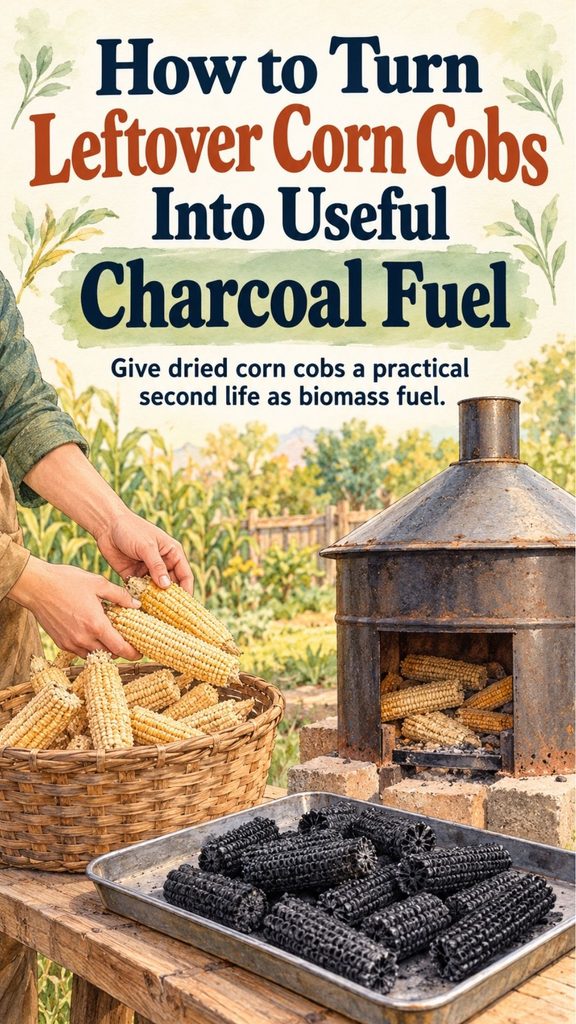
Corn cobs are easy to overlook once the kernels have been removed.
They are dry, bulky, and often end up in compost piles, garden waste, or the trash. But corn cobs are also a form of plant biomass, which means they contain stored energy.
When properly dried and carbonized under controlled conditions, corn cobs can be converted into a charcoal-like fuel.
You Might Also Like:
- Loading posts...
This is not simply an internet trick. Corn-cob charcoal has been studied as a potential solid fuel, including for barbecue charcoal and compressed biomass briquettes.
That makes leftover corn cobs an interesting example of how an agricultural by-product can become useful again.
But there is an important distinction:
A dry corn cob is not the same thing as corn-cob charcoal.
The cob has to undergo carbonization, and that process involves fire, combustible gases, smoke, and carbon monoxide. It should therefore be approached as a serious outdoor biomass project rather than a casual kitchen DIY.
Why Corn Cobs Can Be Used as Fuel
Corn cobs are made largely from combustible plant material.
When they are dried thoroughly, they can burn directly.
Carbonization changes the material.
During carbonization, much of the moisture and volatile material is driven away while more carbon-rich solid material remains.
The result is char.
Compared with the original biomass, properly prepared char can have:
- A higher proportion of fixed carbon
- Higher energy density by weight
- Different ignition characteristics
- Less volatile material
- Better potential for use as a compact solid fuel
This is why agricultural wastes such as corn cobs have attracted interest for biomass energy.
What Does Carbonizing a Corn Cob Mean?
Carbonization is controlled heating with limited oxygen.
If you simply put dry corn cobs into an open fire, they burn and eventually become ash.
To make charcoal, the goal is different.
The plant material is heated while restricting the amount of oxygen available so that much of the biomass decomposes thermally without completely burning away.
This process is related to pyrolysis.
The solid carbon-rich material remaining afterward is char.
Commercial charcoal producers use equipment designed to control:
- Temperature
- Oxygen
- Gas release
- Cooling
- Fire risk
That level of control matters.
Do Not Carbonize Corn Cobs Indoors
This is the most important safety rule.
Carbonization and charcoal combustion can produce carbon monoxide, an odorless and colorless poisonous gas.
Never make or burn charcoal inside:
- Houses
- Garages
- Basements
- Sheds
- Tents
- Enclosed porches
- Poorly ventilated workshops
Opening a door or window does not make indoor charcoal burning safe.
Carbonization should be done only with appropriate equipment in a safe outdoor environment and in accordance with local fire and smoke regulations.
Avoid Improvised Sealed Containers
Charcoal-making systems must allow gases produced during carbonization to escape in a controlled way.
Heating biomass inside a completely sealed improvised container can create dangerous pressure.
The gases released during pyrolysis can also be flammable.
For that reason, do not simply seal corn cobs inside an arbitrary metal container and place it in a fire.
If you want to produce charcoal at home, use a purpose-built charcoal kiln or retort designed for biomass carbonization and follow its operating instructions.
Start With Clean Corn Cobs
Only use clean plant material.
Suitable cobs should be free from:
- Paint
- Chemical treatments
- Plastic
- Oil
- Household chemicals
- Mold
- Trash
Corn cobs that have simply come from food preparation or agricultural harvesting are the most straightforward feedstock.
Do not attempt to increase the fire’s intensity by adding treated wood, plastic packaging, or other questionable materials.
The finished charcoal is only as clean as the material used to make it.
Dry the Cobs Thoroughly First
Moisture wastes heat.
Fresh or recently used corn cobs can contain enough water to make carbonization inefficient and smoky.
Before carbonization, dry the cobs thoroughly.
Spread them in a protected, ventilated place where air can circulate around them.
The cobs should eventually feel:
- Lightweight
- Hard
- Dry throughout
- Free from mold
The drier the biomass is before carbonization, the less energy is wasted driving off water.
Whole Cobs or Smaller Pieces?
Whole dried cobs can be carbonized, but uniform pieces generally make a batch easier to manage.
Very different sizes can heat at different rates.
The important thing is consistency.
Commercial and experimental systems often grind biomass when preparing pellets or briquettes, but whole cob-shaped charcoal can also be produced.
If your goal is briquettes, the charcoal is usually processed further after carbonization.
What Proper Corn-Cob Charcoal Looks Like
Finished char should generally be:
- Black throughout
- Lightweight compared with the original cob
- Dry
- Brittle
- Carbon-rich rather than partly raw inside
A cob that remains brown or woody through the center has not been fully carbonized.
A cob that has largely turned into gray ash has gone too far and has been combusted rather than preserved as charcoal.
Appearance alone cannot prove fuel quality, however.
Professional charcoal is evaluated for characteristics such as:
- Fixed carbon
- Volatile matter
- Moisture
- Ash
- Heating value
Homemade material should not automatically be assumed to behave exactly like commercial charcoal.
Corn-Cob Charcoal Can Burn Hot
The basic claim that carbonized corn cobs can provide substantial heat is reasonable.
Proper carbonization concentrates more of the remaining material into carbon-rich fuel.
But saying that every homemade corn-cob charcoal batch burns hotter than ordinary charcoal would be too broad.
Actual performance depends on:
- Carbonization conditions
- Moisture
- Ash content
- Density
- Airflow
- Shape
- What fuel it is being compared with
Does It Really Burn Clean?
This needs more caution.
Properly carbonized biomass can burn with less visible smoke than wet, unprocessed plant material because much of its volatile material has already been removed.
But low visible smoke does not mean zero pollution.
Charcoal combustion can still produce:
- Carbon monoxide
- Fine particles
- Carbon dioxide
- Other combustion gases
Burning charcoal can produce dangerous levels of carbon monoxide even when the fire appears to be burning cleanly.
So corn-cob charcoal is better described as a potentially useful biomass fuel rather than a smokeless or emission-free one.
Making Corn-Cob Charcoal Briquettes
Loose pieces of carbonized corn cob can be used as char, but they are lightweight and may break apart.
Briquetting can make the material denser and easier to handle.
The general process involves:
- Producing properly carbonized biomass.
- Allowing the char to cool completely.
- Reducing it to a more uniform particle size.
- Mixing it with a suitable binder.
- Compressing the mixture.
- Drying the briquettes thoroughly before storage or use.
The exact binder and proportions affect:
- Strength
- Durability
- Heat output
- Ash
- Burn behavior
That is why simply squeezing damp charcoal dust together does not necessarily make a good fuel briquette.
Why a Binder Is Often Needed
Charcoal particles do not naturally hold together well once crushed.
A binder helps create a briquette that can:
- Survive handling
- Be transported
- Stay intact while drying
- Burn more predictably
Starch-based binders are commonly used in biomass-briquette research.
The amount matters.
Too little binder may create a fragile briquette.
Too much binder can alter how the fuel burns.
If you want consistent briquettes, a proper briquette press and a known biomass formulation are preferable to random mixtures.
Drying Briquettes Is Essential
A freshly pressed briquette may contain considerable moisture from the binder mixture.
It must be thoroughly dried before burning.
Otherwise it can:
- Smoke
- Burn poorly
- Crack
- Grow mold in storage
- Waste energy evaporating water
Do not assume a briquette is dry merely because the outside feels firm.
Thicker material can remain damp internally.
Let Charcoal Cool Completely
Freshly made charcoal can retain heat internally for a surprisingly long time.
A piece that looks dark and inactive may still contain a hot spot.
Do not transfer freshly carbonized material directly into:
- Plastic containers
- Cardboard boxes
- Wooden bins
- Indoor storage
Let it cool completely in a safe, noncombustible location according to the instructions for the kiln or retort you are using.
Smoldering charcoal can reignite when suddenly exposed to additional oxygen.
Store Finished Charcoal Dry
Once completely cool, keep charcoal protected from rain and moisture.
Store it away from:
- Open flames
- Heaters
- Sparks
- Ignition sources
Wet charcoal performs poorly and becomes messy to handle.
Briquettes containing organic binders may also deteriorate if they repeatedly become damp.
Can Corn-Cob Charcoal Be Used for Cooking?
Corn-cob charcoal has been studied for barbecue applications, showing that properly processed material can have real cooking-fuel potential.
However, laboratory-produced charcoal and an untested homemade batch are not necessarily equivalent.
If charcoal will be used around food, never make it from biomass contaminated with:
- Chemicals
- Treated wood
- Paint
- Plastic
- Petroleum products
Use it only in equipment designed for charcoal cooking.
Never bring a charcoal grill indoors after cooking simply because the coals look nearly extinguished.
Smoldering charcoal can continue producing carbon monoxide.
What About Blacksmithing?
Charcoal has historically been used as forge fuel, and carbonized agricultural biomass can produce considerable heat.
Whether a particular batch of corn-cob charcoal performs well in a forge depends on:
- Density
- Airflow
- Particle size
- Ash
- Mechanical strength
Light whole-cob charcoal may behave differently from dense hardwood charcoal or commercial coke.
Compressed briquettes may be easier to handle in some applications.
Treat unfamiliar fuel as an experiment rather than assuming it behaves exactly like traditional forge fuel.
Corn Cobs Can Also Be Useful Without Making Charcoal
Turning cobs into fuel is not the only option.
Depending on your household, leftover cobs can also go into:
- Compost
- Biomass processing
- Certain garden systems
- Agricultural-waste streams
Dry cobs themselves also have fuel value, although carbonization changes their combustion properties.
If you only have a handful of corn cobs after dinner, running a charcoal kiln probably makes little practical sense.
The idea becomes more useful when there is a regular supply from:
- A farm
- Market
- Food processor
- Large garden
- Community harvest
Do Not Confuse Fuel Charcoal With Garden Biochar
Both materials come from carbonized biomass, but they are not automatically interchangeable.
Biochar intended for soil is generally produced and managed with agricultural use in mind.
Fuel charcoal is produced primarily for combustion.
Do not take unknown barbecue briquettes containing unspecified additives and automatically add them to garden soil.
Likewise, high-quality biochar may be more useful as a soil amendment than as fuel.
Decide what you want the material for before choosing how to make it.
Is Making Corn-Cob Charcoal Worth It?
For one household that eats corn occasionally, probably not as a serious heating strategy.
A considerable amount of biomass is required to produce a useful quantity of charcoal, and substantial mass is lost during carbonization.
A large pile of dry corn cobs therefore becomes a much smaller pile of charcoal.
Where corn cobs are an abundant agricultural waste, however, converting some of that material into fuel becomes much more practical.
A Better Way to Think About Corn-Cob Charcoal
The most interesting lesson is not that a few leftover dinner scraps provide unlimited free fuel.
It is that agricultural waste can still contain useful energy.
Corn-cob charcoal demonstrates several practical self-sufficiency principles:
- Use local waste materials.
- Dry biomass before processing it.
- Convert bulky material into a concentrated form.
- Store useful fuel for later.
- Avoid wasting resources that still have value.
The idea itself is sound.
What deserves caution is assuming that charcoal production is simple or harmless.
Essential Safety Rules
If you explore corn-cob charcoal, keep these rules in mind:
- Use only clean, untreated corn cobs.
- Dry them thoroughly.
- Use purpose-built carbonization equipment.
- Carbonize only in a safe outdoor location.
- Do not use sealed improvised vessels.
- Keep combustible materials away from the process.
- Allow charcoal to cool completely before storage.
- Keep the finished fuel dry.
- Follow local fire and smoke regulations.
- Never burn charcoal indoors.
That last rule is especially important.
Carbon monoxide has no color or smell, and charcoal combustion can produce enough of it to cause severe poisoning or death.
A Useful Second Life for Agricultural Waste
So, can corn cobs really become charcoal?
Yes.
The underlying idea is legitimate.
Dry corn cobs already contain useful energy, and controlled carbonization can transform them into a more carbon-rich solid fuel. Corn-cob material can also be processed into compressed biomass briquettes.
What needs changing is the overly simple message that leftover cobs can merely be burned and automatically become a perfectly clean, harmless fuel.
Producing good charcoal requires controlled carbonization.
Using it safely requires appropriate equipment and ventilation.
And burning any charcoal produces combustion gases, including dangerous carbon monoxide.
Handled correctly, however, leftover corn cobs are a good example of an old resourceful principle:
Something that looks like waste can still have considerable value.