Finding more hair than usual in your brush, shower drain, or on your pillow can be unsettling. You might notice that your ponytail feels thinner, your part looks wider, or more strands come loose when you wash your hair.
It’s natural to wonder whether something in your kitchen could help.
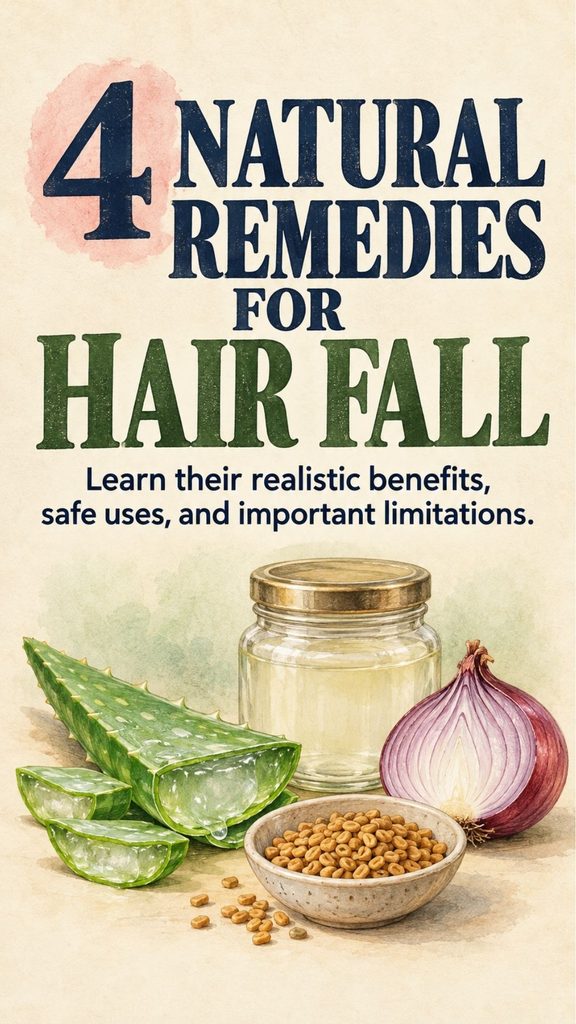
Aloe vera, fenugreek seeds, onion juice, and coconut oil have all been used in traditional hair-care routines. These inexpensive ingredients are often promoted as natural solutions for reducing hair fall and encouraging healthier growth.
You Might Also Like:
- Loading posts...
But there’s an important difference between strengthening the hair you already have and treating hair loss at its source.
Some homemade treatments can help condition dry hair, improve manageability, or reduce breakage. Others have very limited evidence for encouraging hair growth, despite their popularity online.
The best approach is to understand what each ingredient can realistically do, use it safely, and recognize when excessive hair shedding needs medical attention.
Here are four popular natural hair remedies, how to prepare them, their possible benefits, and the precautions worth knowing before trying them.
Why Does Hair Fall Out in the First Place?
Before experimenting with homemade treatments, it’s helpful to understand why hair shedding occurs.
Hair naturally grows through a cycle that includes growing, transitioning, resting, and shedding.
According to the American Academy of Dermatology, losing approximately 50–100 hairs per day is generally considered normal.
The amount you notice can vary depending on hair length, washing frequency, and how you style your hair.
However, persistent thinning, unusually heavy shedding, or new bald patches may indicate a problem.
Common causes include:
- Genetics and hereditary pattern hair loss
- Physical or emotional stress
- Recent illness or high fever
- Childbirth and hormonal changes
- Thyroid disorders
- Certain medications
- Nutritional deficiencies
- Tight hairstyles that pull on the scalp
- Scalp infections or inflammatory conditions
- Damage from excessive heat or chemical processing
One common form of temporary excessive shedding is called telogen effluvium.
It can develop several months after a major illness, significant stress, childbirth, or another physical stressor.
In many cases, hair gradually regrows after the triggering problem resolves.
Other forms of hair loss, including hereditary thinning and certain inflammatory scalp conditions, may require specific treatment.
That’s why no single natural remedy can reliably address every kind of hair fall.
1. Aloe Vera: A Gentle Option for Scalp Comfort
Aloe vera has been used in traditional skin and hair care for generations.
The thick, clear gel inside its leaves contains water and various plant compounds.
It is commonly included in moisturizers, soothing gels, shampoos, and other personal-care products.
People often apply aloe vera to the scalp because it feels cooling and may help relieve some forms of dryness.
Can Aloe Vera Stop Hair Fall?
There isn’t convincing clinical evidence that applying aloe vera gel directly to the scalp prevents common forms of hair loss or reliably stimulates new hair growth.
However, a suitable aloe-based product may help make a dry scalp feel more comfortable.
Healthy scalp care can be useful, particularly when dryness or irritation contributes to scratching and hair breakage.
Aloe vera shouldn’t be presented as a treatment for androgenetic alopecia, alopecia areata, or other diagnosed hair-loss conditions.
How to Make a Simple Aloe Vera Scalp Treatment
You’ll need:
- 1–2 tablespoons of commercially prepared, plain aloe vera gel suitable for skin use
- A small clean bowl
- A wide-tooth comb, optional
Instructions:
- Make sure your scalp is free from irritating styling-product buildup.
- Place the aloe vera gel in a clean bowl.
- Part your hair into several sections.
- Apply a small amount of gel to the scalp.
- Spread gently using your fingertips without scratching.
- Leave it on for approximately 10–15 minutes, provided the product directions permit.
- Rinse thoroughly with lukewarm water.
- Follow your normal gentle hair-care routine.
A patch test on a small area of skin is sensible before using a new product.
If you prefer aloe directly from a plant, be aware that the outer leaf contains a yellow latex layer that differs from the clear inner gel. Improperly prepared plant material may cause irritation.
A commercially processed cosmetic gel is generally a more predictable choice.
How Often Can You Use It?
There is no established medically effective schedule for aloe vera treatments to prevent hair loss.
If your skin tolerates the product, occasional use may be reasonable as part of a moisturizing routine.
Stop immediately if you develop burning, itching, redness, or a rash.
Best use: Supporting scalp comfort and providing a light, soothing hair-care treatment rather than regrowing lost hair.
2. Fenugreek Seeds: A Traditional Homemade Hair Mask
Fenugreek seeds are familiar ingredients in cooking and traditional beauty preparations.
When soaked in water, they soften and produce a slippery, gel-like texture.
This texture makes them popular in homemade hair masks.
Fenugreek contains proteins, fiber, and plant compounds, but the nutrients present in a seed don’t necessarily provide the same benefits when the seed is applied externally to hair.
Does Fenugreek Regrow Hair?
Claims that fenugreek rebuilds damaged hair follicles or reverses baldness aren’t supported by strong clinical evidence.
Research specifically demonstrating that homemade fenugreek seed paste treats hair loss is insufficient.
Still, the soft, slippery paste may temporarily coat hair strands and improve the feeling of manageability for some users.
That cosmetic effect is different from stimulating new hair growth.
How to Prepare a Fenugreek Hair Mask
You’ll need:
- 2 tablespoons fenugreek seeds
- Clean water for soaking
- A blender or grinder
- A small bowl
Instructions:
- Rinse the fenugreek seeds thoroughly.
- Place them in a clean bowl and cover with water.
- Soak them overnight in the refrigerator.
- Drain the seeds.
- Blend them with a small amount of clean water until smooth.
- Add water gradually until the mixture forms a spreadable paste.
- Apply a small amount to your hair, avoiding an irritated or broken scalp.
- Leave on briefly, approximately 10–15 minutes, if tolerated.
- Rinse thoroughly and wash gently to remove any remaining seed particles.
Traditional recipes sometimes recommend using a full cup of seeds and leaving the paste on for 40 minutes.
There’s no evidence that such large quantities or prolonged application improves results.
A small test batch is more practical and less wasteful.
Important Precautions
Fenugreek can cause allergic reactions in some people.
Anyone with known fenugreek or relevant legume allergies should avoid experimenting with homemade fenugreek masks unless a clinician has confirmed that doing so is safe.
Because the mixture contains water and fresh plant material, prepare it immediately before use and discard leftovers.
Don’t store homemade wet seed paste at room temperature for future treatments.
Best use: An occasional traditional hair-conditioning mask, with realistic expectations and attention to allergies.
3. Onion Juice: A Popular Remedy With Limited Hair-Growth Evidence
Onion juice is one of the more unusual home remedies promoted for hair loss.
The method generally involves extracting juice from an onion and applying it directly to the scalp.
Supporters often claim that its sulfur compounds improve circulation, nourish hair follicles, and encourage rapid hair growth.
Those explanations are not established as effective treatments for ordinary hair thinning.
What Does the Research Show?
A small study published in The Journal of Dermatology in 2002 investigated crude onion juice for people with patchy alopecia areata.
The study included 38 participants divided between an onion-juice group and a tap-water comparison group.
The researchers reported more hair regrowth in the onion-juice group during the study period.
However, several limitations matter.
The study was small, its design did not establish broad effectiveness, and it involved a specific autoimmune hair-loss condition rather than common hereditary thinning.
Its findings have not established onion juice as a standard, reliable hair-loss treatment.
The results should not be generalized to every person experiencing hair fall.
How Is Onion Juice Traditionally Prepared?
The traditional method uses:
- 1 small onion
- A grater or blender
- A clean strainer
- A cotton pad
The onion is grated or blended, then strained to collect the liquid.
Some home-remedy instructions recommend applying the juice to the scalp, leaving it for 20–30 minutes, and rinsing.
However, this isn’t an evidence-based home treatment that can be recommended routinely.
Raw onion juice may cause significant irritation, particularly on sensitive or inflamed skin.
Its strong odor can also be difficult to remove.
Should You Try Onion Juice?
For most people dealing with unexplained hair shedding, a gentle scalp-care routine and proper diagnosis are more sensible starting points.
Avoid onion juice if you have open skin, eczema, scalp inflammation, known onion sensitivity, or another condition that makes irritation more likely.
Never continue an application that causes burning or discomfort.
If you develop round bald patches suggestive of alopecia areata, consult a dermatologist. Effective treatments are available, and delaying assessment to experiment with onion juice may postpone appropriate care.
Best use: Not recommended as a dependable general hair-loss treatment; the evidence remains limited and irritation is a concern.
4. Coconut Oil: One of the Better-Supported Options for Reducing Hair Damage
Of the four traditional ingredients, coconut oil has some of the more useful evidence for protecting the hair shaft.
It has been used in hair-care routines across many cultures and is especially popular as a pre-shampoo treatment.
Unlike a treatment designed to stimulate hair follicles, coconut oil primarily acts on the existing hair strands.
What Makes Coconut Oil Different?
Coconut oil contains lauric acid, a fatty acid with properties that allow it to interact with hair proteins.
A study published in the Journal of Cosmetic Science in 2003 compared coconut oil with mineral oil and sunflower oil.
The researchers found that coconut oil reduced protein loss from both damaged and undamaged hair when used as a pre-wash or post-wash product.
This suggests that coconut oil can help protect hair fibers from certain types of damage.
But there is an important limitation.
Reducing hair breakage is not the same as preventing hair from shedding at the follicle.
Coconut oil has not been established as a treatment that reverses hereditary baldness or other medical causes of hair loss.
How to Make a Coconut Oil Hair Treatment
You’ll need:
- 1–2 tablespoons of plain coconut oil, adjusted for hair length and density
- A small bowl
- A wide-tooth comb, optional
Instructions:
- Place a small amount of coconut oil in your hands.
- Allow it to soften naturally or warm the container gently if necessary.
- Avoid applying hot oil.
- Distribute the oil through the mid-lengths and ends of your hair.
- Focus on areas that are dry or prone to breakage.
- Leave on for approximately 20–30 minutes as an optional pre-shampoo treatment.
- Shampoo gently to remove excess oil.
- Follow with conditioner if needed.
For fine hair, begin with much less oil to avoid a greasy or weighed-down appearance.
Should Coconut Oil Go on the Scalp?
Not everyone benefits from applying oil directly to the scalp.
People with certain scalp conditions, including some forms of dandruff or seborrheic dermatitis, may find heavy oiling uncomfortable or unhelpful.
A pre-shampoo treatment focused on the hair shaft is often a more practical starting point.
How Often Should You Use It?
There’s no single ideal schedule.
Some people may enjoy occasional oil treatments, while others find them unnecessary.
Your hair type, product routine, and level of dryness should guide frequency.
Best use: Reducing some forms of hair-fiber damage and improving manageability, not reliably stimulating new follicle growth.
Which Natural Remedy Is Most Worth Trying?
These four popular ingredients have different potential uses, and none has been established as a universal cure for hair fall.
| Ingredient | Possible benefit | Evidence for regrowing hair |
|---|---|---|
| Aloe vera | Scalp comfort and light moisturizing | Insufficient |
| Fenugreek seeds | Traditional conditioning and temporary slip | Insufficient |
| Onion juice | Limited research in patchy alopecia areata | Preliminary and inadequate for general use |
| Coconut oil | Reduces some hair-fiber protein loss and damage | Not established |
If your main concern is dry, fragile hair that breaks during brushing, coconut oil or a suitable conditioner may help improve manageability.
If your scalp is mildly dry, a gentle moisturizing product may improve comfort.
But if hair is shedding excessively from the roots or your hairline is visibly receding, these home treatments may not address the underlying problem.
How to Tell Hair Breakage From Hair Shedding
Understanding what you’re seeing can help you choose an appropriate response.
Hair Breakage
Hair breakage occurs when the shaft snaps.
You may notice shorter broken pieces, split ends, or uneven lengths.
Common contributors include excessive heat styling, chemical processing, friction, and rough handling.
Conditioning and gentler hair-care practices may help reduce further damage.
Hair Shedding
Shedding occurs when a complete hair is released from the follicle as part of its growth cycle or because of a condition affecting the cycle.
You may notice full-length strands in the shower or hairbrush, sometimes with a small pale club-shaped end.
Excessive shedding may be associated with stress, illness, hormonal changes, medication effects, or other causes.
Pattern Hair Loss
Gradual widening of the hair part, thinning around the crown, or a receding hairline may suggest hereditary pattern hair loss.
This often requires a different approach from ordinary cosmetic hair care.
Patchy Hair Loss
Distinct round or oval bald patches may be associated with alopecia areata or other scalp disorders.
Scaling, redness, pain, or broken hairs may indicate an infection or inflammatory condition.
These patterns deserve professional evaluation rather than repeated experimentation with home masks.
Five Everyday Habits That Can Help Protect Your Hair
Natural ingredients are only one small part of hair care.
Some of the most useful ways to reduce avoidable hair damage involve how you wash, style, and handle your hair.
1. Use a Gentle Shampoo and Conditioner
Choose a shampoo that cleanses without leaving your scalp excessively irritated or your hair unusually dry.
Apply conditioner after shampooing, particularly to the lengths and ends.
Conditioner helps reduce friction, tangling, and breakage.
There’s no need to avoid washing your hair because you’re worried about seeing strands in the shower.
Washing often releases hairs that have already completed their shedding cycle.
2. Avoid Tight Hairstyles
Tight ponytails, braids, buns, and extensions can place repeated tension on hair follicles.
Over time, this may cause traction alopecia.
Choose hairstyles that don’t create persistent pulling or discomfort.
If a hairstyle hurts, produces bumps, or repeatedly causes broken hairs around the hairline, change it.
3. Reduce Excessive Heat Styling
Frequent high temperatures can weaken hair strands.
Limit straighteners, curling irons, and other heated tools where practical.
Allow hair to dry naturally when possible, or use a lower heat setting.
Avoid repeatedly applying high heat to already fragile or damaged sections.
4. Handle Wet Hair Gently
Wet hair can be more vulnerable to damage during rough handling.
Avoid vigorous towel rubbing.
Use a soft towel or microfiber wrap to absorb excess moisture.
Detangle gently using a suitable comb or brush for your hair type, working through tangles without pulling.
5. Eat Enough Protein and Essential Nutrients
Hair growth depends on adequate nutrition.
Insufficient intake of protein, iron, zinc, or other nutrients can contribute to hair problems in some individuals.
Include suitable protein sources such as eggs, fish, dairy, beans, lentils, or other foods that fit your diet.
Avoid restrictive crash diets and unnecessary severe calorie restriction.
Don’t assume you need high-dose hair-growth supplements.
Excessive intake of certain nutrients, including vitamin A and selenium, can actually contribute to hair loss.
When Should You See a Dermatologist for Hair Fall?
Mild, temporary shedding isn’t always a sign of serious illness.
However, it’s worth seeking medical advice if you notice:
- Sudden or unusually heavy hair loss
- Clearly defined bald patches
- Gradually widening hair parts
- A receding hairline
- Persistent scalp itching, redness, scaling, or pain
- Hair loss accompanied by fatigue or other unexplained symptoms
- Thinning that continues or becomes progressively worse
- Hair loss after starting a new medication
A dermatologist may examine your scalp, review your medical history, and recommend appropriate testing.
Depending on your symptoms, tests may be used to assess iron status, thyroid function, or other possible contributing factors.
Not everyone needs a large panel of blood tests.
Testing should be selected according to the clinical findings.
For certain types of pattern hair loss, treatments such as topical minoxidil have stronger evidence than homemade masks.
Other conditions may require prescription anti-inflammatory or antifungal treatment.
Some forms of temporary shedding can improve once their trigger has resolved.
The correct approach depends on the diagnosis.
How Long Does It Take for Hair to Grow Back?
Hair growth is a slow biological process.
Even with an effective treatment, visible improvement usually requires patience.
Scalp hair commonly grows around one centimeter per month on average, although individual growth rates vary.
If excessive shedding developed after illness, childbirth, or another temporary trigger, regrowth may occur gradually over several months as the hair cycle normalizes.
For pattern hair loss, treatments may take six months or longer before noticeable improvement becomes apparent.
A few applications of aloe vera, onion juice, or coconut oil won’t reliably create visible new growth within days.
Be particularly skeptical of home remedies promising to regrow thick hair in one or two weeks.
When a product appears to improve hair immediately, the change may be caused by conditioning, reduced frizz, or increased shine rather than actual growth from the follicles.
Common Mistakes to Avoid With Natural Hair Remedies
Using ingredients too frequently: Daily home masks aren’t necessarily better and can increase irritation or buildup.
Applying raw ingredients to broken skin: Onion juice, plant extracts, and other mixtures may worsen an inflamed scalp.
Using very hot oil: Heated oil can burn the scalp and damage fragile hair.
Assuming natural means harmless: Plants and seeds can cause allergies and other reactions.
Expecting coconut oil to cure baldness: Its better-supported benefit involves hair-fiber protection.
Taking supplements without identifying a deficiency: Unnecessary supplementation may be ineffective or harmful.
Delaying diagnosis: Certain hair-loss conditions are more treatable when assessed early.
Trying several new products at once: If irritation develops, it becomes difficult to identify the cause.
The safest strategy is to keep your routine simple and stop using anything that causes persistent discomfort.
A Simple Weekly Hair-Care Routine
If your goal is to protect existing hair and reduce avoidable breakage, you don’t need an elaborate schedule.
Here’s an example of a gentle routine that can be adjusted for your hair type.
| When | Hair-care routine |
|---|---|
| Wash day | Gentle shampoo followed by conditioner |
| Once a week, if needed | Coconut oil pre-shampoo treatment on dry lengths |
| Occasionally, if tolerated | Plain aloe-based product for scalp comfort |
| Daily | Avoid tight hairstyles and unnecessary pulling |
| As needed | Gently detangle and protect hair from excessive heat |
| Ongoing | Eat a balanced diet and monitor unusual shedding |
Fenugreek is an optional traditional conditioning treatment rather than an essential part of hair care.
Onion juice isn’t recommended as a dependable general treatment for hair loss.
If you are experiencing progressive thinning or persistent shedding, prioritize finding the cause instead of relying on a weekly cosmetic routine.
Final Thoughts: Natural Hair Care Can Help, but the Cause of Hair Fall Matters Most
Aloe vera, fenugreek, onion juice, and coconut oil have longstanding places in traditional beauty routines.
Some may make hair feel softer or the scalp more comfortable. Coconut oil also has evidence supporting its ability to reduce certain forms of hair-shaft damage.
But these benefits should not be confused with curing hair loss.
There is currently insufficient evidence that aloe vera or fenugreek masks reliably regrow hair, while research on onion juice remains too limited to support its general use.
If your hair is breaking, gentle conditioning and reduced styling damage may help.
If you’re experiencing excessive shedding, widening areas of thinning, or bald patches, identifying the underlying cause is the more important step.
Start with a mild shampoo, suitable conditioner, gentle styling habits, and adequate nutrition. Treat homemade masks as optional additions rather than guaranteed solutions.
Healthy-looking hair is not the result of one miracle ingredient. It comes from understanding your hair’s needs, protecting it from unnecessary damage, and getting appropriate treatment when hair loss has an underlying medical cause.