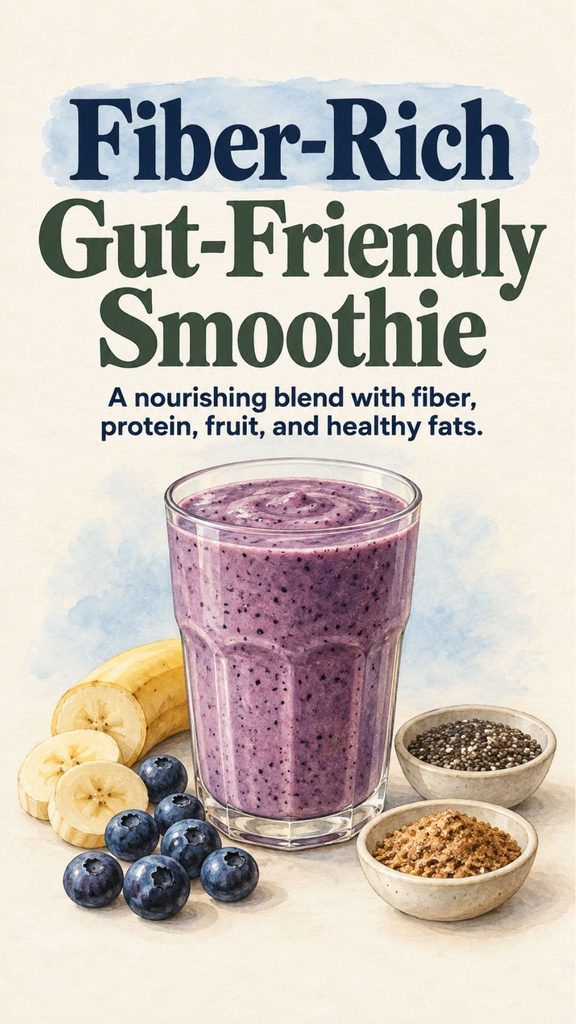
A smoothie made with Greek yogurt, blueberries, banana, chia seeds, and ground flaxseed can be a convenient way to add fruit, fiber, protein, and healthy fats to breakfast or a snack.
What it cannot do is magically “heal the gut,” eliminate bloating for everyone, or balance a woman’s hormones.
Those claims sound appealing, but digestion is far more complicated than one recipe.
You Might Also Like:
- Loading posts...
Bloating can have many causes, including normal intestinal gas, constipation, certain carbohydrates, food intolerances, irritable bowel syndrome, and other digestive conditions. Bacteria in the large intestine naturally produce gas when they break down carbohydrates that were not completely digested earlier in the digestive tract.
Likewise, hormones are regulated by a complex network of glands, organs, signals, nutrition, sleep, health conditions, medications, age, and life stage. No combination of blueberries, yogurt, seeds, and cinnamon has been shown to simply “balance hormones.”
What this smoothie can be is a nutritious, fiber-rich meal or snack that may fit well into an overall healthy eating pattern.
Here is how to make it—and what each ingredient realistically contributes.
The Gut-Friendly Smoothie Recipe
For one large smoothie, use:
- 1 cup unsweetened almond milk
- ½ cup plain Greek yogurt
- 1 small banana
- ½ cup frozen blueberries
- 1 tablespoon chia seeds
- 1 tablespoon ground flaxseed
- 1 teaspoon honey, optional
- ½ teaspoon cinnamon
- Ice, if desired
Add everything to a blender and blend until completely smooth.
If the smoothie is thicker than you like, add a little more almond milk.
If you prefer a colder, thicker smoothie, use a frozen banana or add several ice cubes.
Drink it soon after blending rather than leaving it at room temperature for an extended period.
Why This Smoothie Can Support Digestion
The main digestive benefit of this recipe comes from something much less glamorous than the phrase “gut healing”:
fiber.
Fruit and seeds provide several types of dietary fiber.
Fiber supports normal digestion and can help prevent constipation. Depending on age and sex, adults generally need about 22 to 34 grams of fiber per day, and it is usually best to increase fiber gradually rather than suddenly.
This smoothie contains several fiber-containing foods at once:
banana,
blueberries,
chia,
and flaxseed.
That can be useful for someone whose ordinary diet is low in fruit, seeds, legumes, vegetables, and whole grains.
But there is an important catch.
More fiber does not automatically mean less bloating.
Increasing fiber too quickly can actually cause gas, abdominal discomfort, and bloating, particularly in someone who normally eats very little fiber.
If you are not accustomed to chia and flax, consider beginning with smaller amounts and increasing gradually.
Drinking enough fluids also matters when increasing fiber intake.
Greek Yogurt: Protein Plus Potential Live Cultures
Greek yogurt adds creaminess and protein.
Some yogurts also contain live microorganisms commonly described as probiotics.
Probiotics are live microorganisms intended to provide a health benefit, and they can be found in certain yogurts and other fermented foods. However, probiotic effects depend on the specific organisms and strains involved. Researchers still do not know which probiotics are beneficial for every digestive condition or which people are most likely to benefit.
So simply adding yogurt does not automatically turn a smoothie into a proven digestive treatment.
If probiotic cultures matter to you, check the yogurt label for wording indicating that it contains live or active cultures.
Plain yogurt is also preferable if you are trying to keep added sugar lower.
If regular yogurt causes digestive discomfort because of lactose intolerance, lactose-free yogurt may be easier to tolerate.
Chia Seeds Add Fiber and Plant Omega-3 Fat
Chia seeds are tiny, but they contribute fiber and fat to the smoothie.
They also provide alpha-linolenic acid, or ALA, a plant-based omega-3 fatty acid. Chia seeds and flaxseed are both recognized dietary sources of ALA.
Chia absorbs liquid and thickens quickly, which is why a smoothie containing chia may become noticeably thicker if left sitting.
If you are new to chia seeds, more is not necessarily better.
One tablespoon is plenty for a smoothie like this.
Starting with a smaller amount can be sensible for someone who is increasing fiber gradually.
Ground Flaxseed Is Better Suited to a Smoothie Than Whole Seeds
Flaxseed provides fiber and ALA omega-3 fat as well.
Using ground flaxseed is particularly convenient in a smoothie because it blends easily into the drink.
The original “hormone balancing” idea sometimes attached to flaxseed usually comes from interest in compounds called lignans and their interaction with estrogen metabolism.
That does not mean one tablespoon of flax can “balance female hormones.”
Research on flaxseed for hormone-related concerns such as menopausal symptoms has produced mixed findings. For example, studies reviewed by NCCIH have not consistently found flaxseed superior to placebo for menopausal symptoms such as hot flashes.
Eat flax because it is a nutritious seed—not because it promises to normalize every hormone.
Blueberries Provide Fruit, Fiber, and Flavor
Frozen blueberries make this smoothie naturally sweet and give it its deep purple color.
They also contribute dietary fiber.
Berries are among the fruit sources of fiber recommended as part of a fiber-rich diet.
Frozen blueberries are just as convenient here as fresh ones and have the advantage of making the smoothie cold without needing much ice.
There is no need to buy a special “superfood” powder if ordinary frozen berries are available.
Blueberries are already a useful whole-food ingredient.
Banana Makes the Smoothie Creamy and Naturally Sweet
The banana provides sweetness and texture.
A ripe banana can make the teaspoon of honey unnecessary for many people.
Bananas also contribute carbohydrate and fiber.
If you want a less sweet smoothie, use half a banana.
If you want something more substantial after exercise or as breakfast, using the whole small banana may make more sense.
There is no single correct amount.
The recipe should match your appetite and nutritional needs.
Unsweetened Almond Milk Is Mostly the Liquid Base
Almond milk helps everything blend.
Nutritionally, different brands can vary substantially.
Some are fortified with calcium and vitamin D, while others contain different amounts of protein, sugar, and added ingredients.
Choosing an unsweetened version prevents the smoothie from becoming much sweeter than necessary.
If you need more protein, dairy milk or a higher-protein soy beverage may contribute more than many almond milks.
If you have allergies or intolerances, choose whichever milk fits your needs.
There is nothing uniquely “gut healing” about almond milk itself.
Honey Is Optional
A teaspoon of honey can improve the flavor if the fruit is not very sweet.
But it is optional.
The banana and blueberries already provide natural sweetness.
If you are trying to reduce added sugars, blend the smoothie first and taste it before adding honey.
You may not need any.
Honey does not transform this recipe into a digestive treatment, and more honey does not make it healthier.
Cinnamon Is Primarily Here for Flavor
Cinnamon pairs beautifully with banana and blueberries.
It adds warmth and sweetness without much actual sugar.
But the phrase “anti-inflammatory power” should be used carefully.
Cinnamon contains biologically active compounds and has been studied for several possible health effects, but NCCIH notes that research does not clearly support cinnamon as a treatment for any particular health condition.
At the half-teaspoon amount used in this smoothie, think of cinnamon as a flavorful spice rather than medicine.
That is still a perfectly good reason to use it.
Is This Really a Probiotic and Prebiotic Smoothie?
Possibly—but the labels need some explanation.
The yogurt may provide probiotic organisms if it contains appropriate live cultures.
The fruit and seeds provide fibers that reach the digestive tract, and certain dietary fibers can serve as substrates for intestinal microorganisms.
That does not mean every fiber in the recipe is formally a proven prebiotic with a specific clinical effect.
The terms “probiotic” and “prebiotic” are often used very loosely online.
Research into probiotics is active, but benefits vary by strain, condition, and person. Even for irritable bowel syndrome, evidence for probiotics remains mixed, and there is not enough information to say that any random probiotic food will reliably reduce bloating.
This is better described simply as a fiber-rich smoothie that can include live-culture yogurt.
That is accurate without overselling it.
Will It Reduce Bloating?
Maybe for some people.
Maybe not.
If constipation is contributing to bloating, gradually improving fiber intake and drinking enough fluids may help bowel regularity.
But fiber-rich foods can also temporarily increase gas and bloating.
And some people may find individual ingredients troublesome.
For example, someone who does not tolerate lactose well might feel worse after yogurt.
Someone with IBS may respond differently to bananas, yogurt, or larger amounts of fermentable carbohydrates.
Someone unaccustomed to chia and flax may feel more bloated after suddenly adding several tablespoons of seeds.
NIDDK notes that dietary changes for IBS vary between individuals, and different approaches help different people.
If your goal is reducing bloating, pay attention to your own response rather than assuming a recipe labeled “gut healing” must work.
A Gentler Version for Someone New to High-Fiber Smoothies
If you normally eat little fiber, do not feel obligated to begin with the full amount of seeds.
Try the smoothie with:
½ tablespoon chia
and
½ tablespoon ground flaxseed.
If you tolerate it well, increase gradually.
That is often more comfortable than suddenly adding a large amount of fiber in one meal.
You can also keep the recipe simple.
A digestive-friendly recipe does not need twelve powders, supplements, herbal extracts, and seeds blended together.
When you add too many ingredients at once, it becomes difficult to tell which one caused a problem if symptoms appear.
Can This Smoothie Balance Hormones?
There is no good reason to promise that it will.
Women do not have one universal hormone imbalance that a smoothie can correct.
Estrogen, progesterone, thyroid hormones, insulin, cortisol, and many other hormones are regulated differently.
Symptoms such as irregular menstrual cycles, unexpected hair growth, significant unexplained weight changes, persistent fatigue, fertility problems, unusual bleeding, or severe menopausal symptoms can have many causes.
A smoothie may be part of a nutritious diet, but it is not a substitute for diagnosing or treating conditions involving the endocrine or reproductive systems.
Nutrition can support overall health.
That is different from claiming one recipe “balances hormones.”
What About “Gut Healing”?
The phrase sounds impressive but is usually too vague to be medically meaningful.
The gastrointestinal tract is not one simple organ that is either “healed” or “unhealed.”
Someone with constipation has different needs from someone with celiac disease.
Someone recovering from gastroenteritis has different needs from someone with Crohn’s disease.
Someone with lactose intolerance has different needs from someone with IBS.
Probiotics themselves have condition-specific evidence, and researchers still cannot identify one universal probiotic treatment for all digestive problems.
So rather than saying this smoothie “heals the gut,” it is more accurate to say it provides several foods that can contribute to a nutritious, fiber-containing diet.
When This Smoothie May Not Be Ideal
A recipe that works well for one person may be uncomfortable for another.
You may want to modify it if you:
have a milk allergy,
have lactose intolerance,
have a seed allergy,
have been instructed to follow a low-fiber diet,
have certain gastrointestinal conditions,
or need to carefully manage carbohydrate intake.
People with intestinal narrowing or certain digestive conditions are sometimes advised to restrict fiber under medical guidance.
If a clinician has prescribed a particular diet, follow that advice rather than assuming a high-fiber smoothie is automatically better.
How to Make the Smoothie More Filling
If this is going to be breakfast rather than a light snack, you may want a more substantial meal.
Increasing the Greek yogurt is one option.
Using a higher-protein milk is another.
You could also pair the smoothie with eggs, whole-grain toast, or another food rather than forcing every nutrient into the blender.
Smoothies do not have to contain everything you need for the entire morning.
Sometimes a simple smoothie plus a small solid-food breakfast is more satisfying.
How to Make It Less Sweet
Skip the honey first.
Then reduce the banana to half if necessary.
Plain Greek yogurt and unsweetened milk help keep sweetness under control.
Do not assume that a smoothie needs dates, maple syrup, honey, fruit juice, and a very ripe banana all at the same time.
Fruit already contributes plenty of flavor.
How to Make It Dairy-Free
Replace Greek yogurt with a dairy-free yogurt that fits your dietary needs.
If you specifically want live cultures, check the label rather than assuming every nondairy yogurt contains them.
Remember that protein content varies widely among plant-based yogurts.
Some are relatively high in protein.
Others contain very little.
The front of the package may say “plant based,” but the nutrition label tells you much more.
Smoothies Are Convenient, but Whole Foods Still Matter
There is nothing wrong with blending food.
A smoothie can be especially convenient for busy mornings or for someone who enjoys drinking breakfast.
But you do not need to drink smoothies to have a healthy digestive system.
Whole fruit, vegetables, beans, lentils, oats, whole grains, nuts, and seeds can all provide fiber.
NIDDK lists whole grains, legumes, fruits, vegetables, and nuts among useful sources of dietary fiber.
The smoothie is one option among many.
When Bloating Deserves More Attention
Occasional bloating after meals is common.
Persistent or severe bloating deserves more attention, particularly if it occurs with other symptoms.
Talk with a healthcare professional if bloating is frequent, significantly interferes with daily life, or is accompanied by symptoms such as persistent abdominal pain, repeated vomiting, unexplained weight loss, blood in the stool, major changes in bowel habits, or other concerning changes.
NIDDK notes that frequent or bothersome gas symptoms can sometimes be associated with conditions such as IBS and other gastrointestinal disorders.
Do not keep adding “gut health” supplements to a smoothie while ignoring symptoms that need proper evaluation.
The Bottom Line
This blueberry, banana, Greek yogurt, chia, and flax smoothie is a perfectly reasonable recipe.
It gives you fruit.
It provides fiber.
Greek yogurt adds protein and may contain live cultures.
Chia and flax provide fiber and plant-based ALA omega-3 fats.
And cinnamon makes everything taste better.
Those are already worthwhile qualities.
There is no need to turn the recipe into something it cannot prove itself to be.
It cannot guarantee less bloating.
It does not automatically heal the gut.
And there is no evidence that drinking it will broadly “balance women’s hormones.”
Make it because you enjoy it, because it is convenient, and because its ingredients fit into a nutritious diet.
If your digestive system feels good afterward, wonderful.
If the full amount of seeds leaves you bloated, reduce them and build fiber more slowly.
And if ongoing digestive or hormonal symptoms are bothering you, investigate the cause rather than expecting breakfast to function as medicine.
Sometimes a smoothie is simply a good smoothie—and that is more than enough.