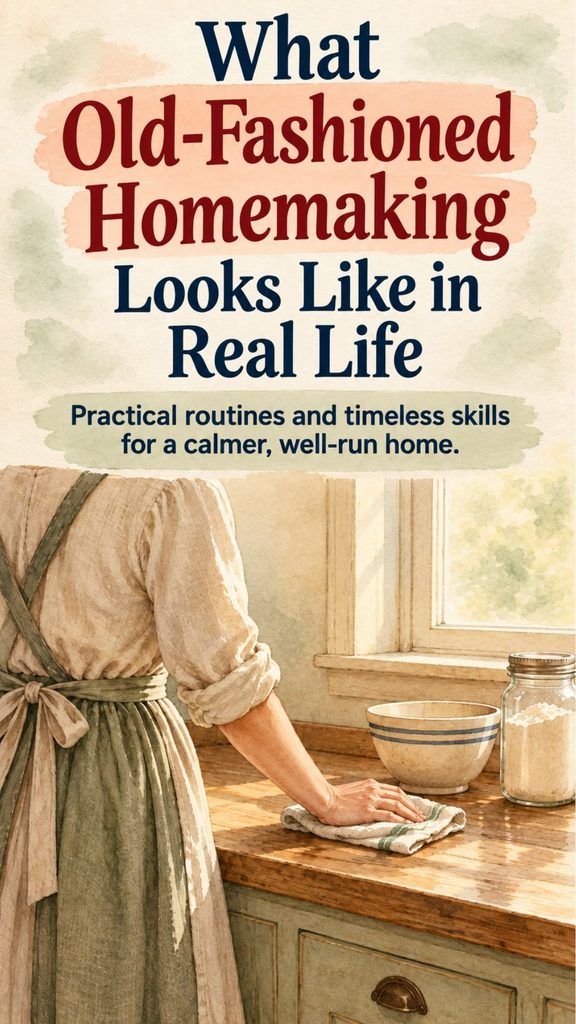
The phrase old-fashioned housewife can bring to mind a very specific picture: a tidy kitchen, bread cooling on the counter, laundry on the line, a neatly tied apron, dinner made from scratch, and a home that somehow always feels calm.
Real life is rarely that polished.
Old-fashioned homemaking is not about pretending to live in another century or recreating a perfect version of the 1950s. It is much more practical than that.
You Might Also Like:
- Loading posts...
At its best, it means learning useful household skills, taking care of what you own, cooking more often, wasting less, creating dependable routines, and making home life feel steady instead of constantly rushed.
You can use modern appliances, order groceries when you need to, wear jeans, work outside the home, and still bring many traditional homemaking habits into everyday life.
The point is not to reject modern life.
It is to keep the old skills that still make modern life better.
Old-Fashioned Homemaking Is Mostly Ordinary Work
Traditional homemaking was not one long afternoon of baking pies and arranging flowers.
It involved repetitive work.
Meals had to be planned.
Clothes needed washing and repairing.
Floors became dirty again.
Food had to be stored properly.
Children needed care.
Bills had to be paid.
Gardens needed weeding.
Household supplies eventually ran out.
Much of homemaking is still exactly the same today.
The tools have changed, but the basic responsibilities have not.
An old-fashioned homemaking mindset starts by accepting that ordinary household work matters even when nobody applauds it.
A freshly cleaned kitchen will become messy again.
You still clean it.
A basket of laundry will return tomorrow.
You still wash today’s load.
The value is in maintaining the household, not permanently finishing it.
Start the Day by Setting the House in Order
A traditional household rhythm often began with a few basic tasks before the rest of the day’s work.
You can create the same effect without following a rigid schedule.
A simple morning reset might include:
- Opening curtains
- Making the bed
- Getting dressed
- Starting one load of laundry
- Unloading the dishwasher
- Washing breakfast dishes
- Wiping the kitchen counters
- Checking what is planned for dinner
These small jobs create momentum.
They also prevent little tasks from becoming much larger ones later.
There is no requirement to wake at dawn or complete an elaborate morning routine.
The goal is simply to give the day a beginning.
Get Dressed for the Work You Are Doing
Old photographs often make homemakers appear far more dressed up than most people would choose for housework today.
There is no need to imitate that literally.
Getting dressed can still be useful because it marks the transition from sleeping to beginning the day.
Your homemaking outfit might be:
- Jeans and a cotton shirt
- Leggings and a sweater
- A simple dress
- Work trousers and a T-shirt
- A skirt and blouse
- Whatever is comfortable and washable
An apron remains surprisingly practical.
It protects clothing from flour, grease, cleaning splashes, garden soil, and ordinary kitchen mess.
But an apron is simply a tool.
It is not proof that someone is a better homemaker.
Cook More Often From Basic Ingredients
Cooking is one of the most useful traditional homemaking skills to keep.
You do not need to prepare every ingredient from scratch.
Learning how to make dependable everyday meals is far more important than attempting elaborate recipes.
Build a collection of meals your household actually enjoys.
For example:
- Soup and bread
- Roast chicken and vegetables
- Pasta with homemade sauce
- Rice and beans
- Stews
- Baked potatoes
- Egg dishes
- Casseroles
- Simple curries
- Homemade pizza
Learn how to use leftovers intentionally.
Cook extra rice for another meal.
Use roasted chicken in soup or sandwiches.
Turn vegetables that need using into a soup, stir-fry, or pasta dish.
Freeze extra portions when appropriate.
This is the less glamorous side of old-fashioned cooking, but it is where much of the savings happens.
Keep a Working Pantry
A traditional homemaker often knew what was available without needing to make a special shopping trip for every meal.
That is still a useful habit.
A practical pantry might contain staples such as:
- Flour
- Sugar
- Salt
- Oats
- Rice
- Pasta
- Dried or canned beans
- Lentils
- Canned tomatoes
- Cooking oil
- Baking ingredients
- Herbs and spices
- Stock ingredients
- Shelf-stable basics your family regularly uses
Your pantry does not need to look like a beautifully arranged shop display.
It needs to function.
Keep commonly used ingredients available, rotate older food forward, and avoid buying large quantities simply because something is on sale.
A pantry saves money only when the food inside it is actually eaten.
Bake the Things That Are Worth Baking
Bread, biscuits, muffins, cakes, crackers, and other foods were once commonly made at home because buying them was not always convenient.
Today, homemade is not automatically cheaper or easier.
Choose the foods that make sense for your household.
Bread can be a wonderful place to start.
A simple loaf teaches you basic dough handling and gives you something useful at the end.
Other approachable homemade staples include:
- Pancakes
- Muffins
- Biscuits
- Simple cakes
- Pizza dough
- Granola
- Cookies
You do not need to turn your kitchen into a bakery.
Make what saves money, tastes better to you, or gives you genuine enjoyment.
Buy the rest without guilt.
Learn to Clean With a Routine Instead of Constantly Cleaning
One of the easiest ways to become overwhelmed by homemaking is to treat every task as equally urgent.
Traditional households often followed rhythms because there was simply too much work to do everything every day.
You can create a modern version.
Daily tasks might include:
- Dishes
- Kitchen surfaces
- Quick floor sweep
- Basic tidying
- One load of laundry
- Making beds
Weekly tasks might include:
- Bathrooms
- Dusting
- Vacuuming
- Mopping
- Changing bed linens
- Cleaning mirrors
- Taking care of household paperwork
Seasonal tasks might include:
- Washing windows
- Cleaning behind furniture
- Sorting closets
- Washing curtains
- Deep cleaning appliances
- Preparing the garden
- Rotating seasonal clothing
A routine removes the feeling that the entire house must be cleaned every morning.
Do Laundry Before It Becomes a Mountain
Laundry is easier when it is treated as a cycle instead of an event.
The cycle is:
Wash → dry → fold → put away.
Starting five loads but leaving them piled on furniture does not complete the job.
Depending on household size, you might wash one load each day or designate several laundry days per week.
Line drying can be useful when weather and living arrangements allow it.
A clothesline can reduce dryer use and is particularly suitable for:
- Sheets
- Towels
- Lightweight cotton clothes
- Tablecloths
But there is no requirement to abandon the dryer just because you enjoy traditional homemaking.
Use whichever method makes sense.
Learn Basic Mending
One of the most genuinely useful old-fashioned skills is knowing how to repair ordinary clothing.
You do not need to sew an entire wardrobe.
Learn how to:
- Sew on a button
- Repair a loose seam
- Patch a hole
- Hem trousers
- Reinforce a small tear
- Fix a loose strap
Keep a small mending basket instead of throwing every damaged garment into the back of a closet.
A needle, several basic thread colors, scissors, pins, buttons, and patches are enough for many repairs.
Repairing what you already own often saves more money than constantly searching for inexpensive replacements.
Use Things Up
An old-fashioned household was generally less accustomed to treating ordinary items as disposable.
That mindset is worth keeping.
Before replacing something, ask:
- Can it be repaired?
- Can it be cleaned?
- Can it be repurposed?
- Can I use what I already own?
- Do I genuinely need another one?
Use the last of the soap.
Finish the food in the freezer.
Repair the basket.
Reuse the jar.
Mend the towel.
Turn worn fabric into cleaning cloths if it is no longer useful for its original purpose.
Not everything needs to be saved forever, but constantly replacing usable things is expensive.
Make Before You Buy—When It Makes Sense
Old-fashioned homemaking often involved producing household goods at home.
Some are still worth making.
Depending on your interests, you might make:
- Bread
- Soup
- Stock
- Simple cleaners
- Cloth napkins
- Aprons
- Curtains
- Gifts
- Garden compost
- Simple furniture repairs
- Preserves using safe methods
But homemade does not automatically mean cheaper, safer, or better.
Some DIY cleaners perform poorly.
Some homemade cosmetics need proper preservation.
Home canning requires tested methods.
Soap making involves caustic lye and requires correct safety procedures.
Choose projects because they are practical and worthwhile, not because everything in the home must be handmade.
Grow Something
Gardening has long been connected with homemaking because it can provide food, herbs, flowers, and a direct connection to the seasons.
You do not need acres of land.
Start with something manageable.
A few possibilities include:
- Culinary herbs
- Tomatoes
- Salad greens
- Peppers
- Green beans
- Strawberries
- Potatoes
- Flowers for cutting
Even a windowsill herb pot teaches you something about growing food.
If you have a larger garden, gradually learn about composting, crop timing, preserving harvests, and saving suitable seeds.
Gardening takes practice.
Expect failures alongside successes.
Learn Food Preservation One Method at a Time
Preserving food is another traditional skill that remains useful.
Begin with simple methods such as:
- Freezing
- Refrigerating
- Dehydrating appropriate foods
- Making refrigerator pickles
If you move into home canning, use current tested recipes and processing methods.
Do not rely solely on old family instructions when safety recommendations have changed.
Certain low-acid foods require pressure canning rather than boiling-water processing.
Traditional homemaking is most useful when old skills are combined with modern food-safety knowledge.
Keep a Household Notebook
One overlooked old-fashioned habit is keeping household information in one place.
A homemaking notebook can contain:
- Weekly meal plans
- Grocery lists
- Cleaning routines
- Garden notes
- Important household dates
- Clothing measurements
- Freezer inventory
- Pantry inventory
- Maintenance records
- Seasonal projects
- Gift ideas
- Favorite recipes
You can use an app instead.
The principle is the same.
A household becomes easier to manage when information is not scattered across your memory.
Practice Frugality Without Making Life Miserable
Traditional homemaking and frugality often overlap.
Frugality is not simply refusing to spend money.
It is using resources thoughtfully.
That might mean:
- Cooking at home most days
- Shopping secondhand
- Borrowing rarely used tools
- Repairing before replacing
- Planning purchases
- Using leftovers
- Cancelling unused subscriptions
- Buying durable items
- Avoiding unnecessary debt
A frugal home should still contain things that make life pleasant.
Flowers from the garden, a favorite tea, a comfortable chair, a good book, or a meal shared with family can all belong in a simple household.
The purpose is not deprivation.
It is reducing waste so money can be used where it matters.
Make the Home Pleasant, Not Perfect
Old-fashioned homemaking is often associated with cozy rooms, fresh flowers, curtains, quilts, and beautiful tables.
There is value in making your surroundings pleasant.
But a comfortable home does not require expensive decorating.
Try:
- Opening the curtains every morning
- Keeping one table reasonably clear
- Using lamps instead of harsh overhead lighting in the evening
- Displaying books you actually read
- Bringing in flowers or greenery
- Using baskets and containers you already own
- Keeping commonly used areas uncluttered
- Displaying handmade or meaningful objects
A home feels welcoming because people live there, not because it resembles a catalog.
Welcome People Without Needing a Perfect House
Hospitality used to be a normal part of home life.
It did not always involve formal entertaining.
Someone stopped by.
Tea was made.
A plate of something simple was offered.
Conversation happened around the kitchen table.
That kind of hospitality is still possible.
Do not wait until:
- The house is spotless
- The furniture matches
- You have special dishes
- You can serve an elaborate meal
- Every room is decorated
Offer what you have.
Coffee, tea, soup, homemade bread, or even a simple snack can be enough.
Hospitality is about making someone comfortable rather than impressing them.
Follow the Seasons
Older household routines were naturally seasonal.
Summer looked different from winter.
Autumn brought preservation.
Spring meant cleaning and planting.
You can bring some of that rhythm into modern life.
Spring
Declutter, deep clean, start seeds, wash windows, and prepare outdoor spaces.
Summer
Garden, preserve seasonal produce, dry laundry outdoors, and keep meals simple during hot weather.
Autumn
Prepare colder-weather clothing, preserve the harvest, organize the pantry, and tackle necessary home maintenance.
Winter
Cook hearty meals, mend clothing, work on crafts, plan the garden, read, and complete indoor projects.
Following seasonal rhythms can make household work feel less repetitive.
Teach Household Skills
Homemaking should not depend entirely on one person.
Children, teenagers, partners, and other household members can all participate according to ability.
Useful skills to teach include:
- Cooking simple meals
- Washing dishes
- Doing laundry
- Making beds
- Cleaning bathrooms
- Sewing on buttons
- Grocery planning
- Basic budgeting
- Gardening
- Using household tools safely
These are life skills.
A child who learns how a household operates becomes an adult who is better prepared to care for themselves.
Use Modern Tools Without Feeling Like You Are Cheating
A washing machine does not make homemaking less authentic.
Neither does:
- A dishwasher
- Vacuum cleaner
- Pressure cooker
- Slow cooker
- Freezer
- Grocery delivery
- Robot vacuum
- Online banking
- Digital calendar
Traditional homemakers used the best tools available to them too.
The purpose of homemaking is not to make ordinary work unnecessarily difficult.
Modern equipment can free time for cooking, gardening, sewing, family, paid work, hobbies, or rest.
Use technology where it genuinely improves your household.
Rest Is Part of Homemaking Too
A household cannot be run well indefinitely by an exhausted person.
Older ways of life were not automatically healthier simply because they involved more physical work.
Build rest into your routine.
Sit down with your tea.
Read.
Walk outside.
Work on a hobby.
Spend time with family without doing another task at the same time.
Leave something until tomorrow when necessary.
A well-run home should support the people living in it—including the person doing much of the work.
What an Old-Fashioned Housewife Actually Looks Like Today
She may wear an apron.
Or she may not.
She may bake bread every week but buy pasta sauce.
She may grow tomatoes but have groceries delivered.
She may sew curtains but use a robot vacuum.
She may stay home full-time, work part-time, run a business from home, or work outside the house.
She may love vintage dresses or live in jeans.
What makes the lifestyle old-fashioned is not appearance.
It is the mindset behind the work.
It is knowing how to cook instead of depending entirely on convenience food.
Repairing instead of immediately replacing.
Keeping a pantry.
Using what you have.
Growing something.
Maintaining routines.
Learning useful skills.
Creating a home that feels cared for.
Keep the Useful Parts of the Past
There is no need to romanticize every part of old-fashioned domestic life.
Previous generations worked extremely hard, often without the appliances, medical care, legal protections, transportation, and conveniences we now take for granted.
The goal should not be to recreate those hardships.
Keep what still serves you:
- Practical skills
- Resourcefulness
- Frugality
- Homemade food
- Repair
- Gardening
- Hospitality
- Household routines
- Seasonal living
- Care for belongings
- Less waste
Then combine those traditions with the best parts of modern life.
That is what old-fashioned homemaking can look like in real life.
Not a perfect woman standing in a spotless kitchen.
Not a costume.
Not a performance.
Just a capable person learning how to care for a home well, use resources wisely, and create a daily life that feels a little more intentional.