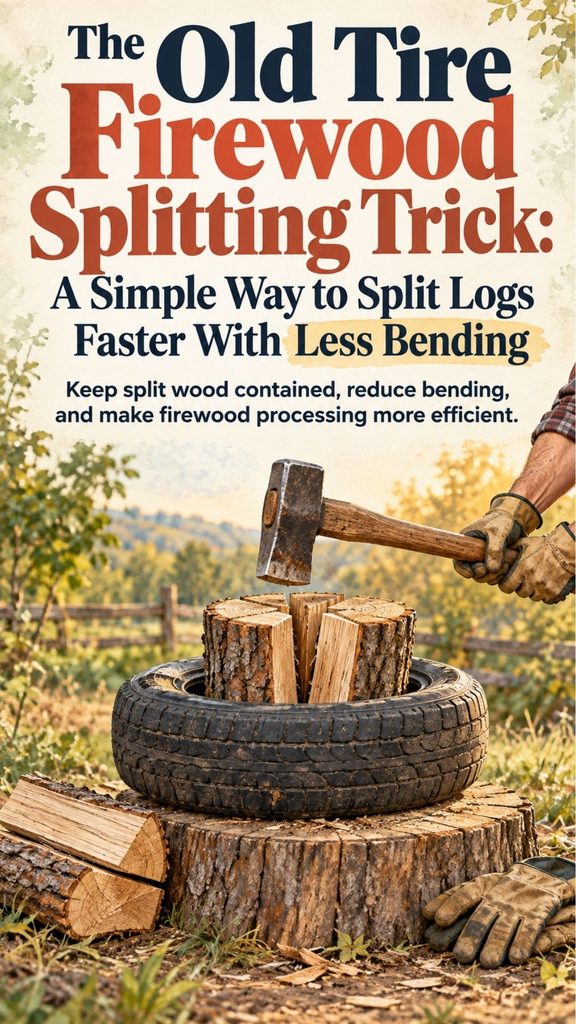
Splitting a pile of firewood usually follows the same frustrating pattern: set a log on the chopping block, swing the splitting maul, watch the pieces fall in different directions, bend down, stand them back up, swing again, and repeat.
An old vehicle tire can make that job surprisingly more organized.
The idea is simple. Place a sturdy tire around a log that is standing upright on a solid chopping block. As the wood splits, the tire helps hold the pieces together instead of allowing them to scatter across the ground. You can continue splitting the same round into smaller pieces without constantly stopping to pick everything up and reposition it.
You Might Also Like:
- Loading posts...
It does not make tough wood magically easier to split, and it does not replace safe axe technique. What it does is reduce some of the repetitive bending and resetting that makes firewood processing slow and tiring.
For anyone who heats with wood, maintains a fire pit, or regularly prepares kindling, this is one of those low-cost homestead ideas that can make an ordinary chore much more efficient.
How the Tire Firewood Trick Works
A tire acts as a flexible retaining ring around the log.
Normally, once a splitting maul separates a round into two pieces, gravity sends those pieces falling away from the chopping block. If you want smaller firewood, each piece has to be picked up, balanced upright again, and struck separately.
Inside a tire, the split pieces remain standing close together.
After the first strike divides the log, you can often split one half, then the other, while the rubber sidewall keeps everything contained.
Once the pieces are the size you want, lift them from the tire and replace them with another round.
The method is especially convenient when processing a large pile of firewood because you’re spending more time splitting and less time chasing pieces around the yard.
What You Need
This project requires very little equipment.
The most important pieces are a solid chopping block, an old tire large enough to fit around the logs you’re working with, and a properly sized splitting tool.
The chopping block should sit firmly on level ground and be wide enough to support the firewood securely.
Choose a tire with an opening that comfortably accommodates your typical log diameter. The wood should have enough room to split outward inside the tire, but the tire should not be so oversized that it provides no containment.
For splitting larger rounds, a splitting maul is often more appropriate than a thin cutting axe because its wedge-shaped head is designed to force wood fibers apart.
Smaller, already-seasoned pieces may require much less force.
Step 1: Build a Stable Splitting Station
Start with the foundation.
Place a large, flat chopping block on firm, level ground. A wide section of hardwood trunk works well because it provides a raised work surface and helps keep your splitting tool from striking soil or stones.
The block should not rock when pressure is applied.
Clear the area around it so you have plenty of room to swing without contacting fences, tools, branches, vehicles, or other objects.
Keep children, pets, and other people well away from the splitting area.
A clean working space is more important than making the setup look tidy.
Step 2: Position the Tire
Set the tire horizontally over the chopping block.
Depending on the size of the chopping block and tire, the tire may rest directly on the block or surround the upper part of it.
The setup should be stable before you place wood inside.
The tire should not slide around excessively while you’re working.
Do not create a tall or unstable stack of tires just to raise the wood. A low, solid chopping surface gives you much better control.
You also want the tire positioned so your axe or maul can strike the wood cleanly without contacting the rubber.
Step 3: Place a Log Upright Inside the Tire
Choose a firewood round with flat enough ends to stand securely.
Position it vertically in the center of the chopping block, inside the tire.
Before swinging, look at the grain and existing cracks.
Logs often split more easily if you take advantage of natural checks running through the end grain.
Knots and branch junctions can make splitting considerably more difficult, so beginning with relatively straight-grained wood is useful when learning the method.
If the log cannot stand securely, do not balance it precariously and attempt to strike it.
Choose another piece or make the end more stable first.
Step 4: Make the First Split
Stand at a comfortable distance where the splitting tool will naturally contact the center of the wood at the end of the swing.
Aim for the wood, not maximum force.
A controlled swing is far more useful than swinging as hard as possible without accuracy.
Strike along a natural crack if one is visible.
As the round separates, the two sections should remain largely contained by the tire instead of falling onto the ground.
This is where the setup begins saving time.
Step 5: Split the Pieces Again
With both halves still standing within the tire, choose one section and divide it again.
Then work around the remaining pieces.
The tire keeps the growing collection of split wood gathered together, so you can gradually reduce a large round into several stove-sized pieces.
You may need to reposition certain pieces by hand between swings, especially if the wood has irregular grain.
Always put the splitting tool down safely before reaching into the tire.
Never hold a piece of wood with one hand while swinging with the other.
Step 6: Remove the Finished Firewood
Once the wood has been split to the desired size, set the tool down and remove the pieces from the tire.
Stack the finished firewood in your drying or storage area and load another round.
After a few rounds, the advantage becomes obvious.
Instead of repeating the cycle of bending down and standing up every individual split piece, much of the wood stays at working height until you are finished with it.
Why This Method Can Be Faster
The tire doesn’t increase the power of your swing.
Its advantage comes from reducing unnecessary movement.
When splitting traditionally, each successful strike often creates another setup job. Two halves fall down. You pick one up, balance it, split it, pick up the pieces, and repeat.
With the tire method, multiple stages can happen without the wood leaving the chopping block.
That becomes particularly noticeable when reducing large rounds into four, six, or eight smaller pieces.
For a sizeable firewood pile, hundreds of small movements can be avoided.
It Also Keeps the Work Area Cleaner
Split firewood can scatter farther than expected.
Pieces may roll downhill, disappear into grass, or land where you’re trying to stand.
Keeping them inside a tire creates a more controlled work area.
That does not mean the tire is a safety barrier. Small chips can still fly, and pieces can move unpredictably.
Eye protection and suitable footwear remain important.
But containing the larger pieces can make the work area easier to manage.
The Technique Is Useful for Making Kindling Too
The same concept can be useful when turning larger split wood into narrower fire-starting pieces.
Place several suitable pieces upright within the tire and work through them gradually.
Because the tire supports neighboring pieces, narrow splits may remain upright more easily than they would on an open chopping block.
As always, stop using the setup if the wood becomes unstable or if your tool is getting too close to the tire.
For very small kindling, a dedicated kindling splitter may be a safer and easier option than continuing to use a full-size maul.
Choosing Firewood That Splits More Easily
Wood species, moisture content, grain, knots, and diameter all influence splitting difficulty.
Straight-grained rounds generally separate more predictably than twisted or heavily knotted wood.
Some species split easily when green, while others become easier after drying.
Natural cracks in the ends of logs can provide useful starting points.
When dealing with a stubborn round, try working from the outside rather than repeatedly striking the exact center.
Splitting off sections around the edge can sometimes be easier than trying to divide a very large log directly in half.
A tire can contain the pieces, but it cannot compensate for unsuitable wood or poor technique.
Important Safety Rules for This Setup
Firewood splitting involves a heavy, sharp tool and deserves careful attention every time.
Keep these precautions in mind:
- Wear sturdy closed-toe footwear, preferably protective work boots, along with eye protection.
- Inspect the axe or maul before use and make sure the head is firmly secured to the handle.
- Use a stable chopping block on level ground.
- Keep everyone else outside the full swing and possible debris area.
- Never hold a log with your hand while striking it.
- Put the tool down before repositioning wood.
- Never deliberately strike the tire. A tool can bounce, deflect, or be damaged.
- Stop when you’re tired enough that your accuracy begins to decline.
The tire is simply a wood-retaining aid. It should never create a false sense that splitting is risk-free.
Don’t Hit the Tire With the Axe or Maul
This deserves special attention.
A modern tire is not just soft rubber. Tires contain reinforcing materials, and striking one with a splitting tool can create unpredictable rebound or damage the cutting edge.
Your tire should be large enough that the wood has room to split while still keeping the tool comfortably away from the sidewall.
If your swings repeatedly come close to the tire, change the setup rather than continuing.
Accuracy matters more than speed.
What Kind of Tire Works Best?
An ordinary passenger-vehicle tire often works for medium firewood rounds, while larger logs may require a wider opening.
The perfect size depends on the wood you’re processing.
Look for a tire that is structurally intact enough to remain stable. It doesn’t need usable road tread because it will no longer be used on a vehicle, but avoid one that is badly shredded or exposing reinforcing wires.
The tire should contain the wood without squeezing it so tightly that the split pieces cannot separate.
If you regularly process several different log diameters, keeping two tire sizes may be more practical than trying to force every piece into one.
Season and Stack the Wood Properly After Splitting
Splitting is only part of preparing good firewood.
Freshly cut wood contains substantial moisture and generally needs time to dry before it burns efficiently.
After splitting, stack the wood where air can circulate around it.
Keep the pile off constantly wet ground if possible and protect the top from prolonged rain while leaving the sides open enough for airflow.
Drying time varies considerably with species, split size, weather, and storage conditions.
A wood moisture meter can help determine whether firewood is sufficiently dry rather than relying only on appearance.
Properly seasoned firewood generally lights more easily, burns more efficiently, and produces less smoke than wet wood.
An Old Tire Can Become a Useful Homestead Tool
Old tires are difficult objects to reuse sensibly, and they should never be burned because burning tires releases hazardous pollutants.
Using one as a temporary firewood-splitting aid can give it a practical second purpose.
The best part of the method is its simplicity.
There is no complicated construction, motor, or specialized machine involved.
A chopping block holds the log at a comfortable working height. The tire keeps the pieces together. You provide the splitting force.
That’s it.
A Small Change That Makes a Repetitive Chore Easier
Many useful homestead ideas aren’t inventions that completely transform a job.
They simply remove one annoying part of it.
The tire firewood trick is a perfect example.
You’re still splitting every piece of wood. You’re still responsible for using the tool correctly. Difficult logs remain difficult.
But you no longer have to chase every half-round across the ground after each swing.
Set a sturdy tire around the wood, keep the entire station stable, split with controlled swings, and let the tire hold the pieces until you’re ready to remove them.
For something that costs little or nothing to set up, that reduction in bending, repositioning, and scattered firewood can make a long afternoon of splitting noticeably easier.