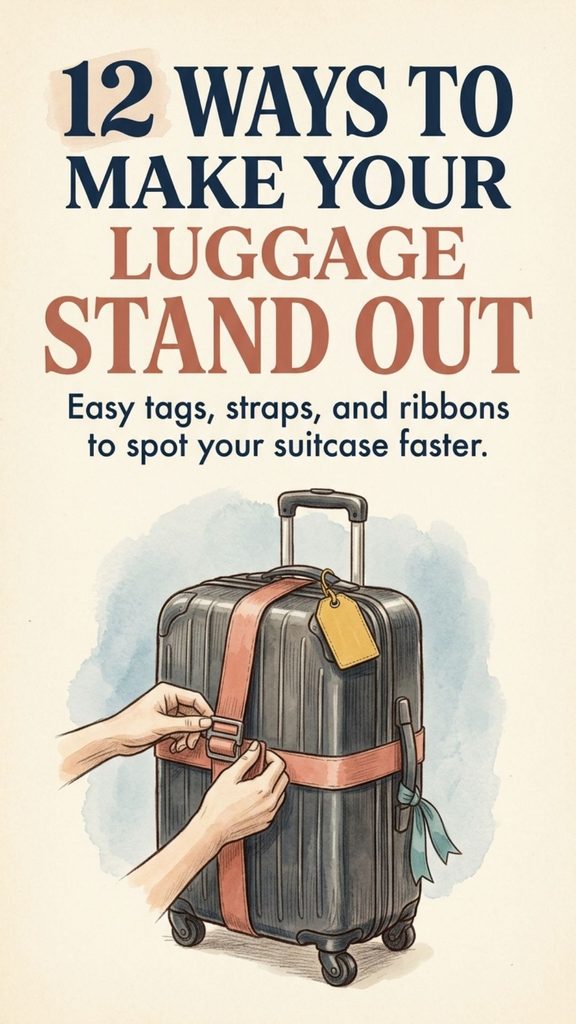
Standing at baggage claim and watching dozens of nearly identical black suitcases pass by can be surprisingly frustrating. You lean forward every time a familiar-looking bag appears, only to discover that it belongs to someone else.
The problem is simple: most luggage looks remarkably similar. Black, gray, and navy suitcases are practical choices, but they’re not always easy to identify in a crowded airport.
Fortunately, you don’t need to replace a perfectly good suitcase to make it recognizable. A colorful luggage strap, distinctive tag, patterned cover, or simple DIY decoration can make a big difference.
You Might Also Like:
- Loading posts...
The best luggage identifiers are easy to recognize from a distance, durable enough to survive baggage handling, and securely attached so they won’t get caught in airport equipment.
Whether you’re preparing for your first international flight, a family vacation, or a weekend getaway, these 12 practical ideas will help you identify your suitcase quickly and reduce the chance of accidentally collecting someone else’s bag.
Why Making Your Luggage Easy to Identify Matters
A distinctive suitcase is more than a fun travel accessory. It can make the airport experience simpler in several ways.
First, recognizable luggage is easier to locate on a busy baggage carousel. Instead of inspecting every similar suitcase, you can look for a particular color, pattern, or combination of identifiers.
Second, personalizing your luggage may reduce accidental mix-ups. Travelers sometimes collect the wrong bag because it resembles their own, particularly when suitcases share the same size, color, and brand.
Third, a clearly labeled bag is easier for airline staff to identify if it becomes delayed or misplaced.
Personalization isn’t a guarantee against theft or lost baggage, but it can make your bag easier to describe and recognize.
Ideally, use two different identification methods: one visible feature that stands out and one secure luggage tag containing appropriate contact information.
1. Choose a Suitcase in an Unusual Color
<AsyncImageGroup query={[“bright turquoise teal hard shell suitcase standing at airport baggage claim colorful distinctive travel luggage”,”bright coral pink hard shell spinner suitcase travel airport terminal”]} aspectRatio=”5:4″ layout=”carousel”/>
One of the simplest ways to recognize your suitcase is to choose a color that doesn’t blend into the usual collection of black and gray luggage.
Bright teal, orange, yellow, coral, and vibrant purple can make a suitcase noticeably easier to spot.
Patterned luggage is another option. Geometric prints, contrasting panels, and bold color combinations can create a distinctive appearance without requiring additional accessories.
However, color alone isn’t foolproof. Other travelers may own the same suitcase, particularly when a popular design becomes widely available.
Always verify your baggage tag or another identifying detail before leaving the carousel.
If your current suitcase is still in good condition, there’s no need to purchase a new one simply for its appearance. The remaining ideas can help you personalize the luggage you already own.
2. Add a Short, Colorful Ribbon to the Handle
<AsyncImage query=”closeup black rolling suitcase handle with neatly tied short bright orange and teal fabric ribbon airport luggage identification” aspectRatio=”5:3″/>
A piece of brightly colored fabric can turn an ordinary suitcase into something much easier to recognize.
Choose a short ribbon or fabric strip in a shade that contrasts with your luggage.
For a black suitcase, bright orange, yellow, or turquoise can work particularly well.
Tie the ribbon securely around a sturdy handle, keeping the ends short and tucked away.
Avoid long, loose scarves or dangling decorations. These can become caught in baggage-handling machinery or damaged during transportation.
If the airport or airline requires loose decorations to be removed, follow their instructions.
For an inexpensive option, use a small piece of leftover fabric rather than buying something new.
3. Attach a Durable, Distinctive Luggage Tag
<AsyncImage query=”bright silicone personalized luggage tags orange green blue attached to black travel suitcase handle closeup” aspectRatio=”5:3″/>
A luggage tag is one of the most useful accessories you can add to any suitcase.
Unlike a ribbon or decorative sticker, a properly completed tag provides a way for someone to contact you if your luggage is separated from you.
Look for a tag with a secure attachment, durable material, and a design that’s easy to recognize.
Bright silicone, reinforced plastic, leather, and metal tags are common choices.
A privacy flap or enclosed information card can help keep your contact details from being immediately visible to everyone nearby.
What Information Should You Put on a Luggage Tag?
Useful information may include:
- Your name.
- A phone number where you can be reached.
- An email address you check regularly.
You generally don’t need to display your full home address on the outside of your suitcase.
Consider placing a second contact card inside the luggage. This provides another way to identify the bag if the exterior tag becomes detached.
Before every trip, confirm that your information is current.
4. Decorate Your Suitcase With Waterproof Stickers
<AsyncImage query=”hard shell travel suitcase decorated with colorful tasteful travel destination waterproof vinyl stickers suitcase against airport setting” aspectRatio=”5:3″/>
Stickers are a creative option for travelers who enjoy adding personality to their belongings.
You can decorate hard-shell luggage with travel-themed illustrations, geometric designs, colorful shapes, or souvenirs representing destinations you’ve visited.
For a recognizable appearance, choose a few large, contrasting stickers instead of covering every available surface.
A distinctive cluster on the front and another on the back can make the suitcase easier to identify from different angles.
Choose waterproof, durable vinyl stickers suitable for your suitcase’s surface.
Clean and dry the area before applying them, and avoid placing stickers over important manufacturer labels, locks, handles, or airline baggage tags.
Some textured or fabric-covered suitcases won’t hold stickers reliably. In those cases, a luggage cover or tag is usually a better choice.
5. Use a Bright, Patterned Luggage Cover
<AsyncImage query=”colorful floral patterned fitted stretch luggage cover on large upright travel suitcase suitcase cover airport terminal” aspectRatio=”5:3″/>
A fitted luggage cover can transform the appearance of an ordinary suitcase without permanently changing it.
Covers are available in bright colors, floral prints, geometric patterns, and other recognizable designs.
Many stretch over the suitcase and include openings for handles and wheels.
A well-fitted cover may also help protect against minor scuffs and surface dirt, although it won’t prevent all damage.
Measure your suitcase carefully before purchasing a cover. Size categories vary between manufacturers, and an incorrectly fitted cover may shift or come loose.
Make sure the design doesn’t obstruct wheels, handles, locks, or necessary luggage labels.
Some airport security procedures may require a cover to be removed for inspection. Choose one that’s easy to take off and reinstall.
6. Make a Simple Pattern With Reflective Tape
<AsyncImage query=”black hard shell suitcase with neatly applied reflective silver and neon yellow diagonal tape pattern luggage identification closeup” aspectRatio=”5:3″/>
Reflective tape is a practical choice for travelers who prefer a simple, low-cost luggage identifier.
It reflects light when illuminated, which can make the marked areas more noticeable under certain lighting conditions.
For the best result, apply several short strips in a recognizable pattern.
You might create two diagonal stripes, a bold letter, or a small geometric shape.
Choose tape designed to adhere to the surface of your suitcase, and test it on an inconspicuous area first.
Some adhesives can leave residue or damage particular finishes.
Avoid covering barcodes, identification labels, or areas needed for baggage inspections.
Remember that reflective tape is most visible when light strikes it at a suitable angle. Brightly colored tape can be easier to recognize under ordinary airport lighting.
7. Secure Your Suitcase With a Colorful Luggage Strap
<AsyncImage query=”black suitcase secured with bright rainbow colored cross luggage strap neatly fitted flat luggage strap at airport” aspectRatio=”5:3″/>
A luggage strap provides an easily recognizable feature while also adding another layer of closure support.
Choose a strap in a color that strongly contrasts with the suitcase.
For example, a bright green strap around black luggage can be easier to identify than a dark strap against a similarly dark surface.
Some straps include adjustable buckles, combination locks, or built-in identification labels.
However, straps are not theft-proof, and they don’t replace the suitcase’s own closure system.
Most importantly, select a strap that fits snugly.
Loose straps may catch on conveyor systems, become damaged, or be removed during baggage handling.
If you choose a locking strap, check whether it is compatible with applicable security-inspection requirements.
A simple, well-secured strap is often more useful than an elaborate accessory with several dangling parts.
8. Use a Small, Recognizable Zipper Pull
<AsyncImage query=”closeup colorful small durable silicone zipper pull tabs attached to travel backpack suitcase zippers” aspectRatio=”5:3″/>
Zipper pulls are a subtle way to personalize luggage, particularly backpacks, duffel bags, and soft-sided suitcases.
You can choose a brightly colored silicone pull, a short cord tab, or a small accessory with a distinctive shape.
This approach is especially useful when you want your bag to stand out without adding a large decoration.
Select something lightweight and durable enough to remain attached during travel.
Avoid fragile ornaments, sharp objects, or long keychains that could become caught in machinery.
For checked luggage, a compact zipper pull is generally preferable to a large hanging charm.
Choose an accessory that won’t interfere with opening, closing, or inspecting the bag.
9. Put a Bluetooth Luggage Tracker Inside Your Suitcase
<AsyncImage query=”small white Bluetooth item tracker beside open travel suitcase packed clothes airport packing closeup” aspectRatio=”5:3″/>
A luggage tracker won’t make your suitcase visually distinctive, but it can provide additional information if your bag is delayed or misplaced.
Devices such as Apple’s AirTag and compatible Bluetooth trackers use nearby participating devices and networks to help report their location.
This can be useful when an airline is attempting to locate delayed baggage.
However, these trackers aren’t the same as continuous GPS tracking devices.
Location updates depend on network coverage, nearby compatible devices, battery condition, and other factors.
You may see a recent location rather than the suitcase’s exact current position.
Place the tracker securely inside your luggage, preferably in an interior pocket where it won’t fall out.
Check airline requirements for electronic tracking devices and batteries before traveling.
A tracker can assist with locating a bag, but it doesn’t replace airline baggage tracking or the formal process for reporting delayed luggage.
Keep your baggage claim receipt until your suitcase has been returned.
10. Personalize Your Luggage With Initials or a Monogram
<AsyncImage query=”elegant beige travel suitcase with tasteful large contrasting embroidered monogram initials on removable luggage tag closeup” aspectRatio=”5:3″/>
A monogram can give your luggage a more personal appearance without making it look overly decorated.
Options include embroidered initials, custom patches, engraved luggage tags, and removable labels.
For practical visibility, choose letters that contrast with the background.
Dark lettering on a dark suitcase may look sophisticated but won’t necessarily help you recognize it from across the baggage carousel.
Larger initials or a distinctive colored patch can be more useful.
If you’re customizing expensive luggage, consider removable accessories before making permanent changes.
Sewing, painting, and adhesive decorations can affect certain materials and may alter manufacturer warranty coverage.
A customized luggage tag is an easy alternative that doesn’t require changing the suitcase itself.
11. Create a Unique Identification Card
A simple identification card can make your bag recognizable without requiring a special product.
Choose a brightly colored card or durable label and add a short, distinctive phrase.
For example, you might use:
- “READY FOR ADVENTURE”
- “MY TRAVEL BAG”
- “HELLO FROM HOME”
- “TAKE ME ON VACATION”
Use large, readable lettering and a simple design.
A card can be placed in a protective luggage-tag holder, helping prevent moisture damage and keeping the paper from tearing.
Don’t attach large sheets of loose paper directly to the suitcase, since they can easily become damaged or detached.
If you prefer something discreet, place a personalized card inside the luggage rather than outside.
The exterior identifier helps you recognize the suitcase, while the interior card helps confirm ownership if the outer tag is lost.
12. Make Your Own DIY Luggage Identifier
<AsyncImage query=”neatly arranged DIY suitcase personalization supplies colorful fabric patches vinyl stickers short ribbon silicone luggage tag and black hard shell suitcase travel craft flat lay” aspectRatio=”5:3″/>
If you’re trying to save money, making a luggage identifier from materials you already own may be the most economical option.
A few inexpensive supplies can provide enough material to personalize several suitcases.
Easy DIY Ideas to Try
Fabric patches: Add a recognizable patch to a suitable soft-sided bag. Use a method compatible with the material and avoid exposing heat-sensitive luggage to an iron.
Colored zipper cords: Replace plain zipper pulls with short, securely tied cord tabs.
Patterned adhesive strips: Create simple shapes using tape designed for your suitcase’s exterior finish.
Custom luggage tags: Make an identification card using sturdy material and place it inside a waterproof tag holder.
Contrasting handle wraps: Use a short, snug fabric wrap around a suitable handle without obstructing its movement.
The best DIY identifier is simple enough to survive repeated travel.
Avoid accessories that depend on weak glue, create loose hanging loops, or interfere with airport screening equipment.
How to Make Black Luggage Stand Out Without Buying a New Suitcase
Black luggage is popular for good reasons. It matches almost everything, often hides ordinary marks, and is available in countless styles and sizes.
The downside is that baggage claim can seem filled with identical black suitcases.
Fortunately, you can make a plain black bag recognizable with only a couple of inexpensive changes.
One practical combination is a brightly colored, securely fitted luggage strap and a contrasting identification tag.
Another option is a small waterproof sticker design with a short, colorful handle wrap.
Using two distinct features is helpful because one accessory could become detached during the journey.
Keep the design simple. An overloaded suitcase covered in ribbons, charms, and hanging decorations is not necessarily easier to handle and may be more vulnerable to damage.
Extra Tips to Prevent Luggage Mix-Ups
Making your suitcase recognizable is useful, but there are additional steps that can help reduce baggage problems.
Photograph Your Suitcase Before Departure
Take a clear photograph showing the complete suitcase, including its color, shape, and identifying details.
If your bag is delayed, the image can help you describe it accurately to airline staff.
Consider photographing the interior contents for your own records as well, particularly when carrying items that may be relevant to a baggage claim.
Remove Old Airline Tags
Previous barcode stickers and baggage labels can cause confusion during handling.
Before checking your suitcase, remove outdated airline routing tags while keeping any permanent manufacturer information intact.
After checking the bag, verify that the newly attached routing tag shows the correct destination.
Verify Before Taking a Bag
Even if a suitcase looks identical to yours, check the baggage tag or another unique feature before removing it from the airport.
A matching luggage color or brand isn’t enough to confirm ownership.
Keep Important Items in Your Carry-On
Don’t place essential medications, travel documents, spare lithium batteries, or irreplaceable valuables in checked baggage.
Follow your airline’s carry-on and battery safety requirements.
Report Missing Luggage Promptly
If your suitcase doesn’t arrive, contact the airline’s baggage service before leaving the airport when possible.
Save your baggage receipt, reference number, and relevant documentation.
A tracker may provide useful additional information, but you should still follow the airline’s official reporting procedure.
Frequently Asked Questions About Luggage Identification
What Is the Cheapest Way to Make a Suitcase Stand Out?
A short, securely attached piece of brightly colored fabric or a simple personalized luggage tag can be among the least expensive options.
Materials you already have at home may work well, provided they’re durable and won’t become caught during baggage handling.
Should You Put Your Home Address on a Luggage Tag?
You usually don’t need to display your full home address publicly.
A name, reachable phone number, and email address can provide useful contact information while limiting unnecessary exposure of personal details.
A second identification card inside your suitcase provides an additional backup.
Do Luggage Covers Help Prevent Scratches?
A properly fitted cover may reduce ordinary surface scuffs and dirt, depending on its material and the conditions of travel.
However, it won’t protect against every impact or prevent damage to wheels, handles, and internal components.
Are Luggage Trackers Worth Using?
A tracker can be useful for travelers who check bags frequently or want additional information about the last reported location of their luggage.
However, tracking updates aren’t guaranteed to be immediate or precise, and a tracker cannot prevent baggage from being delayed or lost.
Can You Attach Ribbons and Keychains to Checked Luggage?
Small, securely attached identifiers may be acceptable, but loose decorations can become caught in baggage equipment.
Airlines and airport handlers may remove unsafe accessories. Keep decorations compact and check applicable baggage policies.
Is a Colorful Suitcase Safer Than a Black Suitcase?
A bright suitcase may be easier to identify, but there is no reliable evidence that its color alone makes it resistant to theft.
Secure packing, accurate identification, and following baggage procedures remain important regardless of appearance.
Make Your Suitcase Easy to Recognize Before Your Next Trip
Finding your suitcase shouldn’t feel like a guessing game after a long flight.
The easiest solution is usually a combination of practical identification and a few distinctive visual details.
You don’t need to cover your luggage with expensive accessories or invest in a completely new suitcase. A durable tag, contrasting strap, patterned cover, or small DIY customization may be all you need.
Choose decorations that remain securely attached, keep your contact information current, and take a photograph of your bag before checking it.
Most importantly, remember that making luggage stand out is about convenience and identification, not guaranteeing that it won’t get lost.
A recognizable suitcase, paired with sensible travel preparation, can help make baggage claim one less thing to worry about on your next journey.