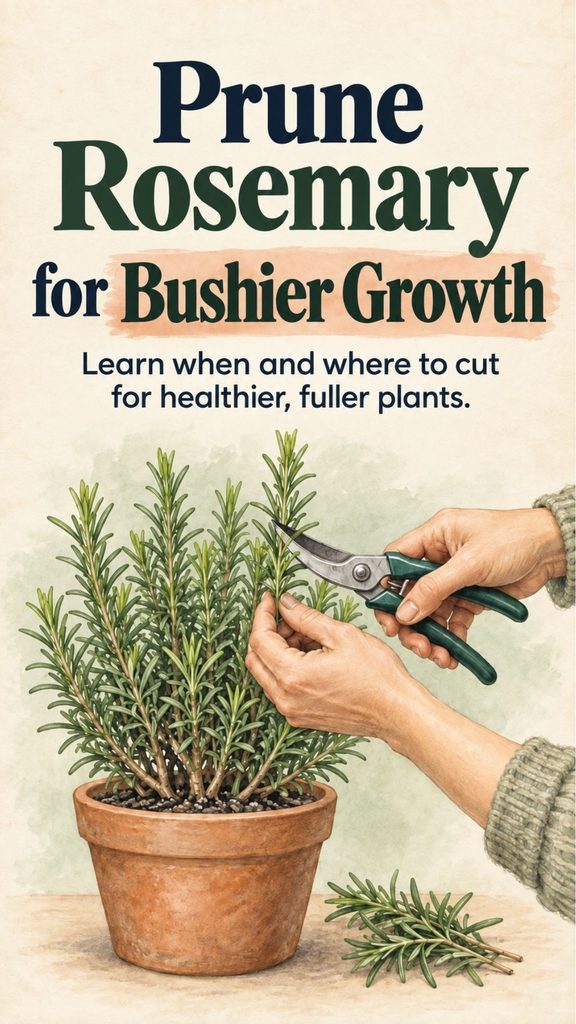
Rosemary is one of those herbs that can look wonderful for years—or gradually turn into a woody, leggy shrub with most of its useful leaves sitting at the ends of long bare stems.
Regular pruning helps prevent that.
The source article emphasizes that rosemary produces fresh growth at the tips of its branches and that thoughtful pruning can encourage a fuller, bushier plant rather than a sparse one.
You Might Also Like:
- Loading posts...
The important part is knowing where to cut and when to stop.
Rosemary is a woody evergreen shrub, not a soft annual herb such as basil. It generally responds well when you trim young leafy growth, but severe cuts into old bare wood can be risky because some rosemary plants do not reliably push new shoots from leafless woody stems.
So the best approach is usually:
prune regularly, prune while the plant is actively growing, and leave healthy green growth below your cuts whenever possible.
Here is how to do it.
Why Rosemary Benefits From Pruning
Rosemary naturally becomes woody as it matures.
That is normal.
But without occasional trimming, a plant can become tall, open, uneven, and increasingly bare near its base.
Light pruning encourages side shoots to develop below the cut, creating a denser shape.
It can also help:
keep the plant within its allotted space,
improve airflow,
remove damaged growth,
make harvesting easier,
and prevent long stems from flopping outward.
The source also distinguishes pruning from ordinary harvesting: harvesting removes smaller amounts for kitchen use, while pruning is done more deliberately to control the plant’s shape and growth.
That distinction is useful.
Every time you snip a few soft tips for dinner, you are technically removing growth, but that is not the same as reshaping an overgrown rosemary bush.
When Is the Best Time to Prune Rosemary?
For significant pruning, spring and early summer are usually the safest times.
Wait until the danger of hard frost has passed and you can see active new growth.
The source recommends spring after the last frost, with another opportunity for lighter pruning in early summer.
That timing makes sense because the plant has a long growing period ahead in which to recover and produce new shoots.
You can also harvest lightly throughout the growing season.
What you generally want to avoid is a major late-autumn pruning in cold climates.
A hard trim can stimulate tender new growth that may be damaged when temperatures fall.
What About Warm Climates?
Where winters are mild and rosemary grows actively for much of the year, the pruning window can be broader.
Even then, it is better to avoid major pruning immediately before a period of environmental stress such as extreme heat, drought, or cold.
Watch the plant rather than relying exclusively on the calendar.
Active, healthy growth is a better time for pruning than a period when the shrub is already struggling.
The Most Important Rule: Don’t Cut Blindly Into Bare Old Wood
This is where rosemary differs from many deciduous shrubs.
If you cut a rosemary stem back to a section of hard, leafless old wood, there may be no active buds capable of rebuilding that branch.
Sometimes shoots do appear.
Sometimes the branch remains bare.
For that reason, a safer pruning cut is usually made within leafy green growth, leaving foliage below the cut.
Look at each branch before you snip.
If the lower half is woody but the upper half carries healthy green leaves, shorten the green portion without removing every leafy shoot from that stem.
This approach may seem conservative, but regular conservative pruning is far more reliable than waiting five years and then attempting to cut an enormous woody rosemary shrub back almost to the ground.
How Much Rosemary Can You Remove at Once?
For routine pruning, removing roughly the outer quarter to one-third of active growth is a sensible upper limit.
The source repeatedly advises against taking more than about one-third during normal pruning because excessive removal can stress the plant.
You do not need to measure every stem.
The point is simply not to strip most of the foliage away in one session.
If the rosemary is badly overgrown, reshape it gradually over more than one growing period.
Slower correction is often safer than one dramatic haircut.
What Tools Should You Use?
For a small rosemary plant, sharp scissors may be enough.
For larger plants, use clean bypass pruning shears.
Very thick stems may require stronger pruners.
The source likewise recommends sharp, clean tools because clean cuts damage stems less than crushing them with dull blades.
Clean the blades before working, especially if you previously pruned diseased plants.
You do not need elaborate equipment.
One good pair of sharp hand pruners can handle most rosemary plants.
How to Prune Rosemary Step by Step
Start by standing back and looking at the entire plant.
Do not immediately begin clipping random stems.
Notice:
which branches extend far beyond the overall shape,
where the plant is dense,
where it is sparse,
whether any stems are dead,
and how much green foliage each branch carries.
Then begin with the easiest cuts.
Remove dead or damaged growth
Dead stems contribute nothing and can usually be removed.
Scratch the bark lightly if you are uncertain.
Healthy living tissue is often greenish beneath the surface, while completely dead stems are dry and brittle.
Cut damaged sections back toward healthy growth.
Shorten long, leggy stems
Find branches extending well beyond the rest of the shrub.
Follow the stem downward until you find healthy leafy growth.
Make the cut just above an area with leaves or side shoots.
That encourages the remaining portion of the branch to continue growing.
Shape the outside gradually
Work around the shrub rather than completing one side before looking at the other.
Take a few cuts.
Stand back.
Look again.
This prevents you from accidentally creating a flat side or removing far more foliage than intended.
Finish with small tip cuts
Once the largest uneven branches are corrected, lightly trim selected growing tips to encourage additional branching.
The plant does not need to look perfectly geometric.
Rosemary naturally has a somewhat informal shape.
How to Make Rosemary Grow Bushier
If your plant is young, you have a major advantage.
You can shape it before it becomes heavily woody.
Pinch or snip the soft growing tips periodically.
Removing the tip reduces the dominance of that single growing point and encourages side shoots to become more active.
Over time, repeated light trimming can create a much denser shrub.
This is easier and safer than trying to rejuvenate a neglected mature plant later.
If you want bushy rosemary, start pruning before it looks as though it desperately needs pruning.
What to Do With a Very Woody Rosemary Plant
An old rosemary plant may have thick trunks, bare lower stems, and green foliage only at the outer ends.
Do not assume you can simply cut it down to half its height and expect it to regenerate like a hedge shrub.
Instead, inspect it carefully.
If some branches still contain leafy shoots lower down, shorten those branches only to the leafy portions.
Remove obviously dead wood.
Then reshape the living portions gradually.
If the plant is extremely woody and unattractive, another good strategy is to take cuttings from healthy young shoots and grow replacement plants before removing the old shrub.
That way you preserve the plant while avoiding the risk of severe pruning.
Should You Hard-Prune Rosemary?
Occasionally you will see advice recommending that an old rosemary be reduced by one-half.
That can be risky if such a cut removes all green growth from important branches.
A safer interpretation of “hard pruning” is:
remove more growth than you would during normal maintenance, but still try to leave active foliage on the stems you expect to keep.
The source itself contains both a recommendation for fairly substantial rejuvenation and repeated warnings not to cut too much or into woody stems.
When those ideas conflict, the more conservative rule is the safer one for rosemary:
keep green growth below major cuts whenever possible.
How to Prune Rosemary in a Pot
Container rosemary needs pruning for the same reasons as garden-grown plants, but space matters more.
A pot-grown plant can become top-heavy as the canopy expands.
Trim it periodically to maintain balance between the foliage and container.
Remove long stems that lean far beyond the edge.
Keep the center reasonably open.
Do not constantly shear it into a dense ball because extremely tight outer growth can shade the interior.
Container plants may dry out faster than garden plants, especially in terracotta pots, but pruning is not a reason to begin watering every day.
Check the growing medium first.
Watering After Pruning
A freshly pruned rosemary plant does not need to be flooded with water.
If the soil is dry, water thoroughly.
If it is already adequately moist, leave it alone.
Rosemary generally prefers well-drained soil and dislikes constantly saturated roots.
The source also warns against overwatering because excess moisture can contribute to root problems.
A good watering method is to water deeply, let excess moisture drain away, and then allow the soil to dry somewhat before watering again.
Avoid leaving a container standing permanently in a full saucer of water.
Does Rosemary Need Fertilizer After Pruning?
Not necessarily.
A healthy outdoor rosemary plant in reasonable soil may need little supplemental fertilizer.
Too much nitrogen can encourage soft, rapid growth rather than the compact, aromatic habit most gardeners want.
Container plants have a smaller reservoir of nutrients and may eventually benefit from light feeding during active growth.
If you fertilize, follow the product directions and use a moderate amount.
Do not automatically apply extra fertilizer simply because you pruned.
Light, drainage, soil condition, and watering often matter more.
How to Prune Rosemary for a Hedge
Rosemary can make a beautiful aromatic low hedge in suitable climates.
Begin shaping plants while they are young.
Allow them to establish first, then lightly trim the outer shoots several times during active growth.
Do not wait until the hedge contains thick bare trunks before trying to force it into shape.
Keep the base slightly wider than the top if possible so light can reach the lower growth.
A hedge that becomes very dense at the top can shade itself below and gradually become bare at the bottom.
Regular light maintenance is much easier than renovation.
How to Shape Rosemary Into a Topiary
Upright rosemary varieties can be trained into small standards or topiary forms.
Start with a plant that has a strong central stem.
Gradually remove competing shoots from the lower trunk while allowing the top to branch.
Once the desired height is reached, pinch or trim the growing tips in the canopy to encourage fullness.
Do this slowly.
Removing too many lower shoots at once can weaken a young plant.
Topiary rosemary also requires regular maintenance because new stems quickly disrupt a carefully defined outline.
Pruning Creeping Rosemary
Trailing or prostrate rosemary behaves differently from strongly upright forms.
It naturally spills over walls, containers, or bed edges.
Do not force it into the shape of an upright shrub.
Instead, shorten stems that extend farther than desired and remove damaged growth.
Its cascading habit is part of its appeal.
Pruning should control the plant without eliminating the growth form you chose it for.
Harvesting Rosemary Without Damaging the Plant
For cooking, select healthy leafy stems.
Use clean scissors and remove a modest portion.
There is no need to strip leaves from a large section of the living plant while it is still attached.
Instead, cut a whole young sprig, then remove the leaves in the kitchen.
The source recommends keeping culinary harvests limited so enough foliage remains for continued growth.
Frequent small harvests can actually serve as light maintenance pruning.
If you are continually snipping the tips of several branches rather than repeatedly taking everything from one spot, the plant tends to remain more balanced.
What to Do With All the Rosemary You Prune
Healthy rosemary cuttings do not have to go to waste.
Use tender shoots fresh in:
roasted vegetables,
potatoes,
soups,
bread,
beans,
chicken,
fish,
or marinades.
You can also dry rosemary.
Tie small bundles loosely or spread sprigs in a single layer somewhere dry and well ventilated.
Once thoroughly dried, strip the leaves from the stems and store them in an airtight container away from heat and direct sunlight.
You can also freeze clean rosemary sprigs for later cooking.
Woody stems can sometimes be used to add aroma to appropriate cooking preparations, although they are generally too tough to eat.
Take Cuttings Before Major Pruning
If you have an old rosemary plant you particularly value, take several healthy cuttings before attempting a significant reshape.
Choose flexible young shoots rather than thick old woody branches.
Remove the lower leaves and root the cuttings in an appropriate propagation medium.
Not every cutting will succeed, so take several.
Once rooted, those plants provide inexpensive replacements and allow you to preserve a favorite cultivar.
This is especially useful when an old woody shrub has reached the point where ordinary pruning can no longer restore a compact shape.
Should You Remove Rosemary Flowers?
You do not have to.
Rosemary flowers are attractive to pollinators, and flowering does not mean the plant is unhealthy.
If your goal is a highly manicured hedge or topiary, you may remove spent flower stems while shaping.
Otherwise, leave the flowers if you enjoy them.
After the main bloom, a light trim can tidy the plant and encourage fresh shoots.
Pruning After Winter Damage
Wait until spring growth begins before deciding how much winter-damaged rosemary is truly dead.
Cold-damaged foliage may look terrible while portions of the stems remain alive.
Once new growth appears, it becomes easier to identify which sections survived.
Remove dead stems back toward healthy living tissue.
Avoid cutting the entire plant down in late winter simply because the foliage looks brown.
Give it a chance to show you where growth remains.
Preparing Rosemary for Winter
Winter care depends heavily on climate.
In regions where the chosen rosemary cultivar is reliably hardy, established plants may remain outdoors with relatively little intervention if drainage is excellent.
In colder areas, container rosemary may need protection or an indoor location.
The source advises bringing container plants indoors in climates where cold would otherwise damage them.
If you move rosemary indoors, give it as much light as possible.
A dark warm room combined with wet soil is a common recipe for decline.
Indoor rosemary generally prefers strong light, good airflow, and careful watering.
Don’t Make Heavy Autumn Pruning a Habit
You may tidy a few unruly stems in autumn, particularly in a mild climate.
But this is usually not the time for a major reshape.
Heavy pruning can produce soft new shoots just as colder weather approaches.
Save structural pruning for spring or early summer when possible.
Autumn is better for light harvesting and removing clearly damaged material.
Common Rosemary Pruning Mistakes
The first is waiting too long.
Once most of the lower plant consists of thick leafless wood, your options become limited.
The second is cutting every stem back into old bare wood.
That can leave a plant unable to refill the empty areas.
The third is removing too much at once.
A gradual reshape is usually safer.
The fourth is pruning a stressed plant simply because the calendar says it is time.
If rosemary is severely drought-stressed, recently transplanted, suffering root problems, or experiencing extreme weather, correct the underlying issue before giving it a major haircut.
The fifth is trying to solve every problem with fertilizer afterward.
Rosemary’s most important requirements are usually sunlight, drainage, appropriate watering, and suitable temperatures.
A Simple Rosemary Pruning Routine
You do not need an elaborate schedule.
In spring, inspect the plant after winter and remove dead or damaged growth.
Once active growth begins, shorten overly long branches while keeping foliage below the cuts.
During spring and early summer, harvest tender tips regularly.
After flowering, lightly reshape the shrub if necessary.
Through the rest of the growing season, remove occasional stray stems rather than allowing the plant to become wildly uneven.
As colder weather approaches, stop major pruning in climates where winter injury is a concern.
That modest routine can prevent the need for drastic renovation later.
The Best Rosemary Pruning Is Preventive
Rosemary is easiest to manage when you never allow it to become excessively woody in the first place.
Start with a young plant.
Give it strong light and well-drained soil.
Pinch growing tips.
Harvest regularly but moderately.
Shape long stems before they become thick trunks.
Prune during active growth.
And whenever you make a significant cut, look for healthy leafy tissue below it.
That one habit can save you from the most common pruning mistake.
The goal is not to force rosemary into perfect symmetry.
It is to maintain a vigorous shrub with plenty of fresh green growth, a natural shape, and enough tender stems to keep both the garden and the kitchen well supplied for years.