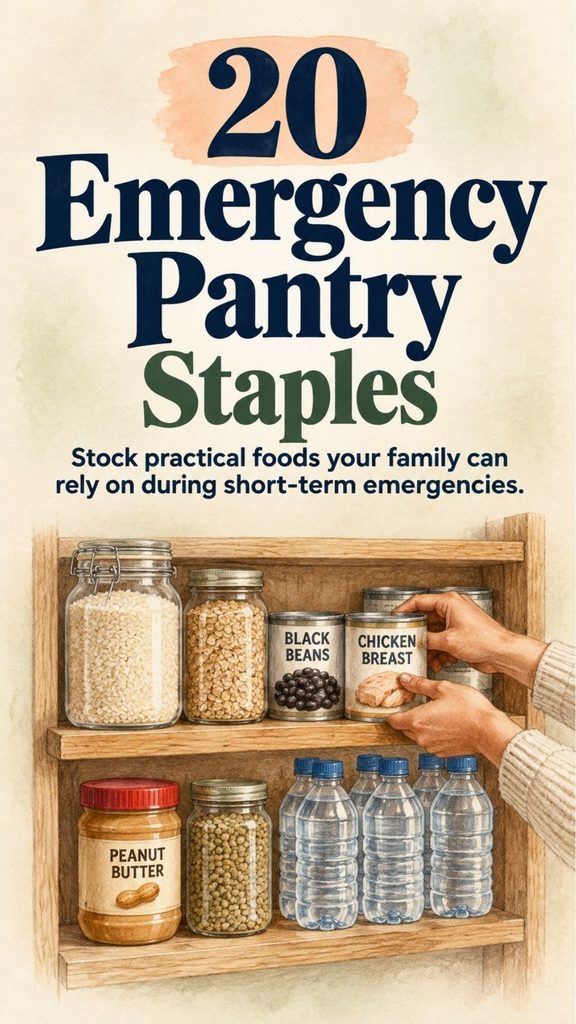
An emergency pantry should make a difficult week easier, not turn your home into a warehouse of food nobody normally eats.
Power outages, storms, temporary water problems, illness, transportation disruptions, or an unexpected financial setback can all make an ordinary grocery trip difficult. Having shelf-stable food and safe water already at home gives you options before everyone else is rushing to the store.
The key is to prepare gradually.
You Might Also Like:
- Loading posts...
You do not need to buy a year’s worth of food. Current U.S. emergency guidance recommends having at least several days of nonperishable food and at least 1 gallon of water per person per day. A three-day water supply is the minimum commonly recommended, while a two-week supply is even better when storage space allows.
Build what your household can realistically store, rotate, and eat.
Here are the 20 things I would prioritize.
1. Safe Drinking Water
Water comes before food.
Store at least 1 gallon per person per day for drinking, cooking, brushing teeth, and basic sanitation. CDC guidance recommends at least three days, with larger supplies useful when practical.
A family of four therefore needs at least 12 gallons for three days.
If you have room to build toward two weeks, do it gradually instead of trying to bring dozens of gallons home at once.
Commercially bottled water is particularly convenient because unopened bottles are already packaged for storage.
Remember pets as well.
Water is one emergency item you do not want to discover you underestimated.
2. Canned Chicken
Canned chicken provides ready-to-eat protein without refrigeration before opening.
It can be eaten with crackers, added to canned beans, mixed into shelf-stable meals, or used in sandwiches if bread is available.
Choose sizes your household can finish reasonably quickly after opening, particularly during a power outage when refrigeration may not be available.
Pull-tab cans are convenient, although I would still keep a manual can opener with emergency supplies.
3. Canned Tuna, Salmon, or Other Fish
Canned fish is another compact protein source that stores easily.
Tuna is convenient for crackers and simple meals, while canned salmon or sardines can provide additional variety.
You do not need twenty cans of something nobody likes.
Choose the fish your household already eats.
The best emergency pantry looks surprisingly similar to your normal pantry—just with a little extra depth.
4. Canned Beans
Black beans, chickpeas, kidney beans, white beans, and other canned legumes are inexpensive, filling, and versatile.
Unlike dried beans, canned beans do not require long cooking.
That difference matters when electricity or fuel is limited.
Drain and eat them cold if necessary, or combine them with canned vegetables, rice, chili, tuna, or seasonings when cooking is available.
If water supplies are limited, you can choose lower-sodium varieties and decide whether rinsing is necessary rather than assuming every can must be washed thoroughly before eating.
5. Peanut Butter or Another Shelf-Stable Nut or Seed Butter
Peanut butter is one of the easiest emergency foods to use because it requires no cooking.
It provides calories, fat, and protein in a compact jar.
Spread it on crackers, add it to oats, eat it with fruit, or use it in simple sauces when cooking is possible.
If your household has a peanut allergy, choose another appropriate shelf-stable spread.
Again, emergency planning should fit the people who actually live in the home.
6. Shelf-Stable Milk
Shelf-stable milk can be useful for cereal, oats, drinks, or recipes.
UHT milk generally does not require refrigeration until opened.
Powdered milk is another option because you can prepare only what you need, although it requires safe water.
Choose smaller containers when possible if you expect to lose refrigeration. Opening a large carton and being unable to keep the remainder cold creates waste.
Families with infants need a separate emergency feeding plan appropriate to the baby’s normal feeding needs.
7. Canned Chili, Soup, or Stew
Not every emergency meal should require assembling five ingredients.
Ready-to-eat canned meals are extremely useful when you are tired, the kitchen is dark, or cooking options are limited.
Chili, soup, ravioli, beans and meat, and hearty stews can often be eaten directly from the container if necessary, although many taste better warmed.
Choose products your household already enjoys.
Keep several meals that require no heating at all because emergency planning should not assume your stove will work. FDA specifically recommends keeping ready-to-eat foods on hand that do not depend on electricity for cooking or refrigeration.
8. Canned Vegetables
Emergency food should not consist entirely of starches and meat.
Keep vegetables your family will actually eat.
Corn, carrots, green beans, peas, tomatoes, and mixed vegetables are all useful possibilities.
Many can be eaten without cooking.
Canned tomatoes are especially versatile when you still have a working stove because they can become soup, pasta sauce, chili, or rice dishes.
Rotate them through normal meals so nothing spends years forgotten at the back of a shelf.
9. Canned Fruit and Applesauce
Canned peaches, pears, pineapple, mandarin oranges, and applesauce give an emergency pantry something fresh-tasting and sweet.
Fruit packed in juice is especially useful because it provides both food and liquid.
Individual applesauce cups or fruit cups are convenient when refrigeration is unavailable because you can open only one serving at a time.
These foods can also make repetitive emergency meals more appealing to children.
10. Oats
Oats are inexpensive, filling, compact, and familiar.
Traditional oats need cooking, so do not count them as a completely no-cook food unless you know how you plan to prepare them.
Quick or instant oats require less fuel and can often be prepared simply with hot water.
Add powdered milk, peanut butter, dried fruit, cinnamon, honey, or nuts if available.
During normal weeks, use and replace them regularly.
Rotation is much easier than trying to preserve one untouched “emergency bag” indefinitely.
11. Rice
Rice deserves pantry space because it is inexpensive and can stretch beans, canned meats, vegetables, and soups.
But there is one important limitation:
dry rice requires both water and cooking fuel.
That makes it excellent for financial emergencies or situations where electricity remains available, but less useful as your only food during a complete power outage.
Keep some rice, but balance it with foods that can be eaten straight from the package.
For emergency cooking, quicker-cooking rice can reduce both water and fuel use.
12. Pasta
Pasta has the same strength and weakness as rice.
It is inexpensive, familiar, and versatile—but it needs cooking water and heat.
Store it because it works beautifully with canned tomatoes, canned vegetables, tuna, beans, and shelf-stable sauces.
Just do not build an emergency pantry where every dinner depends on boiling a large pot of water.
A strong pantry includes both cookable staples and true ready-to-eat foods.
13. Crackers or Crispbread
When bread is unavailable, crackers become extremely useful.
Pair them with:
peanut butter,
tuna,
canned chicken,
shelf-stable cheese products when appropriate,
or canned spreads.
Choose sturdy varieties with reasonably good shelf life and keep packages sealed until needed.
Rotate them more frequently than rice or canned goods because crackers can become stale.
Crispbread can sometimes keep its texture longer than softer crackers.
14. Shelf-Stable Cereal or Granola
Cereal provides a familiar no-cook breakfast.
It can be eaten dry if milk is unavailable, which makes it useful during outages.
Granola can be even more compact and calorie-dense.
Choose something your household already enjoys and store it in sealed packaging away from heat and moisture.
If your family normally eats cereal every week, rotating it through the emergency pantry requires almost no special effort.
15. Cooking Oil
Oil is easy to overlook because it is not a meal by itself.
But it becomes important if you are actually cooking pantry foods.
A little oil can be used for:
rice dishes,
beans,
pasta,
flatbreads,
vegetables,
or frying when conditions allow.
Oil also provides concentrated calories.
Buy a bottle size you can realistically use before quality deteriorates.
Unlike honey or dry rice, cooking oils do not last indefinitely, so rotation matters.
Keep them somewhere cool and away from direct light.
16. Salt and Basic Seasonings
Emergency meals become repetitive quickly.
A modest collection of seasonings can make the same staples taste very different.
I would prioritize salt plus a few flavors the household normally uses, perhaps:
black pepper,
garlic powder,
paprika,
cinnamon,
chili powder,
or a favorite seasoning blend.
Do not create an enormous emergency spice collection.
A few familiar seasonings are enough.
If food has to be simple for several days, taste and familiarity can make it much easier to eat.
17. Honey or Sugar
Honey is a useful shelf-stable sweetener for oats, tea, peanut butter snacks, and simple cooking.
Sugar can serve the same general purpose.
Keep whichever your household normally uses.
One correction is important: ordinary grocery-store honey should not be treated as an improvised medical wound treatment simply because medical-grade honey exists. Products intended for wounds are specially prepared for that purpose.
In an emergency pantry, honey belongs with food.
18. Dried Fruit, Nuts, Trail Mix, or Energy Bars
Every pantry needs some foods that can be eaten immediately.
Trail mix, nuts, dried fruit, granola bars, and similar items require no water, cooking, dishes, or refrigeration.
They are particularly useful if you need to leave home quickly.
They also add variety and can provide a familiar snack during a stressful disruption.
Check allergies and choose products appropriate for everyone in the household.
Nuts and products containing oils should be rotated because they can become rancid over time.
19. Coffee, Tea, and a Few Comfort Foods
Technically, you could survive several days without coffee or chocolate.
That does not mean they are useless.
Emergency preparation should include some normality.
Instant coffee is particularly convenient because it needs less equipment than brewing a pot.
Tea bags store easily.
A few cookies, candy pieces, or other familiar snacks can be comforting, especially for children during a stressful outage or storm.
Just keep these items in proportion.
Your emergency pantry should not be half candy because “morale matters.”
The comfort food supports the pantry; it does not replace it.
20. Electrolyte Drinks or Oral Rehydration Supplies
Electrolyte packets can be useful when someone is losing fluids through vomiting, diarrhea, or heavy sweating.
But they are not a substitute for your basic water supply.
And ordinary sports-drink powders are not identical to medically formulated oral rehydration solution.
Store whatever is appropriate for your household and follow package directions carefully, using safe water.
If someone has a medical condition that affects fluid, sodium, potassium, or sugar intake, their emergency plan should follow professional guidance rather than generic advice.
Don’t Forget a Manual Can Opener
A pantry containing dozens of cans is not very useful if the electricity is out and your only opener is electric.
Keep a sturdy manual can opener with the emergency food.
Ready.gov includes a can opener in its basic emergency supply guidance when canned foods are part of the kit.
I would keep it physically beside the pantry supplies rather than assuming I will remember where it is during an outage.
How Much Food Should You Store?
There is no universal number of cans that fits every household.
A teenager may eat more than an elderly adult.
A nursing parent may have different needs.
A household with diabetes, allergies, celiac disease, kidney disease, or another medical condition may need a more specialized supply.
Start by building enough nonperishable food for at least several days.
Then, if your budget and storage allow, gradually expand toward one or two weeks.
Official emergency guidance commonly uses at least three days as the baseline for basic supplies, while some guidance encourages larger reserves when practical.
Rather than guessing how much food your household uses, try a simple exercise:
Look at what you normally eat over three days.
Then create a shelf-stable version of those meals.
That produces a much more realistic pantry than purchasing random emergency foods based on someone else’s family.
Build Meals, Not Just a Collection of Ingredients
A pantry can look impressive and still be difficult to cook from.
Think in complete meals.
For example:
Meal idea: canned chicken + crackers + canned fruit.
Meal idea: beans + corn + canned tomatoes + seasoning.
Meal idea: oats + powdered milk + dried fruit.
Meal idea: tuna + crackers + applesauce.
Meal idea: canned chili + fruit.
When power and cooking are available:
Meal idea: rice + beans + tomatoes + spices.
Meal idea: pasta + canned tomatoes + tuna.
If you can identify several breakfasts, lunches, dinners, and snacks entirely from the pantry, you have something genuinely useful.
Always Keep Some No-Cook Food
This is one of the most important improvements you can make.
Rice, pasta, and oats are excellent pantry foods, but they require resources.
What if the electricity is out?
What if the gas supply is interrupted?
What if cooking indoors is temporarily unsafe?
What if you are sick and have no energy to prepare food?
FDA recommends having a few days of ready-to-eat food that does not rely on cooking or refrigeration.
Make sure part of your supply can go directly from shelf to plate.
Store Food Where Heat and Moisture Are Low
Shelf-stable does not mean indestructible.
Keep emergency food in a cool, dry place away from excessive heat.
A hot garage or shed may shorten the quality life of foods dramatically compared with an indoor pantry.
Protect packaging from moisture, insects, and rodents.
Do not store food directly beside household chemicals, fuel, pesticides, or strong-smelling products.
If flooding is one of your local risks, FDA recommends keeping emergency food and water where contaminated floodwater is less likely to reach them.
Rotate Instead of Hoarding
The simplest emergency pantry system is:
Buy it.
Store it.
Eat the oldest one.
Replace it.
Move older products toward the front.
Put new purchases behind them.
Check dates periodically.
If a can or package is approaching the point where you would normally use it, move it into this week’s meals and replace it with a newer one.
This keeps your emergency food familiar and prevents money from being wasted.
You should not discover during an actual emergency that the family dislikes half the pantry.
Shop Your Pantry Before Buying More
Before spending money, count what you already have.
You may already own:
six cans of beans,
three jars of peanut butter,
rice,
oats,
pasta,
tuna,
cereal,
and canned tomatoes.
Those items already count.
Emergency preparedness does not require putting identical food on a separate shelf labeled “DO NOT TOUCH.”
A rotating pantry can serve everyday meals and emergency needs at the same time.
Build It Slowly
There is no reason to panic-buy twenty categories of food in one afternoon.
Add a few useful items to normal grocery trips.
One week, buy two extra cans of beans.
Next week, add peanut butter.
When canned fish is on sale, add several.
Gradually increase stored water.
This spreads the cost across months and gives you time to notice what your household actually uses.
Preparedness should make your finances more stable, not create a credit-card bill.
Prepare for the People Who Need Something Different
An ordinary pantry list cannot cover every household member automatically.
Consider:
infants,
older adults,
people with allergies,
people with diabetes,
people following medically necessary diets,
and anyone who depends on prescription medicines.
Pets need food and water too.
CDC emergency guidance specifically recommends considering the needs of children, pregnant people, and pets when building an emergency kit.
If a family member relies on a particular food or medical nutrition product, that item deserves priority over somebody else’s generic emergency checklist.
Know What to Do With the Refrigerator During a Power Outage
A pantry is only part of food preparedness.
When electricity fails, keep the refrigerator and freezer doors closed.
FDA guidance says an unopened refrigerator generally keeps food cold for about four hours. A full freezer can hold a safe temperature for roughly 48 hours, or about 24 hours if half full, provided the door remains closed.
Do not repeatedly open the refrigerator just to check whether things still feel cold.
If refrigerated perishable food has been above safe refrigeration temperatures for too long, it may need to be discarded. Do not rely solely on smell or appearance to determine safety.
This is another reason shelf-stable foods are valuable.
You can leave the refrigerator closed while eating from the pantry.
What I Would Not Prioritize
Some emergency-pantry lists include multivitamins as one of the main twenty items.
For most short-term disruptions, I would rather use that pantry space and budget for actual food and water.
People who regularly take medically recommended supplements should, of course, keep an appropriate supply.
But a multivitamin is not a substitute for food, nor is it one of the first things I would purchase if drinking water and ready-to-eat meals were still missing.
The same applies to fashionable emergency foods.
You do not need expensive freeze-dried meals simply because they are marketed for preparedness.
Ordinary supermarket foods can create an excellent emergency pantry.
Stock Smart, Not Scared
A useful emergency pantry is surprisingly boring.
Water.
Beans.
Peanut butter.
Canned meat.
Vegetables.
Fruit.
Oats.
Rice.
Pasta.
Crackers.
A few complete canned meals.
Some seasonings.
Snacks.
Foods you already know how to use.
That is exactly why it works.
Start with enough safe water and no-cook food for several days.
Add cooking staples.
Build gradually toward a larger reserve if your household, local risks, budget, and storage space justify it.
Rotate everything through normal meals.
Keep a manual can opener nearby.
And prepare for the actual people and animals in your home rather than trying to copy somebody else’s stockpile.
An emergency pantry should give you one simple advantage when normal life gets interrupted:
instead of immediately asking, “How are we going to find food?”
you can open the cupboard and say,
“We already have what we need for now.”