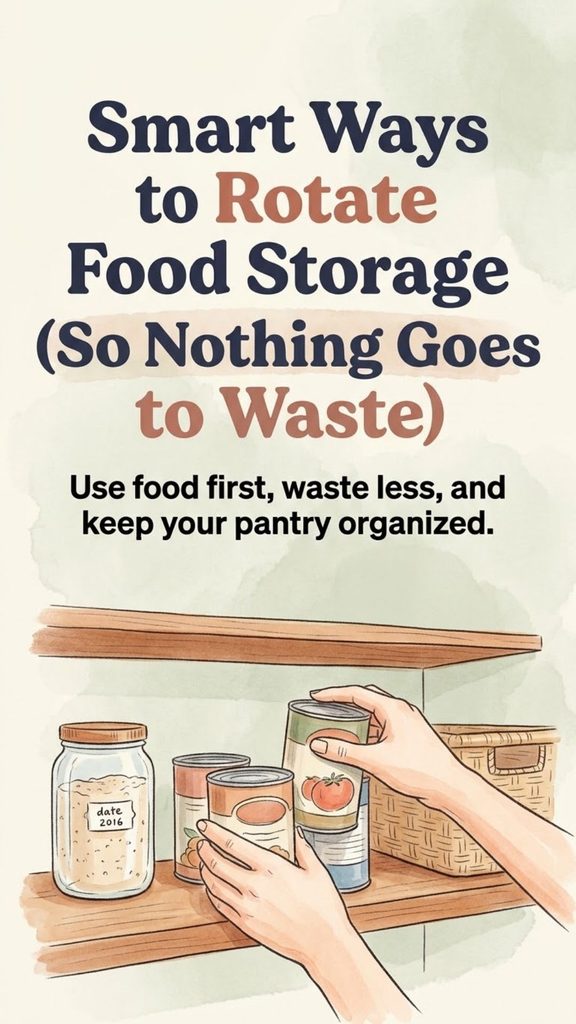
A well-stocked pantry is supposed to make life easier. But when cans disappear behind newer groceries, leftovers become mystery containers, and bags of rice or flour sit forgotten for months, food storage can quietly become a source of waste instead of security.
The solution is not a complicated inventory system or a pantry filled with matching containers. What matters most is creating a simple flow: older food gets used before newer food, items that need attention stay visible, and the foods you store are foods your household actually eats.
That matters financially, too. The U.S. Environmental Protection Agency estimates that wasted food costs the average American consumer about $728 per year, or roughly $2,913 annually for a household of four.
You Might Also Like:
- Loading posts...
A few practical rotation habits can reduce that waste while keeping your pantry, refrigerator, freezer, and emergency food supply much easier to manage.
Start With the First-In, First-Out Method
The easiest food rotation system is usually FIFO: first in, first out.
The idea is simple. Foods that have been stored longest should normally be positioned where you will reach them first. New replacements go behind them.
Suppose you already have three cans of diced tomatoes and buy four more. Instead of placing the new cans in front, move the older ones forward and put the new cans behind them.
The same method works with:
- Pasta and rice
- Canned vegetables and beans
- Broth and soup
- Breakfast cereal
- Baking ingredients
- Bottled sauces
- Frozen foods
- Drinks
- Household staples you buy in multiples
You do not need to reorganize your entire pantry every time you shop. Most of the work happens simply by putting groceries away thoughtfully.
One useful improvement is to consider the dates on the packages rather than assuming the oldest purchase always needs to be eaten first. If a newly purchased product has an earlier best-quality date than one already in your pantry, place the earlier-dated package in front.
In other words, the real goal is not blindly following purchase order. It is making sure the food most likely to need attention soonest is the easiest to grab.
Understand What Food Dates Actually Mean
One of the easiest ways to waste food is to automatically throw away anything that has passed the date printed on the package.
For many packaged foods in the United States, dates such as “Best By” or “Best if Used By” primarily relate to quality rather than an automatic food-safety cutoff. Federal law generally does not require quality date labels on packaged food, with infant formula being an important exception.
That does not mean every old food should be eaten. Storage conditions, the type of food, how long it has been open, packaging damage, and signs of spoilage still matter.
Rather than treating every printed date as an automatic disposal date, use it as one piece of information.
A better rotation system keeps foods from reaching that point in the first place.
Create a Dedicated “Use First” Area
One of the simplest pantry improvements is a small basket, bin, or section labeled USE FIRST.
Put foods there when they need to be worked into meals soon.
This might include:
- A partially used bag of pasta
- Crackers that have already been opened
- Canned foods with earlier dates
- A small amount of rice or lentils
- Produce that is becoming ripe
- Bread that should be eaten or frozen
- An open jar of sauce
- Ingredients left from a previous recipe
Check the area before planning meals or making your grocery list.
Instead of asking, “What do I feel like cooking?” start by asking, “What do I already have that needs to be used?”
That small change can turn forgotten ingredients into actual meals.
A can of coconut milk may suggest curry. Lentils can become soup. Half a package of tortillas might become quesadillas. Vegetables that will not stay fresh much longer can go into a stir-fry, soup, omelet, or roasted vegetable dish.
Food is far less likely to be wasted when it stays visible.
Build a Stockpile From Foods You Really Eat
A useful food reserve should move continuously through your kitchen.
Stocking foods simply because they are inexpensive or have a long shelf life can backfire if nobody in your household actually enjoys eating them.
Instead, begin with the foods you already use repeatedly.
Your list might include:
- Rice
- Pasta
- Oats
- Canned tomatoes
- Beans
- Broth
- Peanut butter
- Flour
- Cooking oil
- Tuna
- Shelf-stable milk
- Favorite sauces and seasonings
Your own list may look completely different, and that is exactly the point.
If your household normally uses six cans of tomatoes per month, keeping several extra cans is practical because they will naturally rotate through your meals.
Buying 24 cans of something nobody likes simply because it was discounted does not create meaningful food security. It creates something that must eventually be stored, donated, or discarded.
Stock depth should follow consumption.
Label Foods Where It Actually Helps
You do not necessarily need to write dates on every unopened grocery item if the manufacturer’s date is already easy to read.
Labels become especially useful once food has been opened, repackaged, cooked, or frozen.
A permanent marker, freezer tape, or removable label can answer two important questions:
What is this?
When was it stored or prepared?
Instead of putting an unidentified container into the freezer, write:
Chicken chili — Sept. 18
Instead of wondering when flour was transferred into a storage container, mark the container with the date it was filled or opened.
For leftovers, the date is particularly useful because appearance alone is not a reliable way to determine how long food has been refrigerated.
USDA guidance recommends using most cooked leftovers within 3 to 4 days when properly refrigerated.
A simple date removes the guesswork.
Rotate the Refrigerator, Not Just the Pantry
Refrigerator waste happens quickly because fresh food has a much shorter usable window than canned or dried food.
Use the same basic rotation rule here.
When you unpack groceries, bring older yogurt, cheese, vegetables, drinks, and other foods forward. Put newer replacements behind them when practical.
Keep foods that need to be eaten soon where they can actually be seen.
A beautiful container of berries hidden behind six jars is more likely to spoil than one sitting in an obvious place.
It can also help to create an EAT FIRST section in the refrigerator for ripe produce, open packages, and leftovers.
Do not overcrowd the refrigerator simply to stock more food. Cold air needs room to circulate for the appliance to maintain safe temperatures effectively.
Pay Special Attention to Raw Meat and Seafood
One claim worth correcting in many food-storage guides is the idea that all fresh meat should be cooked or frozen within two days.
Different meats have different recommended refrigeration times.
USDA guidance says raw ground meats, poultry, seafood, and variety meats should generally be cooked or frozen within 1 to 2 days. Raw beef, pork, lamb, and veal steaks, chops, and roasts generally have a refrigerated storage window of 3 to 5 days.
So rather than using one rule for everything, label meat when you buy it and decide immediately whether it belongs in the refrigerator or freezer.
If Thursday night’s chicken is purchased on Monday and your plans suddenly change, freeze it rather than letting it sit forgotten until the end of the week.
This is especially useful because meat and seafood can represent a relatively expensive portion of the grocery budget.
Make the Freezer Part of Your Rotation System
The freezer is one of the best tools for reducing food waste, but only if you know what is inside it.
Without labels and rotation, a freezer can easily become long-term storage for unidentified containers and forgotten packages.
Organize foods into broad categories if space allows:
- Meat and poultry
- Vegetables and fruit
- Bread and baked goods
- Prepared meals
- Ingredients and leftovers
Keep older packages toward the front or top.
Label homemade foods with the name and freezing date.
And remember that freezing often extends usability much longer than refrigeration. Food held continuously at 0°F (-17.8°C) or below can remain safe for very long periods, although quality such as flavor and texture can gradually decline.
That distinction between safety and quality is helpful. A freezer date is often best treated as a rotation guide rather than a magical moment when frozen food suddenly becomes unsafe.
Keep Your Refrigerator and Freezer at Safe Temperatures
Organization cannot compensate for incorrect storage temperatures.
The refrigerator should be kept at 40°F (4.4°C) or below, while the freezer should be maintained at 0°F (-17.8°C) or below.
A small appliance thermometer is useful because the temperature setting on the refrigerator does not always tell you the actual temperature inside.
Perishable foods also should not remain at room temperature indefinitely. FDA guidance recommends refrigerating perishable foods and leftovers within two hours, or within one hour when the temperature is above 90°F (32°C).
Good rotation and good food safety should work together.
Store Pantry Foods in the Right Environment
Shelf-stable does not mean indestructible.
Canned and dried foods generally store best in a cool, dry place protected from excessive heat and moisture. USDA specifically advises against storing shelf-stable foods above a stove, under a sink, or in damp garages and basements where temperature and moisture conditions may be unsuitable.
Dry foods such as rice, flour, oats, beans, and pasta can also benefit from well-sealed containers, particularly after their original packages have been opened.
Airtight storage can help protect food from moisture and pantry pests, but it does not magically make every food suitable for indefinite room-temperature storage.
For ordinary households, good rotation is usually more valuable than attempting to store huge amounts of food for many years.
Buy what you will realistically use, protect it properly, and keep it moving.
Inspect Cans Before Putting Them Back Into Rotation
Rotation is also a good opportunity to inspect stored food.
A date alone cannot tell you whether packaging has been damaged.
Do not use canned foods that are bulging, leaking, or severely damaged. FDA also advises avoiding cans with suspicious damage and foods that spurt liquid or foam unexpectedly when opened.
Likewise, check dry packages for insects, moisture, broken seals, or unusual odors.
A monthly pantry check should therefore be more than a date check. It is also a quick inspection of storage conditions and packaging.
Use an Inventory Only If It Makes Life Easier
Some households benefit from detailed pantry spreadsheets and freezer inventories. Others abandon them after a week.
The best system is the simplest one you will consistently maintain.
For a modest pantry, you may need nothing more than:
- Older products in front
- New products behind
- A use-first basket
- Dates on leftovers and freezer meals
- A quick weekly glance
- A more thorough pantry check once a month
If you keep a large emergency reserve, preserve food at home, or buy staples in bulk, a written inventory becomes more useful.
Record the item, approximate quantity, and anything that needs to be used soon.
Do not make the tracking system so complicated that maintaining the list becomes harder than managing the food.
Plan Meals From What You Have Before Shopping
One of the most effective rotation habits happens before you enter the grocery store.
Look through your refrigerator, freezer, pantry, and use-first area before making the week’s meal plan.
Try to build several meals around ingredients you already own.
This prevents the familiar cycle of buying another jar of pasta sauce while three jars are hiding in the pantry or purchasing fresh vegetables while last week’s produce is still waiting in the refrigerator.
Then make your shopping list around what is genuinely missing.
Rotation works best when inventory and meal planning are connected.
Have an “Odds and Ends” Meal
Almost every kitchen accumulates awkward quantities: half a bell pepper, a little cooked rice, three carrots, part of a bag of frozen peas, one chicken breast, or the last scoop of beans.
These leftovers do not always fit into another planned recipe, so give them a purpose.
Once a week, consider making a flexible meal such as:
- Soup
- Stir-fry
- Fried rice
- Omelets
- Pasta
- Grain bowls
- Quesadillas
- Casseroles
- Homemade pizza
The objective is not to throw random ingredients together regardless of flavor. It is to use adaptable meals as a framework for ingredients that would otherwise be forgotten.
Some of the most economical meals begin with the question, “What needs to be used?”
Rotate Emergency Food Instead of Forgetting About It
Emergency food supplies deserve the same attention as everyday groceries.
A three-month supply is far more useful when much of it consists of familiar foods that your household regularly eats and replaces.
Instead of buying emergency food and sealing it away indefinitely, create a cycle:
Store it → eat it → replace it → move the replacement to the back.
This keeps familiar pantry foods moving while reducing the risk of discovering years later that much of the reserve has deteriorated in quality or is no longer something your household wants to eat.
It also makes preparedness less expensive because stored food becomes part of the normal grocery budget rather than a completely separate collection.
A 15-Minute Monthly Rotation Reset
Food rotation does not need to become another exhausting homemaking project.
Once a month, spend a few minutes checking the areas where food tends to collect.
Pull older pantry foods forward. Check open packages. Move near-term foods into the use-first basket. Look through the freezer for forgotten meals. Check refrigerator leftovers. Add foods that genuinely need replacing to your shopping list.
Then plan the next few meals around anything that deserves priority.
That short reset prevents small amounts of forgotten food from turning into an entire shelf of waste.
The Goal Is a Pantry That Keeps Moving
Good food storage is not about having the prettiest pantry or the largest stockpile. It is about knowing what you have and actually using it.
Keep older foods accessible. Put new purchases behind them. Label foods when dates would otherwise become confusing. Freeze perishables before they are forgotten. Store shelf-stable foods properly. Build your reserve around ingredients your household genuinely eats.
Most importantly, make rotation part of ordinary meal planning instead of treating it as a separate organizing project.
Once that habit is established, the pantry begins to work as a cycle rather than a warehouse. Food comes in, moves forward, gets used, and is replaced when necessary.
That simple flow can mean fewer forgotten groceries, fewer unnecessary purchases, a more dependable emergency supply, and more of your food budget ending up on the table instead of in the trash.