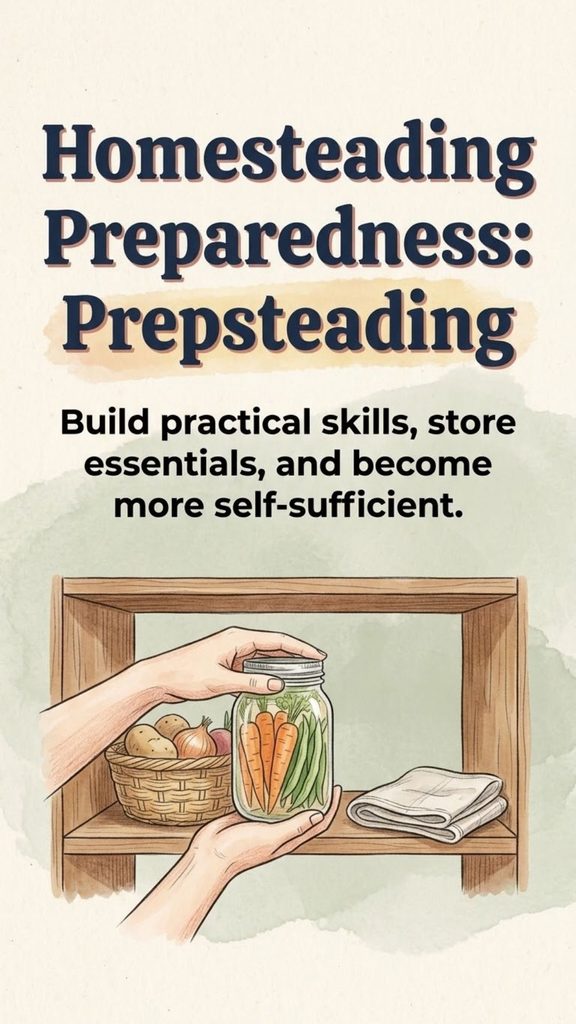
Preparedness does not have to mean filling a basement with emergency products, and homesteading does not require living off-grid on a remote farm. There is a useful middle ground: building everyday skills and household systems that make life more resilient during both ordinary disruptions and larger emergencies.
This approach is sometimes called prepsteading—an informal term that combines practical preparedness with homesteading principles.
The idea is simple. Grow some food if you can. Keep useful pantry staples on hand. Learn how to preserve food safely. Maintain basic tools. Prepare for power and water interruptions. Reduce unnecessary waste. Build relationships with people nearby. Most importantly, develop skills that remain useful whether an emergency happens or not.
You Might Also Like:
- Loading posts...
A pantry full of food you actually eat is more practical than a stockpile you never touch. A garden that produces dinner in summer is useful even if no crisis occurs. Knowing how to cook, repair clothing, conserve water, and manage without electricity for a short period improves ordinary life as much as emergency readiness.
Prepsteading is less about expecting disaster and more about becoming harder to disrupt.
What Does Prepsteading Mean?
Prepsteading combines two related ideas.
Preparedness focuses on having plans, supplies, knowledge, and backup options for situations such as storms, power outages, water interruptions, temporary shortages, transportation problems, or financial difficulties.
Homesteading emphasizes practical skills such as gardening, cooking from scratch, preserving food, repairing possessions, raising food where appropriate, and becoming less dependent on constant purchasing.
Put them together and you get a household that prepares for tomorrow by becoming more capable today.
Someone practicing prepsteading might live on acreage, but they might just as easily live in a suburban house or apartment.
You do not need livestock, a root cellar, or acres of vegetables.
You can begin with canned beans, a flashlight, extra drinking water, a container garden, basic sewing supplies, and five meals you know how to make from pantry ingredients.
Start With Ordinary Emergencies
Preparing for dramatic disasters can become overwhelming very quickly.
A more practical starting point is asking how your household would manage through common disruptions.
Consider:
- A power outage lasting a day or two
- A severe storm
- A temporary water interruption
- An unexpected car repair
- Several days when you cannot reach a store
- Illness that keeps the household home
- A freezer or appliance failure
- Temporary loss of income
These situations are far more useful for identifying weaknesses in your household than imagining the most extreme scenario possible.
Ask simple questions.
Do you have food that can be prepared if the stove is unavailable?
Do you have flashlights that actually work?
Could you cook meals from what is already in the house?
Do you know where the main water shutoff is?
Could you manage several days without shopping?
The answers show you what to work on first.
Build a Pantry You Actually Use
Food storage is one of the strongest connections between homesteading and preparedness.
The best emergency pantry is usually an expanded version of your normal pantry.
Store foods your household already eats, such as:
- Rice
- Pasta
- Oats
- Flour
- Beans and lentils
- Canned vegetables
- Canned tomatoes
- Canned fish or meat
- Nut or seed butter
- Cooking oil
- Shelf-stable milk
- Dried fruit
- Crackers
- Salt
- Sugar
- Spices
- Baking ingredients
Instead of buying a large quantity all at once, add a little extra during normal shopping.
If you normally buy two cans of tomatoes, buy three when your budget allows. If rice is a household staple, keep an unopened bag in reserve.
Then rotate everything.
Use the oldest food first and replace it as necessary.
This avoids one of the biggest problems with emergency stockpiles: food sitting untouched until it is forgotten.
Store Water Before You Need It
Food receives a great deal of attention in preparedness discussions, but drinking water becomes important much more quickly.
Keep an appropriate reserve of potable water for your household and rotate or replace stored water according to the container or local emergency guidance you follow.
Think beyond drinking as well.
Water may be needed for:
- Cooking
- Hand washing
- Basic hygiene
- Cleaning
- Pets
- Certain medical needs
If you rely on an electric well pump, a power outage can become a water outage too.
Learning how your home’s water system works is therefore an important preparedness skill.
Know where the main shutoff is and how to operate it safely.
Learn to Cook From Scratch
A household with hundreds of pounds of food but no idea how to use it is not particularly self-sufficient.
Cooking is one of the most valuable preparedness skills because basic ingredients generally offer more flexibility than highly specialized foods.
Learn how to prepare a few dependable meals from staples.
Useful examples include:
- Bean soup
- Lentil stew
- Rice and beans
- Pasta with tomato sauce
- Oatmeal
- Flatbread
- Vegetable soup
- Egg dishes
- Simple skillet meals
You do not need gourmet cooking skills.
You need enough knowledge to look at flour, beans, canned tomatoes, onions, and spices and recognize several possible meals.
That ability saves money during ordinary weeks and becomes even more useful during disruptions.
Grow Some Food, Even If You Have Little Space
A home garden will not instantly make a family food independent.
It can, however, teach skills that become more valuable with experience.
Begin with crops that suit your space and climate.
You might grow:
- Herbs in containers
- Lettuce
- Radishes
- Tomatoes
- Peppers
- Green beans
- Cucumbers
- Potatoes
Even a balcony can support several edible plants.
The first year should be treated as education rather than a test of self-sufficiency.
Learn how your sunlight changes through the season, how quickly containers dry, which pests are common locally, and when different crops perform best.
Keeping simple garden notes can make each season more productive than the last.
Learn Several Ways to Preserve Food
Growing food is only part of the skill.
A large harvest can still be wasted if everything ripens at once and you do not know what to do with it.
Freezing is an excellent place to start.
Many fruits, vegetables, breads, prepared meals, stocks, and sauces freeze well when properly prepared and packaged.
Dehydrating can also be useful for herbs, fruits, vegetables, and other suitable foods.
Fermentation is another traditional preservation skill, but it should be learned using reliable instructions.
Home canning deserves particular care. Shelf-stable preservation is not an area where improvisation is wise. Different foods require different processing methods, and low-acid foods such as plain vegetables, beans, and meats require pressure canning when prepared for shelf storage.
Use current, research-tested preservation recipes and follow their processing instructions exactly.
A useful prepsteading pantry should be safe as well as abundant.
Practice a “Use It Before You Lose It” Mindset
Self-reliance is partly about production, but it is also about reducing waste.
Before buying something new, ask whether you already have something that can do the job.
Before throwing food away, determine whether it is still safe and useful.
Leftover roasted vegetables might become soup.
Cooked chicken might become sandwiches or a casserole.
Stale bread that is still safe can become breadcrumbs or croutons.
Old towels can become cleaning cloths.
Glass jars can organize dry household supplies when appropriate.
This does not mean saving everything.
A house filled with objects kept “just in case” is not necessarily more prepared.
Keep things that have a clear purpose and dispose of unsafe, spoiled, or genuinely useless items.
Learn Basic Repair Skills
Preparedness improves considerably when a minor problem does not automatically require a professional or replacement purchase.
Learn how to handle straightforward tasks such as:
- Sewing on a button
- Repairing a small clothing tear
- Tightening loose hardware
- Replacing simple household parts
- Maintaining garden tools
- Sharpening appropriate blades
- Patching basic materials
- Fixing a loose cabinet handle
Also learn your limits.
Gas, major electrical work, structural repairs, and many plumbing problems should be handled by qualified professionals when you lack proper training.
Self-reliance is not about attempting dangerous work.
It is about knowing enough to handle simple problems and recognize serious ones.
Keep Useful Hand Tools
Electric tools save enormous amounts of labor, but manual tools provide a useful backup.
A practical household tool collection might include:
- Hammer
- Screwdrivers
- Pliers
- Adjustable wrench
- Tape measure
- Utility knife
- Hand saw
- Garden shovel
- Pruning shears
- Manual can opener
- Sewing kit
If you heat with wood, garden heavily, or maintain a larger property, your needs will naturally expand.
Buy tools because you know what job they will perform, not because they appear on a homesteading checklist.
A few quality tools that you understand are far more valuable than a shed full of equipment you cannot maintain.
Prepare for Power Outages Safely
A power outage reveals how dependent a household is on electricity.
Keep reliable flashlights where they can be found easily rather than searching for them in darkness.
Maintain appropriate backup batteries or rechargeable power sources.
Know which foods can be prepared without an electric oven.
Keep weather-appropriate clothing and bedding available.
If you use a generator, camp stove, grill, propane heater, wood stove, or another combustion appliance, learn its safety requirements before an emergency.
Never move outdoor combustion equipment inside simply because the weather is bad. Carbon monoxide can accumulate without being seen or smelled.
Working smoke alarms and carbon-monoxide alarms are among the most valuable safety tools a household can have.
Create Financial Preparedness Too
Not every emergency is caused by weather.
A broken transmission, medical expense, job disruption, or major appliance failure can affect a household more than a short power outage.
Financial resilience belongs alongside food and water preparedness.
Work toward:
- Knowing your essential monthly expenses
- Paying down expensive debt where possible
- Building emergency savings gradually
- Keeping some flexibility in the grocery budget
- Avoiding unnecessary recurring subscriptions
- Maintaining vehicles and appliances before they fail
You do not need a large amount of money before beginning.
Small reserves still provide options.
Preparedness is fundamentally about having more options when plans go wrong.
Know Your Neighbors
Self-sufficiency does not mean isolation.
Historically, rural households survived difficult seasons partly because people exchanged labor, knowledge, food, tools, and assistance.
That principle remains useful.
One household may own a pressure canner.
Another person may understand small-engine repair.
Someone else may grow an enormous amount of tomatoes.
Another neighbor may have woodworking skills.
Strong local relationships can make a community far more resilient than a collection of completely isolated households.
You do not need to turn every interaction into barter.
Simply knowing trustworthy people nearby and being willing to help one another can matter enormously.
Buy Local When It Makes Sense
A resilient household benefits from knowing where food and essential services come from.
Farmers’ markets, farm stands, independent repair shops, local mills, nurseries, and other nearby businesses can become useful parts of a household’s network.
Local purchasing is not automatically cheaper or environmentally superior in every circumstance, so there is no need to treat it as an absolute rule.
But knowing local producers gives you more options.
You may discover seasonal produce in bulk, locally adapted garden plants, repair services, or knowledge that is difficult to obtain from national retailers.
Learn Before Buying Equipment
One of the easiest ways to turn homesteading into an expensive hobby is to buy equipment for skills you have not yet learned.
You probably do not need a grain mill because you baked one loaf of bread.
You do not need hundreds of canning jars before learning safe canning.
You do not need a greenhouse before successfully maintaining a small garden.
Learn the skill first.
Borrow equipment when appropriate.
Buy used equipment when safe and practical.
Upgrade after experience shows you exactly what you need.
This keeps prepsteading focused on capability instead of consumption.
Expand Slowly
Trying to transform an ordinary household into a miniature self-sufficient farm in one season is a reliable way to become exhausted.
Add skills gradually.
One possible progression might look like this:
First: Build a useful pantry and water reserve.
Next: Learn several meals from basic ingredients.
Then: Plant a few vegetables.
After that: Learn freezing or dehydrating.
Next: Improve your emergency lighting and household tools.
Later: Learn safe canning, expand the garden, or add other projects that genuinely suit your household.
Each improvement should make life easier or more resilient.
If maintaining your preparedness system becomes a full-time source of anxiety, it needs simplifying.
Preparedness Should Support Everyday Life
The strongest version of preparedness does not sit untouched in a basement waiting for catastrophe.
It gets used.
You eat the stored food and replace it.
You cook with the garden harvest.
You use the tools.
You practice the skills.
You rotate batteries.
You maintain the wood stove.
You repair clothes.
You preserve extra produce.
You save money.
You help neighbors.
That is what makes the system sustainable.
Even if the most serious emergency you encounter this year is a two-day power outage or an unexpectedly expensive month, none of the effort has been wasted.
You still have a better-stocked pantry, useful skills, less food waste, stronger household routines, and greater confidence in your ability to solve problems.
Prepsteading is therefore not about becoming completely independent of modern society.
Very few people truly are.
It is about reducing unnecessary dependence while building practical backups for the things that matter most: food, water, shelter, heat, money, household skills, and community.
Start with the vulnerabilities that affect your own home. Add one useful skill, one sensible reserve, and one backup plan at a time.
A resilient household is rarely built through one dramatic preparation spree. It grows slowly through ordinary habits practiced long before they are urgently needed.