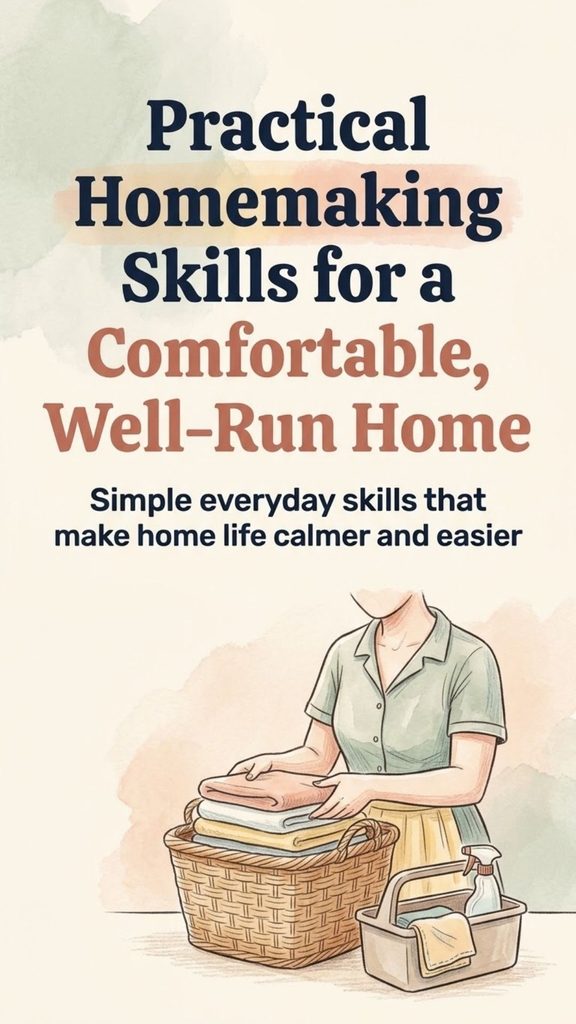
A comfortable home is rarely the result of expensive furniture, perfect décor, or a complicated cleaning system. More often, it comes from a collection of ordinary skills practiced consistently: preparing meals, keeping rooms reasonably tidy, managing laundry, organizing supplies, planning ahead, and knowing how to handle small household problems before they become bigger ones.
Homemaking can look very different from one household to another. Some people manage a home full-time, while others balance household responsibilities with paid work, school, caregiving, or other commitments. The goal is not to follow one ideal schedule. It is to develop enough practical skills that daily life feels manageable instead of constantly chaotic.
If you are just beginning, start with the areas that affect everyday comfort the most.
You Might Also Like:
- Loading posts...
Learn How to Build Simple Household Routines
One of the most useful homemaking skills is not cleaning or cooking. It is learning how to create routines that prevent ordinary tasks from piling up.
Without a routine, even simple chores can become mentally exhausting because you are constantly deciding what needs to happen next.
A basic rhythm might include a few daily tasks, several weekly jobs, and occasional deeper maintenance.
Daily tasks could include:
- Making the bed
- Washing dishes or loading the dishwasher
- Wiping kitchen counters
- Putting clutter back where it belongs
- Checking laundry
- Preparing meals
- Doing a short evening reset
Weekly tasks might include cleaning bathrooms, changing bed linens, vacuuming, mopping, grocery shopping, and reviewing the coming week.
The exact schedule matters less than consistency.
If washing one load of laundry each morning keeps your household under control, do that. If it makes more sense to handle all the laundry on two designated days, that works too.
A good routine should support your household, not make you feel trapped by a checklist.
Master Everyday Cleaning Before Deep Cleaning
A home does not need constant deep cleaning to feel pleasant.
The most important cleaning skill is understanding how to maintain frequently used spaces so dirt does not have time to build up excessively.
Focus first on:
- Kitchen surfaces
- Bathrooms
- Floors
- Frequently touched areas
- Dust-prone surfaces
- Bedding and linens
Learn which cleaning products are appropriate for the materials in your home. Wood, natural stone, glass, stainless steel, painted surfaces, and upholstery do not always respond well to the same cleaner.
More products are not necessarily better.
A basic cleaning kit can usually include an appropriate general-purpose cleaner, dish soap, microfiber cloths, a scrub brush, a vacuum, a broom, and whatever products are specifically needed for surfaces in your home.
Work logically when cleaning. Declutter before wiping. Dust higher surfaces before cleaning floors. Let a suitable cleaner sit for the recommended amount of time rather than immediately scrubbing harder.
Efficient cleaning is often about sequence, not speed.
Create Simple Organization Systems
Organization should make everyday tasks easier.
If an organizing system looks beautiful but requires fifteen steps to put something away, it probably will not last.
Start with the areas that cause the most frustration.
The entryway may need a place for shoes, keys, bags, and mail.
The kitchen may need clear zones for baking supplies, breakfast foods, cooking oils, snacks, and frequently used tools.
A bedroom may simply need better laundry storage and fewer clothes.
Before buying bins and baskets, remove items you no longer need. Organizing excess belongings usually creates temporary neatness rather than lasting order.
After decluttering, give frequently used items obvious homes.
The simplest organizing principle is often the best:
Store things close to where you use them.
If family members can easily find something and easily put it away, the system has a much better chance of working.
Learn to Cook a Core Collection of Meals
You do not need hundreds of recipes to become a capable home cook.
Start by learning a small group of meals you can prepare confidently without much thought.
Useful basics include:
- A simple soup
- A pasta meal
- Rice or another staple grain
- Roasted vegetables
- Eggs prepared several ways
- A basic chicken or bean dish
- A simple casserole
- Homemade salad dressing
- A few inexpensive lunches
- One or two easy desserts
Once you understand basic techniques, recipes become much easier to adapt.
Learn how to chop vegetables safely, season food gradually, tell when common foods are cooked properly, store leftovers, and substitute ingredients sensibly.
Cooking from scratch does not mean everything must be homemade.
Using frozen vegetables, canned beans, prepared broth, or another convenient ingredient can still produce a practical home-cooked meal.
The goal is to be able to feed the household reliably, not to make dinner into a performance.
Improve Your Meal Planning Skills
Meal planning is less about creating an impressive weekly menu and more about reducing repeated decisions.
Before shopping, check what you already have.
Then plan meals around:
- Food that needs to be used soon
- Ingredients already in the pantry
- Your actual schedule
- Household preferences
- Your grocery budget
Do not plan seven complicated dinners for a week when several evenings will be busy.
Include simple meals.
Leftover night, sandwiches, soup, eggs, pasta, or a freezer meal can be just as useful as a more elaborate dinner.
Keeping a short list of dependable meals also helps.
When you do not know what to cook, choose from that list instead of searching endlessly for a new recipe.
Learn Basic Baking Skills
Baking is not essential to running a home, but it is a useful skill.
Simple breads, muffins, biscuits, cakes, and cookies can be economical, enjoyable, and practical once you understand the basics.
Baking differs from ordinary cooking because ingredient proportions often matter more.
Learn to:
- Measure accurately
- Preheat the oven
- Understand basic dough and batter textures
- Avoid overmixing when a recipe warns against it
- Recognize when baked goods are finished
- Cool and store them properly
A kitchen scale can make many baking recipes more consistent because ingredients such as flour can vary considerably when measured by volume.
Start with forgiving recipes and build confidence gradually.
There is no reason to begin with complicated pastries if a reliable loaf of bread or batch of muffins would be more useful.
Know How to Manage Laundry Properly
Laundry becomes much easier once you stop treating every garment exactly the same.
Read care labels and learn the basics of sorting.
You do not necessarily need a complicated system, but it helps to separate items when color transfer, fabric type, or washing temperature makes a difference.
Important laundry skills include:
- Treating stains before they set
- Using the appropriate amount of detergent
- Avoiding overloading the machine
- Choosing suitable water temperatures
- Drying delicate items correctly
- Folding or hanging clothes soon after drying
- Cleaning the washer and dryer as recommended
Using more detergent does not automatically produce cleaner clothes. Excess product can leave residue and create other problems.
Keeping clothing in good condition also includes knowing when something does not need to be washed after a single short wear.
Learn Basic Sewing and Mending
You do not need a sewing machine to learn useful clothing repairs.
A needle, thread, small scissors, and a few spare buttons can handle many everyday problems.
Start with:
- Sewing on a button
- Repairing a loose seam
- Closing a small tear
- Hemming simple garments
- Reinforcing a weak area
- Applying a patch
These small skills can extend the life of clothing, linens, curtains, and other household textiles.
If you later enjoy sewing, you can learn to use a machine and move on to larger projects such as pillow covers, aprons, curtains, reusable bags, or simple clothing.
But basic repair skills provide value long before you reach that point.
Understand Household Budgeting
Money management is also part of homemaking.
A household budget does not need to be complicated.
You should know:
- How much income is available
- Which expenses are fixed
- Which expenses vary
- What bills are due
- How much is normally spent on food
- What needs to be saved
- Which expenses can be reduced if necessary
Reviewing spending regularly helps prevent small recurring costs from disappearing unnoticed into the budget.
Grocery planning, food storage, maintenance, reducing waste, repairing possessions, and shopping deliberately all connect directly to household finances.
Frugality does not require buying the cheapest possible item every time.
Often, it means spending carefully on things that last and avoiding purchases that provide little real value.
Learn Basic Home Maintenance
You do not need to become a contractor, but every household benefits from knowing a few simple maintenance tasks.
Learn how to:
- Change a light bulb safely
- Replace batteries in alarms
- Change HVAC filters if your system uses them
- Shut off water in an emergency
- Unclog a simple drain mechanically
- Tighten loose screws
- Reset a tripped breaker safely
- Recognize signs of a leak
- Know when a repair requires a professional
Preventive maintenance is often cheaper and easier than repairing damage later.
Create a small household maintenance list and review it every few months.
Do not attempt electrical, gas, structural, or other hazardous repairs beyond your skill level. A good homemaker also knows when not to DIY.
Build Basic Gardening Skills
Gardening can be as simple as growing basil in a pot.
You do not need acreage or a large vegetable plot.
Start by learning:
- How much light a plant needs
- How to water correctly
- How to choose suitable containers
- How to recognize basic pest problems
- When to harvest
- What grows well in your climate
Herbs, leafy greens, tomatoes, peppers, and other container-friendly crops can be good starting points depending on local conditions.
Gardening is useful not only because it can provide food. It also teaches observation, patience, planning, and seasonal awareness.
Start small enough that caring for the garden remains enjoyable.
Learn Safe Food Preservation
Freezing is one of the easiest preservation methods for beginners.
You can freeze many cooked meals, breads, stocks, fruits, vegetables, and leftovers with very little specialized equipment.
Dehydrating and canning require more specific knowledge.
For shelf-stable home canning, use current research-tested recipes and the correct processing method.
High-acid foods may be appropriate for boiling-water or atmospheric steam canning when prepared according to a tested recipe. Low-acid foods such as plain vegetables and meats require pressure canning.
Do not improvise processing times, jar sizes, acidity, or ingredient proportions.
Food preservation can be an excellent homemaking skill, but safety matters more than tradition.
Improve Your Time Management
A long to-do list is not the same as a useful plan.
Each day, identify a few priorities.
Ask:
- What absolutely needs to happen?
- What would make tomorrow easier?
- What can wait?
Group similar tasks together when possible.
Run errands in one trip. Prepare several vegetables while the cutting board is already out. Fold laundry while listening to something you enjoy.
Time blocks can help, but they do not need to be rigid.
You might divide the day into broad periods such as morning home care, afternoon errands or projects, and evening meal and family time.
Leave some unscheduled time.
A plan that assumes nothing unexpected will happen is usually the first plan to fall apart.
Practice Hospitality Without Perfection
Hospitality is less about creating an impressive home and more about making people comfortable.
You do not need matching dishes, elaborate centerpieces, or a spotless house to welcome people.
Useful hosting skills include:
- Planning simple meals
- Asking about allergies and dietary needs
- Preparing some food ahead
- Making seating comfortable
- Keeping drinks available
- Giving yourself enough time before guests arrive
For larger gatherings, create a simple timeline.
Prepare what you can the day before. Set out serving dishes. Clean the spaces guests will actually use rather than trying to deep-clean the entire house.
A relaxed host usually creates a more pleasant gathering than an exhausted one.
Make Your Home Comfortable, Not Just Attractive
Decorating is part of homemaking, but comfort and function should come first.
Before purchasing decorative items, think about how the room is used.
Good lighting, comfortable seating, clean bedding, practical storage, uncluttered walkways, and a pleasant temperature often improve a room more than another decorative object.
Use color, texture, art, books, plants, family photographs, and meaningful objects to give the home personality.
You do not need to follow every design trend.
A home usually feels more personal when it develops slowly rather than being purchased all at once.
Learn to Plan Without Expecting Perfection
Homemaking is repetitive.
There will always be another meal, another load of laundry, another floor that needs sweeping, and another drawer that becomes messy.
The goal is not to reach a point where everything is permanently finished.
The skill is learning how to maintain the household without allowing maintenance to consume your entire life.
Some weeks will be productive. Others will be difficult.
If the house becomes messy, return to the basics:
Clean the kitchen. Handle the laundry. Clear the main living area. Plan a few meals. Take care of the most important maintenance.
Then rebuild your routine from there.
Start With the Skills That Make the Biggest Difference
You do not have to master sewing, gardening, bread baking, decorating, meal planning, budgeting, cleaning, and preserving food all at once.
Begin with the skills that solve your household’s biggest problems.
If dinner is stressful, learn five dependable meals and start meal planning.
If clutter is the problem, work on organization.
If laundry is always behind, create a simpler routine.
If your grocery spending is too high, learn budgeting and pantry management.
Once one area becomes easier, move to another.
Homemaking is not one talent. It is a collection of practical abilities that become more natural through repetition.
A cozy, well-run home is built gradually through useful routines, thoughtful care, basic competence, and the willingness to keep learning.
You do not need to know everything before you begin. You simply need to learn the next skill that makes daily life a little easier.