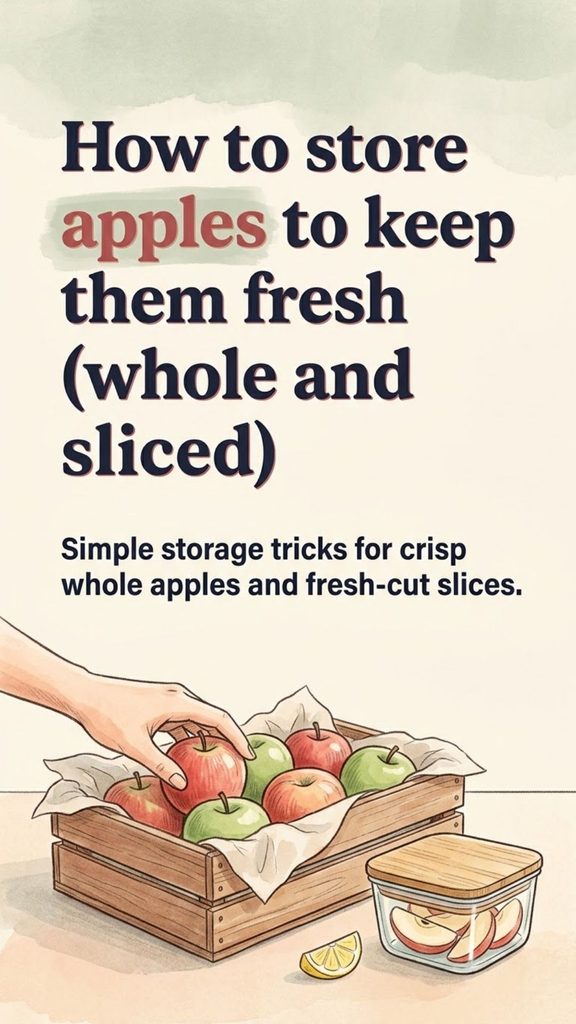
A crisp apple can turn soft surprisingly quickly when it is left on the counter, and a freshly sliced apple may begin browning within minutes. Neither problem means apples are difficult to store. They simply respond strongly to temperature, humidity, air exposure, and the condition of the fruit when it goes into storage.
If you buy apples by the bag, pick them from an orchard, or bring in a large homegrown harvest, a few simple storage habits can make a noticeable difference. Whole apples generally keep best when they are cold, humid, and protected from bruising. Cut apples need refrigeration plus protection from oxygen if you want them to stay pale and crisp.
The best method depends on whether you need the apples tomorrow, next week, or several months from now.
You Might Also Like:
- Loading posts...
Why Apples Spoil Faster on the Counter
Apples remain alive after harvest. They continue to respire and ripen, and they naturally produce ethylene, a plant hormone that influences ripening.
Warm temperatures speed these processes. That is why an apple sitting in a fruit bowl normally softens much sooner than one stored correctly in the refrigerator.
Cold storage slows ripening and moisture loss. Under carefully controlled commercial conditions, some varieties can be stored for months. Home storage is less precise, but refrigeration still makes a major difference.
For long-term storage, horticultural guidance generally recommends temperatures close to 30–32°F (-1–0°C) for suitable varieties, along with high relative humidity. A normal household refrigerator is usually somewhat warmer, but it remains the most practical storage location for most households.
The Best Way to Store Whole Apples at Home
If you expect to eat your apples within a day or two, a fruit bowl is perfectly reasonable. If you want them to stay crisp much longer, move them to the refrigerator.
The crisper drawer is usually the best location because it helps reduce moisture loss.
For larger quantities, apples can be stored in perforated plastic bags. Utah State University Extension recommends perforated bags because they help maintain humidity while still allowing some ventilation. Too little humidity encourages shriveling, while excessive trapped moisture can encourage decay.
For everyday home storage:
- Sort the apples before refrigerating them.
- Remove fruit that is bruised, cut, cracked, or beginning to decay.
- Place sound apples in the refrigerator crisper or a ventilated/perforated bag.
- Keep them cold but do not intentionally freeze them.
- Check stored apples periodically and remove any that begin deteriorating.
One bad apple really can create problems in a stored batch—not because of the old saying, but because damaged fruit deteriorates faster and can become a source of decay.
Start With Apples That Are Worth Storing
The condition of the fruit at the beginning has a major influence on how well it keeps.
Choose apples that are:
- Firm
- Free of deep bruises
- Free of cuts and punctures
- Not showing mold or decay
- Mature but not excessively soft or overripe
Handle them gently. An apple may look tough, but bruising damages tissue beneath the skin. The resulting soft area tends to deteriorate sooner than undamaged flesh.
If you have apples with minor bruises, do not automatically throw them away. Cut away damaged portions before eating or cooking, provided there is no rot or mold. FDA guidance recommends discarding produce that is rotten and cutting away bruised or damaged areas before preparation.
Use imperfect apples first for applesauce, baking, cooked fillings, or another recipe rather than placing them into long-term storage.
Which Apples Store the Longest?
Apple varieties differ considerably in storage life.
In general, firm, later-season apples tend to be better candidates for extended storage than very soft or early-ripening varieties. Apples commonly chosen for keeping include varieties such as Fuji, Granny Smith, and other firm storage types.
Even within the same variety, however, storage life depends on maturity at harvest, fruit condition, temperature, humidity, and handling.
For a mixed home harvest, a practical strategy is to eat the softer, more mature, or damaged apples first and reserve the firmest, blemish-free fruit for longer storage.
Should You Sort Apples by Size?
If you are storing a large harvest, sorting can be useful.
Larger or more mature fruit may not keep exactly as long as smaller fruit from the same harvest, and separating fruit into groups makes it easier to monitor what should be eaten first.
For the average bag of supermarket apples, this is unnecessary. For several boxes of orchard apples, it can make managing the crop easier.
Condition matters more than perfect sizing. A small bruised apple should be used sooner than a large flawless one.
Should Apples Be Wrapped Individually?
Wrapping apples is an old storage method that can still be useful when you are keeping a substantial homegrown crop.
Individual wrapping helps prevent fruits from rubbing directly against one another and makes it more difficult for one deteriorating apple to contact several neighboring fruits.
Use clean, plain paper rather than airtight wrapping around each fruit.
For ordinary refrigerator storage, individual wrapping is usually more work than necessary. A perforated bag or suitable crisper drawer provides a simpler solution.
Keep Apples Away From Potatoes
Apples and potatoes are not ideal storage companions.
Apples release ethylene as they ripen. Iowa State University Extension recommends keeping potatoes away from apples and other fruits because ethylene can encourage potato sprouting.
That is the practical reason to separate them.
Claims that storing apples with potatoes produces dangerous clouds of poisonous “solanine gas” are misleading. Solanine is associated with potato tissue, particularly green or sprouted portions; it is not a poisonous gas released into the room because an apple is nearby.
Store apples and potatoes separately because they have different storage requirements and because ethylene can affect the potatoes—not because the combination creates a toxic atmosphere.
Humidity Matters Almost as Much as Temperature
Cold air slows ripening, but apples also need protection from dehydration.
The ideal humidity used for apple storage is high—often around 90–95% relative humidity under controlled conditions. High humidity helps prevent the fruit from losing water, shriveling, and becoming soft.
That does not mean you should make apples wet.
Condensation and standing moisture can encourage decay. What you want is humid air around cold fruit, not water sitting on the skin.
A refrigerator crisper or perforated plastic storage bag helps create a more suitable microenvironment without sealing the fruit in a dripping-wet container.
Avoid improvised pans of water in household storage areas unless you can monitor conditions carefully. Raising humidity in a warm basement or enclosed room can encourage mold on walls, boxes, and produce.
Why Sliced Apples Turn Brown
Apple browning is mainly an enzymatic reaction.
Cutting damages the fruit’s cells. Once compounds inside those cells are exposed to oxygen, an enzyme called polyphenol oxidase contributes to reactions that create brown pigments.
The color change may look unappealing, but normal enzymatic browning does not mean the apple instantly became unsafe.
Reducing oxygen exposure and using an effective anti-browning treatment can slow the reaction dramatically.
Does a Ceramic Knife Stop Apples From Browning?
A sharp knife makes cleaner cuts and is useful for preparing fruit, but the idea that a ceramic knife alone prevents apple browning is overstated.
Apples brown because cut cells are exposed to oxygen. Simply switching from stainless steel to ceramic does not remove that underlying process.
There is also no need to avoid an ordinary clean stainless-steel kitchen knife. For most home cooks, knife sharpness, safe handling, and an effective anti-browning treatment matter far more than whether the blade is ceramic or steel.
How to Keep Sliced Apples From Turning Brown
Several methods work, but some are more reliable than others.
Use Ascorbic Acid
Ascorbic acid—vitamin C—is one of the most effective options because it acts as an antioxidant.
Commercial fruit-color protectors often contain ascorbic acid and can be convenient if you regularly prepare apples for lunches, freezing, drying, or preserving.
Follow the package directions for commercial products.
University Extension recommendations also provide formulations using pure ascorbic acid or crushed vitamin C tablets, although concentrations vary depending on whether the apples are being served fresh, canned, frozen, or dried.
Try Diluted Lemon Juice
Lemon juice is easy to find and effective for everyday sliced apples.
Illinois Extension suggests combining approximately 3 tablespoons of lemon juice with 1 quart of water, soaking the apple pieces for about 3–5 minutes, then draining them.
The advantage is simplicity. The disadvantage is that a strong lemon solution may change the apple’s flavor slightly.
Other Vitamin-C-Rich Juices Can Help Too
Orange, pineapple, lime, grape, and other juices containing vitamin C can also slow browning.
So the common claim that orange juice does nothing is incorrect. University Extension guidance specifically lists several fruit juices as possible anti-browning dips.
The tradeoff is flavor. Pineapple juice, for example, may work well but can leave the apple tasting noticeably sweeter or more tropical.
For a lunchbox, that might be enjoyable. For apples destined for a particular recipe, it may not be.
An Airtight Container Helps, but It Is Not the Whole Solution
Once the apple slices have been treated, reduce their exposure to air.
Place them in a tightly covered food-storage container or sealed food-safe bag and refrigerate promptly.
Less available oxygen means slower browning. Refrigeration also slows quality deterioration.
However, an airtight container does not completely stop enzymatic browning. For best appearance, combine reduced air exposure with an anti-browning treatment.
Pretreated cut apples generally keep about three to four days in the refrigerator, depending on the apple variety and condition. Illinois Extension also advises not leaving cut apples at room temperature for more than two hours.
If they develop an unpleasant odor, mold, sliminess, or obvious spoilage, discard them rather than relying only on a storage-time estimate.
Wash Apples Safely
Apples should be washed before they are cut or eaten.
Rinse them thoroughly under clean running water and rub the surface with your hands. Dry them with a clean towel if desired.
Do not wash apples with dish soap, detergent, bleach, or household cleaners. FDA guidance specifically advises against washing produce with soap or detergent because produce can absorb residues, and these products are not intended for food washing.
Washing reduces surface dirt and bacteria, but it does not sterilize an apple.
For fruit going directly into long-term storage after harvest, keeping it clean, dry, and undamaged is important. Before eventually preparing or eating it, rinse it under running water.
You Do Not Need an Ozone Machine to Make Apples Safe
Some home-storage advice recommends treating apples with ozone to eliminate bacteria such as Listeria monocytogenes. That is unnecessary for routine household apple storage.
Commercial postharvest research and industrial controlled-atmosphere systems should not be confused with recommendations for home kitchens.
For consumers, the FDA’s advice is much simpler: select sound produce, keep food-preparation surfaces clean, rinse fruits and vegetables thoroughly under running water, remove damaged areas, and refrigerate cut produce appropriately. Washing can reduce bacteria, although it cannot guarantee complete removal of every microorganism.
A household ozone generator should not replace normal food-safety practices.
How to Freeze Apples for Longer Storage
If you have more apples than you can eat before their quality declines, freezing is an excellent option.
Frozen apples will not retain the exact crisp texture of fresh fruit after thawing, but they are useful for pies, crisps, sauces, muffins, cooked breakfasts, and other recipes.
Start with firm apples.
Wash, peel if desired, core, and slice them. Treat the slices with ascorbic acid or another recommended anti-browning method.
For loose slices, you can freeze the drained pieces in a single layer on a tray first. Once frozen, transfer them to a freezer-safe container or bag and remove as much excess air as practical.
Penn State Extension recommends properly packaged frozen apples for several months of best quality and provides specific methods for syrup, sugar, or dry packing depending on their eventual use.
Freezing is particularly useful when you have good fruit that simply cannot be eaten quickly enough.
What to Do With Apples That Will Not Store Well
Slightly bruised apples should not occupy valuable long-term storage space.
Use them promptly for:
- Applesauce
- Apple butter
- Baked apples
- Pies or crisps
- Muffins and quick breads
- Cooked oatmeal
- Freezer-ready apple slices
Cut away bruised or damaged areas first and discard any apples showing actual rot or mold.
If you plan to can applesauce, preserves, pie filling, or other apple products for room-temperature storage, use a current, tested canning recipe from a reliable food-preservation authority rather than improvising processing times.
Safe canning depends on acidity, jar size, preparation method, processing time, and altitude. Simply filling hot jars and briefly boiling them is not an adequate substitute for a tested preservation process.
Quick Guide to Storing Apples
For a few apples you will eat soon, countertop storage is fine.
For apples you want to keep crisp for longer, refrigerate them in a crisper drawer or perforated bag.
For a large harvest, select only firm, undamaged fruit, keep it cold and humid, monitor it regularly, and use softer fruit first.
For sliced apples, use ascorbic acid, a commercial fruit protector, or diluted lemon juice; then refrigerate them in a covered container.
For long-term preservation, freeze, dry, or can the fruit using a tested method.
The Simplest Method Is Usually the Best
Keeping apples fresh does not require special machines, unusual knife materials, or complicated homemade treatments.
For whole apples, the biggest improvements come from choosing sound fruit, handling it gently, keeping it cold, maintaining reasonable humidity, and removing deteriorating fruit promptly.
For sliced apples, focus on the real cause of browning: oxygen-driven enzymatic reactions. An ascorbic-acid treatment or diluted lemon juice, followed by airtight refrigerated storage, is a practical solution.
Handled correctly, a large bag—or even a fall harvest—does not have to turn into a race against spoilage. Store the best apples cold, use imperfect ones first, and preserve the surplus before quality begins to decline.