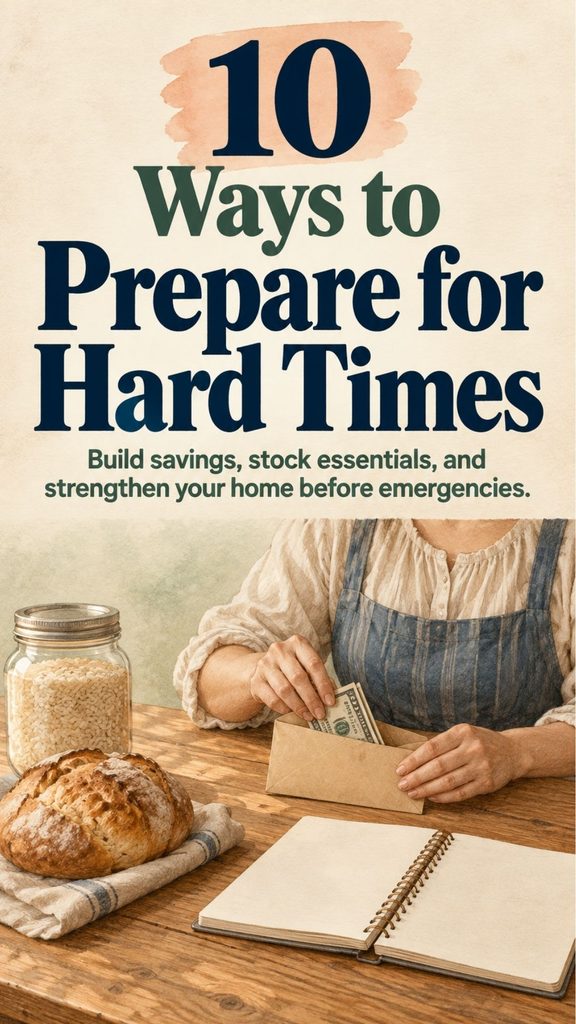
Hard seasons rarely arrive with perfect timing.
A job can disappear unexpectedly. A family may need to adjust to one income after having a baby. Medical problems can interrupt normal routines. Prices can rise faster than expected. A large repair can arrive during an already expensive month.
Preparing for situations like these does not mean living in fear or assuming disaster is around the corner.
You Might Also Like:
- Loading posts...
It means using a relatively stable season to make your household a little less fragile.
You do not need a basement filled with supplies, an enormous emergency fund, or a completely self-sufficient lifestyle. A useful starting point is much simpler: spend with more intention, save what you can, keep useful food at home, strengthen practical skills, and create systems that would help your household continue functioning if life became more difficult.
The best preparation is often ordinary.
Here are ten practical ways to begin.
1. Simplify Your Spending Before You Have To
One of the easiest times to reduce expenses is before money becomes extremely tight.
Start by looking honestly at where your money currently goes.
Do not begin with guilt.
Begin with information.
Review several weeks or months of spending and look for expenses that have quietly become normal.
Maybe takeaway meals have increased.
Perhaps several subscriptions are still being paid even though nobody uses them much.
Maybe frequent small shopping trips regularly turn into larger purchases.
These expenses are not necessarily wrong. The point is identifying which ones matter enough to keep and which ones could be reduced without making life miserable.
Start with one or two categories.
You might halve the takeaway budget instead of eliminating it.
Pause one streaming service.
Try buying certain household items secondhand.
Plan errands so you make fewer unnecessary shopping trips.
Small reductions practiced now can make a future income change less shocking because your household already knows how to live with a little less.
2. Build a Modest Emergency Fund
You do not need to save an enormous amount before emergency savings become useful.
Even a relatively small reserve can help when something unexpected happens.
A car repair, urgent household problem, vet bill, or temporary income disruption can be much easier to handle when at least some money has already been set aside.
Choose an initial goal that feels achievable.
For some households, $1,000 may be a useful first target.
For others, the first goal may simply be $100, then $250, then $500.
The exact number is less important than building the habit.
Save small amounts consistently.
Ten dollars counts.
Twenty dollars counts.
Money from selling unused items counts.
Any extra income can help.
It may also be useful to keep emergency savings separate from ordinary spending so it does not quietly disappear into groceries, entertainment, or impulse purchases.
Most importantly, define what the fund is for.
A genuine emergency is different from a planned birthday, a sale, or a holiday expense.
The clearer that boundary is, the more likely the money will still be there when you actually need it.
3. Build a Pantry Around Food You Really Eat
A useful pantry provides flexibility.
It means you can prepare several meals without immediately visiting the grocery store.
That can help during illness, a difficult financial week, unexpected weather, or simply an exhausting season when shopping is harder than usual.
But stocking a pantry does not mean filling shelves with foods your family dislikes because they happen to be cheap or have a long shelf life.
Buy what you already use.
Think about meals you can reliably make from inexpensive staples.
Rice, pasta, oats, canned tomatoes, beans, baking ingredients, frozen vegetables, and other familiar foods can form the foundation.
Then add slowly.
Instead of attempting one enormous stock-up trip, buy one or two extras when the budget allows.
If you regularly use canned tomatoes and they are on sale, buy an extra can.
If your family eats rice every week, keeping another bag on hand may make sense.
Rotate what you store so older food gets used first.
A pantry is most useful when it functions as an extension of your ordinary kitchen rather than a collection of emergency food nobody wants to eat.
4. Learn to Cook Simple Food From Scratch
Cooking is one of the most practical skills a household can strengthen before money becomes tight.
You do not need to make everything yourself.
Start with meals that provide good value and can be adapted easily.
Learn how to make a basic soup.
Cook rice confidently.
Make a simple pasta sauce.
Roast a chicken.
Prepare porridge.
Bake an easy loaf of bread if that fits your household.
Learn what you can do with leftovers.
A roast chicken, for example, might become dinner one night, sandwiches the next day, and part of a soup afterward.
A small amount of meat can often be stretched with rice, lentils, beans, potatoes, or additional vegetables.
The ability to look at what is already in the kitchen and turn it into a meal is extremely useful when money is limited.
Try learning one new basic recipe each week rather than attempting to transform your entire cooking routine at once.
Confidence grows through repetition.
5. Practice Living on Less Income
If your household currently depends on two incomes, a temporary practice period can reveal how prepared you really are for a change.
You do not necessarily have to move every dollar from one income into savings immediately.
The purpose is to experiment.
Ask:
Could the essential bills be covered on one income?
Which expenses would need to change?
What would be difficult?
What would we stop paying for?
What would we wish we had prepared earlier?
If possible, direct part or all of the second income toward savings, debt reduction, pantry supplies, or other financial goals during the experiment.
You may discover that the household can comfortably reduce certain expenses.
Or you may discover that one-income living would currently leave a serious gap.
That knowledge is valuable because you can address the problem while both incomes are still available.
If you already live on one income, the same principle can be used differently.
Try finding small ways to create additional margin within the income you already have rather than waiting until an emergency forces the changes.
6. Reduce Non-Essentials Gradually
When finances suddenly tighten, losing every enjoyable extra at once can make an already difficult season feel even harder.
Practicing lower-cost ways to enjoy life now can make future cutbacks much easier.
You might borrow books from the library instead of purchasing every one.
Meet a friend for a walk rather than an expensive outing.
Have a movie night at home.
Spend time at the beach, park, or another free local place.
Create a simple home spa evening.
Shop secondhand when you need clothing or household items.
The point is not to eliminate pleasure.
It is to break the assumption that enjoyment must always involve spending money.
This also helps you discover which paid conveniences or activities genuinely matter to you.
Maybe you cut five things and hardly miss four of them.
That makes it easier to protect the one that really does improve your life.
7. Declutter and Turn Unused Things Into Useful Money
Unused belongings can create two kinds of waste.
They occupy space, and some may hold value that could be more useful elsewhere.
Go through the home gradually.
Ask whether each item is being used, genuinely loved, or realistically needed.
Some things should simply be donated.
Others may be worth selling.
Furniture, children’s equipment, tools, appliances, electronics, good clothing, hobby supplies, and other useful items may bring in a little extra money.
The amount does not have to be impressive.
Fifty dollars from items that were sitting unused is still fifty dollars that could be added to emergency savings, used for groceries, or put toward debt.
Do not let the selling process create another form of clutter, though.
If something remains listed for months with no interest, decide whether keeping it around is worth the potential sale.
Decluttering should create more breathing room, not another unfinished project.
8. Keep a Simple Household Information System
Hard times become harder when essential information is scattered everywhere.
A simple home binder, notebook, folder, spreadsheet, or digital system can make a household easier to manage during stressful periods.
Keep information such as your basic budget, recurring expenses, meal plans, pantry notes, emergency contacts, and important family information organized in one place.
The system does not need to be beautiful.
It needs to be understandable.
Imagine that the person who normally manages household finances becomes ill for two weeks.
Could another adult figure out what bills need paying?
Could they find important phone numbers?
Would they know where essential information is kept?
Good household organization creates resilience because knowledge is not trapped in one person’s memory.
Review the system occasionally so it remains current.
9. Grow, Make, or Repair a Few Things Yourself
Self-sufficiency does not require acreage.
It begins with learning useful skills.
You might grow herbs on a windowsill.
Keep a few tomato plants in containers.
Grow lettuce in a small bed.
Bake muffins.
Make simple snacks.
Learn to sew on buttons.
Turn worn fabric into cleaning cloths.
Learn basic food preservation methods that are appropriate and safe for what you grow.
The goal is not to eliminate stores from your life.
It is to increase the number of things you know how to do.
Skills remain useful even when circumstances change.
A person who knows how to cook inexpensive food has options.
Someone who can make a basic repair can delay replacement.
Someone who can grow a little food understands how to produce at least part of what the household consumes.
Start with something you genuinely want to learn.
One practical skill practiced repeatedly is more valuable than twenty ambitious projects abandoned halfway through.
10. Invest in Relationships Before You Need Help
Financial preparation matters, but households do not survive difficult seasons on money alone.
Relationships matter too.
Neighbors who know each other can share information, tools, rides, or practical help.
Family members can support one another during illness.
Friends can provide company during a difficult period.
Community can make hard seasons feel less isolating.
Do not think of relationships as resources to collect for future emergencies.
Build genuine connection now.
Check on people.
Help someone move.
Watch a friend’s child when appropriate.
Share extra food.
Offer a ride.
Bring a meal to someone who is having a hard week.
Accept help graciously too.
Strong communities are created through ordinary generosity long before anyone knows who will need support next.
Prepare for the Most Likely Problems First
It is easy to become overwhelmed when you start thinking about everything that could go wrong.
Do not try to prepare for every possible disaster.
Look at your actual household.
What disruptions are most realistic?
Perhaps one income is less stable than the other.
Maybe your vehicle is older and repairs are becoming more likely.
Perhaps you live far from shops and keeping extra food makes sense.
Maybe you have a baby coming and expect income to decrease temporarily.
Perhaps inflation has already made groceries difficult.
Start there.
Preparation is more useful when it responds to realistic vulnerabilities rather than vague fear.
Build Margin Into Ordinary Life
One of the best forms of preparation is margin.
A little extra money.
A few additional pantry meals.
Some free space in the freezer.
A week without every hour scheduled.
Useful household supplies before the final one runs out.
A few practical skills.
People you can call.
None of these things seems dramatic.
Together, they make a household more adaptable.
When something goes wrong, you do not have to solve every problem immediately because you already created a little room to maneuver.
Don’t Go Into Debt Trying to Prepare
Preparing for hard times should strengthen your finances, not weaken them.
There is little benefit in putting hundreds or thousands of dollars of emergency supplies on a credit card if paying off the purchase becomes another financial emergency.
Build slowly.
One pantry item at a time.
One useful skill at a time.
One small deposit into savings.
One reduced expense.
One repaired object.
One relationship strengthened.
Preparation works best when it becomes part of normal life rather than an expensive project.
Practice Using What You Store
If you build up pantry supplies, cook with them.
If you learn to make bread, make it occasionally.
If you create a budget system, use it during ordinary months.
If you buy supplies for preserving food, practice while life is calm.
Preparedness that exists only theoretically may fail when you actually need it.
A system becomes reliable through use.
That also reveals weaknesses.
Perhaps you discover that your family does not like a certain pantry meal.
Maybe the spreadsheet you created is too complicated.
Perhaps an item you thought would be useful is unnecessary.
It is better to discover that now.
Keep Important Skills Current
Practical skills fade when they are never used.
Cook familiar economical meals regularly.
Keep basic sewing supplies somewhere accessible.
Learn simple household maintenance.
Know where water and power controls are in your home.
Understand your household bills.
Know how much food you typically use in a week.
These are ordinary homemaking skills, but they become especially valuable when money, time, or access to services becomes limited.
Preparing Should Make You Calmer, Not More Afraid
If preparing for hard times makes you constantly anxious, continuously shopping, or obsessed with every possible crisis, something has gone off course.
The purpose is stability.
You are trying to create a household that could absorb a setback a little more easily.
A stocked pantry should reduce worry.
Savings should provide breathing room.
Practical skills should create confidence.
A good budget should provide clarity.
Community should provide connection.
Preparation is useful precisely because, once a basic system is in place, you can return to ordinary life.
Start With One Small Step
You do not need to complete all ten ideas this month.
Choose one.
Track your spending for the next two weeks.
Transfer $20 into emergency savings.
Add two extra pantry staples to the grocery cart.
Learn one inexpensive meal.
List three unused items for sale.
Create one page containing essential household information.
Plant one pot of herbs.
Call someone you have not spoken with lately.
Small actions may seem insignificant, but preparedness is built through accumulation.
One dollar saved becomes several hundred.
One cooking skill becomes a collection of reliable meals.
One stocked shelf becomes a useful pantry.
One neighbor you know becomes part of a community.
Hard times cannot always be prevented.
But they do not have to find you completely unprepared.
The goal is not fear, perfection, or total self-sufficiency.
It is to make your household a little steadier while you have the opportunity—so if life shifts unexpectedly, you already have savings, skills, food, systems, and people helping you find your footing again.