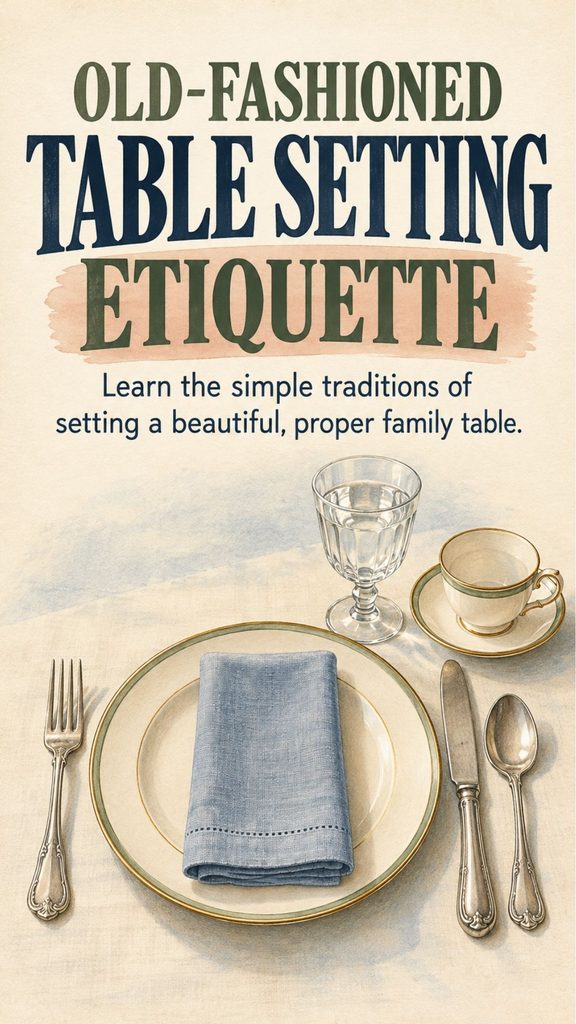
There was a time when setting the dinner table was an important household chore, not something done hurriedly just before everyone sat down to eat. Plates were placed neatly, forks and knives had their proper positions, napkins were folded, and drinking glasses were arranged with care.
In many homes, children learned these habits early. Setting the table was a daily responsibility that helped teach organization, consideration, and the value of sitting down together for a family meal.
Those traditions might seem formal compared with modern dining habits, but there’s something lovely about a thoughtfully arranged table. Even an ordinary weeknight dinner feels a little more inviting when everyone has a proper place setting.
You Might Also Like:
- Loading posts...
The good news is that traditional table etiquette isn’t nearly as complicated as it looks. Once you understand a few basic rules, arranging a beautiful table becomes second nature.
From the correct position of silverware to the proper placement of drinking glasses, napkins, and teacups, here’s how to set a table for everyday meals, family gatherings, and more formal occasions.
Why Traditional Table Setting Still Matters
A properly set table is about more than appearances.
Every item has a practical purpose. Forks and knives are positioned where diners can reach them comfortably. Drinking glasses are placed where they’re less likely to be knocked over. Napkins are easy to find, and serving dishes can be arranged so people aren’t constantly reaching across one another.
A well-set table also communicates thoughtfulness.
It tells the people sitting down that the meal has been prepared with care, whether you’re serving a homemade casserole on a Tuesday evening or hosting a special holiday dinner.
Traditional etiquette provides a helpful starting point, but it doesn’t mean every meal requires fine china or polished silver.
You can follow the same principles with everyday dishes, simple cotton napkins, and ordinary drinking glasses.
The most important part is making the table comfortable, welcoming, and practical for the people using it.
1. Start With the Dinner Plate in the Center
The dinner plate is the starting point for almost every traditional table setting.
Place it directly in front of the chair, centered within the space reserved for each diner.
In formal dining terminology, this individual place setting is sometimes called a cover.
Each guest should have enough space to use their utensils comfortably without crowding the person beside them.
For an everyday dinner, the main plate can sit directly on the table or on a placemat.
For a more elaborate occasion, you might use a charger plate beneath the dinner plate. A charger is a larger decorative plate that helps frame the place setting, although it isn’t necessary for ordinary meals.
How Far From the Edge Should the Plate Be?
A common guideline is to position the plate approximately one inch from the table’s edge.
This provides a neat appearance while leaving enough room for comfortable dining.
Consistency matters more than measuring every position exactly.
If you’re setting the table for several guests, step back and look across the arrangement. Keeping the plates evenly spaced creates an organized, attractive result.
2. Put the Forks on the Left Side of the Plate
One of the easiest traditional etiquette rules to remember is that forks generally belong on the left.
For a simple family meal, place one dinner fork to the left of the plate.
The tines should point upward in a typical American table setting.
If you’re serving a separate salad course before the main meal, you may need two forks.
Arrange them according to the order in which they’ll be used.
For example:
- Salad fork: On the outside left when salad is served first.
- Dinner fork: Closer to the plate for the main course.
This arrangement follows one of the most useful rules of traditional table etiquette:
Use your silverware from the outside toward the plate as each course is served.
It sounds complicated at first, but it makes perfect sense once you see a complete table setting.
The utensil needed first is positioned where it’s easiest to reach.
Keep in mind that some formal dining traditions place the salad fork differently when the salad is served after the main course.
The menu determines which utensils are needed and how they should be arranged.
3. Place the Knife and Spoons on the Right
The dinner knife belongs immediately to the right of the plate.
Its cutting edge should face inward, toward the plate.
This is one of the most consistent rules of Western table setting.
The arrangement has practical and traditional roots, and it remains standard for many everyday and formal meals.
If the meal includes soup, place the soup spoon to the right of the knife.
If additional spoons are required for multiple courses, arrange them according to the order of use.
A Simple Way to Remember Silverware Placement
For a basic dinner, think of the setting from left to right:
Fork — Plate — Knife — Spoon
That’s the foundation.
You don’t need additional utensils unless the meal actually requires them.
A spaghetti dinner, for instance, doesn’t need a soup spoon unless soup is being served.
Similarly, there is no reason to place several forks on the table when everyone will be using only one.
Good etiquette favors practicality over unnecessary decoration.
4. Position Drinking Glasses Above the Knife
Traditional table settings place drinking glasses in the upper-right area of the dinner plate.
For everyday meals, one water glass is usually enough.
Position it slightly above the tip of the dinner knife.
This placement keeps it conveniently within reach while leaving room for the utensils.
What About Formal Glassware?
When a meal includes additional beverages, the arrangement can become more elaborate.
A traditional formal setting may include a water goblet, wine glasses, or other specialized glassware.
Generally, the water glass occupies the position above the knife, with other glasses arranged to its right or in a suitable diagonal or triangular formation.
The exact arrangement depends on which drinks will be served and the style of service.
For example, a dinner with one wine option doesn’t require several different wine glasses.
And if no alcoholic beverages are being served, there’s no reason to place wine glasses simply for the sake of formality.
The goal is to provide the appropriate glass for each beverage without overcrowding the table.
5. Fold the Napkin and Place It Neatly
A beautifully folded napkin can make even a modest table setting feel special.
Traditionally, napkins may be positioned to the left of the forks or directly on the dinner plate.
Both arrangements are common.
For an informal family meal, a neatly folded napkin beside the plate is perfectly appropriate.
For a holiday dinner, you might fold cloth napkins into simple rectangles, triangles, or decorative shapes.
Napkin rings can also add a polished touch.
Should You Use Cloth or Paper Napkins?
Cloth napkins have long been associated with more formal dining, but they’re useful for everyday meals too.
They can be washed and reused, and a simple set of cotton or linen napkins can last through many family dinners.
Paper napkins are completely suitable for casual dining, outdoor meals, and occasions when convenience matters.
You don’t need expensive materials to follow good table etiquette.
What Should Guests Do With Their Napkins?
After sitting down, diners generally place their napkins on their laps.
Use the napkin gently to blot the mouth when necessary.
If you temporarily leave the table, place the napkin loosely on your chair or in another location consistent with the host’s customs.
At the end of the meal, it can be placed loosely beside the plate.
There’s no need to refold it into its original arrangement.
6. Use Place Cards for Formal Dinners and Special Gatherings
Place cards are a charming tradition that can make a dinner table feel thoughtfully organized.
They are particularly useful for weddings, holiday meals, anniversaries, and gatherings involving several families.
A typical place card sits above the dinner plate, where guests can easily read it as they approach the table.
If dessert utensils occupy that space, position the card so it remains visible without interfering with the setting.
Why Use Place Cards?
Beyond their decorative appeal, place cards eliminate confusion about where everyone should sit.
They’re especially helpful when you’re arranging seating for guests who may not know one another well.
You can make simple place cards with folded cardstock and handwritten names.
For a vintage-inspired setting, consider small floral designs, cream-colored paper, or understated calligraphy.
There is no need to make them elaborate.
A neatly handwritten name can be every bit as welcoming as an expensive printed card.
7. Where Does the Teacup and Saucer Go?
Tea service is one area where family customs and cultural traditions can differ.
In many British and Irish households, tea has historically been an important part of daily life, although individual families vary in when and how they serve it.
Some families enjoy tea with meals, while others reserve it for breakfast, afternoon tea, or a separate tea service.
If tea is being served as part of the meal, the cup and saucer are generally positioned on the right side of the place setting, beyond the main plate and utensils.
The exact position depends on the available space, glassware, and other items being used.
Traditional Teacup Placement
When the teacup is included in a conventional place setting, the saucer sits to the upper right of the plate, often beyond the knife and spoons.
The cup handle is normally turned toward the right.
A teaspoon may rest on the saucer, depending on the form of service.
Make sure the arrangement doesn’t crowd the water glass or make the utensils difficult to reach.
How Is Tea Served in American Dining?
In many American dining traditions, tea or coffee is commonly offered with dessert rather than being automatically served throughout the main meal.
In that situation, cups and saucers may be brought to the table during the dessert course instead of being placed out at the beginning.
The cup and saucer are usually positioned to the right of the dessert setting.
Neither approach is universally required.
Family tradition and the type of meal should guide the arrangement.
If your household enjoys tea with dinner, there’s no reason to abandon that custom simply because another etiquette tradition handles tea differently.
8. How to Set a Basic Everyday Dinner Table
You don’t need a dozen dishes or elaborate silverware to make an ordinary family meal feel properly arranged.
A basic table setting requires only a few items.
Step-by-Step Basic Table Setting
- Place the dinner plate directly in front of each chair.
- Set the dinner fork to the left of the plate.
- Position the dinner knife to the right, with its cutting edge facing the plate.
- Add a spoon to the right of the knife if the meal requires one.
- Place the drinking glass above the knife.
- Fold the napkin and position it to the left of the fork or on the plate.
That’s all you need for most everyday dinners.
If you’re serving bread, you can place it on a small bread plate in the upper-left area of the setting.
For an informal family meal, it’s also acceptable to keep bread in a shared basket.
The beauty of a basic table setting is its simplicity.
It provides everything diners need without making the table feel crowded.
9. How to Set a Formal Dinner Table
A formal dinner setting follows the same basic principles, but includes additional utensils and tableware for separate courses.
Imagine you’re hosting a dinner with soup, salad, a main course, bread, and dessert.
The setting might include:
- A charger or dinner plate in the center
- A dinner fork to the left
- A salad fork farther left if salad is served first
- A dinner knife immediately to the right
- A soup spoon outside the knife
- A bread plate above the forks
- A butter knife on the bread plate, if provided
- A water goblet above the dinner knife
- Appropriate additional beverage glasses
- Dessert utensils above the dinner plate, when set in advance
- A neatly folded napkin
- A place card for assigned seating
The outside-in rule helps guests navigate a multicourse meal.
As each course arrives, use the utensils positioned farthest from the plate that are intended for that course.
When a course is finished, the used utensils are normally removed with the dish.
What About Dessert Forks and Spoons?
Dessert utensils may be positioned horizontally above the dinner plate or brought out when dessert is served.
If both a dessert fork and dessert spoon are placed above the plate, they are traditionally arranged in opposite directions.
However, many modern hosts prefer bringing dessert utensils to the table with the dessert itself.
This approach saves space and keeps the table less cluttered.
10. Teach Children to Set the Table
Learning how to arrange a table can be a useful responsibility for children.
It introduces practical household skills and gives them a meaningful role in preparing family meals.
Start with simple tasks appropriate to the child’s age and abilities.
Younger children might place napkins or unbreakable drinking cups at each seat.
Older children can learn where forks, knives, spoons, and plates belong, with appropriate supervision around sharp utensils.
Make It a Simple Family Routine
Rather than treating table setting as a complicated lesson, make it part of regular household life.
Children can learn the basic pattern by repeating it:
Fork on the left, knife on the right, glass above the knife, and napkin neatly folded.
With practice, the arrangement becomes familiar.
You can also let children help select placemats, create holiday place cards, or fold napkins for special dinners.
Learning table manners doesn’t need to feel rigid or intimidating.
The purpose is to develop useful habits and encourage consideration for the people sharing the meal.
11. Classic Table Manners That Never Go Out of Style
A well-set table creates a pleasant first impression, but the way people behave around it matters even more.
Traditional table etiquette emphasizes making others feel comfortable.
A few basic manners remain useful in almost any dining situation.
Wait Until Everyone Is Ready
At a shared family meal, it’s considerate to allow others to be seated and ready before beginning.
At a hosted dinner, follow the host’s lead.
Keep Your Napkin on Your Lap
Once the meal begins, place your napkin on your lap and use it as needed.
Pass Dishes Instead of Reaching
If something is out of reach, politely ask another person to pass it.
Avoid reaching across someone else’s plate.
Chew With Your Mouth Closed
This simple habit remains one of the most recognizable dining manners.
Wait until you’ve finished chewing before speaking.
Put Phones Away When Practical
Shared meals offer a chance for conversation.
Unless there’s a genuine reason to keep a device nearby, leaving phones off the dining table helps reduce distractions.
Treat Other Diners With Consideration
Good manners aren’t about correcting every small mistake.
They’re about allowing people to enjoy their meal without embarrassment or unnecessary discomfort.
A gracious host will usually make guests feel welcome rather than scrutinize their table manners.
12. Make Your Table Beautiful Without Spending Much Money
An attractive table doesn’t require matching fine china, elaborate centerpieces, or expensive table linens.
Many of the most inviting dining tables rely on just a few simple touches.
A clean tablecloth or set of placemats creates a pleasant foundation.
Cloth napkins add texture, while a small vase of fresh flowers can provide a natural centerpiece.
For a vintage-inspired table, consider floral dishes, simple glassware, and understated decorations.
You can also use seasonal details.
In autumn, a small arrangement of leaves and pumpkins may look lovely. During Christmas, greenery or a few candles can make the table feel festive.
Keep decorations low enough that guests can comfortably see and speak to one another.
If you’re using candles, position them securely and away from flammable materials.
A beautiful table should never interfere with serving or enjoying the meal.
13. Common Table Setting Mistakes to Avoid
Even people familiar with traditional etiquette occasionally mix up the details.
Fortunately, most mistakes are easy to correct.
Placing the knife blade outward: The cutting edge should face the plate.
Putting the fork on the right: In a conventional Western setting, the dinner fork belongs on the left.
Crowding the utensils: Leave enough room for diners to use each piece comfortably.
Setting out unnecessary silverware: Only include utensils required for the meal.
Putting the drinking glass on the wrong side: The water glass generally belongs above the knife.
Blocking the table with decorations: Centerpieces should enhance the meal rather than obstruct conversation.
Using one arrangement for every occasion: A casual breakfast doesn’t require the same tableware as a formal multicourse dinner.
Traditional etiquette is a guide, not a reason to make guests uncomfortable.
A neat, practical arrangement is always preferable to an overly complicated display.
Bringing Back the Charm of a Properly Set Table
Setting the table is a small household ritual that can have a surprisingly lasting impact.
It’s a practical way to prepare for a meal, but it can also become part of the memories associated with family dinners, holidays, and special occasions.
The simple act of placing plates, folding napkins, and arranging silverware creates a sense of care and intention.
You don’t need to copy every formal dining tradition or own a collection of antique tableware.
Begin with the basics: a centered plate, fork on the left, knife on the right, drinking glass above the knife, and a neatly folded napkin.
Add the other pieces as the meal requires.
Over time, these little details become familiar habits rather than rules you have to stop and remember.
And perhaps that’s the nicest thing about old-fashioned table etiquette: the dishes and decorations may change over the years, but making people feel welcome at the table never goes out of style.