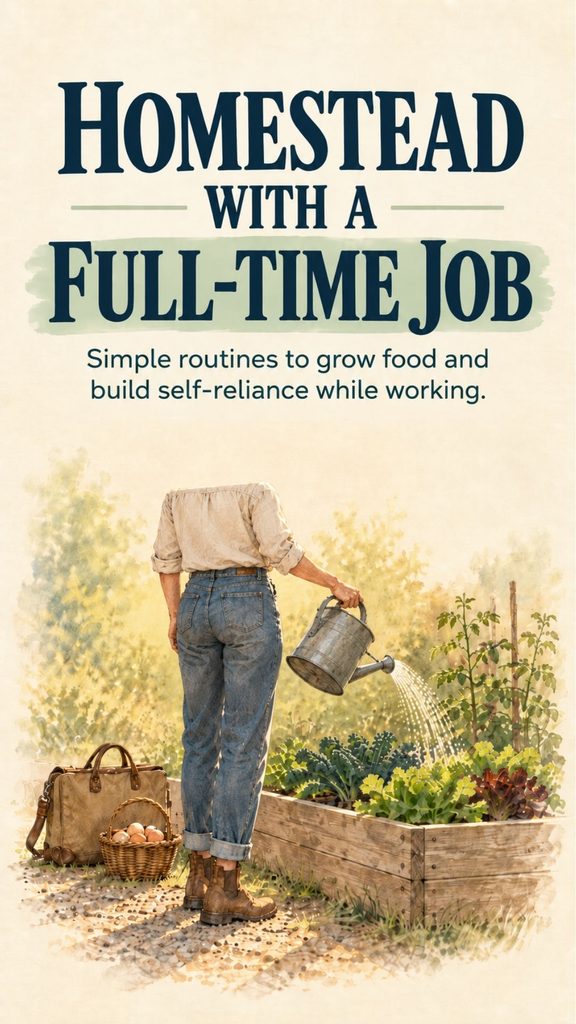
Homesteading can look impossible when you also work full-time.
The picture people often have in mind includes a large vegetable garden, chickens, homemade bread, overflowing pantry shelves, compost, food preservation, fruit trees, repairs, and perhaps a few livestock projects—all maintained before and after a regular workday.
That version can become exhausting very quickly.
You Might Also Like:
- Loading posts...
But homesteading does not have to mean doing everything yourself or living on several acres. The source article makes the useful point that you can begin with a few manageable skills or projects and gradually build a more self-reliant lifestyle around the time you actually have.
For someone with a full-time job, successful homesteading is usually less about doing more and more about choosing carefully.
Grow what you eat.
Preserve what you will use.
Automate repetitive jobs.
Avoid animals you cannot reliably care for.
Learn one skill before adding another.
And leave enough room in your week to enjoy the life you are building.
Here is how to make homesteading work alongside a regular job without turning every morning, evening, and weekend into another shift.
1. Decide What Homesteading Means to You
There is no official checklist.
You do not need:
chickens,
a cow,
a greenhouse,
a root cellar,
twenty raised beds,
or shelves full of home-canned food
to call what you are doing homesteading.
For one household, homesteading may mean growing vegetables, composting, cooking from scratch, and learning to repair things.
For another, it may include chickens and fruit trees.
Someone in an apartment might grow herbs, bake bread, preserve seasonal food, reduce waste, and learn traditional household skills.
Start by asking:
What do I actually want from this lifestyle?
Perhaps your goal is to reduce grocery costs.
Maybe you want better-tasting vegetables.
Perhaps you enjoy gardening.
You may want to learn practical skills or become less dependent on convenience purchases.
That answer should determine what you build.
Do not build a homestead around what looks impressive online.
2. Start With One or Two Projects
The source strongly recommends beginning with manageable projects rather than trying to create a fully developed homestead immediately.
That is especially important when your job already consumes much of the week.
Good first projects might include:
a small vegetable bed,
several containers of herbs,
a compost system,
a few fruit bushes,
learning to bake one reliable loaf of bread,
or establishing a simple pantry.
Choose something you can maintain during a difficult week.
That is the real test.
A garden that works only when you have two free hours every evening is probably too large.
A household system that collapses whenever work becomes busy is not yet sustainable.
Start smaller than your enthusiasm tells you to.
You can always expand.
3. Design the Homestead Around Your Real Schedule
Do not plan for the hours you hope to have.
Plan for the hours that actually exist.
The source recommends identifying predictable pockets of time—for example, watering before work, collecting eggs after work, and saving larger projects for weekends.
Take an ordinary workweek and look at it realistically.
Maybe you have:
20 minutes in the morning,
30 to 45 minutes after work,
and several hours Saturday morning.
That is your homestead budget.
Treat time the same way you would treat money.
Do not spend six hours of homestead labor when you only have four available.
4. Create a Small Daily Chore List
Some jobs cannot wait until Saturday.
Plants may need water.
Animals need food and fresh water.
Eggs need collecting.
A greenhouse may need ventilation.
The goal is to keep those daily responsibilities short.
A practical weekday routine might look like:
Morning: check animals, water anything not automated, inspect vulnerable plants.
Evening: collect eggs, harvest produce, check water, spend ten minutes tidying.
That is very different from trying to weed, preserve food, bake bread, clean a coop, turn compost, and repair fencing after a full workday.
Keep weekday maintenance minimal.
Save projects for project time.
5. Use a Weekly Rhythm
A weekly rhythm removes the constant question:
What should I be doing tonight?
The source recommends grouping similar tasks and assigning recurring jobs to specific days to reduce decision fatigue.
Your version might be:
Monday: garden inspection and watering check
Tuesday: no major homestead work
Wednesday: harvest and kitchen prep
Thursday: animal-area cleanup or garden maintenance
Friday: gather supplies for weekend work
Saturday: larger outdoor jobs
Sunday: meal prep, preserving, planning, and rest
Do not fill every evening.
A schedule without recovery time is not efficient.
It is simply overbooked.
6. Choose Crops That Earn Their Space
The best crop for a working homesteader is not necessarily the crop with the highest theoretical yield.
It is one you:
enjoy eating,
can grow successfully,
and can manage with limited time.
The source suggests relatively dependable crops and herbs such as green beans, kale, rosemary, thyme, strawberries, rhubarb, and asparagus.
But “low maintenance” depends heavily on your climate, soil, pests, rainfall, and growing system.
Zucchini may be famously productive, but it can still face squash vine borers, powdery mildew, or other regional problems.
Tomatoes can be easy in one garden and demanding in another.
Keep records.
After each season, ask:
What produced well?
What required constant intervention?
What did we actually eat?
What did I give away because I planted too much?
Then adjust.
A small garden filled with dependable foods is often more useful than a large garden grown for variety alone.
7. Use Perennials to Reduce Replanting
Perennial food plants can be useful because they do not need to be started from scratch every year.
Depending on your climate, possibilities may include:
asparagus,
rhubarb,
certain berries,
fruit trees,
perennial herbs,
or other regionally appropriate crops.
Perennials are not maintenance-free.
They may still need pruning, mulching, watering, pest management, and periodic feeding.
But once established, they can reduce some of the yearly planting workload.
Choose plants that are appropriate for your climate rather than assuming every popular homestead crop will thrive where you live.
8. Automate Watering
Few upgrades save more routine garden labor than reliable irrigation.
Drip irrigation and soaker hoses can deliver water directly to the root zone while timers can help maintain a predictable schedule.
The source specifically recommends irrigation timers and similar systems to reduce weekday workload.
Automation does not mean forgetting the garden.
Check the system regularly.
A timer cannot tell you that:
a line has become disconnected,
a dripper is clogged,
rain has already saturated the soil,
or a plant is wilting despite the programmed schedule.
Automation handles repetition.
You still provide judgment.
9. Mulch More and Weed Less
Mulch can be one of the best time-saving garden tools.
Appropriate organic mulch can:
reduce evaporation,
moderate soil temperature,
and suppress many weeds.
Use materials suitable for your garden, such as straw, shredded leaves, wood chips in appropriate locations, or another locally available option.
Keep mulch away from direct contact with plant stems where prolonged moisture could cause problems.
The more bare soil you leave exposed, the more opportunities weeds have to compete.
A well-mulched bed may require much less routine maintenance during a busy workweek.
10. Be Very Realistic Before Adding Animals
This is where homesteading changes dramatically.
Vegetables can occasionally tolerate a neglected evening.
Animals cannot.
The source describes chickens and rabbits as relatively manageable options while cautioning that dairy animals require much more time.
The important correction is that no animal is truly low-maintenance.
Chickens still require:
fresh water,
appropriate feed,
safe housing,
predator protection,
health monitoring,
cleaning,
weather management,
and arrangements when you travel.
Rabbits require similarly consistent daily care, suitable housing, nutrition, sanitation, temperature management, and health observation.
Before acquiring any animal, ask:
Who feeds them when I work late?
Who cares for them when I travel?
What happens if one becomes sick?
Can I afford veterinary or emergency care?
Are they legal where I live?
Do I have predator-proof housing ready?
If you cannot answer those questions comfortably, grow plants first.
There is no requirement that a homestead contain livestock.
11. Don’t Start With Dairy Animals
Dairy goats and cows can be wonderful animals, but they can also create schedules that revolve around them.
Milking must happen reliably.
Breeding, kidding or calving, feed, fencing, hoof or health care, shelter, and milk handling all require skill and time.
Someone working full-time can certainly keep dairy animals under the right circumstances.
But they are rarely the easiest first step.
Gain experience with simpler systems before adding something that creates non-negotiable daily responsibilities.
12. Batch Kitchen Work
Cooking and food preservation can consume entire evenings if you approach every task separately.
Batching helps.
If the oven is already on, roast extra vegetables.
If you cook beans, prepare enough for several meals.
Bake two loaves and freeze one.
Wash and chop several days of produce at once.
Prepare several freezer meals during one kitchen session.
The source recommends grouping activities such as baking, dehydrating, and preserving into designated blocks rather than trying to do everything every day.
That is one of the most useful strategies for a working household.
13. Preserve Food According to the Harvest—Not Your Fantasy Pantry
It is easy to become fascinated with rows of beautiful jars.
But food preservation requires time.
Only preserve foods your household will actually eat.
If your family loves tomato sauce, preserving tomatoes may be worthwhile.
If nobody likes pickled zucchini, producing 30 jars simply because zucchini is abundant does not make you more self-sufficient.
Choose the preservation method that fits the food and your available time.
Freezing is often faster than canning.
Dehydrating can be relatively hands-off for suitable foods.
Refrigerator or freezer preparations may sometimes be easier than shelf-stable preserving.
Use safe canning methods
If you preserve foods by home canning, use current, tested recipes from reliable food-safety sources and the correct processing method.
Low-acid foods generally require pressure canning.
Do not assume that an old family recipe, oven-canning method, or simply turning hot jars upside down makes food safely shelf-stable.
Traditional skills are worth preserving.
Unsafe methods are not.
14. Make Weekends Useful Without Sacrificing Them
The source describes weekends as the main opportunity for larger homestead jobs while also stressing the importance of leaving room to enjoy the homestead.
That balance matters.
A productive Saturday might include:
two hours of garden work,
one repair,
and some food preparation.
Then stop.
If every weekend is:
wake at 6,
work outside until dark,
preserve food until midnight,
then repeat Sunday,
your homestead has effectively become a second full-time job.
Some seasons genuinely are busy.
Harvest time can be intense.
But that should not be the permanent operating model.
15. Prepare for Saturday on Friday
One simple way to make weekends more efficient is to reduce setup time.
Friday evening, spend ten minutes preparing.
Charge batteries.
Locate tools.
Check the weather.
Buy missing materials.
Set out seed packets.
Thaw food you plan to process.
Make sure jars or freezer containers are available.
A one-hour project can easily become a three-hour project when the first ninety minutes are spent searching for supplies.
Preparation protects your limited weekend time.
16. Share the Work
A household homestead should not automatically become one person’s responsibility.
The source encourages partners and children to participate through age-appropriate jobs such as watering, gathering produce, collecting eggs, and helping with garden or compost tasks.
Make responsibilities clear.
One person might manage chickens.
Another handles irrigation.
Someone else keeps track of freezer inventory.
Children can participate according to age, maturity, and safety.
Do not make them responsible for hazards beyond their abilities.
But giving children real, manageable jobs can help them learn where food comes from and what household cooperation looks like.
17. Keep a Homestead Notebook
You do not need sophisticated software.
A notebook can save enormous amounts of repeated guesswork.
Record:
planting dates,
varieties,
harvest amounts,
weather problems,
pests,
preservation quantities,
animal-care notes,
repairs,
expenses,
and things you want to change next year.
Write down failures too.
Perhaps one tomato variety produced poorly.
Maybe watering three times per week was not enough during a heat wave.
Perhaps six zucchini plants were four too many.
Those notes become more valuable each year.
You are gradually creating instructions for your property rather than following generic advice written for somebody else’s climate.
18. Learn Skills in the Off-Season
The source recommends using quieter seasons to learn skills before the busy growing period begins.
That is much better than trying to learn pressure canning for the first time while 40 pounds of tomatoes are deteriorating on the counter.
Winter or another quieter period can be used to learn:
bread making,
basic sewing,
tool maintenance,
seed starting,
food-safety principles,
composting,
pruning,
or simple repairs.
Practice when mistakes are inexpensive.
Then use the skill when it matters.
Be careful with higher-risk crafts
Some traditional skills require more safety knowledge than others.
Soap making, for example, can involve sodium hydroxide, or lye, which is highly caustic.
If you learn it, use proper protective equipment, accurate measurements, suitable containers, and established safety procedures.
“Old-fashioned” does not automatically mean low-risk.
19. Build an Emergency Plan for Busy Weeks
Eventually, work will become chaotic.
You may get sick.
A child may need attention.
You may have to travel unexpectedly.
Design the homestead so it can survive those weeks.
For the garden, that may mean:
automatic irrigation,
mulch,
and fewer high-maintenance crops.
For animals, it means having a reliable backup caregiver.
For food preservation, it may mean accepting that some produce gets frozen instead of canned.
For housework, it may mean doing only essentials.
A resilient homestead can temporarily operate at a lower level.
If every system requires perfect daily attention from one person, the system is fragile.
20. Learn to Say No to Homestead Projects
This may be one of the most valuable skills of all.
The source emphasizes simplifying goals and accepting that sometimes the garden needs to be smaller or a preservation project needs to be skipped.
There will always be another appealing project.
Bees.
Quail.
Mushrooms.
A greenhouse.
Sourdough.
Soap.
Cheese.
Fruit trees.
A larger compost system.
More chickens.
A pond.
An orchard.
A bigger garden.
You are allowed to say:
That sounds interesting, but not this year.
Every project you add creates maintenance.
Choose the ones whose benefits justify that maintenance.
21. Don’t Grow Food Nobody Wants to Eat
Growing something successfully can be exciting.
But if your family dislikes it, productivity is meaningless.
Look at your grocery habits.
Which vegetables do you regularly buy?
What herbs do you use?
Which foods are expensive enough that growing them might be worthwhile?
Start there.
A small bed of salad greens, herbs, tomatoes, peppers, or beans that you use constantly can be more valuable than a huge garden full of novelty crops.
Self-sufficiency begins with usefulness.
22. Don’t Try to Make Everything From Scratch
Making everything yourself sounds wonderfully self-reliant.
It can also consume every hour of your life.
You do not need to simultaneously make:
bread,
yogurt,
cheese,
soap,
candles,
cleaners,
pasta,
butter,
jam,
laundry detergent,
and every household meal.
Pick the homemade products that provide real value.
Maybe homemade bread is important to you.
Perhaps you prefer buying bread and using your time to garden.
Maybe preserving tomatoes saves money.
Perhaps buying tomato sauce is easier and allows you to spend Saturday with your family.
Self-reliance does not mean refusing efficient trade.
Humans have always exchanged goods, labor, and skills.
23. Track the Real Cost
Homesteading can save money.
It can also become an expensive hobby.
Raised beds.
Soil.
Fencing.
Tools.
Feed.
Coops.
Seeds.
Irrigation.
Canning equipment.
Freezers.
Greenhouses.
Repairs.
These costs add up.
Track them.
If producing a dozen eggs costs significantly more than buying high-quality eggs locally, you may still decide the chickens are worthwhile because you enjoy them.
That is perfectly reasonable.
But know the difference between:
saving money
and
spending money on a lifestyle you value.
Both can be legitimate.
They are not the same claim.
24. Use Modern Technology Where It Helps
There is nothing inconsistent about using modern tools to support traditional goals.
Automatic watering.
Freezers.
Weather apps.
Electric pressure canners only where specifically approved for the process being used.
Timers.
Efficient tools.
Online agricultural extension resources.
Spreadsheets.
Smart sensors.
These can make a small homestead far easier to manage alongside employment.
The source makes the same broader point: efficiency allows modern tools to support old-fashioned goals instead of forcing you to do everything the hardest possible way.
Homesteading is not a competition to see who can reject the most technology.
Use tools intelligently.
25. Keep Learning Without Trying to Master Everything
Homesteading combines an enormous range of skills.
Gardening alone can include:
soil science,
irrigation,
plant disease,
pest management,
seed starting,
pruning,
harvesting,
and crop rotation.
Then add animals, preservation, cooking, repairs, and household management.
Nobody masters all of that in one season.
The source wisely describes homesteading as a long-term learning process rather than something with a finish line.
Learn what you need next.
If you are planting fruit trees this winter, learn pruning.
If tomatoes are producing heavily, learn safe preservation.
If you are considering chickens next spring, spend winter researching housing and local requirements.
Knowledge is easier to retain when you immediately use it.
26. Remember Why You Started
There will be evenings when the garden needs water and you are exhausted.
There will be pests.
Seeds will fail.
Weather will ruin plans.
Something will break.
A batch of food may not turn out as expected.
The source encourages keeping the original reason for homesteading in view during those frustrating periods.
Maybe you started because you wanted:
fresh food,
more time outside,
practical skills,
greater resilience,
a slower home life,
less waste,
or something meaningful to build with your family.
Return to that reason.
If the homestead is consistently moving you farther away from it, something needs simplifying.
A Realistic Week for a Working Homesteader
A manageable schedule could look like this:
Monday
Spend 15 minutes checking the garden and harvesting anything ready.
Tuesday
No project night.
Complete only essential watering or animal care.
Wednesday
Spend 30 minutes in the kitchen washing produce or preparing food.
Thursday
Light weeding, pruning, or another 20-minute maintenance job.
Friday
Check weekend weather and prepare tools and supplies.
Saturday
Complete one major outdoor job in the morning.
Rest in the afternoon or do something enjoyable.
Sunday
Meal prep, preserve a small amount of food if needed, and plan the coming week.
Daily animal care continues if you keep animals, but major projects remain limited.
That may not look impressive enough for social media.
That is precisely why it has a chance of lasting.
A Good First-Year Homestead Plan
If you are beginning from nothing while working full-time, consider deliberately limiting the first year.
For example:
Spring: establish one or two vegetable beds and a compost system.
Summer: learn to manage the garden and preserve one easy crop.
Autumn: plant a few suitable perennials and improve storage.
Winter: learn one practical indoor skill and plan next year’s garden.
Then evaluate.
If that felt comfortable, expand.
If it overwhelmed you, do not add animals and double the garden.
Simplify.
There is no prize for rapid expansion.
You Do Not Need to Quit Your Job to Start Homesteading
A full-time job may actually help fund the infrastructure that makes a small homestead sustainable.
Income can pay for:
quality tools,
good fencing,
irrigation,
soil improvements,
fruit trees,
repairs,
and professional help when necessary.
The goal does not have to be escaping employment as quickly as possible.
For some people, the ideal life may be both:
a career they value
and
a small productive homestead they love returning to.
Those things are not incompatible.
Homesteading Should Give You More Capability, Not More Exhaustion
The most sustainable homestead is rarely the one doing the greatest number of things.
It is the one whose systems fit the people living there.
Start small.
Build around your real schedule.
Automate repetitive work.
Choose plants according to your climate and meals.
Think very carefully before adding animals.
Batch tasks.
Use weekends without sacrificing every weekend.
Preserve only what you will eat.
Share responsibilities.
Keep records.
Learn slowly.
And say no to projects that do not fit your life.
The source closes with the reminder that homesteading can begin wherever you are and grow one intentional step at a time.
That is particularly true when you have a full-time job.
You do not need endless acreage or endless hours.
You need a handful of systems you can maintain consistently.
Grow one bed.
Bake one loaf.
Compost one bucket of kitchen scraps.
Learn one repair.
Plant one fruit tree.
Then let experience decide what comes next.
A homestead built slowly around your actual life has a much better chance of becoming the simpler, more capable lifestyle you wanted in the first place.