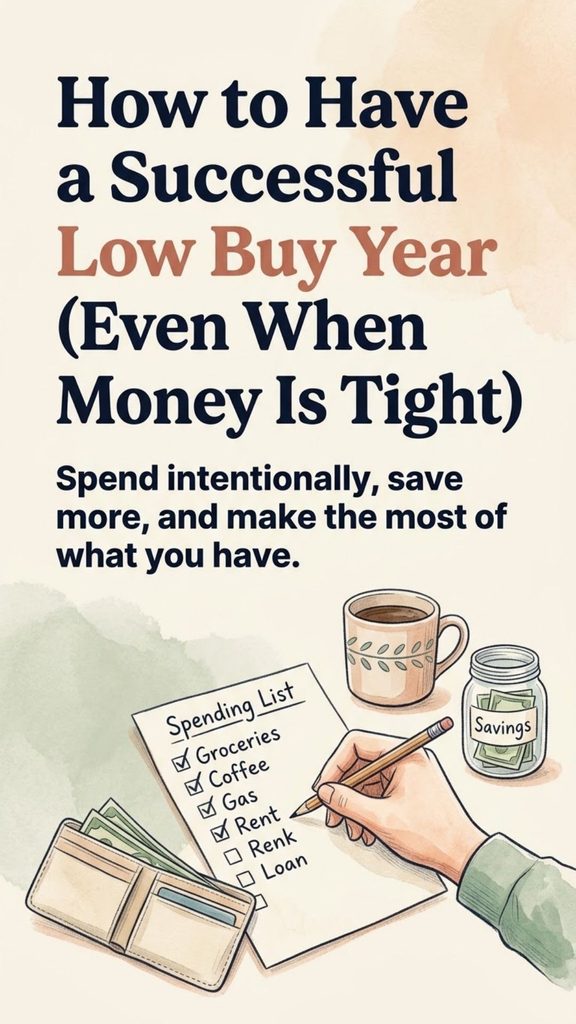
A low-buy year sounds simple: spend less, buy fewer unnecessary things, and keep more of your money. In practice, it can be much more meaningful than that.
For many households, the problem is not one dramatic purchase. Money disappears through dozens of small decisions—takeout because dinner was not planned, another inexpensive household item, a sale that felt too good to miss, an app subscription that was forgotten, or a quick online order made out of boredom.
A low-buy year creates a reason to slow those decisions down.
You Might Also Like:
- Loading posts...
Unlike a strict no-spend challenge, you are not trying to eliminate every nonessential purchase. You decide in advance what you want to spend freely on, what you want to limit, and what you would rather stop buying for a while. That flexibility makes the idea especially useful when money is already tight.
The goal is not deprivation. It is to make your money reflect your priorities more clearly.
What Is a Low-Buy Year?
A low-buy year is a period—usually several months or a full year—during which you intentionally reduce discretionary spending according to rules you create for yourself.
Essential expenses continue as normal. Housing, utilities, groceries, transportation, healthcare, insurance, debt payments, and other genuine needs are not the target.
Instead, you might decide to reduce spending on areas such as:
- Clothing
- Home decor
- Takeout and restaurant meals
- Beauty products
- Books you could borrow
- Hobby supplies
- Electronics
- Online impulse purchases
- Entertainment
- Duplicate household products
A low-buy year is different from a no-buy challenge because purchases are still allowed. The difference is that they have boundaries.
You might allow yourself to replace worn-out shoes but not buy shoes simply because they are on sale. You may budget for one restaurant meal a month instead of stopping dining out completely. You might continue buying skincare products but only after the current product has been used up.
The rules should fit your circumstances rather than someone else’s challenge.
Start With a Reason That Actually Matters to You
A vague goal such as “I should spend less” is easy to abandon.
A specific reason gives the challenge direction.
Perhaps you want to:
- Build an emergency fund
- Pay down credit-card debt
- Stop living so close to the edge each month
- Save for a large necessary purchase
- Reduce clutter
- Break an online-shopping habit
- Use what you already own
- Learn where your money is really going
Your goal does not have to be dramatic.
For someone with a comfortable income, success might mean saving several thousand dollars. For someone already struggling with basic expenses, success may simply mean avoiding new debt or creating a small financial cushion.
Both are meaningful.
Write down your reason and make it measurable if possible. “Put $50 a month into emergency savings” gives you something clearer to work toward than “be better with money.”
Know Where Your Money Is Going Before You Make Rules
Before deciding what to cut, look at what you currently spend.
You do not need an elaborate budgeting system. Review a few recent bank and credit-card statements and group your spending into broad categories.
Look especially at purchases that happen frequently but do not feel significant individually.
A $6 purchase does not seem important. Several $6 purchases every week can become a noticeable monthly expense.
Ask yourself:
What did I buy because I truly needed it?
What did I buy because it was convenient?
What did I buy because I was bored, stressed, tempted by a sale, or influenced by advertising?
Which recurring costs do I barely use?
Which categories consistently surprise me?
This exercise is not about feeling guilty. It gives you the information needed to create realistic low-buy rules.
Protect Essentials First When Money Is Tight
If you are already struggling financially, a low-buy year should never be built around skipping genuine necessities.
Start with the expenses that protect your health, housing, safety, and ability to function.
Depending on your circumstances, priorities may include:
- Rent or mortgage payments
- Utilities
- Basic groceries
- Necessary transportation
- Medication and healthcare
- Insurance
- Minimum debt payments
- Essential household supplies
- Necessary clothing replacements
Once those are accounted for, look at what remains.
Someone with very little discretionary income may not have many obvious luxuries to cut. In that situation, a low-buy year may focus less on dramatic savings and more on preventing unnecessary spending from making a difficult budget even tighter.
That distinction matters.
You cannot budget your way out of every income problem. If your essential expenses already exceed your income, cutting coffee or entertainment may help at the margins, but it will not solve the underlying shortfall. A low-buy plan can still reduce financial leakage while you address larger issues such as income, housing costs, debt, or available assistance.
Create Rules That Are Clear Enough to Follow
A low-buy year works better when you make decisions before temptation appears.
Instead of saying:
“I’ll buy less clothing.”
Try:
“I will only buy clothing to replace something worn out or to meet a genuine need I cannot fill from my current wardrobe.”
Instead of:
“I’ll stop eating out so much.”
Try:
“I will budget for two restaurant meals each month and cook at home the rest of the time.”
Your rules might include:
Clothing: Replacement-only purchases.
Books: Use the library first. Buy only books unavailable through borrowing that you expect to reread or use regularly.
Beauty products: Finish an item before buying another in the same category.
Home decor: No decorative purchases for six months.
Takeout: Once per month or only within a predetermined budget.
Hobbies: Use existing supplies before purchasing more.
Electronics: Replace only broken or genuinely inadequate devices.
The more specific your boundaries are, the fewer decisions you have to make in the moment.
Give Yourself a Small Amount of Flexible Spending
A plan that feels like punishment is difficult to maintain for an entire year.
If your budget allows it, consider setting aside a modest amount for enjoyable purchases with no guilt attached.
The amount is less important than the principle.
Having a defined entertainment or personal-spending category can prevent the feeling that every enjoyable purchase represents failure.
You might use it for coffee with a friend, a secondhand book, a favorite snack, craft materials, or another small pleasure.
If your budget currently has no room for discretionary spending, rewards do not have to involve buying anything. A quiet afternoon, a homemade dessert, a library visit, a movie you already own, a picnic, or time spent on a hobby can still mark progress.
Use What You Already Have
One of the easiest ways to support a low-buy year is to turn your attention toward what is already in your home.
Before buying something, check your cupboards, closets, drawers, freezer, bathroom cabinets, bookshelves, and storage spaces.
You may already have more than you remember.
This can be particularly effective with:
Food
Plan some meals around pantry and freezer ingredients before making another large grocery trip.
This does not mean eating every forgotten item regardless of quality or safety. It simply means checking what you already own before automatically buying more.
Toiletries
Finish partially used shampoo, lotion, makeup, or cleaning products before opening replacements.
Clothing
Experiment with different combinations of pieces you already own before deciding you need something new.
Hobbies
Use existing yarn, fabric, art supplies, gardening materials, puzzles, books, or craft supplies.
Household items
Repair, repurpose, borrow, or make do when doing so is practical and safe.
The point is not to cling to useless possessions. It is to stop purchasing duplicates while perfectly usable things sit forgotten.
Make Impulse Buying More Difficult
Modern shopping is designed to remove friction. Stored payment details, one-click ordering, constant notifications, and personalized advertising make purchases almost effortless.
For a low-buy year, adding a little friction can be useful.
Try:
- Removing saved payment information from shopping sites
- Deleting retail apps from your phone
- Unsubscribing from promotional emails
- Turning off shopping notifications
- Avoiding recreational browsing of online stores
- Unfollowing accounts that constantly promote products
- Keeping a wish list rather than purchasing immediately
A waiting period can also help.
For an ordinary nonessential purchase, give yourself several days—or longer for expensive items—before deciding. You do not have to follow an exact 30-day rule. The purpose is simply to separate the urge to buy from the final decision.
Many wants lose their urgency once some time passes.
Learn Your Spending Triggers
Budgeting focuses on numbers, but spending is often emotional.
People sometimes buy because they are:
- Bored
- Stressed
- Lonely
- Celebrating
- Tired
- Frustrated
- Looking for novelty
- Trying to reward themselves
- Comparing themselves with others
If shopping has become entertainment or emotional relief, simply creating rules may not be enough.
Pay attention to what happens immediately before an unnecessary purchase.
Perhaps you browse online stores late at night. Maybe stressful workdays lead to takeout and impulse orders. Perhaps social media creates the feeling that your home or wardrobe is always missing something.
Once you recognize the pattern, create an alternative response.
That might mean going for a walk, making tea, calling someone, reading, exercising, working on a hobby, journaling, or putting an item on a list rather than purchasing immediately.
The goal is not to eliminate enjoyment. It is to give yourself more than one way to respond to an emotion.
Find Cheaper Alternatives Without Making Life Miserable
Low-buy living becomes much easier when you replace expensive habits instead of simply removing them.
If restaurants are expensive, invite friends for a potluck.
If you buy books regularly, use the library.
If entertainment costs are rising, look for free community events, parks, walks, game nights, or activities at home.
If clothing is necessary, compare secondhand options before buying new.
If an item will only be used once, consider borrowing it.
If replacing something seems necessary, ask whether repairing it would be practical.
These substitutions do not need to become permanent rules for the rest of your life. They simply give you more options.
Be Careful With the “It’s on Sale” Trap
A discount does not automatically make a purchase financially smart.
Saving 40 percent on something you did not intend to buy still requires spending the remaining 60 percent.
During a low-buy year, judge an item based on whether you actually need or value it—not on how much the retailer says you are saving.
A useful question is:
Would I still want this if it were not on sale?
If the answer is no, the discount may be creating the desire rather than simply making a planned purchase cheaper.
Sales can be useful for something you had already decided to buy. They are less useful when they convince you to add another item to the list.
Make Socializing Fit Your Budget
Spending less can become awkward when social activities revolve around restaurants, shopping, expensive outings, or gifts.
You do not need to provide everyone with a detailed explanation of your finances. A simple statement is enough:
“I’m cutting back on spending this year. Could we do something inexpensive instead?”
Suggest alternatives before turning down the invitation entirely.
You might meet for coffee instead of dinner, cook together, go for a walk, host a movie night, visit a park, organize a potluck, or spend time together at home.
Friends and family may be more accommodating than you expect, especially when you offer an alternative rather than simply saying no.
Track What You Do Not Spend
Most people notice purchases more easily than avoided purchases.
Keeping a record of your low-buy wins can make progress more visible.
For example:
“Almost ordered a $45 sweater. Waited three days and decided I didn’t need it.”
“Used freezer food instead of ordering dinner: approximately $30 kept in the budget.”
“Borrowed the book from the library instead of buying it.”
You do not have to calculate every dollar perfectly. The purpose is to notice patterns and keep yourself motivated.
Also track tangible progress toward your larger goal.
If the challenge frees up money, direct it intentionally. Transfer money to savings, make an extra debt payment, or put it toward whichever goal motivated your low-buy year.
Otherwise, saved money can easily disappear into another category.
What a Low-Buy Day Can Actually Look Like
A successful low-buy lifestyle is usually less dramatic than people imagine.
You might make breakfast from ingredients already in the kitchen instead of stopping somewhere on the way to work.
You pack lunch.
During your break, you read or take a walk rather than browse shopping sites.
After work, you cook dinner using ingredients that need to be used soon.
Instead of ordering something because you are bored in the evening, you read a library book, work on an unfinished project, watch something you already have access to, or spend time with family.
None of those individual decisions changes your finances overnight.
Repeated hundreds of times, however, they can reshape your spending.
What to Do When You Break Your Own Rules
At some point, you may buy something you had planned not to buy.
That does not mean the year has failed.
The all-or-nothing mindset can be more damaging than the purchase itself. One impulse order does not erase months of better decisions.
Instead, ask what happened.
Was the rule unrealistic?
Were you responding to stress?
Did you forget your goal?
Was the purchase genuinely useful despite not fitting the original plan?
Use the answer to improve your system.
If your original rules are too restrictive, change them deliberately rather than repeatedly breaking them and feeling guilty.
The purpose of a low-buy year is to develop better financial habits, not to maintain a perfect score.
Check Your Progress Throughout the Year
Do not wait until the final day to evaluate your challenge.
Every month or two, review:
- What you spent
- What you saved
- Which categories improved
- Which rules were difficult
- Which purchases you genuinely missed
- Which things you stopped wanting altogether
- Whether your financial goal is moving forward
You may discover that some categories need stricter limits while others never caused much trouble.
You might also realize that one expense you considered unnecessary genuinely improves your quality of life. That is useful information too.
A good low-buy plan becomes more accurate as you learn about your own habits.
Measure Success by More Than the Amount Saved
Saving money is an obvious benefit, but it is not the only measure of success.
At the end of your low-buy year, perhaps you have:
- Less credit-card debt
- A larger emergency fund
- Fewer impulse purchases
- Less clutter
- Better awareness of your spending
- More confidence saying no to unnecessary purchases
- Greater appreciation for what you own
- More intentional habits around shopping
Those changes can continue helping long after the challenge ends.
A Low-Buy Year Should Give You More Control, Not More Guilt
The strongest low-buy plan is not necessarily the strictest one. It is the one you can realistically maintain while meeting your genuine needs.
Decide what matters. Protect essential expenses. Put clear limits around problem categories. Make impulse purchases harder. Use what you already own. Keep some room for enjoyment when your budget allows it.
Most importantly, remember why you started.
A low-buy year is not about proving how little you can survive on. It is about becoming more deliberate with the money you do have.
When every dollar is already important, that intention matters even more.