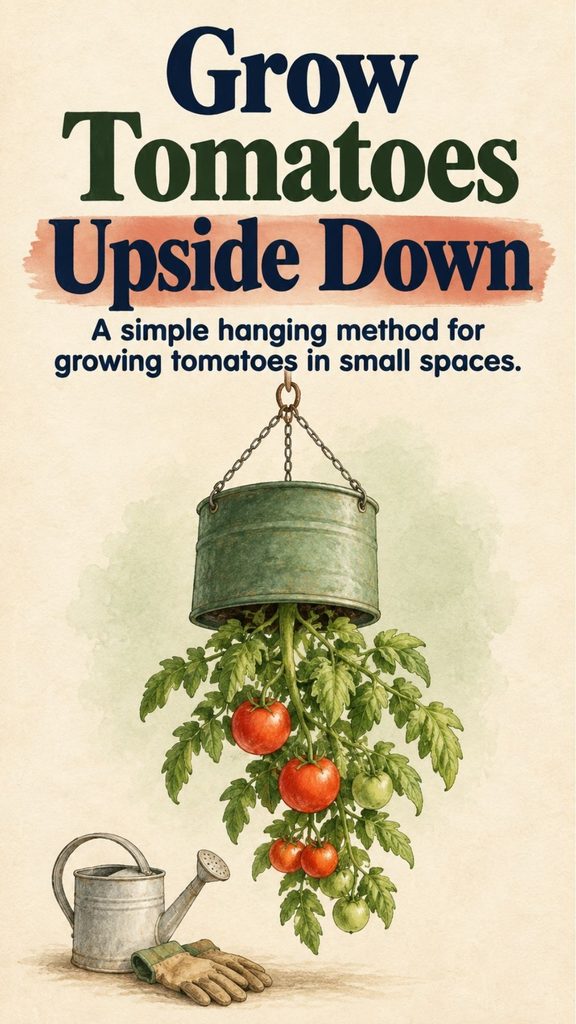
Growing tomatoes upside down is an unusual container-gardening method that can work surprisingly well when ground space is limited.
Instead of placing a tomato plant upright in a pot, the root ball sits inside a hanging container while the stem grows downward through an opening in the bottom. As the plant develops, the stems may naturally curve upward toward the light while the fruit hangs freely below.
This method is especially appealing for balconies, patios, porches, and small backyards where there is little room for traditional garden beds.
You Might Also Like:
- Loading posts...
But upside-down tomatoes are not automatically easier or more productive than tomatoes grown normally.
The planter can become extremely heavy, containers dry out quickly, and large tomato varieties may become difficult to support. Success depends on choosing the right plant, using a strong container, hanging it securely, and watering consistently.
Done carefully, though, an upside-down tomato planter can be both productive and a fun way to use vertical space.
How an Upside-Down Tomato Planter Works
The basic setup is simple.
The tomato grows through a hole in the bottom of a suspended container while its roots remain surrounded by potting mix above.
A simplified side view looks like this:
        STRONG SUPPORT
              |
          -----------
         |   SOIL    |
         | ROOT BALL |
          -----------
              ||
              ||
          TOMATO STEM
              ||
            \ || /
             \||/
            FRUIT
The container hangs high enough that the plant can grow freely without touching the ground.
Because the foliage hangs below the planter, you do not need a traditional tomato cage around the plant.
However, the hanger itself must be much stronger than many people expect.
Wet potting mix, the container, mature foliage, and tomatoes can create considerable weight.
Choose the Right Tomato Variety
Small-fruited tomatoes are generally the easiest choice for upside-down growing.
Cherry tomatoes are particularly suitable because the fruits are light and the plants usually tolerate container culture well.
Good choices include compact cherry, grape, patio, or dwarf tomato varieties.
Determinate tomatoes can also be easier to manage because they tend to reach a more predictable size.
Large indeterminate tomatoes can become challenging.
A vigorous plant producing heavy slicing tomatoes may create a great deal of weight and stress on both the stems and the hanging container.
You can experiment with larger tomatoes if you have an exceptionally strong setup, but beginners will usually have better results with smaller varieties.
Start With a Healthy Tomato Seedling
Use a sturdy young tomato plant rather than a large mature transplant.
Look for:
a strong central stem,
healthy green foliage,
no obvious pests,
and a compact root system.
Avoid seedlings that are already severely root-bound or weak and stretched.
A smaller transplant is easier to feed through the opening in the bottom of the container without damaging it.
Choose a Strong Container
You need a container large enough to hold an adequate volume of potting mix.
A sturdy bucket or purpose-made upside-down planter can work.
A container around 5 gallons is commonly used for one tomato plant, although exact needs depend on variety and climate.
The container must be strong enough to remain suspended while filled with wet growing medium.
Inspect the handle or hanging points carefully.
A thin plastic handle that seems strong when the bucket is empty may not be trustworthy after the planter becomes heavy.
If using a bucket, reinforce the hanging system when necessary.
Create the Planting Hole
Make an opening in the center of the container’s bottom.
The hole needs to be large enough for the tomato stem and root ball to pass through carefully but not so large that potting mix continuously falls out.
For many bucket systems, an opening a few inches wide is sufficient.
Smooth any sharp plastic edges.
A rough edge rubbing against the tomato stem can damage the plant as wind moves it.
Some gardeners place a small piece of landscape fabric, coconut liner, or other appropriate porous material around the stem opening to help hold the potting mix inside.
Do not tightly constrict the stem.
It needs room to thicken as the plant grows.
Plant the Tomato Before Filling the Container
This is usually the easiest part to do with the container sitting on its side or supported between two sturdy surfaces.
Carefully remove the tomato seedling from its nursery pot.
Gently guide the foliage and stem through the bottom hole from inside the container so that the root ball remains inside while the plant hangs below.
Handle the stem carefully.
Tomato stems are flexible, but they can still snap.
Once the plant is positioned, support it while adding potting mix around the roots.
Use Potting Mix, Not Garden Soil
A hanging container needs a growing medium that drains well while still retaining enough moisture for tomato roots.
Ordinary garden soil is usually too dense for this purpose.
It can become heavy, compacted, and difficult to water evenly.
Use a quality container potting mix instead.
A mix intended for vegetables or outdoor containers is a good starting point.
You can incorporate mature compost if appropriate, but do not fill the entire container with heavy compost or native soil.
Remember that weight matters.
Every extra pound must be supported by the hanger.
Fill the Container Gradually
Add potting mix around the root ball a little at a time.
Gently firm it with your hands to remove very large air pockets, but do not pack it tightly.
Leave some space at the top of the container for watering.
Once filled, water thoroughly and allow excess moisture to drain before lifting the planter into position.
This initial watering also gives you an opportunity to see whether soil escapes excessively through the bottom opening.
Hang the Planter From a Very Strong Support
This is one of the most important steps.
Do not hang a tomato bucket from a lightweight decorative hook.
The support should safely handle considerably more than the planter’s expected wet weight.
A substantial structural beam, heavy-duty bracket installed correctly into structural framing, or another appropriately rated support is much safer.
Do not rely on weak fencing, thin gutters, decorative trim, or a small screw installed only into siding.
Remember that wind adds additional force.
A heavy planter swinging in a storm can place much more stress on its mounting point than a stationary planter.
Give the Tomato Plenty of Sun
Tomatoes are sun-loving plants.
Choose a location that receives at least six hours of direct sunlight, with more often producing better growth and fruiting where temperatures are suitable.
A porch may look bright but still be too shaded.
Pay attention to where direct sunlight actually falls.
If the container hangs beneath a roof overhang, the upper part of the planter may also be protected from rainfall.
That means you may have to water even after a rainy day.
Watering Is the Biggest Challenge
Hanging tomato containers can dry out very quickly.
They are exposed to sun and wind from multiple sides, and mature tomato plants use a substantial amount of water.
Check the soil frequently.
During hot summer weather, a small upside-down planter may need watering daily.
In extreme heat, it may need even more attention.
Water slowly from the top until excess drains from the bottom.
If water immediately rushes through dry potting mix without thoroughly moistening it, apply a little water first, wait several minutes, and then water again.
This allows extremely dry mix to absorb moisture more effectively.
Do Not Let the Plant Wilt Repeatedly
Tomatoes prefer reasonably consistent moisture.
Allowing the plant to become severely dry and then flooding it repeatedly can stress the plant and contribute to fruit problems.
Check the planter before the leaves begin dramatically wilting.
Mulching the top surface with a light layer of suitable organic material can help reduce evaporation.
Do not block the watering area or pile mulch directly against any stems growing at the top.
Fertilize Because Containers Have Limited Nutrients
Tomatoes grown in containers depend almost entirely on the nutrients you provide.
Potting mix contains a limited nutrient reserve.
Once the plant is established and growing actively, use an appropriate tomato or vegetable fertilizer according to its label.
Do not simply add extra fertilizer every time the plant looks weak.
Overfertilization can cause excessive leafy growth, salt buildup, and plant damage.
Container plants may need regular feeding, but they need the correct amount rather than the largest possible amount.
You Can Grow Something on Top Too
One interesting advantage of an upside-down planter is that the top surface may still be usable.
Small herbs or flowers can sometimes be planted above the tomato.
For example, you might grow a compact herb on top while the tomato hangs underneath.
But do not overcrowd the planter.
The tomato already needs significant root space, water, and nutrients.
Adding several vigorous plants creates competition.
If you want to use the top, choose something small and shallow-rooted.
Watch the Plant’s Natural Growth Direction
An upside-down tomato will not necessarily continue growing perfectly straight toward the ground.
Plants respond to light and gravity.
New stems may curve outward and upward toward sunlight.
This is normal.
Do not keep forcing the stems downward.
Allow the plant to orient itself naturally.
The resulting shape may look a little unusual, but it does not mean anything is wrong.
Wind Can Be a Serious Problem
Traditional tomato plants are supported by cages or stakes.
Upside-down plants hang freely.
That makes strong wind an important consideration.
A large plant loaded with fruit can twist, swing, or develop broken branches during storms.
Place the planter somewhere with good sunlight but at least some protection from extreme wind.
You can loosely guide especially long stems if necessary, but avoid tying them tightly.
Inspect the hanging hardware regularly as the plant becomes heavier.
Prune Carefully
You do not need to heavily prune an upside-down tomato simply because it hangs differently.
Remove damaged, diseased, or dead leaves.
If the plant becomes extremely dense, selective pruning can improve airflow.
For indeterminate tomatoes, some gardeners remove selected suckers to control size, but heavy pruning can reduce the plant’s leaf area and overall productivity.
Prune with a purpose rather than cutting simply to make the plant look tidy.
Keep Foliage Healthy
Upside-down growing does not prevent tomato diseases.
Leaves can still develop fungal or bacterial problems.
Provide good airflow.
Avoid repeatedly soaking the foliage when watering.
Remove clearly diseased leaves.
Keep fallen plant material cleaned up.
Inspect the undersides of leaves for aphids, whiteflies, spider mites, and other pests.
Because the plant hangs at eye level, it is often easier to inspect than a ground-grown tomato.
Harvest Regularly
Cherry and grape tomatoes are particularly convenient in hanging planters because ripe fruits are easy to see.
Pick tomatoes as they ripen.
This reduces unnecessary weight on branches and encourages you to catch fruit before it becomes overripe.
Use one hand to support a branch while picking with the other if the stems feel delicate.
Do not pull aggressively.
Advantages of Growing Tomatoes Upside Down
This method has several genuine advantages.
It saves ground space.
There is no need for a traditional tomato cage.
Fruit is easy to see and harvest.
The planter can be placed on patios or balconies where digging a garden bed is impossible.
It can also keep the plant elevated away from some ground-level pests and soil splash.
For a small-space gardener, those benefits can make the method worthwhile.
Disadvantages You Should Know About
Upside-down tomatoes also have clear disadvantages.
The containers become very heavy.
They may dry out rapidly.
Water can drip onto the plant below.
Hanging the planter requires a strong structural support.
Large varieties can become awkward.
Root temperatures can rise quickly when the container receives direct sun.
And an upside-down planter does not automatically produce more tomatoes than a well-grown plant in a conventional container.
This method should be chosen because it fits your space—not because it is inherently superior.
Is Upside-Down Growing Better Than a Normal Container?
Usually, neither system is universally better.
A normal large container is often easier to water, easier to move before the plant becomes large, and capable of supporting a cage or trellis.
An upside-down planter excels where floor space is extremely limited.
If you have plenty of sunny patio space, growing a tomato upright in a large pot may be simpler.
If your floor space is already crowded but you have a strong overhead support, upside-down growing can add another productive layer to the garden.
A Simple Setup That Can Produce Real Tomatoes
You do not need a complicated commercial planter to experiment with upside-down tomatoes.
The essential system is straightforward:
        SECURE HOOK
             |
        STRONG HANDLE
             |
      +---------------+
      | POTTING MIX   |
      | TOMATO ROOTS  |
      +-------+-------+
              |
              |
          TOMATO PLANT
          /    |    \
       fruit fruit fruit
Choose a compact tomato.
Use a sturdy container.
Give it plenty of sun.
Water consistently.
Feed appropriately.
Protect it from strong wind.
Most importantly, make sure the hanging system is strong enough to support the mature planter.
Upside-down gardening is not magic, and tomatoes do not grow better merely because they are hanging from a bucket.
But where space is limited, it can turn an unused overhead area into a productive little garden.
And there is something undeniably satisfying about walking onto a balcony or patio and picking ripe tomatoes from a plant growing where you would normally expect nothing at all.