Squash plants can take over a garden bed surprisingly quickly. What begins as a compact seedling soon develops broad leaves, long stems, and fruit that may disappear underneath a dense canopy. In a small raised bed, one vigorous plant can occupy space you hoped to use for several other vegetables.
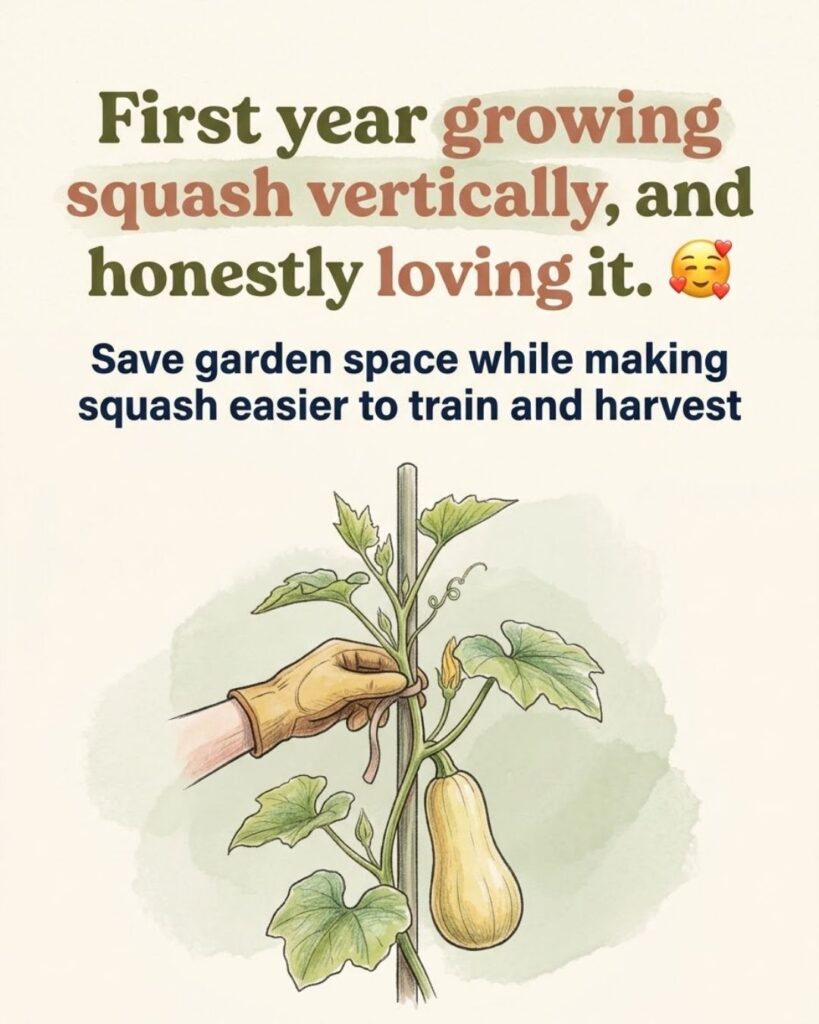
Training certain summer squash plants vertically offers another option. Instead of allowing the main stem to sprawl across the soil, you support it upright against a sturdy stake and secure it gradually as the plant grows.
The result is sometimes nicknamed a “squash tree.” It does not turn squash into a true climbing plant—zucchini and many summer squash varieties do not naturally climb the way pole beans or cucumbers do—but careful staking can keep the plant more upright, make harvesting easier, and free some ground-level space.
You Might Also Like:
- Loading posts...
The method works best when you start early and continue supporting the plant throughout the season.
Why Grow Squash Vertically?
Traditional zucchini and summer squash plants are commonly grown as large bushy plants. Their stems gradually lengthen as new leaves and fruit develop, causing the plant to spread outward.
That growth habit is perfectly normal, but it can become inconvenient in a small garden.
Supporting the main stem vertically can help with several practical problems.
First, it reduces how much of the garden bed is covered by the plant. The leaves will still spread outward, but the central stem occupies a smaller footprint than it would if allowed to trail across the ground.
Second, an upright plant is often easier to inspect. You can see developing squash, damaged leaves, and the base of the plant without digging through a pile of foliage.
Harvesting can also become easier because fruits are more visible.
Finally, keeping some leaves and stems away from the soil may improve airflow around the lower portion of the plant and reduce unnecessary contact between foliage and damp ground.
Vertical growing is not essential for producing squash, but it can be a useful management technique where garden space is limited.
Choose the Right Squash Plant
This method is most commonly used with zucchini and other summer squash varieties that develop a relatively strong central stem.
Not every squash grows the same way.
Vining winter squash, pumpkins, and some other varieties naturally produce long runners. Those plants are usually better trained onto a strong trellis rather than tied vertically to a single stake.
Large-fruited winter squash can also become extremely heavy, so their support requirements are very different from those of zucchini.
Before planting, check whether your variety has a bush or vining growth habit. A vertical stake is particularly useful for managing bush-type summer squash whose central stem becomes longer as the season progresses.
Start With a Strong Stake
A flimsy support will quickly become frustrating once the plant is mature.
A sturdy garden stake around six feet tall can work well, although the exact height you need depends on the variety and how long you intend to keep training it.
Wooden stakes, metal garden stakes, or other strong supports can all work.
The most important consideration is stability.
Push the stake deeply enough into the ground that it cannot easily wobble. If you are growing in a raised bed filled with loose soil, you may need to drive it farther down or reinforce it.
A mature squash plant can become surprisingly heavy. Large leaves catch wind, and the plant may carry several fruits at once. The stake needs to support that weight without leaning or pulling out of the soil.
Installing the stake while the squash is young is much easier than trying to force one into the root zone later.
1. Install the Support Early
Place the stake beside the young squash plant before the stem becomes large and difficult to move.
Leave enough room that you are not pushing the stake directly through the plant’s root crown.
At this stage, you are simply giving the plant something to grow alongside.
Trying to convert a large sprawling squash plant into an upright one later in the season can be difficult. Older stems are heavier and less flexible, and forcing them into a new position can cause cracking or breakage.
Early training allows the plant to adjust gradually.
2. Guide the Main Stem Upward
As the plant develops, identify the main stem.
This is the thick central portion from which the leaf stalks and flowers emerge.
Keep this stem close to the stake as it lengthens.
Squash does not naturally wrap itself around a support, so you will need to guide it. Move it only as much as necessary and avoid bending it sharply.
The goal is not to force the plant perfectly straight. A slightly curved stem is fine as long as it remains supported and off the ground.
Check the plant regularly because summer squash can grow quickly during warm weather.
3. Use Soft, Loose Ties
Secure the main stem to the stake at intervals as it grows.
Soft garden tape, plant ties, strips of soft fabric, or loose twine are good choices because they can hold the stem without cutting into it.
Whatever material you use, leave room for the stem to expand.
A tie that seems loose when the plant is young can become restrictive as the stem thickens.
Avoid tightening zip ties directly against a growing stem. If you use them, make a large loose loop and check them frequently so they do not constrict the plant.
Pipe cleaners can also work temporarily, but their wire cores can damage stems if twisted tightly.
Think of each tie as a support rather than a clamp.
Add new ties as the plant grows instead of relying on one or two attachment points to hold the entire weight.
4. Be Selective About Removing Lower Leaves
Vertical squash growing is sometimes paired with pruning, but removing leaves requires more care than simply cutting everything below the newest fruit.
Leaves are the plant’s main source of photosynthesis. Healthy foliage captures light and produces the carbohydrates needed for continued growth and fruit production.
For that reason, there is little benefit in removing healthy leaves simply because the plant looks crowded.
Pruning is most useful when lower leaves are:
- yellowing or dying
- badly damaged
- lying directly on wet soil
- creating an obstruction around the base of the plant
When a leaf does need to be removed, use clean pruning shears and cut the leaf stalk near the main stem without damaging the stem itself.
Avoid stripping large numbers of leaves at one time.
Maintaining a healthy upper canopy is particularly important because the plant still needs adequate leaf area to support fruit development.
5. Continue Training Before the Plant Gets Heavy
The easiest time to adjust a squash stem is while the newest growth is still relatively manageable.
Do not wait until the plant is sprawling several feet across the bed.
As new sections develop, bring them gently toward the stake and add another loose tie.
Regular small adjustments are much safer than trying to reposition an entire mature plant in one afternoon.
This routine may only take a few minutes during a garden check, but it prevents the plant’s weight from suddenly pulling against a single attachment point.
Give the Plant Enough Room
Growing squash vertically saves ground space, but it does not make the plant physically small.
The leaves of a healthy zucchini plant can still spread widely in every direction.
Avoid planting several squash plants extremely close together simply because their stems are staked.
They still need access to sunlight, water, nutrients, and moving air.
Follow the spacing recommendations for your particular variety rather than assuming vertical training allows unlimited crowding.
The newly available soil beneath and beside the plant may be useful for smaller crops, but choose companions that will not interfere with the squash roots or become completely shaded by its leaves.
Water at the Soil Level
Vertical training does not change squash’s need for consistent moisture.
Water the soil around the root zone rather than routinely wetting the foliage. This puts water where the plant can use it and avoids unnecessarily keeping leaves wet.
Mulch can also help conserve soil moisture and reduce weed growth.
Keep mulch from being packed tightly against the main stem. Leaving a little breathing room around the plant’s base makes it easier to inspect the stem and avoid trapping excessive moisture directly against it.
Check Ties and Supports Regularly
A vertical squash plant is not a set-it-and-forget-it project.
As the stem thickens, inspect every tie.
Loosen or replace anything that begins pressing into the plant.
Check the stake after storms or strong winds as well. A leaning support can place unnecessary pressure on the stem and root system.
Fruit placement matters too. If a developing zucchini becomes trapped between the main stem and stake, gently reposition it while it is still small.
Regular inspection helps you catch these minor problems before they become difficult to correct.
Do You Need to Support the Fruit?
Most zucchini and ordinary summer squash fruits do not require individual slings when the plant is staked upright.
The fruit is naturally connected to the main plant by a sturdy stem.
However, the supporting stake still needs to carry the overall weight of the plant.
This is one reason a solid stake and several loose attachment points are better than tying a heavy plant to one weak support near the bottom.
Very large squash varieties are a different situation and may need a stronger trellis system designed for their weight.
Common Mistakes to Avoid
One of the biggest mistakes is starting too late. A mature squash plant can be difficult to straighten without damaging it.
Another is tying the plant too tightly. Squash stems continue expanding throughout the growing season.
Over-pruning is also unnecessary. Removing a few old or damaged lower leaves is different from stripping the plant until only a small cluster remains at the top.
Finally, remember that staking does not replace ordinary plant care. Squash still needs adequate sun, appropriate spacing, fertile soil, water, and regular inspection for pests and disease.
Vertical growing simply changes how the plant is supported.
Is Growing Squash Vertically Worth Trying?
For gardeners working with raised beds or limited space, it can be.
A strong stake and a handful of soft ties can transform a sprawling zucchini plant into a more upright structure. The main stem becomes easier to follow, fruits are often easier to locate, and the ground around the plant remains more accessible.
The method does require attention. You need to start while the plant is young, add support as it grows, keep ties loose, and avoid removing more healthy foliage than necessary.
Once a squash plant becomes large and heavy, repositioning it becomes much harder. Early and gradual training is the safest approach.
Vertical squash will never behave exactly like a naturally climbing bean or cucumber, and it will still produce a substantial canopy of leaves. But in a crowded garden bed, getting the central stem off the ground can make a noticeable difference.
If your zucchini seems determined to claim half the garden every summer, a sturdy stake may be one of the simplest ways to give both the squash—and everything growing beside it—a little more room.