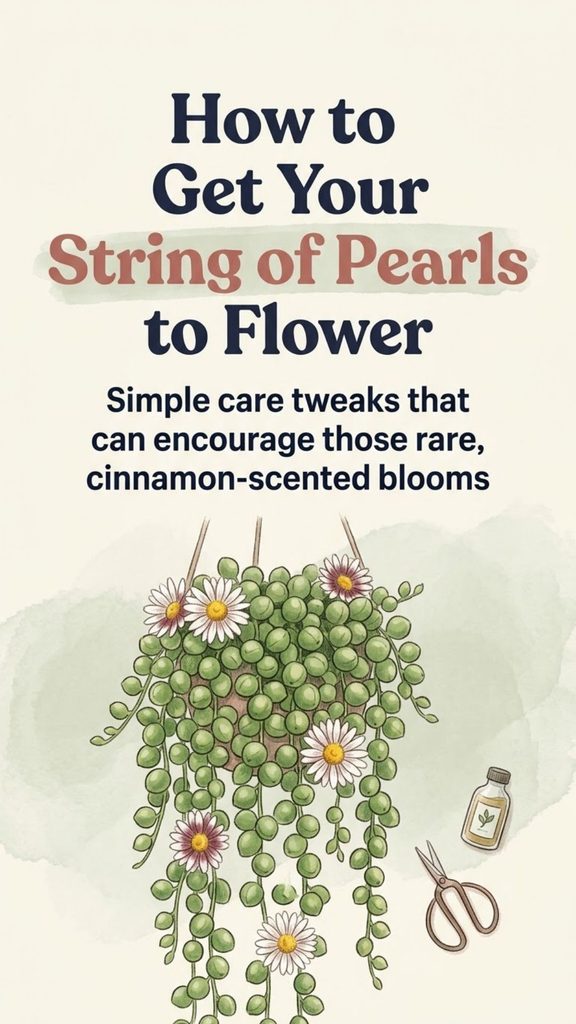
String of pearls is usually grown for its cascading strands of round, bead-like leaves, so its flowers can come as a surprise. A healthy plant can produce clusters of small, fragrant blooms, but flowering indoors is far less reliable than simply growing long, attractive vines.
The secret is not a special fertilizer or an extremely root-bound pot. Flowering is more likely when Curio rowleyanus—also widely known by its older botanical name, Senecio rowleyanus—receives strong light during the growing season and a cooler, drier rest during winter.
Those conditions matter because they more closely resemble the seasonal changes the plant experiences naturally. Indoor plants kept warm, wet, and relatively dim all year may grow foliage without ever receiving the environmental cues that encourage flowering.
You Might Also Like:
- Loading posts...
Here is how to give your string of pearls its best chance of blooming.
What Do String of Pearls Flowers Look Like?
The flowers look quite different from the plant’s famous spherical leaves.
String of pearls belongs to the daisy family, Asteraceae, and produces small composite flower heads rather than large individual petals. The blooms are generally white to creamy white, with prominent reddish stamens and yellow anthers. They are often described as looking like tiny pom-poms or paintbrushes.
One of their most appealing features is their fragrance. The flowers can produce a sweet, spicy scent often compared with cinnamon.
Individual flowers are small—roughly ½ inch across—but several appearing above a curtain of green pearls can make an established plant especially attractive.
Flowering generally occurs during summer. Indoor blooming is possible, but North Carolina State Extension notes that string of pearls rarely flowers indoors, so a plant that has never bloomed is not necessarily unhealthy.
1. Give It Much More Light
Insufficient light is one of the biggest obstacles to flowering.
String of pearls can survive in moderately bright indoor conditions, but producing flowers requires energy. A plant stretching toward a window, producing widely spaced leaves, or developing thin, sparse growth is unlikely to be in ideal flowering condition.
The Royal Horticultural Society recommends a bright position and states that the plant can receive several hours of direct sun. North Carolina State Extension recommends bright indirect light indoors and warns that intense direct sun can scorch the foliage.
The practical approach is to provide very bright light with some gentle direct sun, rather than suddenly placing an indoor-grown plant in harsh afternoon sunlight.
An east-facing window is often useful because the plant can receive softer morning sun followed by bright light later in the day. A bright south- or west-facing position may also work, but plants should be acclimated gradually if the sunlight is intense.
If moving a string of pearls outdoors for summer, introduce it to stronger light slowly. A sudden move from an indoor shelf to full outdoor sun can scorch the leaves. University of Wisconsin Extension specifically recommends gradually acclimating indoor plants when moving them outside.
Good light does more than encourage flowers. It also helps the plant maintain compact growth and closely spaced pearls.
2. Give the Plant a Cooler, Drier Winter Rest
This is one of the most useful flowering tips and is often overlooked.
String of pearls benefits from different care in winter than it receives during active summer growth. University of Wisconsin Extension notes that a cool, dry winter rest may promote summer blooming. It recommends approximately 55–60°F (13–16°C) during this resting period. RHS guidance gives a similar winter temperature range and advises watering sparingly.
That does not mean exposing the plant to frost.
String of pearls is a tender succulent and should be protected from freezing temperatures. Instead, think of a bright but cooler indoor location away from heating vents.
During winter:
- Keep the plant in strong light.
- Reduce watering considerably.
- Avoid keeping the pot continually moist.
- Keep it away from freezing temperatures and cold drafts.
- Avoid pushing lots of soft growth with heavy fertilizer.
Then, as spring temperatures and daylight increase, resume normal growing-season care.
The change between a cooler, drier winter and a brighter, warmer growing season can be more meaningful for flowering than simply applying additional fertilizer.
3. Be Careful With Water
Trying to encourage flowering by watering more frequently can easily backfire.
String of pearls is a succulent with fleshy leaves designed to store water. Its roots are particularly vulnerable when kept in consistently wet potting mix.
University of Wisconsin Extension identifies overwatering and root rot as a major problem and recommends very well-drained growing medium. RHS likewise advises free-draining compost and lighter watering during winter.
During active growth, water thoroughly enough to moisten the root zone, then allow the growing medium to dry substantially before watering again. Do not leave the pot standing in water.
Winter watering should be less frequent.
There is no universal schedule such as “water every seven days” because drying speed depends on:
- pot size
- pot material
- temperature
- humidity
- light intensity
- season
- soil composition
Judge the plant and potting medium rather than following the calendar.
Shriveling pearls can indicate that the plant needs water, but be cautious: damaged roots caused by excessive moisture can also leave a plant unable to absorb water properly. Checking the soil before automatically adding more water is important.
4. Use a Fast-Draining Potting Mix
Healthy roots are necessary before flowering becomes a realistic goal.
String of pearls naturally comes from relatively dry regions of southern Africa and performs best in a porous growing medium. A commercial cactus or succulent mix can work, especially when it drains quickly rather than remaining damp for long periods.
University of Wisconsin Extension recommends a very well-draining mix and notes that mineral materials such as pumice, coarse sand, grit, or small gravel can be incorporated to increase drainage.
Whatever mix you choose, the container should have a drainage hole.
Avoid planting a small string of pearls in an enormous pot filled with moisture-retentive soil. Its root system does not require a large volume of wet compost, and oversized containers can remain damp long after the plant needs them to dry.
5. Don’t Force It to Become Severely Root-Bound
A common piece of advice claims that string of pearls flowers because being root-bound makes the plant “think it is dying.”
There is little reason to treat that as a reliable flowering method.
String of pearls does have a relatively modest root system, and it does not need a dramatically oversized container. A slightly snug pot can therefore be perfectly appropriate. But deliberately allowing the roots to become severely congested can create water-management and nutrient problems rather than guaranteeing flowers.
University of Wisconsin Extension recommends repotting periodically—about every year or two as needed—rather than keeping the plant permanently trapped in an undersized container.
Repot when you notice signs such as:
- roots becoming excessively crowded
- potting mix breaking down
- water passing through abnormally quickly
- the plant drying much faster than before
- growth declining despite otherwise suitable care
Move up only modestly in container size. A huge jump is unnecessary.
6. Fertilize Lightly Rather Than Heavily
Fertilizer can support healthy growth, but more fertilizer does not automatically mean more flowers.
University of Wisconsin Extension recommends light fertilization in spring.
A balanced fertilizer formulated for houseplants or succulents can be used during active growth according to its label directions. If using a concentrated houseplant fertilizer, many growers prefer applying it at reduced strength rather than repeatedly giving succulents a heavy dose.
Avoid fertilizing a stressed plant simply because you want it to flower. Correct poor light, root problems, or watering mistakes first.
Likewise, reduce or stop routine feeding when the plant enters its cooler winter rest. The goal during that period is not to force lush new growth.
7. Prune Weak or Damaged Growth
Pruning is useful for maintaining a dense, healthy plant, although it should not be presented as a guaranteed way to trigger flowers.
RHS recommends trimming weak or straggly stems back to encourage fresh growth.
Remove:
- dead stems
- rotting sections
- badly damaged vines
- excessively weak or bare growth
You can also trim excessively long strands if you want a fuller plant.
Healthy cuttings do not have to be wasted. String of pearls is readily propagated from stem cuttings, and portions of stem placed against suitable potting mix can develop roots at the nodes.
Avoid repeatedly pruning healthy growth late in the season merely in hopes of stimulating flowers. Maintaining an established, vigorous plant is more important.
8. Give the Plant Time to Mature
A recently propagated cutting should not be expected to flower immediately.
Its first job is establishing roots and producing healthy stems and leaves. Blooming is more likely from a vigorous, established plant receiving consistent care.
If your string of pearls is growing densely, producing healthy pearls, and showing no signs of rot or severe stress, continue providing appropriate conditions rather than changing its care every few weeks.
Indoor flowering remains somewhat unpredictable, even on healthy specimens.
Common Reasons a String of Pearls Doesn’t Bloom
If you have had your plant for years without seeing flowers, look first at its growing conditions.
The most common issues include insufficient light, especially when the plant is several feet away from a window; warm conditions throughout winter, which eliminate a natural seasonal rest; and excessive watering, which weakens the roots.
Other problems can include poor drainage, oversized containers that remain wet too long, excessive fertilizer, or a plant that is simply too young or recovering from stress.
A plant does not have to flower to be healthy. The foliage remains the main attraction, and flowering indoors is naturally less common.
A Simple Flowering Routine
For the best chance of blooms, keep your string of pearls in the brightest suitable location during spring and summer, with gentle direct sunlight where possible. Water only after the potting mix has dried sufficiently, maintain excellent drainage, and feed lightly during active growth.
During winter, move it to a bright, cooler location around 55–60°F (13–16°C) if you can provide those conditions safely. Reduce watering significantly and allow the plant to rest. When spring returns, gradually resume more active watering and light feeding.
That seasonal rhythm is far more worthwhile than trying to stress the plant with severe root restriction or excessive fertilizer.
And if flowers finally appear, look closely. The little white blooms may not be as dramatic as the trailing pearls, but their unusual reddish and yellow details—and especially their cinnamon-like fragrance—make them one of the most charming surprises this succulent can produce.
One final precaution: string of pearls should not be eaten. Its sap may irritate skin, and ingestion can cause illness, so keep the plant where young children and pets cannot chew the strands.