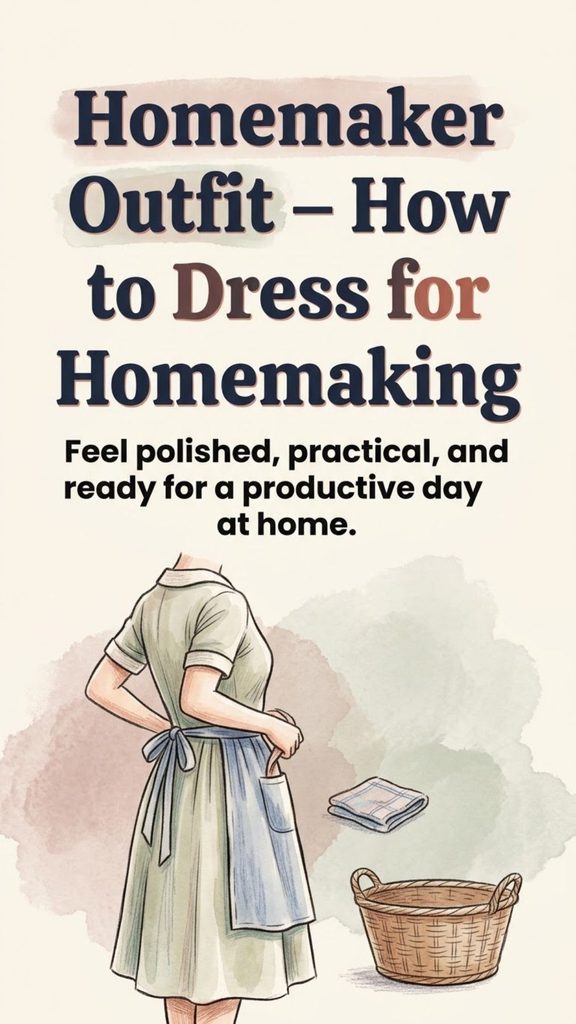
Getting dressed for a day at home can seem unnecessary when your plans involve laundry, cooking, cleaning, gardening, or chasing children rather than going to an office. Yet there is a useful middle ground between wearing clothes that feel too precious for housework and spending every day in whatever you happened to sleep in.
A good homemaker outfit does not need to be fancy, vintage, feminine, expensive, or carefully coordinated. It simply needs to help you move comfortably through the work of the day while making you feel ready for it.
For some people, that means a cotton dress and apron. For others, it is jeans and a soft shirt, linen trousers and a sweater, or a practical skirt with comfortable shoes. The best homemaking wardrobe is the one that fits your actual routine.
You Might Also Like:
- Loading posts...
The goal is not to look perfect inside your own home. It is to make getting dressed simple, useful, and intentional.
Why Getting Dressed at Home Can Make a Difference
One challenge of homemaking is that home is both your living space and your working space. There may be no commute, uniform, scheduled starting time, or other obvious signal that the working part of the day has begun.
Changing out of sleepwear can become a simple transition.
It separates resting from starting.
That does not mean a particular outfit will automatically make someone more productive, cheerful, or disciplined. Clothing is only one part of a daily routine, and people respond differently to it. Still, many homemakers find that changing into daytime clothes helps them feel more prepared to begin household tasks.
There is also a practical advantage. If you are already dressed in something presentable, an unexpected knock at the door, a school pickup, a grocery run, or a quick appointment requires less scrambling.
The important word here is presentable, not perfect.
You should still be able to kneel beside a laundry basket, reach into a cabinet, carry groceries, cook dinner, and clean a sink without worrying constantly about your clothes.
What Makes a Good Homemaker Outfit?
A useful homemaking outfit usually has four qualities: comfort, movement, washability, and practicality.
Comfort
Housework involves far more movement than people sometimes realize. You bend, reach, lift, walk between rooms, stand at counters, climb stairs, carry baskets, and spend time on your feet.
Clothes that pinch, slide, restrict movement, or require constant adjusting quickly become annoying.
Choose fabrics and cuts that allow you to move naturally.
Easy Care
Homemaking can be messy.
Tomato sauce splashes. Flour lands on shirts. Cleaning water drips. Gardening leaves soil on knees. Children have little respect for freshly washed clothing.
Everyday homemaking clothes should therefore be reasonably easy to launder. This is usually not the best setting for a wardrobe full of dry-clean-only garments or delicate fabrics that cannot tolerate ordinary washing.
Appropriate for the Day
There is no single homemaker uniform because no two days are identical.
A morning spent cleaning bathrooms calls for different clothing than an afternoon hosting friends. Gardening requires different clothes than paperwork and meal planning.
Before getting dressed, consider what you are actually doing.
Something You Enjoy Wearing
Practical clothing does not have to be unattractive.
Color, shape, texture, jewelry, hair accessories, or a favorite dress can make simple clothes feel more intentional without making them less functional.
You do not need a large wardrobe. A small number of clothes that fit properly and work together is often more useful.
Easy Everyday Homemaker Outfit Ideas
If deciding what to wear every morning creates another chore, build a few simple outfit formulas.
These can be repeated throughout the week with different colors or layers.
Jeans or Casual Pants With a Simple Top
Straight-leg jeans, chinos, cotton trousers, or another comfortable pair of pants work well for general household jobs.
Pair them with:
- a cotton T-shirt
- a long-sleeved knit top
- a button-front shirt
- a lightweight sweater
- a simple blouse
This combination works especially well on days that include errands because you are already dressed to leave the house.
Avoid jeans that are so stiff or tight that bending and kneeling become uncomfortable. Homemaking clothes need to work as clothing rather than merely look good while standing still.
Comfortable Trousers With a Tucked or Fitted Top
Soft cotton or linen-blend trousers can provide the comfort people often want from lounge clothing while looking a little more finished.
A simple tucked-in shirt or fitted knit top keeps the outfit from feeling bulky.
This is a useful option for warm weather, cooking days, light cleaning, organizing, and general household routines.
A Simple House Dress
The traditional house dress became popular for a practical reason: one garment creates an entire outfit.
Modern versions can still work beautifully.
Look for a dress that is:
- washable
- comfortable through the shoulders
- easy to move in
- not excessively long
- not too loose around appliances or open flames
- made from practical everyday fabric
Cotton shirt dresses, relaxed midi dresses, knit dresses, and simple A-line styles can all work.
A dress can also make the transition from home to errands surprisingly easy. Add shoes and perhaps a cardigan, and you are ready to go.
Of course, dresses are optional. Homemaking does not become more serious or traditional simply because someone wears one.
Choosing a House Dress That Is Actually Practical
A beautiful dress that prevents you from scrubbing a bathtub is not a useful house dress.
Length matters. Very long skirts can drag on wet floors or get in the way on stairs. Extremely full sleeves can dip into dishwater or come too close to burners.
Pockets are particularly useful. They can hold a clothespin, phone, grocery list, hair tie, or other small item you need while moving around the house.
Fabric matters too. Cotton and many washable blends tend to be easier to maintain than delicate materials.
Think of a house dress as everyday work clothing, not a costume inspired by another era. Vintage style can be charming if you enjoy it, but the clothing still has to make sense for a modern kitchen and household.
Why Aprons Still Deserve a Place in the Home
Few traditional homemaking items remain as practical as a good apron.
An apron creates a washable protective layer between your clothes and whatever you are doing. Put one on before cooking, baking, washing dishes, preserving food, handling messy craft projects, or completing dirtier cleaning jobs.
A full or cross-back apron provides more coverage than a waist apron.
Useful apron features include:
- sturdy washable fabric
- comfortable straps
- generous front coverage
- one or two pockets
- a length that does not restrict walking
Keep an apron somewhere convenient rather than buried in a linen closet. If you have to search for it every time you start cooking, you are less likely to use it.
Owning two or three inexpensive washable aprons can also be useful so one is available while another is in the laundry.
An apron reduces stains, but it will not protect clothing from everything. For painting, bleach cleaning, muddy gardening, or similar work, change into dedicated work clothes.
Dress for the Messiest Job on Your Schedule
An intentional homemaking wardrobe should never make you afraid to work.
On deep-cleaning days, choose old but serviceable clothing. There is nothing wrong with having a few garments specifically for jobs where stains are likely.
For gardening, consider sturdy pants, a breathable top, appropriate gloves, and footwear suitable for soil and outdoor surfaces.
For ordinary cooking and cleaning, comfortable daytime clothes with an apron may be enough.
For paperwork, menu planning, sewing, folding laundry, or hosting someone for coffee, you may prefer something a little nicer.
Intentional dressing does not mean wearing your nicest clothes while scrubbing grout. It means choosing clothes on purpose rather than by default.
Do You Need to Avoid Leggings and Sweatpants?
No.
There is nothing inherently wrong with leggings, joggers, sweatpants, or other casual clothing. They can be excellent for active household work.
The better question is whether the outfit works for you.
If comfortable clothes help you stay active and you feel perfectly good in them, there is no reason to remove them from your wardrobe.
If you notice that staying in sleepwear or very relaxed lounge clothes keeps you mentally in “rest mode,” try changing into a different outfit after breakfast and see whether it affects your routine.
A useful distinction is between daytime casual clothes and sleepwear.
Even if both are comfortable, changing from one to the other can give the morning a clearer beginning.
Shoes Matter More Than Most Homemaker Wardrobes Admit
A homemaker may spend hours standing on hard kitchen floors or moving from room to room.
Footwear should therefore be chosen for comfort and safety, not simply appearance.
Depending on your home and preferences, you might wear:
- supportive house shoes
- clean indoor sneakers
- secure slippers with proper soles
- clogs
- flat shoes with good traction
Loose backless slippers can become inconvenient on stairs, while socks alone may be slippery on some flooring.
If you experience foot discomfort, footwear deserves more attention than matching an outfit perfectly.
Keep separate outdoor shoes for gardening or muddy chores so you are not tracking soil through freshly cleaned rooms.
Hair and Personal Care Can Stay Simple
Getting ready does not have to become a lengthy beauty routine.
For many people, a few basic steps are enough:
- Get dressed.
- Wash your face and complete your usual personal-care routine.
- Brush or arrange your hair.
- Add any makeup or accessories you genuinely enjoy.
- Put on practical shoes and an apron when needed.
Makeup is entirely optional.
So is styled hair.
The point is to create a repeatable routine that makes you feel prepared without turning the morning into an elaborate project.
If long hair gets in the way while cooking or cleaning, a braid, bun, clip, or ponytail can be both practical and neat.
Build a Small Homemaking Wardrobe
You do not need to buy an entirely new wardrobe to start dressing more intentionally at home.
Begin with what you already own.
Pull out the clothes that meet three requirements:
- You genuinely like wearing them.
- You can move comfortably in them.
- You are willing to wash them regularly.
You may discover that you already have the foundation of a practical homemaking wardrobe.
A simple rotation might include several everyday tops, two or three pairs of pants, one or two casual dresses or skirts if you enjoy them, a cardigan or sweater, work clothes for messy jobs, comfortable shoes, and a couple of aprons.
Choose pieces that coordinate easily so getting dressed requires very little decision-making.
There is also no reason to save every attractive garment for a special occasion. If a washable blouse or dress makes an ordinary Tuesday more enjoyable, wear it.
Clothes are meant to be used.
Prepare Your Outfit the Night Before
One of the easiest ways to make morning dressing consistent is to remove the decision from the morning.
Check the next day’s plans and set out an appropriate outfit before bed.
For example:
Cleaning day: comfortable pants, washable shirt, apron and supportive shoes.
Garden day: older jeans, breathable top, sun protection and outdoor shoes.
Errand day: casual trousers or jeans, simple top and easy walking shoes.
Home-and-company day: washable dress, skirt, or slightly neater casual outfit.
This takes only a moment but prevents the familiar morning habit of wandering through the house in pajamas because you have not decided what to wear.
Avoid Turning Homemaking Clothes Into Another Standard to Fail
There is an important difference between a routine that helps and a rule that creates unnecessary guilt.
Some mornings are difficult. Babies wake through the night. Children get sick. Schedules collapse. People have exhausting seasons of life. Sometimes staying comfortable and doing only what is necessary is perfectly reasonable.
There is no moral value attached to wearing a dress instead of sweatpants, styling your hair, or putting on makeup.
A polished appearance does not make someone a better homemaker.
Neither does an untidy morning automatically mean someone is lazy.
Clothing should support the work of home life rather than become another measure by which you judge yourself.
A Five-Minute Homemaker Dressing Routine
If you want to develop the habit, make it simple enough to repeat.
Choose your clothes the night before. In the morning, change into them soon after getting up or finishing breakfast. Brush your hair, complete whatever basic grooming matters to you, and put on suitable shoes.
Then start the first planned task of the day.
You do not need a complicated wardrobe or a 30-minute getting-ready routine. Consistency usually becomes easier when the process is uncomplicated.
Try the routine for a week and pay attention to how you feel.
If wearing a dress makes household work awkward, switch to pants.
If jeans are uncomfortable, try softer trousers.
If you love leggings, build intentional outfits around them.
If wearing an apron prevents you from constantly changing stained shirts, keep one hanging in the kitchen.
Adjust the routine around your life instead of forcing your life to fit an image of homemaking.
Dress for the Home You Actually Keep
The best homemaker outfit is not defined by a particular decade, trend, or idea of what a homemaker is supposed to look like.
It is clothing that lets you cook without fuss, bend to unload the dryer, step outside to water the garden, answer the door comfortably, and leave for an errand without feeling completely unprepared.
For some, that may be a floral cotton dress and apron. For someone else, it may be jeans, a clean T-shirt, and sneakers.
What matters is that the outfit serves the person wearing it.
Creating a small habit of changing into practical daytime clothes can give the morning structure and make home responsibilities feel more deliberate. But the clothes themselves are only tools. They should make homemaking easier, more comfortable, and perhaps a little more enjoyable—not turn an ordinary day at home into a performance.