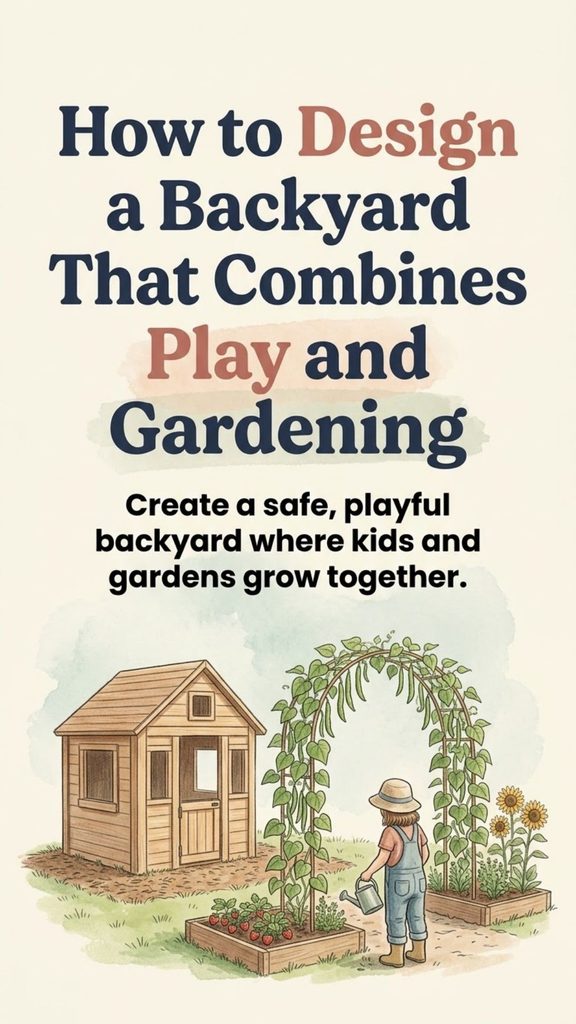
A backyard does not have to choose between being a children’s play space and a productive garden. With thoughtful planning, climbing, digging, hiding, harvesting, watering, and exploring can happen within the same landscape.
The best version of this idea is not a vegetable bed squeezed beside a swing set. It is a yard designed so that play areas, edible plants, paths, shade, wildlife habitat, and family gardening support one another without creating unnecessary hazards.
That last part deserves attention. A beautiful “edible playground” can become frustrating—or unsafe—if vigorous vines take over climbing equipment, delicate plants are constantly trampled, rain barrels are treated as toys, or protective surfacing is replaced with ordinary landscaping mulch without considering fall protection.
You Might Also Like:
- Loading posts...
A good integrated playground garden begins with three priorities: safe play, healthy plants, and a layout children actually want to use.
What Is an Integrated Playground Garden?
An integrated playground garden combines conventional outdoor play features with gardening and nature-based activities.
Instead of dividing a yard into a lawn, a playground corner, and a separate vegetable plot, the different functions overlap more naturally.
A backyard might include:
- a playhouse beside a small children’s vegetable garden
- an edible berry border along a frequently used path
- a freestanding bean or pea tunnel that doubles as a hideaway
- sensory herbs near a digging or mud-play station
- sunflower circles that create temporary summer rooms
- a garden path that connects climbing, digging, harvesting, and quiet areas
- a child-height potting table near raised beds
The objective is not to make every square foot productive. Children still need room to run, climb and invent games. The goal is to make gardening part of the places they naturally use rather than treating the vegetable patch as an area they must stay out of.
That can make gardening more approachable for children. Research on gardening-based programs suggests gardening can improve children’s knowledge, attitudes and willingness to eat fruits and vegetables, although the size and consistency of the effect varies between studies. A systematic review of 14 gardening interventions, for example, found that 10 reported significant increases in fruit or vegetable consumption, while also noting important limitations in the evidence.
Start With How Your Family Already Uses the Yard
Before buying lumber or plants, spend several days observing the existing space.
Notice where children already run, stop, climb and hide. Watch where balls tend to land. Identify the spots that remain soggy after rain and those that become unbearably hot in midsummer.
Also map practical conditions such as:
- morning and afternoon sun
- existing shade
- drainage
- gates and entrances
- hose access
- slopes
- mature trees
- windows overlooking the yard
- utility lines and easements
- high-traffic routes
Trying to place a vegetable bed across a favorite running route is usually an invitation for conflict. It is easier to design around established movement patterns than to repeatedly tell children not to use them.
Put sturdier landscape elements near active areas and reserve delicate vegetables, seedlings, and flowers for protected beds.
Keep Active Play Zones Truly Playable
The biggest design mistake is allowing the garden to interfere with the safety requirements of playground equipment.
In the United States, the Consumer Product Safety Commission recommends protective surfacing beneath and around home playground equipment. For most equipment, protective surfacing should extend at least six feet in all directions. Swings require a larger area in front and behind them—generally twice the height of the swing’s suspension bar.
That means the fall zone around a climbing structure is not a good place for:
- raised-bed corners
- large rocks
- garden stakes
- rigid edging
- trellises
- concrete planters
- thorny shrubs
- irrigation hardware
A bed of strawberries may look charming beneath a climbing platform, but maintaining a clear, appropriately surfaced landing area is more important.
Protective surfacing also needs to be chosen for the height and type of equipment. CPSC guidance notes that loose-fill materials must be deep enough to provide adequate impact protection and require regular maintenance because they compress and are displaced through use. Ordinary landscaping material should not automatically be assumed to perform as playground surfacing.
Follow the play-equipment manufacturer’s instructions and current safety guidance rather than relying on a universal mulch depth.
Grow Vines Beside Play Equipment, Not Through Critical Play Components
A fort covered with grapevines may look like something from a storybook, but vigorous perennial vines become heavy as they mature. They can also hide fasteners, interfere with handholds and make structural inspection more difficult.
A better approach is to build the growing structure next to the playground.
For example, an independent arch can connect the vegetable garden to the play zone. Pole beans, peas, cucumbers or other suitable climbers can cover the arch during the growing season without becoming part of the load-bearing playground structure.
Likewise, a freestanding teepee can become both a plant support and a hiding place without modifying a swing set.
Keep climbing plants away from:
- moving swing components
- slides
- ladders
- handrails
- ropes and chains
- equipment entrances
- fall zones
This separation also makes pruning and harvesting much easier.
Build a Child-Friendly Snack Garden
One of the easiest ways to encourage interaction with a garden is to place a few familiar edible plants where children can see and reach them.
Possible choices include:
- strawberries
- cherry tomatoes
- sugar snap peas
- blueberries where the soil and climate suit them
- currants where locally appropriate
- bush beans
- lettuce
- chives
- basil
- parsley
Plant choices should always reflect your climate, growing conditions, children’s ages, and any allergies in the household.
Rather than planting everything at adult height, give children one small bed or container that is clearly theirs. A low raised bed can make sowing, watering, and harvesting easier without requiring children to step into the growing area.
Make the rules for harvesting clear as well. Children should learn to eat only plants that a responsible adult has identified as edible. Poison Control specifically recommends teaching children to ask an adult before eating plants outdoors because toxic and edible species can sometimes be confused.
Be Much More Selective About Ornamental Plants
A family garden should not assume that a beautiful plant is harmless.
Foxglove, for example, contains cardiac glycosides and can cause serious poisoning if swallowed. Poison Control advises against growing it where children or pets play. Yew, castor bean, oleander, lily-of-the-valley and several other familiar landscape plants also appear on Poison Control’s list of poisonous plants.
This does not mean every garden with children must contain only vegetables. It does mean you should identify plants before introducing them into areas where young children regularly play.
Also consider physical characteristics.
Near running paths and climbing areas, avoid plants with:
- sharp thorns
- stiff spines
- irritating sap
- fruits or seeds that may tempt a young child but are unsafe to eat
Save thorny food crops and more delicate ornamentals for clearly separated beds.
Add Plants Children Can Touch, Smell and Explore
Not every plant needs to provide food.
Sensory planting can make a garden engaging even between harvests. Fragrant culinary herbs such as mint, rosemary, thyme and basil provide obvious differences in scent and texture.
Just place aggressive spreaders wisely. Mint, for instance, can spread vigorously in suitable conditions, so growing it in a container may make maintenance easier.
Other sensory experiences can come from rustling grasses, large sunflower heads, textured leaves, seed pods and flowers that attract insects.
Children do not need a label explaining that an area is “educational.” The learning comes naturally from noticing why one leaf smells different from another, watching pollinators move between flowers and observing how a pea pod changes as it matures.
Use Temporary Living Hideouts
Some of the most entertaining garden structures last only one season.
A simple circle or curved row of tall sunflowers can form a summer hideaway. Pole beans trained up a sturdy freestanding frame can create a leafy tunnel. Peas can cover a smaller spring trellis before hot weather arrives.
These structures change from week to week, which makes them different from manufactured play equipment.
Children see the transformation from seed to seedling, from bare framework to shaded enclosure, and finally from flowers to pods or seeds.
Just design living structures so they do not block important sightlines, exits, gates or playground fall zones.
Give Children Real Garden Jobs
An integrated garden becomes much more interesting when children are participants rather than spectators.
Tasks can be matched to age and ability.
Young children may enjoy:
- carrying a small watering can
- dropping large seeds into prepared holes
- collecting strawberries
- moving leaves into a bucket
- washing harvested vegetables
Older children can gradually help with:
- sowing rows
- labeling plants
- spreading mulch
- measuring rainfall
- tying plants to supports
- composting suitable garden materials
- harvesting vegetables
- planning what to grow next
The objective is not to turn playtime into unpaid yard work. A five-minute gardening task that happens naturally while a child is already outside is often more appealing than announcing an hour-long gardening session.
Make Paths Part of the Experience
Paths are more than transportation.
A straight path from the back door to a swing set may be efficient, but winding routes can make a small garden feel larger and create opportunities for discovery.
A path might move past strawberries, continue beneath an arch, curve around a herb bed and eventually reach a playhouse.
Keep main circulation routes wide and unobstructed enough for the people who actually use the garden, including anyone who needs a stroller, wheelbarrow or mobility aid.
Smaller informal paths can branch from those main routes where space allows.
The important distinction is between paths meant for feet and areas meant for plants. Clear edging, changes in surface material or low visible borders can often communicate that difference without turning every planting area into a fenced enclosure.
Create More Than One Kind of Play
Not every child wants to spend the entire afternoon climbing.
A successful garden can support active, imaginative and quiet play at the same time.
You might create:
An active zone
Swings, climbing equipment or open space for running.
A messy zone
A digging area, mud kitchen or outdoor workbench.
A growing zone
Vegetable beds, containers and fruiting plants.
A hideaway zone
A bean tunnel, sunflower enclosure or small shaded nook.
A quiet zone
A bench beneath a tree where children can read, draw, watch insects or simply rest.
This is especially helpful when siblings of different ages share one yard.
Nature-based environments may provide useful opportunities for varied physical activity and motor development. Research in young children has found some positive associations with balance and lower sedentary time, although findings for overall physical activity and other motor skills are not consistently positive across studies.
Handle Rainwater Carefully
Collecting rainwater can connect gardening with an easy lesson about where water comes from, but a rain barrel should remain garden infrastructure rather than children’s play equipment.
A barrel must be stable, closed and screened appropriately. EPA-associated guidance recommends screening openings to keep debris and mosquitoes out and warns against allowing children to play in or around rain barrels. A full 55-gallon barrel can weigh roughly 450 pounds, so the base also needs to remain level and stable.
If children help water plants, an adult can fill a small watering can for them rather than making the storage barrel itself part of the playground.
Collected roof runoff also should not automatically be treated as drinking water.
Design for Shade Without Creating New Hazards
Shade makes outdoor spaces much more pleasant during hot weather.
Existing mature trees can be valuable, but inspect them for damaged branches and avoid attaching equipment without understanding how the attachment may affect both the tree and the structure.
You can also create shade using:
- pergolas
- dedicated garden arbors
- shade sails installed according to manufacturer instructions
- strategically placed shrubs or small trees
- deciduous trees planted with their mature size in mind
Remember that a tiny sapling planted today may eventually develop a broad canopy and large root system. Check mature dimensions before placing trees beside foundations, play structures, underground services or paved areas.
Expect the Garden to Take Some Abuse
A family play garden should not be designed like a display garden.
Balls will land in beds. A child will occasionally step on a plant. Someone will pick an unripe tomato. Paths will widen. Mulch will migrate.
Plan for that reality.
Use tougher plants near busy routes, while keeping fragile seedlings farther from active play. Grow extra plants when practical. Protect newly planted shrubs until established.
And resist creating so many rules that children become afraid to touch anything.
A garden meant for family use should look lived in.
Plan for the Yard to Change as Children Grow
The perfect yard for a four-year-old is unlikely to remain perfect for a fourteen-year-old.
That is one reason modular designs work well.
A preschool digging station can eventually become another planting bed. A playhouse can later become a potting shed. A low children’s garden can become a herb garden. A simple gathering space may matter more than a sandbox once children are older.
Avoid locking every part of the yard into a single purpose.
Trees, shrubs, paths and major structures are long-term decisions. Smaller play elements can remain flexible.
Start With One Integrated Area
You do not have to rebuild the entire backyard.
Choose one simple project first.
It might be a strawberry bed beside an existing path, a child-height vegetable box, a freestanding pea tunnel, a sunflower hideaway or a small sensory herb garden close to where children already play.
Then watch what happens.
Which plants do the children notice? Where do they naturally sit? What gets stepped on? Which vegetables do they actually pick? Which areas are ignored?
Those observations are more useful than trying to create the perfect master plan on the first attempt.
An integrated playground garden works best when it grows with the family. Keep the true playground safety zones clear, put edible and sensory plants where children can genuinely interact with them, separate vigorous vegetation from safety-critical equipment, and provide enough flexibility for messy, imaginative outdoor play.
The result is not simply a playground surrounded by vegetables. It is a backyard in which growing food, exploring nature and playing outside become ordinary parts of the same experience.