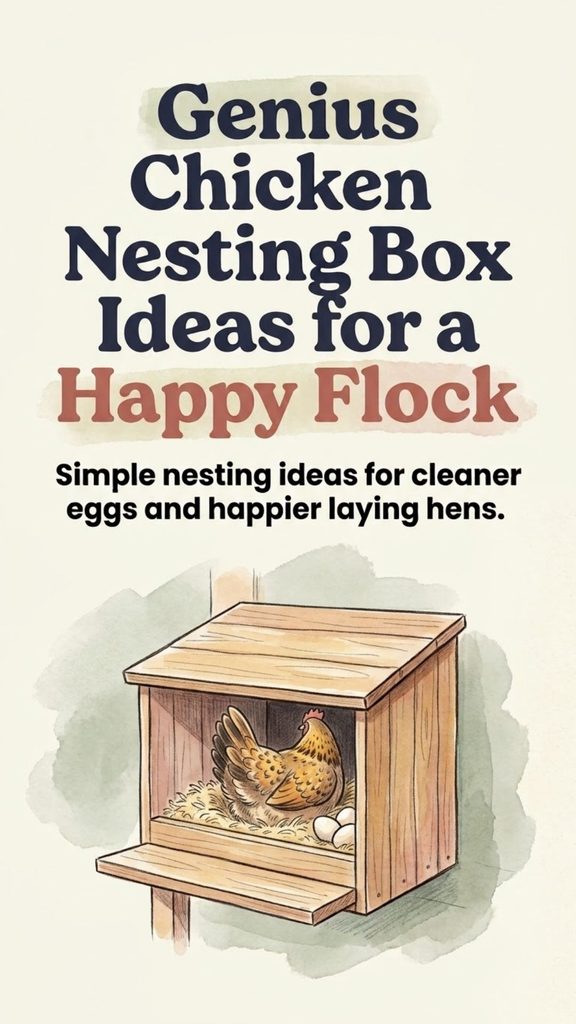
A good chicken nesting box does not need to be complicated or expensive. What matters is whether your hens actually want to use it.
The best nesting boxes give laying hens what they naturally look for: a quiet, dim, protected place where they can settle down without being disturbed. A well-planned box also makes life easier for the person keeping the flock. Eggs stay cleaner, fewer are broken, bedding is easier to replace, and collecting eggs becomes a quick part of the daily routine rather than a hunt around the coop.
For most backyard flocks, a simple wooden nesting box with a few thoughtful design features works remarkably well. Here is how to create one that is comfortable for hens, easy to maintain, and practical for everyday use.
You Might Also Like:
- Loading posts...
What Makes a Chicken Nesting Box Work?
Chickens do not need an elaborate miniature house for laying eggs. In fact, overly complicated nesting areas can create more problems than they solve.
A useful nest should be:
- large enough for one hen to sit comfortably
- relatively dark and private
- dry and protected from drafts and rain
- easy for hens to enter
- filled with clean nesting material
- simple for you to inspect and clean
- positioned away from the main roosting area
For an average-size laying hen, a nesting box measuring roughly 12 by 12 inches is a common starting point. Larger chicken breeds may need a little more room. Extension poultry guidance generally recommends approximately one nest for every four to five hens, although flock behavior matters too.
You may discover that five perfectly good boxes are available while every hen insists on using the same one. Chickens can be surprisingly opinionated about their favorite laying spot.
That does not necessarily mean your other boxes are badly designed. It does mean that placement, light, privacy, and accessibility can be just as important as box dimensions.
A Simple Nesting Box Design That Makes Daily Care Easier
One of the most useful designs for a backyard coop is a row of individual wooden boxes with a raised front edge, a landing ledge, removable bedding, and easy access for egg collection.
Think of it as a small cabinet built specifically for hens.
Each compartment can be approximately 12 inches wide and 12 inches high for average-size chickens. Depth can vary somewhat, and bigger breeds benefit from additional space. Mississippi State Extension, for example, describes individual nests around 14 inches wide, 12 inches high, and 16 inches deep for laying hens.
The important part is not copying one measurement perfectly. The hen should be able to enter, turn around, and settle comfortably without the nest becoming so oversized that several birds regularly crowd inside.
Add a Raised Front Lip
A small board across the lower front of the nest is an extremely useful detail.
Penn State recommends a front lip approximately 3 to 4 inches high. It helps prevent nesting material and eggs from being kicked out when hens enter and leave.
Without that edge, an enthusiastic hen can scratch most of the shavings onto the coop floor within a surprisingly short time.
The lip should not be so high that getting into the box becomes difficult.
Give Hens Somewhere to Land
If the boxes are raised from the floor, a small landing perch or ledge in front can make access easier.
University of Georgia guidance describes nesting boxes raised about two feet above the ground with a perch positioned in front so hens can land before entering.
This feature can be especially helpful when the nest entrance cannot be reached comfortably from the coop floor.
For very heavy breeds or birds with mobility problems, however, accessibility matters more than height. A lower nest or small ramp may be more appropriate than requiring repeated high jumps.
Put the Nesting Boxes in the Right Location
A beautifully constructed nest can still be rejected if it is installed in the wrong part of the coop.
Hens generally prefer a more secluded, dimly lit area for laying. Penn State advises placing nests in a darker section of the poultry house rather than directly opposite bright windows or in a busy area. Mississippi State likewise recommends locating nests away from direct sunlight.
That gives you a useful rule:
Make the nesting area quiet and inviting, not bright and exposed.
Avoid putting the boxes beside the feeder, directly in a doorway, or somewhere flock members constantly pass.
Keep them separated from the birds’ main sleeping roosts as well.
This matters because hens that begin sleeping in nesting boxes can quickly fill them with droppings. Penn State specifically recommends keeping nests away from roosting areas to reduce contamination and egg breakage.
A nesting box should feel like a laying space, not the flock’s bedroom.
Use Enough Soft, Dry Nesting Material
Even the best wooden box needs cushioning.
Pine shavings are a common choice because they provide a soft surface and are easy to replace. Clean straw can also be used.
Penn State recommends maintaining roughly two to three inches of clean nesting material, while Mississippi State guidance similarly calls for several inches of litter inside laying nests.
The exact depth does not need to be measured every morning. What matters is that eggs are not repeatedly landing on bare plywood.
Adequate padding can help reduce cracked eggs.
Replace material when it becomes wet, heavily soiled, flattened, or contaminated by broken eggs.
A removable nest tray can make this job much easier. Instead of scraping bedding from corners inside a fixed wooden compartment, you can lift out the tray, empty it, clean it, let it dry, and refill it.
That small design choice can save considerable effort over the life of the coop.
Consider an Outside Egg-Collection Door
If you are building a coop from scratch, one feature is particularly convenient: access to the nesting boxes from outside the coop.
A hinged exterior door lets you collect eggs without walking through the chicken area each time.
For the design to work well, the door should:
- close securely
- have weather-resistant hinges
- prevent rain from entering
- avoid gaps large enough for predators
- open without disturbing hens unnecessarily
A sloped or well-sealed top can also help keep water away from the nesting compartment.
The convenience is substantial, but security comes first. Raccoons and other predators can manipulate surprisingly simple closures, so a flimsy hook should not be the only thing standing between the flock and the outside world.
A Sloped Top Solves Another Annoying Problem
Flat-topped nesting boxes often become chicken furniture.
A hen discovers the top, another follows, and before long the nesting-box roof becomes another roosting platform. The result is usually manure exactly where you do not want it.
Building the upper surface on a slope makes it much less attractive as a resting place.
This is one of those small coop-design decisions that does not directly affect egg laying but can significantly reduce cleaning.
The same idea can be applied anywhere you want to discourage chickens from congregating: eliminate comfortable flat ledges that serve no useful purpose.
How Many Nesting Boxes Do You Really Need?
More boxes are not automatically better.
Recommendations vary slightly, but approximately one nest for every four to five laying hens is commonly suggested for backyard flocks. University of Georgia guidance gives one box for every four to five hens, while Penn State guidance generally provides additional nests as flock size increases.
A flock of eight hens, for example, does not need eight individual nests.
Providing too few nests can create competition, crowding, and additional opportunities for eggs to be broken. But filling half the coop with unused nest compartments wastes valuable space.
Observe your flock.
If hens consistently queue outside a favorite nest while other suitable boxes remain empty, investigate what makes that particular location more attractive. It may be darker, quieter, better padded, or positioned farther from activity.
Sometimes adjusting the undesirable boxes works better than simply adding more.
Introduce the Boxes Before Hens Begin Laying
Do not wait until you discover eggs underneath the feeder to decide that the flock needs nesting boxes.
University of Georgia recommends having nests available as pullets approach laying age, around 18 to 20 weeks in many laying breeds.
Actual maturity varies with breed, genetics, nutrition, season, and management, so age should be treated as a general guideline rather than a deadline.
Providing the boxes beforehand gives young hens an obvious appropriate place to investigate as laying begins.
If a pullet chooses a hidden floor corner instead, remove the attraction when practical. Block access to tempting dark spaces and keep the intended nest area comfortable and inviting.
Once several hens begin laying in the boxes, the rest of the flock often becomes easier to manage.
Keep Eggs From Becoming a Temptation
Broken eggs create more than a mess.
Once hens discover that broken eggs are edible, egg eating can become a difficult habit to control. Penn State recommends reducing nest congestion, providing sufficient nesting space, keeping nests properly padded, and collecting eggs frequently to reduce the chance of breakage and egg eating.
That makes regular collection part of good nesting-box management.
Do not allow a large pile of eggs to remain in a popular box if you can avoid it.
Check the nests routinely, especially during the period of the day when most of your flock lays.
If you repeatedly find cracked shells, investigate the cause instead of assuming the hens are deliberately breaking them. The box might have insufficient bedding, too much traffic, exposed hard surfaces, or several birds attempting to occupy it simultaneously.
Make Cleaning Part of the Design
The most beautiful chicken coop becomes frustrating if every cleaning job requires dismantling half the structure.
Before building your nesting box, imagine trying to clean it after several months of use.
Can you reach the back corners?
Can the bedding be removed easily?
Are there deep cracks where debris will accumulate?
Can removable parts be taken outside for cleaning?
Will moisture become trapped between boards?
Smooth, accessible surfaces usually make more sense than decorative details inside the box.
Avoid exposed screw points, sharp metal edges, splintered boards, and gaps that could injure feet or trap toes.
If you paint or seal the structure, allow materials to cure fully according to the product directions before chickens gain access.
Common Nesting Box Mistakes
A few design mistakes cause a disproportionate amount of trouble.
Making the Box Too Bright
A nest facing a sunny window may look pleasant to us while feeling exposed to a hen.
Choose the quieter, darker side of the coop instead.
Letting Hens Sleep in the Boxes
Sleeping birds leave droppings behind, which quickly leads to dirty nests and dirty eggs.
Keep appropriate roosting areas available and separate from nests.
Leaving Bare Wood Under the Eggs
Scratched-out bedding means eggs can strike a hard floor.
Use a front lip to retain litter and replenish nesting material as needed.
Building Too Few Boxes
Crowding can increase competition and breakage. Plan the number of nests around your actual laying flock rather than simply fitting one box wherever space remains.
Making Cleaning Difficult
If a nesting box takes twenty minutes to clean properly, it is less likely to receive frequent maintenance.
Removable bedding trays, wide access openings, and simple construction are much more useful than elaborate decoration.
Ignoring Larger Breeds
A 12-inch box works well as a general starting point, but it is not a universal measurement. Large-bodied breeds need enough room to enter and settle without being squeezed.
The Best Nesting Box Is the One Your Hens Choose
A successful chicken nesting box is really a collection of small practical decisions.
Give your hens a private place rather than an exposed one. Provide enough boxes without overcrowding the coop. Add soft, dry bedding, a front retaining lip, and comfortable access. Keep nests away from sleeping roosts, and design everything so you can remove dirty material without a struggle.
For the keeper, extras such as an exterior egg door, removable tray, and sloped top can make an ordinary wooden box much easier to live with.
Then watch the chickens.
Their behavior will tell you more than the appearance of the finished project ever can. If the hens willingly return to the nests, eggs stay clean and protected, and daily collection takes only a few moments, the design is doing its job.