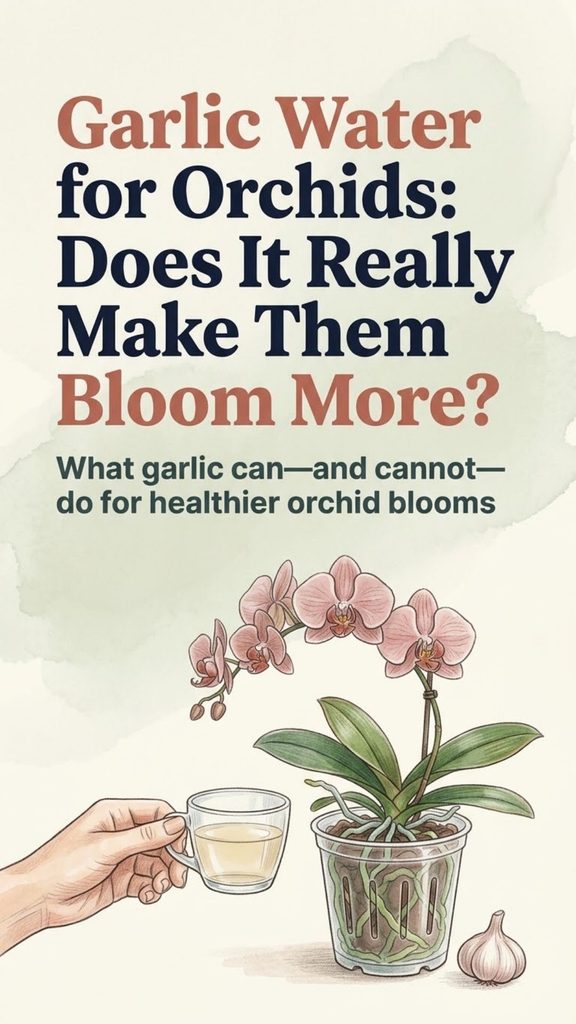
A popular orchid tip claims that adding a teaspoon of garlic powder to water, allowing it to steep, and pouring the mixture around an orchid’s roots can produce greener leaves, prevent mold and disease, and dramatically increase flowering.
It sounds appealing because garlic is inexpensive, easy to find, and contains naturally occurring sulfur compounds. But claims that garlic water can make an orchid bloom almost continuously or produce several times more flowers should be treated cautiously.
Garlic is not a substitute for proper orchid care, and there is no reliable reason to expect a homemade garlic solution to transform a struggling orchid into a heavily flowering plant within days or weeks.
You Might Also Like:
- Loading posts...
Understanding what garlic may—and may not—do is much more useful than simply pouring a homemade mixture into the pot.
Why Garlic Is Used in Homemade Plant Remedies
Garlic contains several sulfur-containing compounds that give freshly crushed garlic its characteristic smell.
These compounds have attracted attention because some have antimicrobial properties under certain conditions. That is one reason garlic appears frequently in homemade gardening sprays and traditional plant-care remedies.
However, laboratory activity does not automatically mean that pouring garlic water into orchid potting media will prevent disease or improve flowering.
The concentration matters.
The preparation method matters.
The orchid species matters.
And the condition of the roots and growing medium matters even more.
An orchid growing in poor conditions will not suddenly become healthy because garlic has been added to its water.
Will Garlic Make an Orchid Produce More Flowers?
There is no dependable evidence that a teaspoon of garlic powder can make an orchid bloom continuously or produce five times more flowers.
Flowering is controlled mainly by the plant’s genetics and growing conditions.
For common Phalaenopsis orchids, successful flowering depends heavily on factors such as:
- Adequate light
- Healthy roots
- Correct watering
- Suitable temperatures
- Proper nutrition
- A well-aerated growing medium
- The maturity and overall health of the plant
Garlic does not replace any of these requirements.
An orchid that receives too little light, for example, may grow attractive leaves but fail to produce a flower spike. Adding garlic water will not correct the light problem.
Likewise, an orchid with rotting roots cannot absorb water and nutrients effectively. Garlic will not repair dead roots.
Can Garlic Prevent Mold and Orchid Diseases?
This claim also needs some perspective.
Garlic contains natural compounds that can affect certain microorganisms, but that does not make homemade garlic water a proven orchid fungicide.
Orchid disease problems are often caused or encouraged by environmental conditions such as:
Poor airflow.
Water remaining on leaves or in the crown.
Constantly wet potting media.
Dirty cutting tools.
Old decomposing bark.
Contaminated pots.
Overcrowded plants.
Correcting these conditions is far more important than routinely treating healthy orchids with garlic.
If an orchid develops a genuine bacterial or fungal disease, identify the problem before treating it. Different diseases require different management approaches.
A homemade solution should not be expected to cure serious rot or infection.
Be Careful With Garlic Powder
Many online recipes recommend mixing approximately one teaspoon of garlic powder with two cups of warm water.
Garlic powder introduces an extra concern that fresh garlic does not: not every packaged product contains exactly the same ingredients.
Pure garlic powder may contain only dehydrated garlic, but garlic seasonings and blends can contain salt, flavorings, anti-caking ingredients, or other additives.
Salt accumulation around orchid roots can be harmful.
Even pure garlic powder can leave fine particles behind in the potting medium. Orchid bark is supposed to remain open and airy, so repeatedly pouring mixtures containing suspended material into the pot is not necessarily beneficial.
For this reason, putting dry garlic powder directly into an orchid pot is not recommended.
Should You Try Garlic Water Anyway?
For a healthy orchid, there is little reason to make garlic water part of the regular care routine.
If someone chooses to experiment with a homemade garlic infusion, it should be treated as an occasional experiment rather than a fertilizer, fungicide, or guaranteed flowering treatment.
Never pour concentrated garlic paste or powder directly over orchid roots.
Avoid repeatedly soaking the potting medium with homemade solutions.
Do not apply garlic mixtures to open flowers.
And do not allow liquids to collect in the crown of a Phalaenopsis orchid.
Most importantly, watch the roots.
Healthy Phalaenopsis roots are usually firm. Hydrated roots often appear green, while dry roots may look silvery-gray. Brown, hollow, mushy, or easily collapsing roots are signs of trouble that require attention to the root system and growing conditions.
Garlic Water Is Not Fertilizer
Another common misconception is that garlic water acts as a complete natural fertilizer.
Orchids require several mineral nutrients, including nitrogen, phosphorus, potassium, calcium, magnesium, and micronutrients.
Garlic water does not provide these nutrients in the balanced concentrations required for predictable orchid growth.
If your orchid needs supplemental nutrition, an appropriately formulated fertilizer is much more reliable.
Use fertilizer according to its label rather than assuming that a stronger solution will produce faster growth.
Overfertilization can damage orchid roots and lead to salt buildup in the potting medium.
Periodically allowing plain water to move through the pot can help reduce accumulated fertilizer salts, especially when orchids are grown in containers with good drainage.
Light Has a Much Bigger Effect on Flowering
If an otherwise healthy orchid refuses to bloom, light should be one of the first things you evaluate.
Phalaenopsis orchids generally perform well in bright, indirect light.
A plant kept too far from a window may remain alive for years without receiving enough energy to flower well.
Very dark green leaves can sometimes accompany insufficient light, although leaf color alone should not be used as a perfect diagnostic tool.
On the other hand, direct intense sunlight can scorch orchid leaves.
Gradual adjustment is important whenever you move an orchid into brighter conditions.
Instead of searching for a secret flowering ingredient, improving light conditions often produces far more meaningful results.
Temperature Can Help Trigger a Flower Spike
Many Phalaenopsis orchids respond to a period of cooler nighttime temperatures by initiating flower spikes.
This is one reason they often begin producing spikes when seasonal temperatures start changing.
The plant does not need extreme cold.
It needs appropriate conditions and a healthy root system capable of supporting flowering.
If an orchid is mature, healthy, and receiving enough light but refuses to bloom, temperature conditions may be worth examining.
Again, garlic cannot reproduce this natural flowering signal.
Water Correctly Instead of Watering on a Schedule
One of the most common orchid problems is overwatering.
Orchid roots need both moisture and air.
Many commonly sold orchids grow in bark, moss, or another loose medium rather than ordinary garden soil because their roots require excellent aeration.
Rather than automatically watering every few days, examine the roots and growing medium.
A bark-grown orchid may dry faster than one packed tightly in sphagnum moss.
Warm weather may increase drying.
Cool, humid conditions may slow it down.
Water thoroughly when needed and then allow excess water to drain completely.
Never leave an orchid sitting permanently in water unless you are using a growing system specifically designed for that purpose.
Constantly wet, oxygen-starved roots are much more likely to cause problems than a lack of homemade garlic treatment.
Check the Potting Medium
Old orchid bark gradually decomposes.
As it breaks down, the particles become smaller, hold more water, and allow less air around the roots.
That can eventually contribute to root decline.
An orchid that suddenly stays wet much longer than it once did may need its potting medium examined.
Repotting into fresh orchid-appropriate material can sometimes improve plant health dramatically because it restores air movement around the roots.
Remove dead or mushy roots using clean cutting tools while preserving firm healthy roots.
This basic maintenance is far more important than adding household ingredients to deteriorated potting material.
Good Airflow Helps Prevent Problems
Mold and disease prevention begins with the environment.
Give orchids gentle air circulation, particularly when humidity is high.
Do not crowd many plants tightly together.
Avoid leaving flowers and leaves wet for long periods.
For Phalaenopsis orchids, pay particular attention to the crown—the central area where new leaves emerge.
Water trapped there for prolonged periods can contribute to crown problems.
If water accidentally collects in the crown, gently remove it rather than leaving it overnight.
What Actually Encourages More Orchid Blooms?
There is no single household ingredient that guarantees spectacular flowering.
For stronger blooming, focus on the basic conditions orchids actually depend on:
- Give the plant sufficient bright, indirect light.
- Maintain healthy, firm roots.
- Water thoroughly but allow appropriate drying between waterings.
- Use an airy orchid potting medium.
- Provide gentle air circulation.
- Fertilize moderately with an appropriate fertilizer.
- Avoid excessive fertilizer salts.
- Keep water from sitting in the crown.
- Repot when the growing medium has seriously deteriorated.
- Give mature Phalaenopsis orchids suitable seasonal temperature conditions.
These practices may sound less exciting than a one-teaspoon miracle treatment, but they address the biological reasons orchids grow and flower.
What About Shiny Green Leaves?
Garlic water is sometimes credited with making orchid leaves noticeably greener and shinier within a short period.
Be skeptical of dramatic before-and-after claims.
Healthy leaves naturally become firm and attractive when a plant has appropriate water, light, nutrients, roots, and humidity.
A dull or wrinkled leaf may indicate several different problems, including damaged roots or dehydration.
Simply making a leaf look shinier does not necessarily mean the plant has become healthier.
Avoid coating orchid leaves with oils or heavy homemade mixtures merely to produce shine. Leaves need to remain clean and functional.
Dust can be removed gently with a soft damp cloth.
A Better Way to Think About Homemade Orchid Remedies
Garlic is an interesting plant and its natural compounds have legitimate biological properties. That does not mean every garlic-based gardening claim is reliable.
There is a large difference between saying:
“Garlic contains biologically active compounds.”
and saying:
“One teaspoon of garlic will make an orchid bloom nonstop and produce five times more flowers.”
The first statement is reasonable.
The second is an extraordinary promise that should not be treated as established orchid-care advice.
Homemade gardening remedies are most useful when they are approached with realistic expectations rather than treated as guaranteed cures.
The Simple Orchid Routine That Works Best
You do not need a long list of kitchen ingredients to grow beautiful orchids.
Start with the roots.
Make sure they are healthy and receiving air.
Then evaluate the light.
Water according to the condition of the plant and potting medium rather than following an inflexible calendar.
Feed moderately.
Keep the plant clean and well ventilated.
Provide appropriate temperatures.
And allow the orchid time to follow its natural growth and flowering cycle.
Garlic water is unlikely to turn a poorly grown orchid into a continuously blooming plant, and it should not be relied upon to prevent every disease.
Good orchid care is less dramatic than the viral one-teaspoon trick, but it is far more dependable.
Healthy roots, suitable light, sensible watering, good airflow, and balanced nutrition remain the real foundation for strong leaves and beautiful flowers.