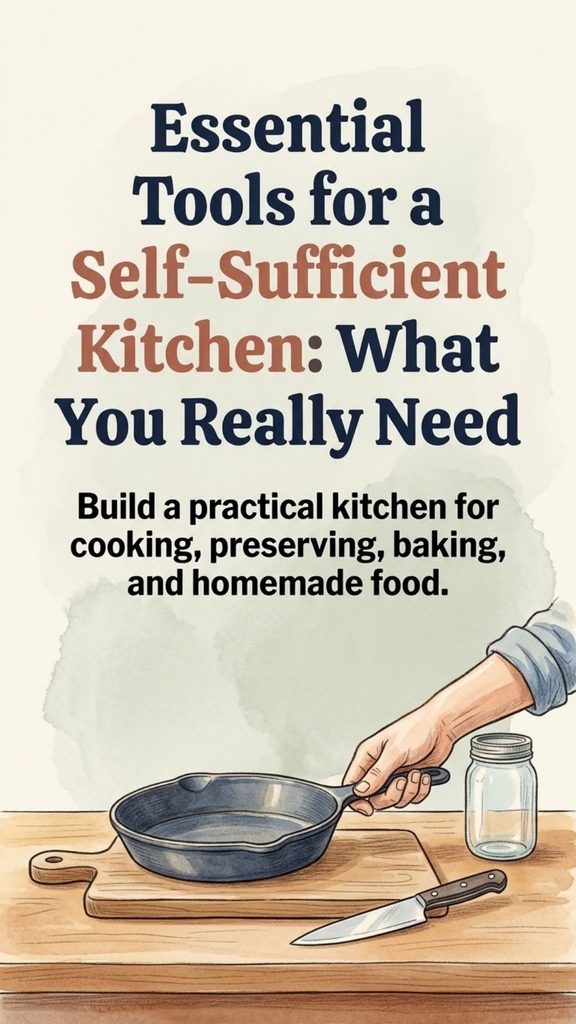
A self-sufficient kitchen does not need to be packed with specialized gadgets. In fact, the most useful setup is usually built around a relatively small collection of dependable tools that can handle many jobs: cooking from scratch, baking bread, processing garden produce, preserving food, preparing bulk ingredients, and storing the harvest safely.
The right equipment will look different for every household. Someone who grows a large vegetable garden may rely heavily on a dehydrator and pressure canner, while a family focused on baking may get more value from a grain mill and kitchen scale.
The goal is not to buy everything associated with homesteading. It is to build your kitchen gradually around the foods you actually prepare and preserve.
You Might Also Like:
- Loading posts...
Here are the tools that provide the most practical value, along with a few items that are useful only for certain households.
1. A Small Collection of Good Knives
You do not need a large knife block filled with blades you rarely touch.
For most kitchens, three dependable knives cover the majority of food preparation:
- Chef’s knife
- Paring knife
- Serrated bread knife
A chef’s knife handles chopping vegetables, slicing meat, mincing herbs, and dozens of everyday jobs. A paring knife is better for peeling, trimming, and other small tasks. A serrated knife makes cleaner cuts through bread, ripe tomatoes, and other foods that can be crushed by a straight blade.
If you regularly process your own meat, additional equipment may make sense. A boning knife has a narrow blade designed for working close to bones and joints. A meat saw may also be useful for certain butchering jobs.
These are specialist tools, however. A household that does not butcher animals has little reason to buy them.
Keep Knives Sharp Instead of Buying More
A few sharp knives are safer and more useful than a drawer full of dull ones.
A honing rod can help maintain an edge between sharpenings, while sharpening stones or another appropriate sharpening system actually remove metal to restore the edge.
Do not assume every knife should be sharpened at exactly the same angle. Edge geometry varies by knife design and manufacturer. If possible, follow the manufacturer’s recommendation and concentrate on maintaining a consistent angle rather than memorizing one universal number.
2. A Large Wooden Cutting Board
A roomy cutting board makes nearly every cooking job easier.
Wood is an excellent choice when maintained properly. It is comfortable for chopping, relatively gentle on knife edges, and can last for many years.
Having more than one board can also make food preparation easier. USDA recommends separating raw meat, poultry, and seafood from foods such as bread and fresh produce to reduce the risk of cross-contamination. Boards should be replaced once they develop excessive wear or grooves that are difficult to clean.
Avoid glass cutting boards for routine knife work. Although easy to wipe clean, their hard surfaces are unnecessarily tough on knife edges.
3. Heavy-Duty Cookware
Good cookware is far more valuable than a cupboard filled with single-purpose appliances.
At minimum, a scratch-cooking kitchen benefits from:
- A medium saucepan
- A large saucepan or stockpot
- A dependable skillet
- A large pot or Dutch oven
Cast iron is particularly useful for households interested in versatile, durable cookware. A cast-iron skillet can move from stovetop to oven and, with suitable equipment and precautions, can also be used for outdoor cooking.
Vintage cast iron can be wonderful, but old does not automatically mean better. Older pans sometimes have smoother cooking surfaces and lighter construction, while modern cast iron is widely available and can also last for generations when maintained properly.
Choose cookware based on condition, size, weight, and how comfortable it is for you to use rather than age alone.
4. A Large Stockpot
A generous stockpot becomes increasingly useful as you cook more food from scratch.
It can handle:
- Broth and stock
- Large batches of soup
- Pasta
- Blanching vegetables
- Tomato sauce
- Corn on the cob
- Large-batch cooking
A household processing a substantial garden harvest may eventually appreciate a very large pot, while an ordinary family kitchen may be well served by something more manageable.
Bigger is not always better. A huge pot that barely fits your sink or stovetop can be frustrating for everyday cooking.
5. A Digital Kitchen Scale
A kitchen scale takes very little space but can replace a surprising amount of guesswork.
It is particularly helpful for bread and other baking projects because weighing flour is more consistent than scooping it into measuring cups.
A scale also helps when:
- Dividing bulk meat into freezer portions
- Measuring salt for fermentation
- Portioning dough
- Following recipes written by weight
- Measuring ingredients for large batches
Look for a scale with an easy-to-read display, a tare function, and enough capacity for the quantities you commonly prepare.
For most households, this is one of the highest-value tools on the list.
6. Mixing Bowls and Measuring Tools
Basic equipment should come before specialized equipment.
A set of durable mixing bowls, dry and liquid measuring tools, wooden spoons, spatulas, ladles, and a whisk will be used far more frequently than many expensive appliances.
Stainless-steel bowls are particularly practical because they are durable, lightweight, and resistant to staining.
If you are building a kitchen from scratch, spend money on dependable basics before buying bread machines, specialty slicers, or other appliances with a single narrow purpose.
7. A Food Dehydrator
A dehydrator becomes genuinely useful once you begin growing or buying food in seasonal quantities.
It can be used for properly prepared:
- Fruits
- Vegetables
- Herbs
- Fruit leather
- Certain meats and jerky recipes
Drying removes enough moisture to slow the growth of microorganisms and reduces the amount of storage space needed. The National Center for Home Food Preservation describes dehydration as a practical preservation method and recommends controlled indoor drying for vegetables and meats rather than relying on unpredictable outdoor conditions.
A good dehydrator should provide controlled heat and airflow. Models with a thermostat and fan are more useful than very simple units that give you little control over drying conditions.
Storage Matters After Dehydrating
Drying is only half the job.
Dried foods should cool before packaging and then be kept in clean, dry containers that protect them from moisture and insects. Heat, moisture, and repeated exposure to air shorten storage quality.
So if you invest in a dehydrator, plan for proper containers at the same time.
8. A Pressure Canner
For households that want to preserve low-acid foods, a pressure canner is one of the most important specialized tools you can own.
Foods such as meat and most plain vegetables cannot safely be processed for shelf storage using an ordinary boiling-water canner.
Low-acid foods require the higher temperatures achieved in a pressure canner. The National Center for Home Food Preservation lists approximately 240°F to 250°F as the processing range for low-acid vegetables, meat, and poultry.
This is an area where improvisation is not worthwhile.
Follow a current research-tested recipe and processing procedure. Do not change jar sizes, processing times, pressure, food density, or ingredient proportions simply because another method looks easier.
A pressure canner is not essential for everyone. But if storing home-canned meat, beans, soups, or garden vegetables is part of your self-sufficiency plan, it becomes a very valuable piece of equipment.
9. Canning Jars and Proper Lids
Reusable glass canning jars are useful far beyond canning season.
They can hold:
- Dry beans
- Herbs
- Dried fruit
- Ferments
- Leftovers
- Homemade sauces
- Bulk pantry ingredients
For actual shelf-stable canning, however, use jars and closures designed for that purpose and follow the closure manufacturer’s directions.
Inspect jars before every canning session. Chips around the rim, cracks, and other damage can interfere with sealing or cause breakage.
You can often reuse sound canning jars many times, which makes gradually building a collection more economical than purchasing everything at once.
10. A Food Mill
A food mill is an old-fashioned tool that still solves several modern kitchen problems remarkably well.
It can puree cooked foods while separating some skins and seeds, making it useful for:
- Applesauce
- Cooked tomato products
- Vegetable purees
- Smooth soups
- Mashed foods
Unlike an electric blender, a food mill requires no electricity.
That makes it especially appealing for anyone who values simple tools that can continue working during a power outage.
If you process tomatoes or apples every year, a food mill may earn its storage space quickly.
11. An Immersion Blender
Where a food mill is slow and mechanical, an immersion blender is fast and convenient.
It can puree soup directly in the pot, blend sauces, make smooth vegetable purees, and handle small blending jobs without requiring you to transfer hot liquid into a countertop blender.
It is not absolutely essential, but it is one of the more useful small appliances for anyone who cooks frequently from scratch.
If you make nonfood products such as soap, keep those tools completely separate from food equipment. Equipment exposed to caustic soapmaking ingredients should not later return to food preparation.
Labeling dedicated nonfood tools clearly can prevent an expensive—and potentially dangerous—mix-up.
12. A Stand Mixer—or a Strong Mixing Bowl
A stand mixer can be extremely useful, but it is not a requirement for a self-sufficient kitchen.
If you frequently make bread, large batches of dough, cakes, whipped cream, or other mixed foods, a durable stand mixer can save substantial hands-on effort.
Attachments may also allow some mixers to grind meat, roll pasta, or perform other jobs.
But do not buy one because a self-sufficient kitchen supposedly “needs” it.
Bread existed long before electric mixers. Dough can be kneaded by hand, cream can be whipped with a whisk or hand mixer, and many batters require little mechanical help.
If budget or space is limited, consider a stand mixer a convenience upgrade rather than a foundational tool.
13. A Grain Mill
A grain mill makes sense for households that regularly bake with whole grains or store wheat, corn, or other suitable grains in whole form.
It allows you to grind only as much flour or meal as you need.
Freshly milled whole-grain flour contains the bran and germ as well as the endosperm. Because the germ contains oils, whole-grain flour generally has a shorter storage life than highly refined flour and benefits from appropriate cool storage.
The practical advantages of milling at home include control over grind size, the ability to keep grain whole until needed, and access to flour types that may be difficult to buy locally.
Still, grain mills can be expensive. If you bake one loaf of bread every few months, a mill may spend most of its life in a cabinet.
Buy one when your cooking habits justify it.
14. A Vacuum Sealer
A vacuum sealer can be very useful for households that freeze large amounts of food.
Removing much of the air around frozen foods can help limit freezer burn and slow quality deterioration caused by exposure to oxygen.
It works particularly well for individually portioned meat, bulk purchases, garden vegetables prepared for freezing, and other foods destined for long-term freezer storage.
There is an important limitation: vacuum sealing does not sterilize food and does not turn perishable food into a room-temperature shelf-stable product.
Foods that require refrigeration or freezing still require refrigeration or freezing after vacuum sealing.
Think of the machine as a packaging tool, not a preservation method by itself.
15. A Mortar and Pestle
Few tools are simpler.
A mortar and pestle can crush:
- Whole spices
- Garlic
- Herbs
- Peppercorns
- Small quantities of seeds
It requires no electricity and gives you excellent control over texture.
For someone growing herbs or storing spices whole, it becomes particularly useful because many spices can be ground shortly before use instead of being stored already powdered.
A large mortar is more versatile, but even a small one handles many everyday seasoning tasks.
16. Fermentation Jars or a Crock
Fermentation does not require elaborate equipment.
Small batches of vegetables can often be prepared in suitable glass jars with appropriate weights and lids. A traditional fermentation crock becomes worthwhile when you regularly prepare larger quantities.
Whichever container you use, accurate measurements, clean equipment, appropriate salt concentrations, and validated guidance matter more than buying an attractive crock.
Fermentation is controlled microbial activity, not simply leaving vegetables on the counter.
Start with researched recipes for foods such as sauerkraut or fermented pickles before experimenting with proportions.
17. A Reliable Food Thermometer
A good digital thermometer deserves a place in a practical kitchen.
It helps with:
- Checking meat for safe doneness
- Bread baking
- Candy and syrup preparation when using an appropriate model
- Monitoring liquids
- Some preservation processes
For meat in particular, appearance is not a reliable substitute for measuring internal temperature.
A thermometer is inexpensive, compact, and useful even if you never grow or preserve a single vegetable.
Self-sufficiency should include being able to verify what is happening in your food rather than relying entirely on guesswork.
18. A Manual Can Opener
This may be the least exciting tool in the kitchen—and one of the easiest to appreciate during a power failure.
If your primary can opener is electric, keep a dependable manual one as well.
The same principle applies elsewhere: not every kitchen job should require electricity.
Manual whisks, graters, food mills, peelers, and other simple tools provide useful backup capacity and often last longer than complicated appliances.
What You Probably Do Not Need
A self-sufficient kitchen can easily become an excuse to buy equipment.
Before purchasing another appliance, ask four questions:
Will I use it regularly?
A tool used twice a year may not deserve prime cabinet space.
Can something I already own do the same job?
A Dutch oven, for example, may replace several specialty cooking vessels.
Does this tool help me preserve or prepare something I actually produce?
A pressure canner is extremely useful if you preserve low-acid foods and unnecessary if you never intend to can them.
Can I buy it later?
Most equipment does not need to be purchased before you learn the skill associated with it.
This approach keeps the kitchen functional rather than turning it into a storage room for imagined future projects.
Build Your Kitchen Around Skills, Not Gadgets
The most capable kitchens are not necessarily the ones with the most equipment.
Start with sharp knives, a large cutting board, reliable pots and pans, mixing tools, a kitchen scale, storage containers, and a thermometer.
Then add equipment according to what your household actually does.
Grow a large garden? A dehydrator and preservation equipment may become priorities.
Bake several times a week? A grain mill or stand mixer might save time.
Process your own food in bulk? A vacuum sealer and large stockpot may be worthwhile.
Preserve low-acid foods? Learn safe pressure canning and invest in the correct canner.
Self-sufficiency grows from knowing how to use your tools, maintain them, improvise when appropriate, and recognize when a process requires precise safety procedures.
A kitchen filled with equipment you understand and genuinely use will serve you far better than shelves of gadgets purchased because someone else’s homestead considered them essential.