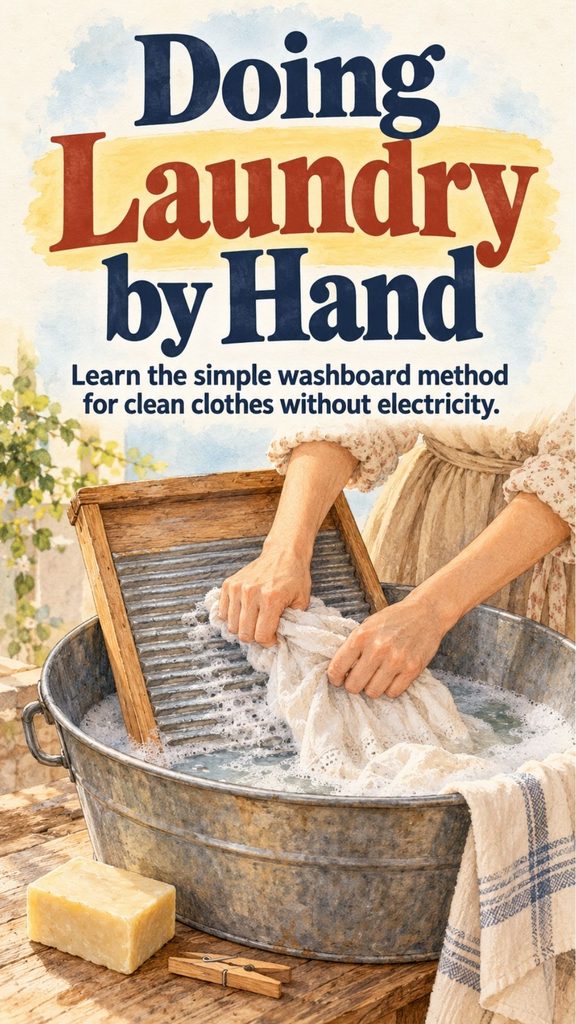
Doing laundry without a washing machine sounds like something that belongs to another era, but it is still a surprisingly useful household skill.
A power outage, broken appliance, camping trip, off-grid property, extended emergency, or simply a few delicate garments can suddenly make hand washing practical. For homesteaders and anyone interested in preserving traditional household skills, it also offers a glimpse into how ordinary clothing was cared for before automatic washers became standard equipment.
Hand washing is more physical than loading a machine, but the basic process is straightforward: sort the clothes, soak them, gently agitate or scrub the dirtiest areas, rinse thoroughly, remove excess water, and hang everything to dry.
You Might Also Like:
- Loading posts...
You do not need an elaborate vintage laundry setup to begin. A sink, basin, bucket, appropriate detergent, and drying rack can handle a surprisingly large amount of washing.
Learning the technique before you actually need it is much easier than figuring it out during an emergency.
Why Learn to Wash Clothes by Hand?
Modern washing machines save enormous amounts of physical labor, and there is no reason to abandon one simply for the sake of doing everything the old-fashioned way.
Still, hand washing has several practical uses.
It can help when:
- the washing machine stops working,
- electricity is unavailable,
- you are living or camping off-grid,
- you need to wash only one or two garments,
- a clothing label specifies hand washing,
- you want to clean delicate items more gently,
- or you simply want to understand a traditional homemaking skill.
For anyone interested in self-sufficiency, the ability to clean clothing without electricity is particularly valuable.
The skill is simple enough that almost anyone can learn it with a little practice.
What You Need for Hand-Washing Laundry
A basic setup does not require much equipment.
A traditional version might include a galvanized wash tub, washboard, laundry soap, wringer, clothesline, and sturdy clothespins.
A modern version can be much simpler.
Useful supplies include:
- A large basin, utility sink, bucket, or wash tub
- A second container for rinsing, if available
- Laundry detergent suitable for hand washing
- A washboard or laundry plunger if you regularly wash larger loads
- Rubber gloves if detergent irritates your hands
- Towels for removing excess water from delicate garments
- A clothesline, drying rack, or other ventilated drying area
- Strong clothespins for outdoor drying
You do not need all of these items to wash clothing successfully.
If you have water, an appropriate detergent, a clean container, and somewhere to dry the clothes, you already have the essentials.
Choose Detergent Carefully
Traditional laundry routines often relied on bars of laundry soap that were rubbed directly onto heavily soiled fabric.
That method can still work for certain sturdy washable items, but modern laundry detergents are generally easier to rinse from clothing and are available in formulations designed for different fabrics.
For hand washing, use only a small amount.
More detergent does not make clothes cleaner.
Too much soap makes rinsing difficult and can leave residue behind, particularly when you are working with limited water.
Follow the detergent manufacturer’s directions whenever possible.
If you are washing delicate wool, silk, or other specialty fabrics, use a detergent specifically intended for that material and follow the garment-care label.
Step 1: Sort the Laundry
Machine washing or hand washing, sorting remains useful.
Separate white and light-colored clothing from dark or strongly colored garments, particularly when washing something new that may release dye.
Also separate:
heavily soiled work clothes,
delicate garments,
towels,
and ordinary everyday clothing.
Check pockets before anything enters the wash water.
Close zippers so their teeth are less likely to catch neighboring fabrics, and secure hooks where appropriate.
Read care labels as well. Some garments marked “dry clean only” should not simply be dropped into a tub of water.
Step 2: Fill the Wash Tub
Fill your basin with enough water for the clothes to move freely.
The ideal water temperature depends on the fabric and care instructions.
Warm water is suitable for many ordinary washable garments, while delicate fabrics and dark colors may call for cool water.
Very hot water is not automatically better.
It can shrink certain fibers, encourage dye loss, damage elastic, or set some stains.
Add a small amount of detergent and move your hand through the water until it is dispersed.
If you are washing a heavily soiled load, leaving enough empty space in the tub for agitation is more useful than packing in as many clothes as possible.
Step 3: Presoak When Necessary
Presoaking can make manual laundry considerably easier.
Place the garments in the wash water and make sure they are thoroughly saturated.
For ordinary moderately dirty laundry, around 10 to 20 minutes may be sufficient before washing begins.
Heavier soil may require more attention.
However, soaking for hours is not appropriate for every material or color. Follow care instructions for delicate or dye-sensitive garments.
During the soak, water and detergent begin loosening ordinary dirt, which means less aggressive scrubbing may be required later.
This is important because excessive friction is one of the easiest ways to damage clothing when washing by hand.
Step 4: Agitate the Clothing
Once the clothes have soaked, move them through the water.
Lift, press, swirl, and gently squeeze the fabric.
The goal is to move detergent solution through the fibers, much as an automatic washing machine agitates clothing mechanically.
For ordinary lightly soiled garments, this may be all the washing action required.
Focus additional attention on areas that commonly collect dirt and body oils, such as collars, cuffs, underarms, socks, and the knees of children’s clothing.
Avoid twisting delicate fabrics aggressively.
Gentle repeated movement is usually more effective—and much easier on clothing—than treating every garment as though it needs vigorous scrubbing.
Using a Washboard
A real washboard can be useful for sturdy, heavily soiled clothing, but it should be used carefully.
Wet the garment thoroughly first.
Apply a small amount of appropriate soap or detergent to the particularly dirty area.
Lay the fabric against the washboard and move it gently over the ridges.
You do not need to grind the fabric against the board with maximum force.
Repeated harsh scrubbing can thin fibers, damage seams, and wear holes into clothing.
Think of the washboard as a tool for targeted cleaning rather than something every square inch of every garment needs to encounter.
It works especially well for sturdy work clothing and dirty socks.
Delicate knits, lace, fine fabrics, and stretchy materials deserve gentler treatment.
Using a Laundry Plunger
A laundry plunger, sometimes called a rapid washer, is a surprisingly useful non-electric tool.
Unlike a toilet plunger, it is designed specifically for laundry.
The device is pushed up and down through the water, forcing water and detergent through the clothing.
This creates agitation without requiring you to scrub every garment individually.
It can be especially helpful for larger loads, heavy clothing, bedding, or situations where you expect to do hand laundry regularly.
It also reduces some of the strain on your hands compared with manually squeezing and swishing every garment.
A laundry plunger can be useful during the rinse stage as well.
Step 5: Drain the Dirty Water
Once the clothes have been thoroughly washed, remove them from the basin.
Gently squeeze out some of the wash water without aggressively twisting the fabric.
Drain the dirty water.
If you have two tubs, the process is easier because one can remain the wash basin while the second serves as the rinse tub.
If you have only one container, simply remove the clothing, empty and rinse the basin, and refill it with clean water.
Step 6: Rinse Thoroughly
Good rinsing is one of the most important parts of hand laundry.
Detergent left in fabric can make clothes stiff and may irritate sensitive skin.
Place the washed garments into clean water and move them around thoroughly.
Gently squeeze water through the fibers.
Drain the rinse water and inspect it.
If it remains noticeably soapy, refill the container and rinse again.
You may need more than one rinse, especially if too much detergent was used during washing.
This is another reason to be conservative with soap at the beginning.
Step 7: Remove Excess Water
Wet laundry can hold a surprising amount of water.
Removing as much as practical before hanging reduces drying time.
For sturdy cotton garments, gentle squeezing may be enough.
Avoid aggressive twisting, especially with stretchy garments, knits, and delicate materials, because wringing can distort their shape and stress fibers.
A useful technique for delicate clothing is the towel-roll method.
Lay a clean, dry towel flat.
Place the wet garment on top.
Roll the towel and garment together, then gently press along the roll.
The towel absorbs a significant amount of moisture without requiring the garment to be twisted.
Unroll it and reshape the item before drying.
What About a Hand Clothes Wringer?
Traditional hand-cranked wringers squeezed wet clothing between two rollers.
They can remove large amounts of water quickly and may still be useful in off-grid laundry setups.
However, they require care.
Keep fingers, loose hair, and clothing away from the rollers.
Do not force thick items through equipment that is not designed to accommodate them.
A wringer also may not be appropriate for garments with fragile fasteners, delicate fabrics, or bulky features.
For occasional household hand washing, you probably do not need one.
For frequent off-grid laundry, however, a well-designed manual wringer can significantly reduce drying time and physical effort.
Step 8: Hang Clothes to Dry
After rinsing and removing excess water, hang the laundry where air can move around it.
An outdoor clothesline works beautifully when weather permits.
Shake each item gently before hanging to reduce wrinkles.
Hang shirts and trousers carefully so the fabric is not excessively stretched while wet.
Sweaters and certain knits are often better dried flat because hanging their wet weight can distort their shape.
Indoors, use a sturdy drying rack in a well-ventilated space.
Avoid crowding garments together.
Air needs to circulate between them if you want them to dry efficiently.
If drying indoors, remember that wet laundry adds moisture to the room, so ventilation can help prevent excessive indoor humidity.
Hand Washing When Water Is Limited
An off-grid or emergency situation introduces another challenge: water itself may be scarce.
In those circumstances, laundry should be prioritized.
Not everything needs washing after a single use.
Outer layers, trousers, sweaters, and similar garments may often be worn several times when they remain clean and odor-free.
Underwear, socks, and clothing exposed to heavy sweat or contamination deserve more frequent attention.
You can also wash smaller loads instead of filling a large tub.
Using an appropriate amount of detergent is particularly important because excess soap requires additional rinse water.
When possible, wash the least dirty items first and the dirtiest last rather than contaminating fresh wash water immediately.
Do You Need Hot Water?
Earlier generations often heated water manually for laundry, and hot water still has specific uses.
But you do not need boiling water for ordinary hand washing.
The correct temperature depends on the garment, detergent, type of soil, and cleaning objective.
Warm water can help with some oily soils, while cool water is appropriate for many colors and delicate fabrics.
Always let the garment’s care label guide you.
If water must be heated over a stove, fire, or other off-grid heat source, be particularly careful when transferring it.
Large containers of very hot water create serious burn risks.
Warm wash water is far safer to handle than attempting to recreate old laundry-boiling practices unnecessarily.
A Modern Non-Electric Alternative
If you want to wash clothing without electricity but don’t want to scrub garments on a board, manual portable washers offer a useful middle ground.
Hand-cranked compact washers use human power to move clothing through detergent and water.
Some resemble small drums that rotate with a crank.
Others use a spinning basket.
They are particularly useful for:
small households,
camping,
RVs,
cabins,
apartments,
emergency preparedness,
and off-grid living.
They still require you to fill, drain, rinse, and dry the laundry manually, but they can reduce the amount of direct scrubbing required.
Before purchasing one, consider its actual load capacity. Portable washers that look large in photographs may accommodate only a small amount of clothing.
Don’t Try to Hand-Wash a Giant Load at Once
One common mistake is filling the tub as if it were a washing machine.
If the clothing is packed tightly, water and detergent cannot circulate effectively.
You also make every part of the process heavier and more exhausting.
Several smaller loads are easier to wash, rinse, lift, and wring than one enormous load.
Start with lightweight everyday clothing while learning the technique.
Towels, jeans, blankets, and bedding become dramatically heavier when soaked and require much more physical effort.
How to Make Hand Laundry Easier on Your Body
Old-fashioned laundry was hard physical work.
There is no prize for making it harder than necessary.
Place the basin at a height that minimizes constant bending if your setup allows.
Use a laundry plunger for agitation.
Keep loads small.
Let soaking do some of the work.
Avoid excessive scrubbing.
Use a towel to press moisture from delicate clothing rather than repeatedly wringing it.
If you’re washing outside, choose a shaded working area during hot weather and keep drinking water available.
A traditional skill should be practical, not punishing.
When a Washing Machine Is Still the Better Choice
Knowing how to hand-wash laundry doesn’t mean hand washing is always the most economical or efficient option.
Modern washing machines can clean large amounts of clothing using controlled cycles with relatively little labor.
For households with regular access to electricity and water, the machine is usually the sensible choice for everyday family laundry.
Hand washing becomes particularly valuable for delicate items, emergencies, very small loads, and off-grid situations.
This is a skill to have available—not necessarily a chore you must perform every Monday because your great-great-grandmother did.
Keep the Skill Alive Before You Need It
The easiest time to learn hand laundry is when your washing machine is working perfectly.
Choose a small load of ordinary clothing one afternoon.
Fill a basin.
Add a little detergent.
Soak the clothes.
Agitate them by hand.
Rinse them thoroughly.
Press out the water.
Hang them outside.
That single practice session will teach you far more than simply reading about the process.
You’ll learn how much detergent you actually need, how heavy wet clothing becomes, which garments take longest to dry, and how much water a manual load requires.
If the power goes out for several days or your washing machine breaks unexpectedly, you will already know what to do.
A Vintage Homemaking Skill That Still Has a Place
Laundry by hand belongs to an era when household work demanded far more time and physical effort than it usually does today.
We should appreciate the labor-saving machines that replaced that daily burden.
But there is also value in remembering how the work can be done without them.
With a wash tub, a small amount of detergent, clean rinse water, and somewhere to hang clothes, you can keep basic laundry moving even when electricity and modern appliances are unavailable.
Add a washboard, laundry plunger, or manual wringer and the job becomes easier for larger loads.
You may never choose hand washing as your normal laundry routine.
That is perfectly fine.
The value is in knowing that if the situation calls for it, you are capable of doing one more essential household job with your own hands.
And that is exactly why old-fashioned homemaking skills like this are worth keeping alive.